- Global production for 2023/24 estimated much above consumption, according to USDA;
- Still weak economic indicators;
- Absolute production record in Brazil and lack of storage;
- Fast pace of US planting;
- El Niño should be beneficial for US crop.
- Considerable crop losses in Argentina due to the weather;
- Record soybean imports by China in May;
- Chinese crush margins are more positive;
- Increase in mandatory biodiesel blending in Brazil;
- Forecast of drier weather for some of the US production region.
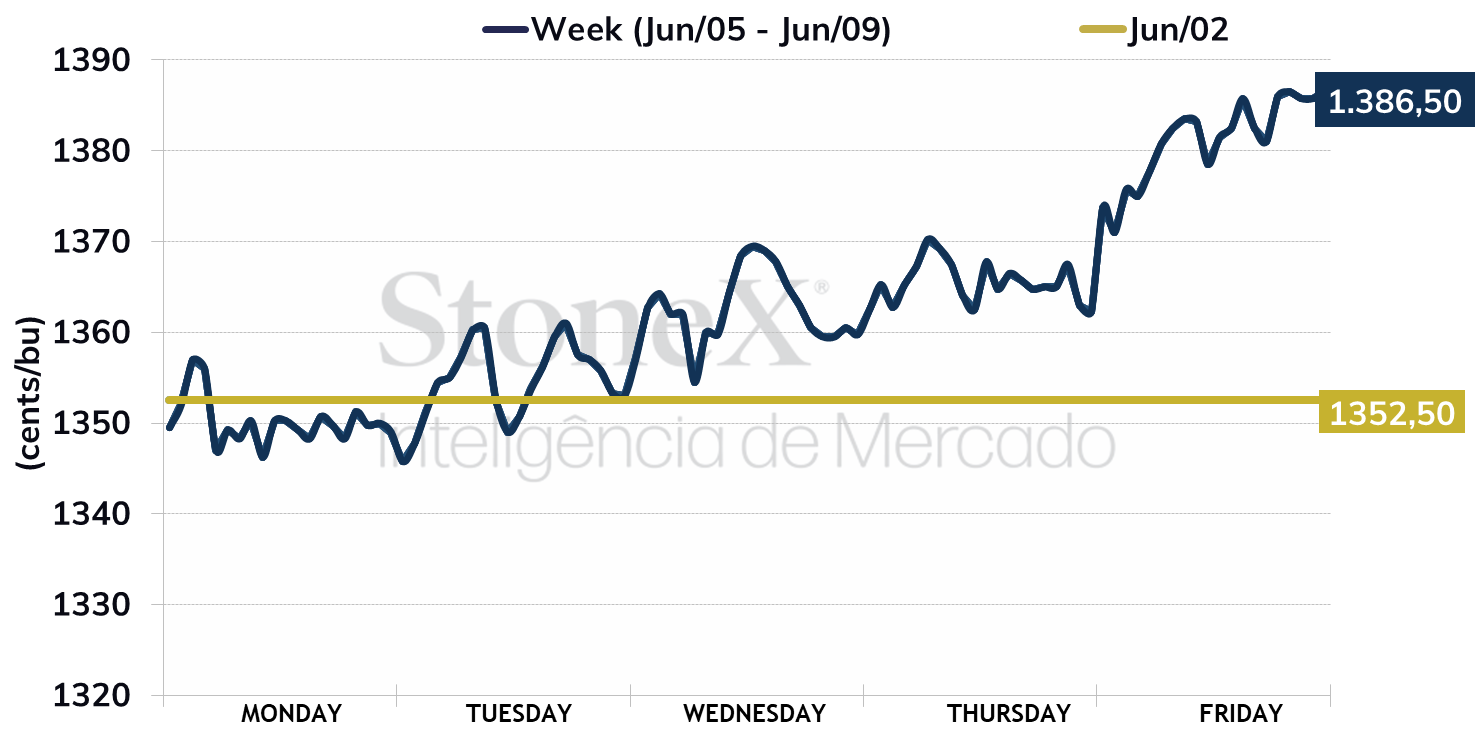
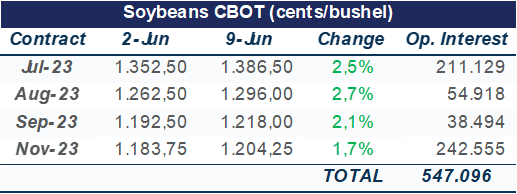
Soybean prices in Chicago started last week at a low level, but the upward trend predominated once again as the US weather market influenced prices. In addition, it should be noted that there was movement in spreads between the July and November contracts (old and new US crops), which also offered support at times. The July/23 contract ended on Friday (9) at 1386.5 cents per bushel, up 2.5% for the week.
On Monday (5), some forecasts of rain for areas in the US Midwest weighed on soybean prices. However, on the next day the weather models had already changed, showing a drier pattern again.
The region of greatest concern is the Midwest. On the weekend, the rain was light in this region and further north of the belt. For the next five days, the Midwest should record below normal rainfall for the most part, with forecasts pointing to a return of rain from next weekend (17). Even so, it is unlikely that these rains will be enough to alleviate drier conditions in some areas, with concerns about the weather pattern in the main producing states, Illinois and Iowa.
Amid this scenario of attention to the weather, it should be noted that the first crop conditions follow-up released by the USDA, referring to the week ended June 04, showed that 62% of the US crop is in good/excellent conditions, below the average of 71% for the period. The states that pushed that percentage down were Nebraska, South Dakota, Missouri, Arkansas, Illinois and Indiana.
Since the key grain-filling stage in the country is concentrated in August (although it should be a little earlier this year), the weather will continue to be the center of attention in the coming months, which is usual in this period. This year, it may even change the prospects for 2023/24 world supply well above the demand estimated by the USDA.
Speaking of demand, in spite of lingering concerns about the economic performance around the world, soybean imports from China (the world's largest consumer) are very strong. In May, the country imported a monthly record of 12 million tonnes of soybean, taking the accumulated amount since September to 72 million tonnes. If this faster pace is maintained, the USDA estimate of 98 million tonnes for the 2022/23 cycle could even be surpassed.
In this context, Brazilian exports stand out, which remain very competitive after the harvest of a record crop, with estimates that June will continue to see very high shipments, closer to 15 million tonnes than 10 million.
Also worth mentioning are the gains in soybean oil last Friday, amid rumors that the stocks in the US biofuels sector are at a low level, with the physical market driving the futures market.
US export sales in the week ended June 1 reached 172,700 tonnes for the 2022/23 crop and there was a net cancellation of 106,800 tonnes for the 2023/24 cycle. Although the result for the current crop was within expectations, accumulated sales are at 51.2 million tonnes, considerably lower than in the same period last year, which had reached almost 60 million.
On Friday (9), the USDA's monthly supply and demand report was released, but without major surprises. There were no changes in the 2023/24 US balance sheet, since productivity only begins to be revised in August, based on qualitative surveys, and the planted area will be updated at the end of June.
On the other hand, the Department reduced US exports for the 2022/23 crop, from 54.8 to 54.4 million tonnes, with an impact of equal magnitude on ending stocks, which rose to 6.27 million tonnes.
The biggest highlights were new revisions for the 2022/23 crop in South America. Brazilian production gained another 1 million tonnes, rising to 156 million, while Argentina's fell from 27 to 25 million, which is still considerably above the country's exchanges' estimates. The Buenos Aires exchange estimates Argentina's production at 21 million tonnes, while the Rosario exchange's figure is at 21.5 million. This difference between estimates for Argentine production can directly impact the country's balance sheet. If the lower number is confirmed, Argentine soybean imports could rise even more and crushing could struggle even more, with a reflection on meal and oil prices, whose world exports are led by Argentina.
This week, the weather in the US should continue to be a key factor moving prices, but the release of official preliminary figures of Brazilian exports between June 1 and 9 and the Conab crop survey stand out.