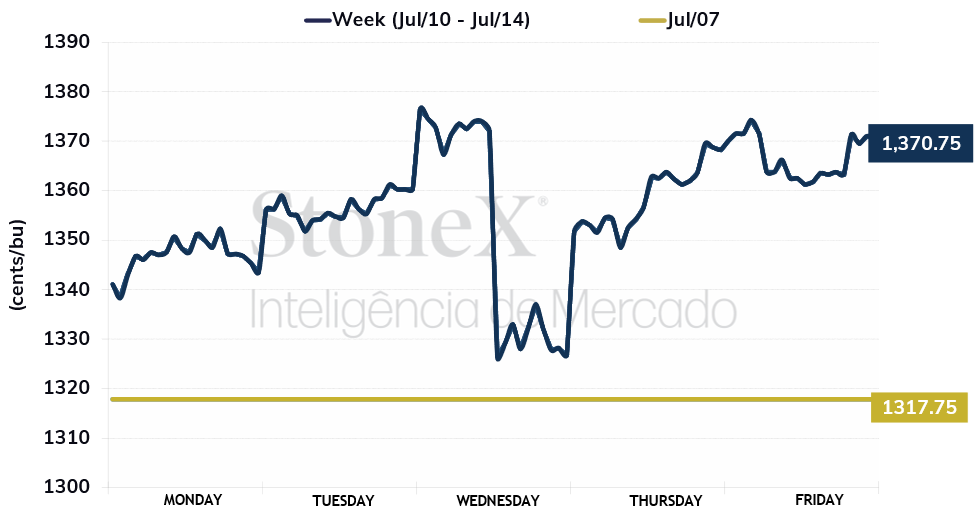
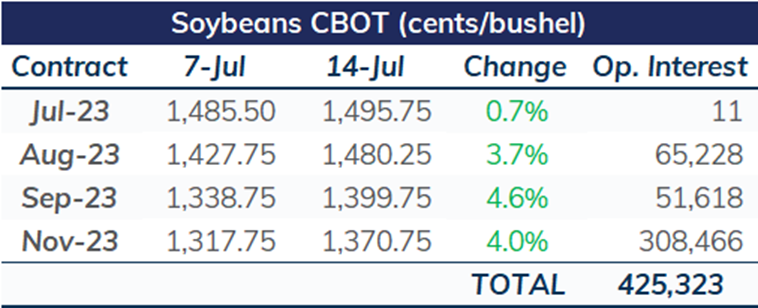
The previous week was again dominated by the outlook for the US 2023/24 crop, highlighted by the release of the USDA's WASDE report. The November contract closed Friday’s session (14) at 1370.5 cents per bushel, a gain of 4.0%.
Concerns about the size of the US production and how it will affect the country's supply and demand balance, with a lower supply, set the tone for the weekly increase.
Although the weather in the US has improved since late June, with more abundant rainfall leading to soil moisture recovery and improvement in crop quality, the soybean crop still needs good precipitation until August, when the grain filling phase takes place. The forecasts for the second half of July indicate a drier pattern for the northwest of the belt, emphasizing that some regions could not replenish adequate moisture with the rainfall in the first half of July.
The latest USDA weekly crop progress report, as of July 9, showed an improvement in the conditions of the US crop, with the good/excellent rating increasing from 50% to 51%, a level in line with expectations but below the 5-year average and the rating achieved in the same week of the previous year, which was 62%.
Nevertheless, the USDA's current yield estimate for the country, at 3.5 tonnes per hectare, is not likely to be achieved, intensifying the decline in the US supply, which has been significantly impacted by the smaller planted area, as announced on June 30, surprising the market that was expecting a small increase.
There was even speculation that the USDA would already lower its estimate of the US yield for the 2023/24 crop in the monthly supply and demand report, which is unusual and did not materialize. The production decreased from 122.7 to 117 million tonnes solely due to the incorporation of the smaller area, which was already known.
The disappointment regarding the USDA's expectations of yield reduction conditioned a sharp decline in prices in Chicago after the report was released. However, after this initial impact, attention turned to the weather in the country and the possibility of future yield adjustments.
Regarding the US supply and demand balance, the USDA made a small cut in domestic consumption, while the estimate for 2023/24 exports was reduced from 53.75 million to 50.35 million tonnes at a time when accumulated sales for the new crop are much weaker than in previous years. There was also a small reduction in 2022/23 exports, which fell to 53.9 million tonnes.
Therefore, despite the lower production and a decrease in demand, US stocks for 2023/24 decreased from 9.5 to 8.16 million tonnes, a less tight situation than expected, as there were no adjustments in productivity.
In any case, it is worth noting that global production for 2023/24 would still be more than 20 million tonnes above consumption for the current season, according to the USDA.
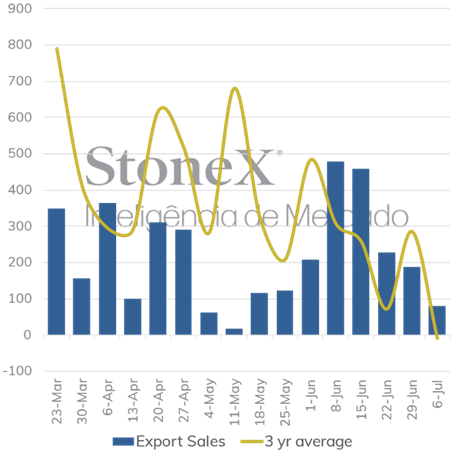
Returning to the US export sales, the week ending July 6 negotiations showed relatively weak results for the 2022/23 and 2023/24 crops, reaching 80.6 and 209.2 thousand tonnes, respectively. The accumulated sales for the 2023/24 crop stand at 52.6 million tonnes, while the 2023/24 cycle negotiations reach 4.1 million tonnes.
Although the US crop is in the spotlight, which is normal for this time of the year, the exports of soybeans from Brazil are also worth highlighting, as they are stronger than last year after the record 2022/23 crop harvest. According to official data, 3.6 million tonnes of soybeans were shipped in the first week of July alone, bringing the total since January to 66.5 million tonnes.
These strengthened exports from Brazil raise concerns about future shipments from the US in the last quarter of the year after the 2023/24 crop harvest. China has been importing large volumes and taking advantage of the ample supply of Brazilian soybeans, which are more competitive than those from the US. After reaching record imports in May, China imported an additional 10.27 million tonnes of soybeans in June, 24.5% higher than the same month in 2022. The market expected this volume, which leads the Chinese soybean imports in the first half of 2023 to exceed the volume registered in the same period of 2022 by 13.6%.
Another highlight of the previous week was Conab’s crop survey, which was surprising as it cut the Brazilian soybean production for 2022/23 by just over 1 million tonnes to 154.6 million tonnes, with a slight decrease in productivity. Nevertheless, this volume remains a record, albeit below StoneX's estimated 157.7 million tonnes.
In the week ahead, attention is expected to remain on the US crop, with another update on crop condition follow-up this afternoon. In Brazil, weekly export data will be released today (July 17).