- According to the USDA, the estimated global production for 2023/24 is significantly higher than consumption;
- Weak economic indicators;
- Record-breaking production in Brazil and lack of storage facilities;
- Disappointment in the US regarding biofuel mandates;
- Weak US exports.
- Considerable crop losses in Argentina due to weather conditions;
- Increased soybean imports by China;
- Positive crushing margins in China;
- Forecasts of drier weather in the US in the coming weeks;
- Soybean planted area in the US much lower than expected.
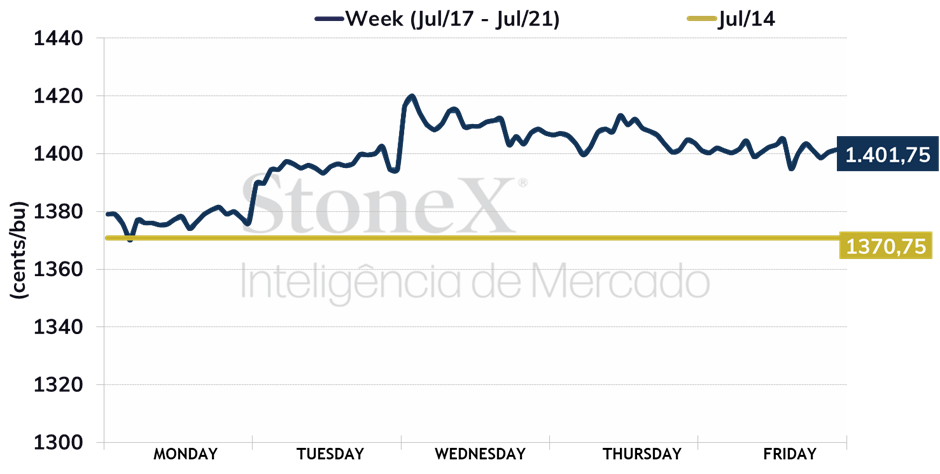
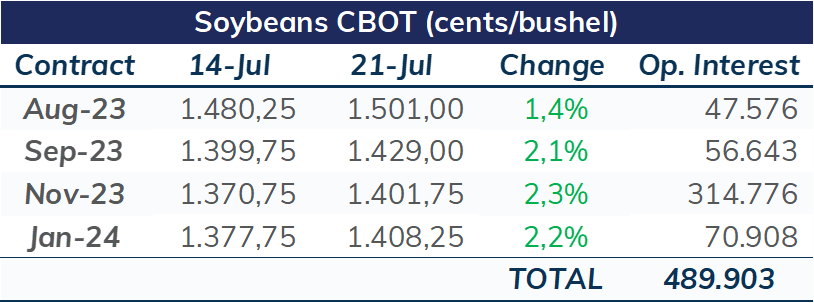
Soybean prices in Chicago experienced an increase last week, with November futures closing at 1407.75 cents per bushel, representing a 2.3% gain.
Regarding soybean exports, the non-renewal of the agreement to export soybeans through the Black Sea had a limited impact on prices, as the region is not a major producer and exporter of soybeans, although it stands out in the sunflower oil market. Consequently, soybean prices are influenced by vegetable oils, mainly due to Ukraine and Russia's significant production and exports of sunflower oil.
The major factor affecting prices was the US crop. Weather forecasts indicate a drier pattern in the coming weeks in a significant portion of the belt, precisely when soybean crops are entering the critical phase for determining productivity, the grain-filling period.
The size of the US soybean crop remains uncertain, especially after the surprise reduction of 1.6 million hectares in the country's planted area, bringing it to 33.8 million, as reported on June 30. The official yield estimate remains at 3.5 tonnes per hectare, despite some localized damage due to drought in June. If the dry weather persists in the coming weeks, the loss of yield potential could intensify, considering that the US supply and demand balance for soybeans is not comfortable.
The USDA's weekly crop progress report for the week ending July 16 showed a good/excellent rating for soybeans at 55%, an increase of 4 percentage points in seven days. However, this figure is still below last year's rating and the five-year average for the same period, 61% and 62%, respectively. Additionally, some states important for soybean production continue below 50%, such as Illinois, where crops in good/excellent condition increased from 36% to 40%.
Although the size of the US soybean crop may result in demand rationing, US exports continue to remain weak. As a result, the USDA has reduced the 2023/24 estimate from 53.75 million to 50.35 million tonnes and revised the 2022/23 number downward.
US soybean export inspections for the week ending July 13 were at only 155.6 thousand tonnes, bringing the total shipments since September 2022 to 49.9 million tonnes, with 45 days remaining until the end of the 2022/23 crop year in late August.
Meanwhile, Brazilian soybean exports remain robust. As of July 14, 6.2 million tonnes have been shipped, compared to 7.5 million tonnes for July 2022. Since January, Brazil has already exported 69.1 million tonnes of soybeans after harvesting a record crop, and China is taking advantage of this situation to intensify its purchases.
As a result, US soybean exports for the 2023/24 crop year may suffer, considering that the last quarter is the best period for soybean shipments from the country, just after the harvest. Besides, Brazilian soybean remains competitive, and geopolitical issues between China and the US may influence the choice of origin for Chinese purchases.
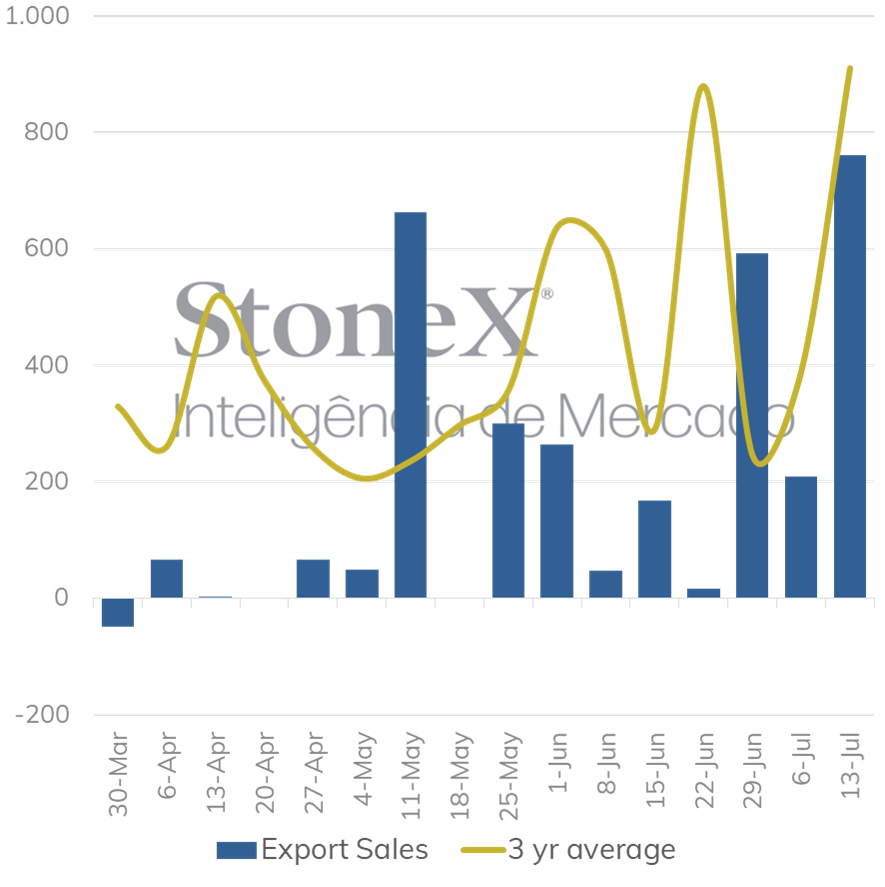
US export sales for the week ending July 13 reached 760.3 thousand tonnes for the 2023/24 crop year, exceeding the high end of the estimates, which ranged from 150 to 700 thousand tonnes. Nevertheless, the total sales for the new crop year amounted to 4.9 million tonnes, significantly lower than the figures for the same period in previous years.
Market observers are also monitoring US soybean crushing, considering that the prospects for soybean oil usage are very positive due to the growth of green diesel production. However, the National Oilseed Processors Association's (NOPA) data showed 4.5 million tonnes of soybeans crushed in June, falling short of the average expectations of 4.64 million tonnes.
In the week ahead, weather conditions in the USA will continue to be central to soybean price movements in Chicago, along with US export data.