- Estimated global production for 2023/24 is expected higher than consumption, according to USDA;
- Weak economic indicators;
- Record production in Brazil and lack of storage capacity;
- Forecast of rain and mild temperatures in the upcoming weeks;
Weak US exports.
- Considerable crop losses in Argentina due to weather conditions;
- Increased soybean imports by China;
- Positive crushing margins in China;
- Prospects of a tighter balance in the USA;
- Much lower planted area than expected in the USA.
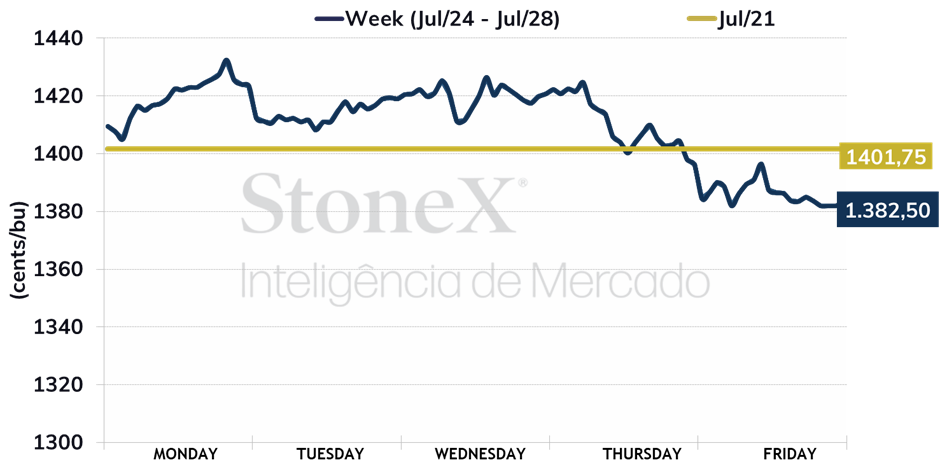
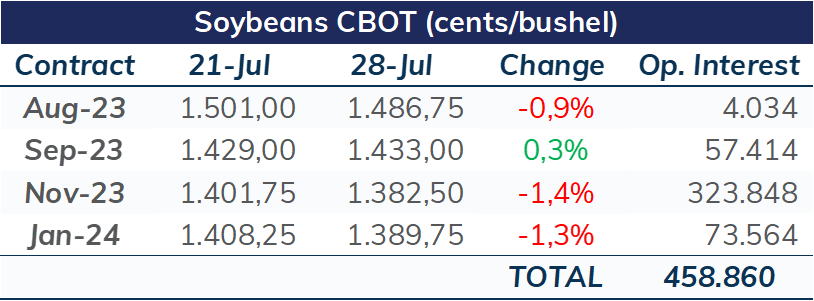
Soybean prices started the previous week higher but failed to sustain the gains, with November futures ending Friday (28) at 1382.5 cents per bushel, a 1.4% drop over the period.
The Russian attacks on port facilities in Ukraine, including warehouses on the Danube River, at the beginning of last week affected corn and wheat prices, with soybeans also advancing. The Black Sea region, mainly Ukraine, stands out in producing and exporting sunflower oil, impacting the vegetable oil market and soybeans. It's worth noting that the attacks on the Danube River came as a surprise since it is an important alternative route for Ukraine that hadn't been targeted until then.
However, during the week, the "lack of news" and the absence of new Russian attacks opened space for other supply and demand factors to prevail.
The weather in the US was a central point during the period, as the soybean crop entered the critical grain-filling stage, which is crucial for crop productivity. The forecasts during the previous week indicating good rains in the next fortnight, along with milder temperatures, were well received by the market. It is important to highlight the role of not-so-high temperatures, which reduce plant stress, especially if rain falls short of expectations.
During the last weekend, good rains were recorded in the Midwest's northern, central, eastern, and southern regions, with the highest volumes in northern Nebraska, southern Wisconsin, northern Illinois, northern Indiana, and southern Michigan.
For the first days of August, the forecasts indicate that rains should become more concentrated in the Plains regions, with some areas in the central and southern belt receiving good precipitation volumes. From the following weekend onwards, rains are expected to occur in practically the entire Midwest, combined with milder temperatures in much of the country's producing region.
In the last USDA report for the week ending on 07/23, the percentage of good/excellent soybean crops in the US decreased from 55% to 54%. Still, there were improvements in important states like Illinois, with a four-percentage point increase in plants classified as good/excellent, reaching 44%.
Regarding demand, US export inspections for the week ending on 07/20 reached 283.4 thousand tonnes, bringing the total to 40.2 million tonnes, about 3 million tonnes less than the same period last year, highlighting that USDA export estimates for the 2022/23 season are 4.7 million below those registered in the 2021/22 crop.
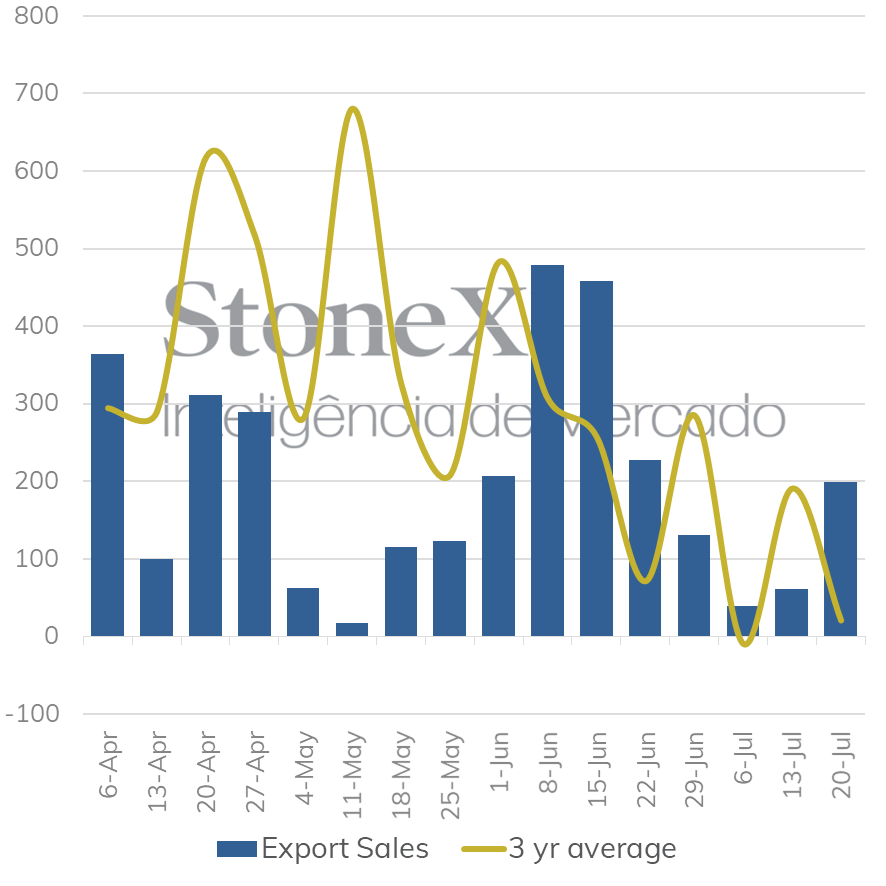
As for net export sales for the country in the same week, they reached 198.5 thousand tonnes for the 2022/23 season and 544.6 thousand tonnes for the 2023/24 season, in line with market expectations. Cumulatively, sales for the 2022/23 season reached 52.8 million tonnes, while USDA export estimates stand at 53.9 million up to the end of August. It is important to note that cancellations are common at the end of the cycle as the rolling to the next crop year.
Regarding exports for the US 2023/24 crop, accumulated sales are 5.5 million tonnes, a much lower volume than in previous years. With the record harvest in Brazil, there are concerns about US shipments, which peak in the last quarter of the year, right after the harvest.
In July, as of 07/21, Brazil exported 7.96 million tonnes of soybeans, which already exceeds the total registered in July 2022. Cumulatively since January, Brazilian soybean exports have totaled 70.8 million tonnes. Tomorrow (01), the official data for July as a whole will be released.
It is also worth noting that StoneX will release its first number for the Brazilian 2023/24 crop tomorrow. The USDA division will also release its survey for the productivity and production of the 2023/24 US crop on Wednesday (02).