- Estimated global production for 2023/24 significantly exceeds consumption, according to the USDA.
- Weak economic indicators.
- StoneX estimates a new record crop for Brazil in 2023/24.
- Forecast of rain and mild temperatures in the coming weeks.
- Weak US exports.
- Considerable crop losses in Argentina due to weather conditions.
- Increased soybean imports by China.
- Positive crush margins in China.
- Prospects of productivity cuts in the US.
- Planted area in the US below expectations.
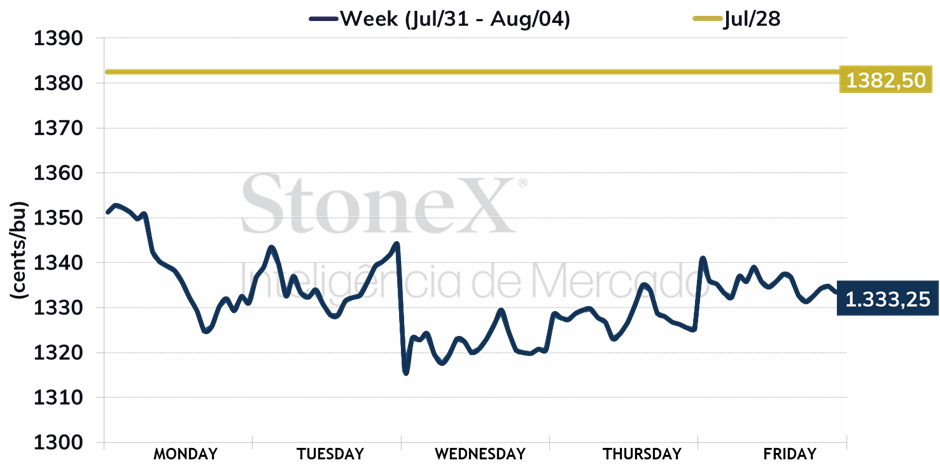
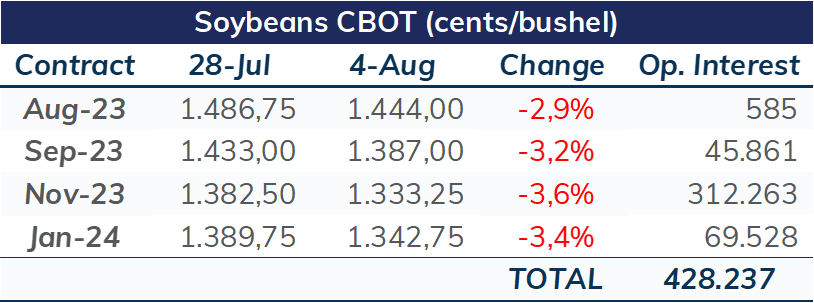
Last week, soybean prices dropped in Chicago due to market monitoring of US weather conditions. The November contract ended Friday (04) at 1333.25 cents per bushel, a decrease of 3.6% during the period.
As August begins, weather forecasts for the US crop region are crucial due to the grain-filling phase, which requires adequate moisture and significantly impacts final crop productivity.
The forecasts have shown a positive pattern, indicating good precipitation in the belt region. Last weekend, good rains were recorded in the upper and central Plains regions and the central and western Midwest, with the highest volumes in South Dakota, southern North Dakota, western Iowa, northern Missouri, central Illinois, and western Indiana.
This week, more significant precipitation is forecasted for the western, central, and southern Midwest, as well as the northeastern Delta region, which should be favorable for the development of US soybean crops.
As a result, the country's crop conditions are eagerly awaited in the USDA's weekly report, which is released on Monday late afternoon. In the last update as of July 30, there was a deterioration in conditions, with the good/excellent rating dropping from 54% to 52% due to the heatwave that affected part of the crop region.
Given this scenario, the USDA's WASDE report, to be released on Friday (11), is highly anticipated for productivity adjustments. There are expectations that crop yields will be cut, considering that June was quite dry in some areas of the US belt.
StoneX released its first estimate for the 2023/24 US crop, with the average productivity projected at 3.4 tonnes per hectare, lower than the current USDA figure of 3.5. Considering the official USDA area numbers, US production would drop to 113.57 million tonnes, raising concerns about the possibility of demand rationing, as the country's supply and demand balance is uncomfortable. In the last USDA report, export estimates were reduced, easing the tightness in the balance, but the size of the US crop could complicate this balance.
Regarding US soybean exports, as of July 27, 50.5 million tonnes were inspected. Considering the USDA's 2022/23 crop exports estimate of 53.89 million tonnes, the country needs to ship over 3 million tonnes of soybeans by the end of August, representing a weekly volume higher than recently recorded, ranging from 200,000 to 300,000 tonnes. Thus, the chances of the current estimate not being reached are significant.
As for accumulated exports for the 2022/23 crop, they reached 52.8 million tonnes at a time when cancellations and roll-overs for the next cycle are quite common. In the week ending July 27, 90.6 thousand tonnes of soybeans from the current cycle were traded, within expectations, but closer to the floor of 50 thousand tonnes than the ceiling of 400 thousand tonnes.
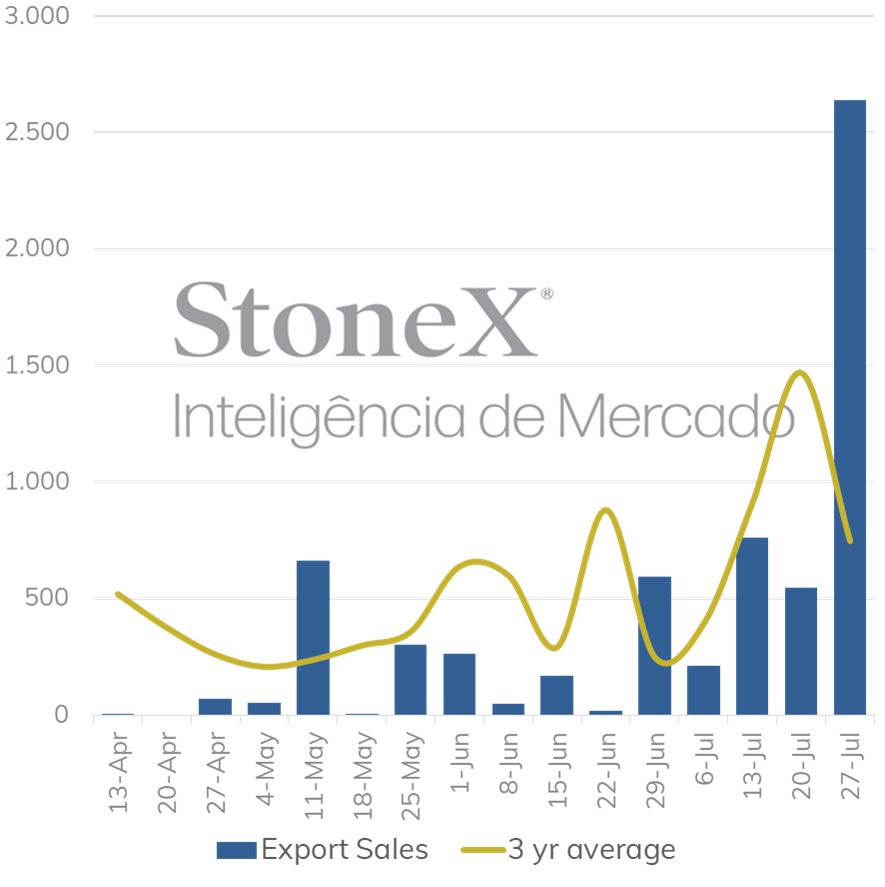
There was significant trading volume for the 2023/24 crop, reaching 2.64 million tonnes, exceeding the upper limit of expectations, ranging from 1 to 2.5 million tonnes. Out of this total, 860 thousand tonnes were sold to China. However, the accumulated volume, just over 8 million tonnes, is still well below the levels recorded in previous years for the same period.
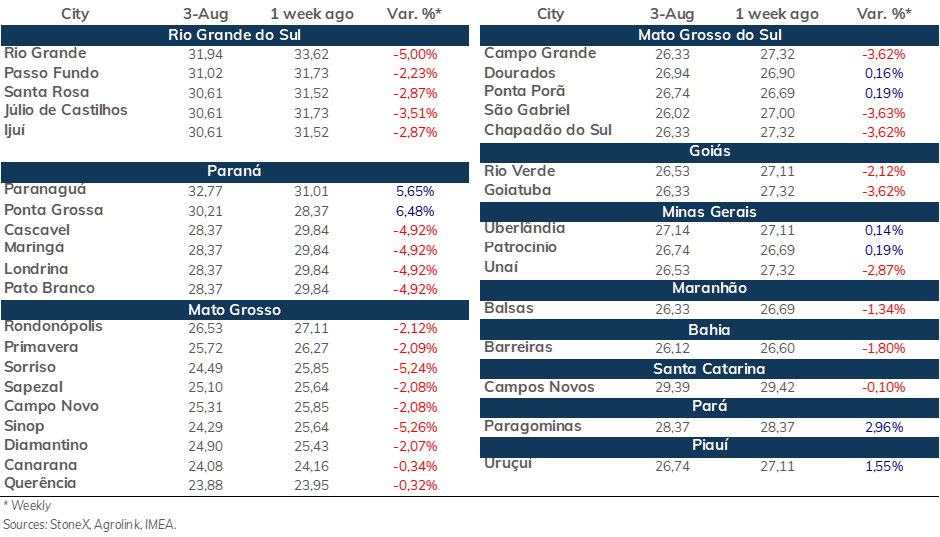
In Brazil, soybean exports in July reached 9.9 million tonnes, higher than the 7.5 million tonnes in the same month last year. The accumulated exports for Brazil already reached 72.8 million tonnes.
StoneX also released its report on crop estimates in the previous week and adjusted the estimate for the 2022/23 crop exports from 96 to 98 million tonnes.
However, the highlight was the first numbers for the 2023/24 crop, with Brazilian production rising to a new record of 163.5 million tonnes, an increase of 3.7% compared to the previous cycle, which reached 157.7 million tonnes.
Even with the planted area increasing to 45.1 million hectares, a record, the variation compared to the previous cycle would be 2.1%, much more moderate than the recent historical average, as the price drop in 2023 tightened the producer's margin.
Much can still change regarding productivity, but a recovery is expected in Rio Grande do Sul, which was affected by La Niña, while the national average would also advance.
In addition to the USDA's supply and demand report this week, attention is drawn to Conab's crop survey. However, the official Brazilian source's report will not provide the 2023/24 crop numbers.