- Estimated 2023/24 global productions well above consumption, according to USDA;
- Weak economic indicators;
- StoneX estimates another record harvest for Brazil in 2023/24;
- Improved crop conditions in the US;
Weak US exports.
- Strong soybean imports by China;
P - ositive crushing and hog industry margins in China;
- Cut in US crop productivity and production;
- Forecast of drier weather, with temperatures rising again in the US.
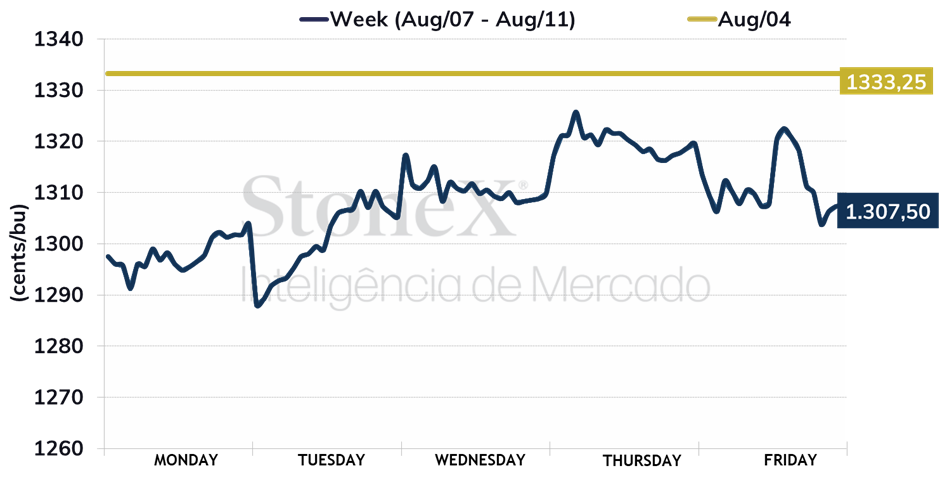
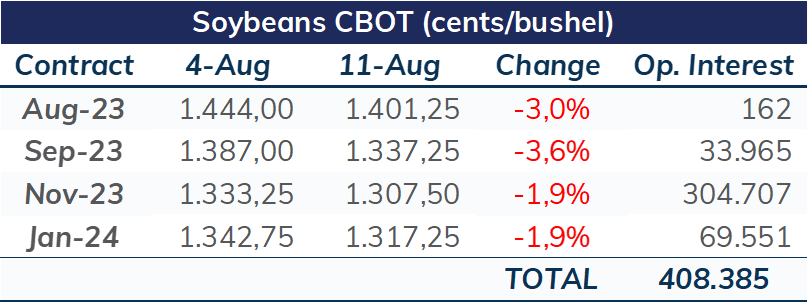
Soybean prices in Chicago continued the downward trend from the previous week. The November contract closed at 1307.5 cents per bushel on Friday (August 7), down 1.9% over the period.
Weather conditions in the US have been the predominant factor influencing the movement of international soybean prices, and last week was no exception.
The good rainfall recorded in the early days of August and forecasts indicating good precipitation volumes in the first half of the month were well received by the market at a crucial time for determining the productivity of American crops, with the grain-filling phase in progress.
With these more favorable weather conditions, there were expectations that the weekly updated percentage of good/excellent crop conditions would improve, and this was confirmed by data for the week ending on August 6. There was a 2-percentage-point increase, with 54% of crops in good/excellent conditions, compared to predictions of a 1-percentage-point improvement. Although some states, such as North Dakota, Minnesota, Iowa, Kansas, and Michigan, still experienced a reduction in the percentage of good/excellent conditions, other states advanced, notably Illinois, where conditions improved by 12 percentage points. This improvement was a key determinant of the national gains. However, this level of 54% is still nine percentage points below the five-year average for the same period.
Over the past weekend, significant rainfall was recorded in important parts of the Midwest, particularly in regions of South Dakota, central Minnesota, and Missouri. However, forecasts for this week indicate drier weather across most of the Corn Belt, although temperatures are expected to remain milder. From the following weekend onwards, drier weather will continue as temperatures rise above normal. This situation is concerning, as US soybean crops are entering the crucial grain-filling phase.
On the demand side, US exports are closely monitored, even with the reported Chinese purchases. American soybeans have generally become more competitive than Brazilian ones starting in October. Additionally, crushing margins and pork industry margins in China have remained positive.
However, as of August 3, a total of 50.8 million tonnes of soybeans have been inspected for export in the US. With one month left in the 2022/23 crop year, slightly over 3 million tonnes must be shipped to reach the USDA's estimated 53.9 million tonnes. The current shipping pace raises doubts about whether this volume will be achieved, with the latest weekly inspection reaching 281.9 thousand tonnes.
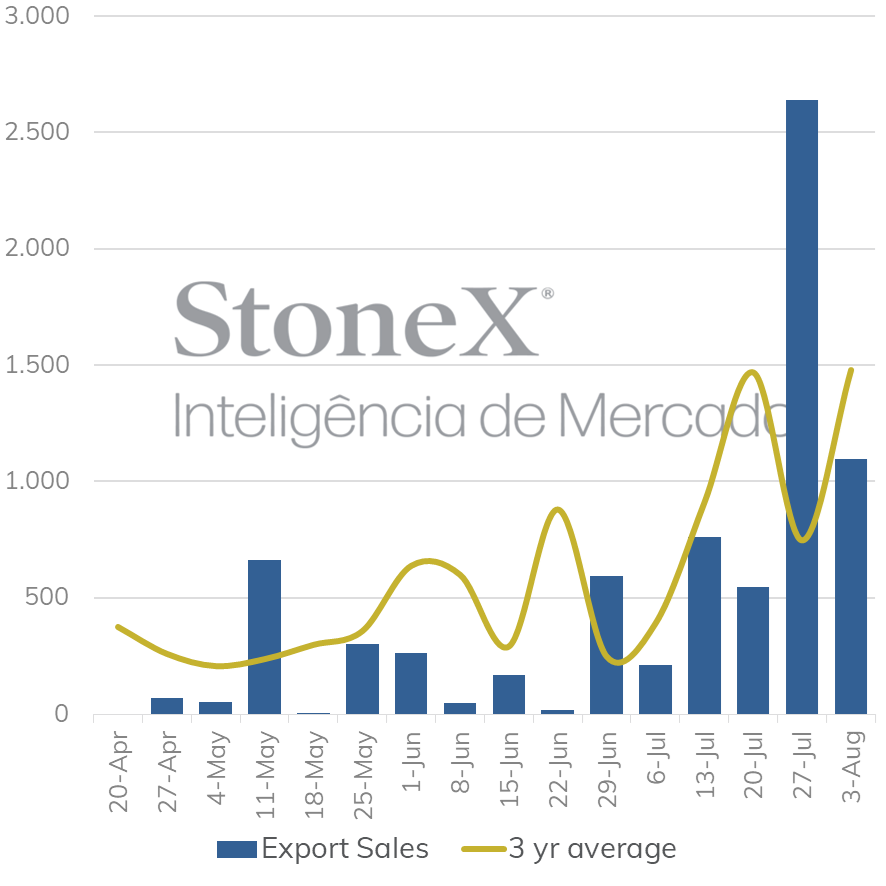
Regarding the country's export sales, in the same week ending August 3, negotiations for the 2022/23 crop exceeded expectations, reaching 406.6 thousand tonnes, while sales for the 2023/24 crop reached 1.1 million tonnes, within the estimated range of 300 thousand to 1.5 million tonnes. China remains the main destination for negotiations for the new crop. Nevertheless, it should be highlighted that, cumulatively, sales for the 2023/24 crop are far behind what was recorded in the same period in previous years, raising questions about the size of US exports following record soybean availability here in Brazil in 2023.
The USDA's supply and demand report, released on Friday (August 11), brought another cut to the US export estimate for the 2023/24 cycle, dropping it below 50 million tonnes.
However, as it is still early, this cut was more about balancing the supply and demand balance after the report confirmed expectations of a cut in productivity, affecting the size of the American crop. The estimated yield decreased to 3.42 tonnes per hectare, with production falling to 114.4 million tonnes. With this reduced supply, ending stocks stood at 6.67 million tonnes, even though the USDA had adjusted imports for the 2022/23 and 2023/24 crops upwards.
Nevertheless, it is worth noting that Chicago prices ended the day lower, as prospects for the global supply and demand balance still indicate production nearly 20 million tonnes above consumption. This week that begins will likely continue to digest the USDA report, but the main focus should be on US weather, with predictions of reduced rainfall.