- World production 2023/24 estimated well above consumption, according to USDA;
- Economic indicators still weak;
- StoneX estimates new record 2023/24 crop for Brazil;
- Improving crop conditions in the US;
- Weak US exports.
- China's heated soybean imports;
- Positive crushing and hog industry margins in China;
- US crop productivity and production cut;
- Positive outlook for North American crush;
- Drier weather with high temperatures in the US.
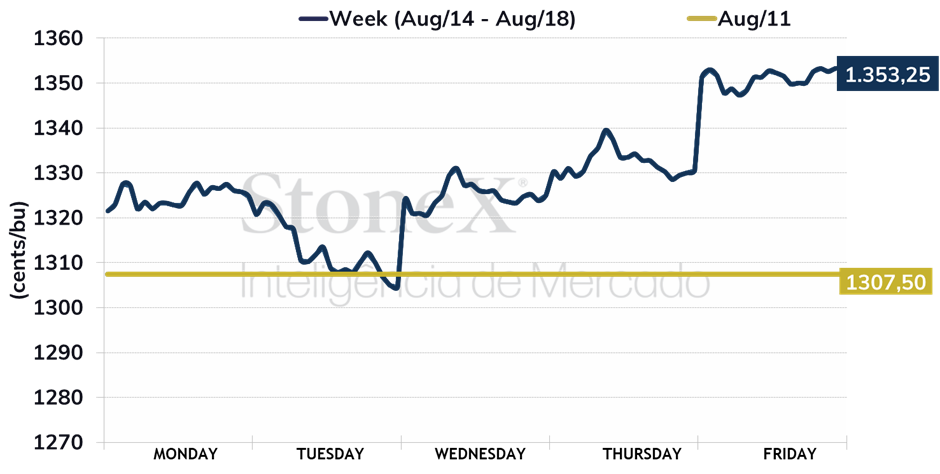
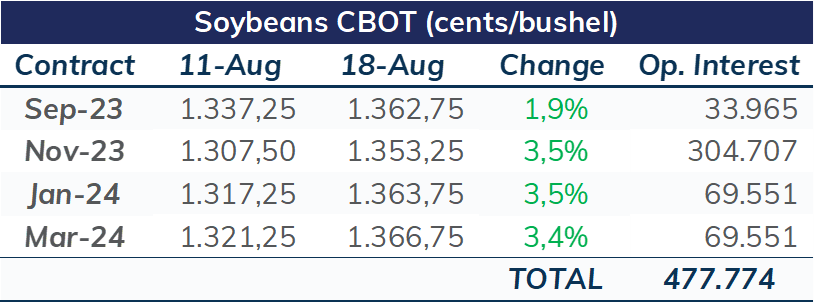
Last week, soybean prices in Chicago rose again, influenced by the weather in the US and concerns about the supply and demand balance in the country. The November contract ended Friday's session (18) at 1353.25 cents/bushel, up 3.5%.
Although the August USDA supply and demand report did not bring any major surprises by cutting US productivity and output, other factors have contributed to the prospects that the country's balance sheet could become even tighter, resulting in demand-side rationing.
The weather in the US continued to be closely monitored. More significant rainfall and milder temperatures positively impacted crop conditions, tracked weekly by the USDA. On Sunday (13), 59% of the crop was in good/excellent condition, an increase of 5 p.p. compared to a week earlier, an advance above what the market expected. Highlight for the state of Illinois, one of the leaders in North American soybean production, where the increase in the percentage good/excellent from one week to another was 12 p.p.
However, as much as the weather until mid-August was beneficial, forecasts again indicated below-average rainfall in practically the entire Midwest of the US, combined with above-average temperatures. This situation is worrying since the key phase of grain filling is underway and has supported prices in the face of the country's tighter balance sheet.
On the demand side, the National Oilseed Processors Association (NOPA) released US crushing data in July. 4.72 million tonnes of soybeans were crushed in the month, exceeding the average market expectations of 4.66 million. With one month to go until the end of the 2022/23 US crop year, the annual estimate of 60.42 million tonnes is expected to be confirmed. On the other hand, this strong monthly number has raised questions about the USDA's estimate for the 2023/23 crop, in which the expected crush is 62.60 million tonnes. As there was a sharp drop in oil stocks, reaching the lowest of the season, the strength of consumption for renewable diesel again configured an important support factor for vegetable oils and, consequently, for grain, in the face of the already quite tight balance sheet scenario.
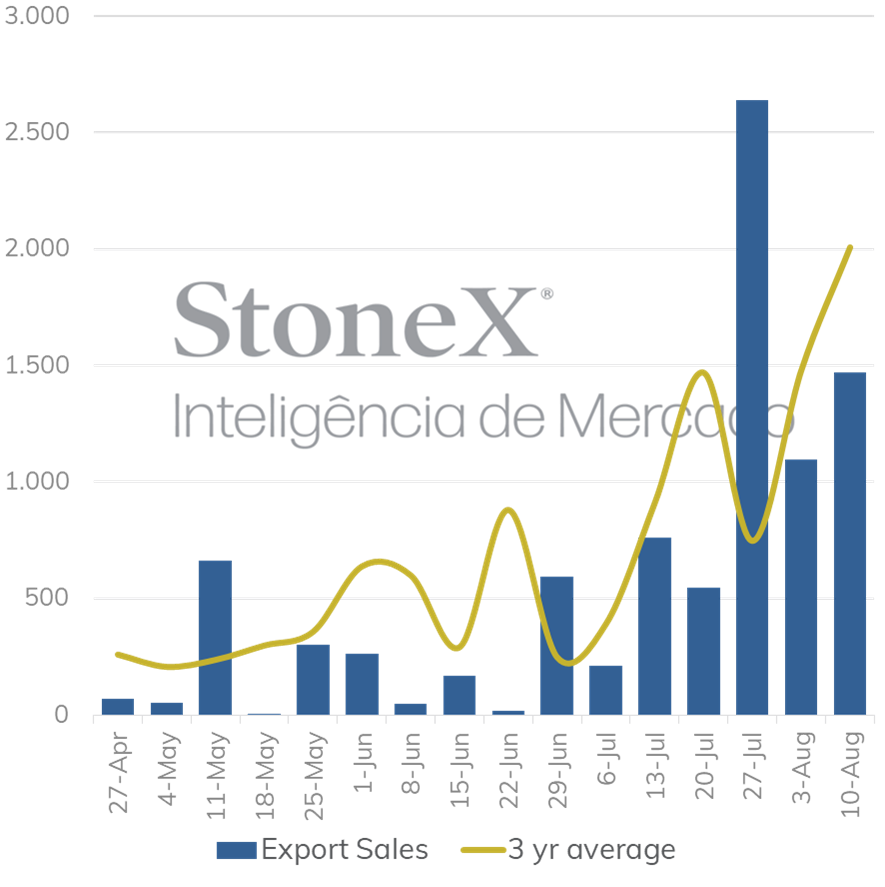
In the reverse direction, US exports remain weaker. Sales of the 2022/23 crop, in the week ended 08/10, reached 93,6 thousand tonnes, a volume closer to the floor of estimates, which ranged from 0 to 400 thousand tonnes. Cumulative sales reach 53.2 million tonnes, remembering that the export estimates are at 53.9 million. Shipments reached 51.2 million tonnes, with three weeks left until the end of the crop year. Considering the average volumes shipped weekly, there are chances that the USDA's estimate of exports will not be reached.
For the 2023/24 crop, sales reached 1.47 million tonnes, at the upper limit of estimates, between 550 thousand and 1.5 million tonnes. Even so, in the accumulated, the negotiations reached 10,6 million tonnes, a volume that remains lower than that registered in the same period in previous years.
It is important to remember that the last quarter of the year tends to record the largest shipments of North American soybeans right after harvest. However, after the record crop in Brazil, there are concerns about the size of US exports in this period. In any case, US soybeans for China are already more competitive than Brazilian soybeans as of October.
StoneX updated its biweekly marketing follow-up in Brazil, with 77.2% of the 2022/23 crop already traded. Despite the most significant advances in recent months, this percentage is low compared to previous years, with 36 million tonnes still to be sold.
This week, the weather in the US should continue to move international soybean prices. The forecasts continue to indicate hot and dry weather throughout the belt, with chances of the western region hitting 40°C this Monday (21). Starting next weekend, temperatures are expected to drop, but rainfall tends to stay below normal in most producing regions.