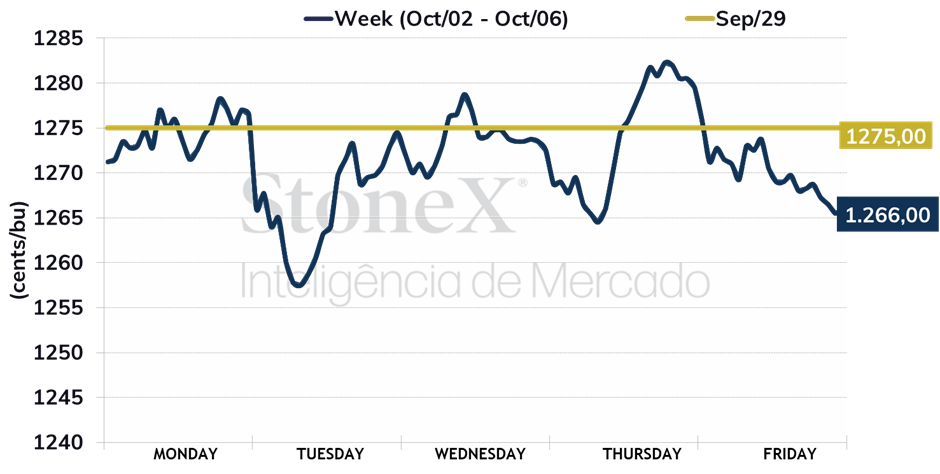
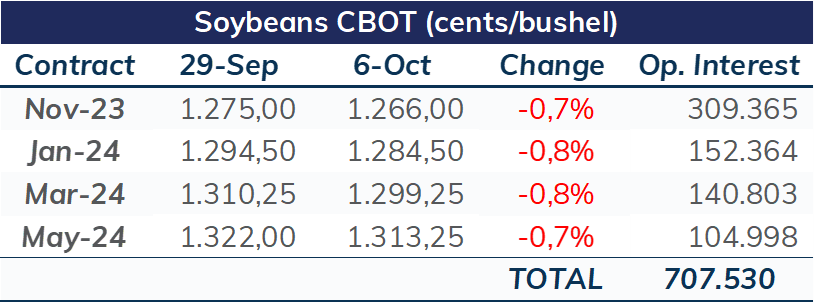
The soybean quotes in Chicago recorded a more limited fluctuation last week, remaining stable until Thursday (05). On Friday (06), a slightly larger drop led to the lower weekly close, with the November contract dropping to 1266 cents per bushel, a 0.7% decline for the week.
The seasonal harvest period of the American crop season puts pressure on prices, even with the prospects of a tighter supply and demand balance in the US. Until Sunday (01), soybean harvesting in the US was 23% complete, slightly above the five-year average of 21%.
Regarding the size of the supply in the US, despite the losses in the 2023/24 crop due to the hotter and drier weather that prevailed mainly in the second half of August, there are doubts about what the final number will be, with the USDA monthly report being highly anticipated this week. StoneX updated its crop survey for the country on Monday (02) and increased production, which would be 113.6 million tonnes, above the last USDA number of 112.8 million. This positive revision of StoneX was motivated by the expected increase in productivity, which went from 3.37 to 3.39 tonne per hectare, considering the official area number.
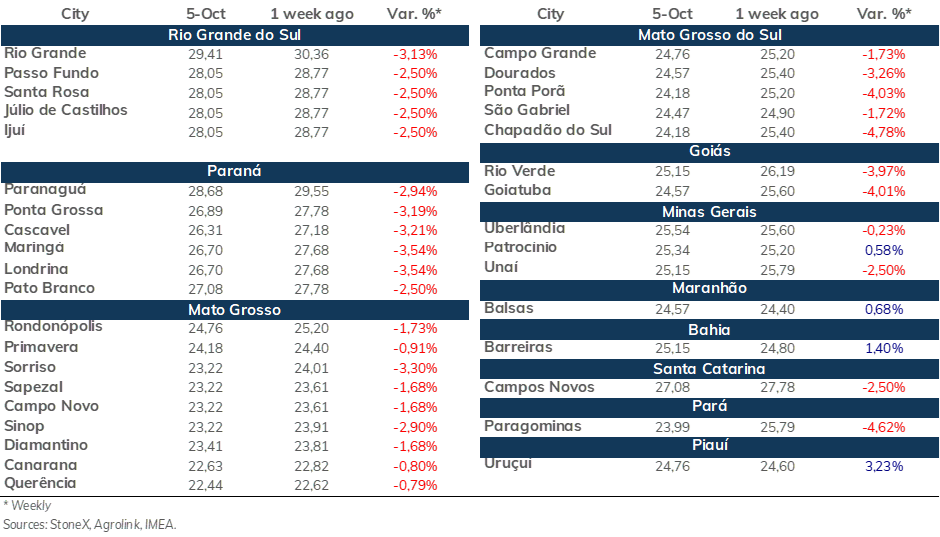
On the demand side, export sales and shipments from the US continue to be closely monitored. With the record harvest this year here in Brazil, Brazilian soybeans available in China have remained more competitive than American ones. Brazil ended September exporting 6.4 million tonnes, bringing the total since January to 87.3 million. In addition, according to lineup data, the outlook for October points to exports around 7.5 million tonnes.
In this way, concerns about the possible impacts of heated Brazilian exports on the volumes exported by the US remain. Usually, the best period for the shipment of American soybeans is the last quarter of the year, between October and December. In addition, the low level of the Mississippi River is also a concern, as it is one of the main routes for American grain exports.
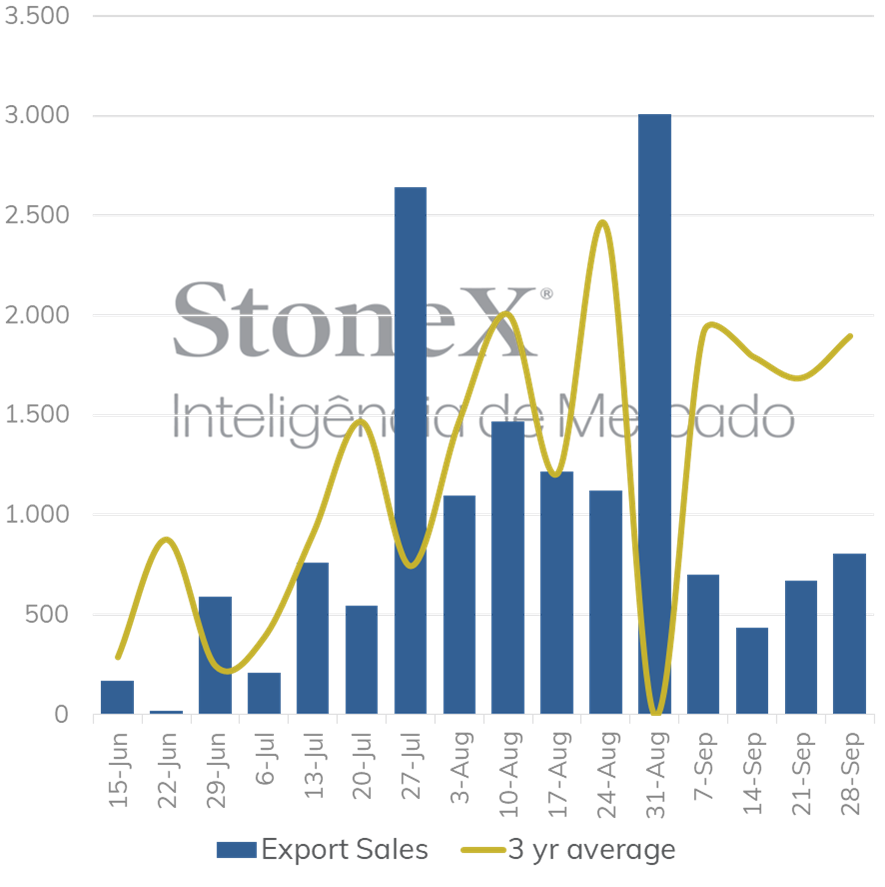
Export sales in the week ended on 09/28 reached 808.5 thousand tonnes, a volume within market expectations but closer to the ceiling, bringing the accumulated total for the 2023/24 crop year to 18.6 million tonnes. There are concerns about the pace of negotiations, especially with China, which is taking advantage of the availability of Brazilian soybeans this year.
On the demand side, despite positive prospects for the growth of renewable diesel production in the US, the recent decline in Renewable Identification Numbers (RINs) prices, which are credits generated when producing biofuels in the country, raises some concerns. The supply of D4 RINs (related to renewable diesel and biodiesel production) has rapidly increased as renewable diesel production grows, and the spread between soybean oil on the CBOT and diesel on the NYMEX decreases. As trading these papers is important for the revenue of biofuel producers, the activity becomes less attractive, with RINs at lower prices, which could affect the demand for soybean oil and, thus, the oilseed crushing.
It should be noted that the last trading session of the previous week, amidst expectations of significant advances in the US harvest, was also influenced by fears that the Fed may further strengthen its contractionary policy with new increases in US interest rates, following data showing a heated job market in the country. This situation favors the search for security and becomes a bearish factor for commodities.
This week, as it begins, Conab releases its monthly crop survey, including figures for the 2023/24 cycle. Also worth noting is the USDA's monthly report, always eagerly anticipated by the market, set to be released on Thursday, the 12.
In addition, the harvest in the US, the country's export sales, the level of the Mississippi River, and planting and weather conditions in Brazil should remain on the radar, influencing the quotes.