- World production estimated above consumption in 2023/24, according to the USDA;
- US harvest progress;
- StoneX estimates a new record crop for Brazil in 2023/24;
- USDA increases US production for 2023/24;
- Weak accumulated exports sales from the US.
- Sales of significant volumes of soybean from the US to China;
- Heated American domestic consumption;
- Argentina may run out of soybeans for crushing in the coming weeks;
- Irregular rains in some Brazilian producing areas;
- Delay in the Brazilian crop planting.
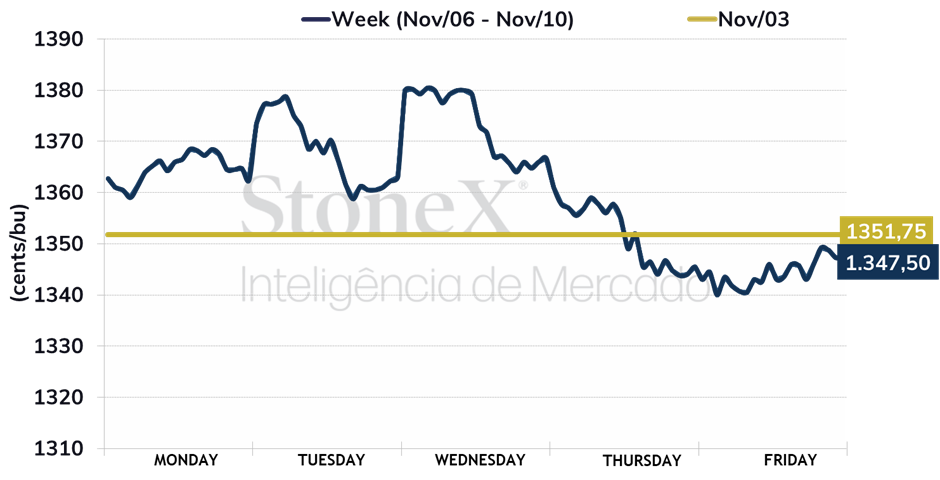
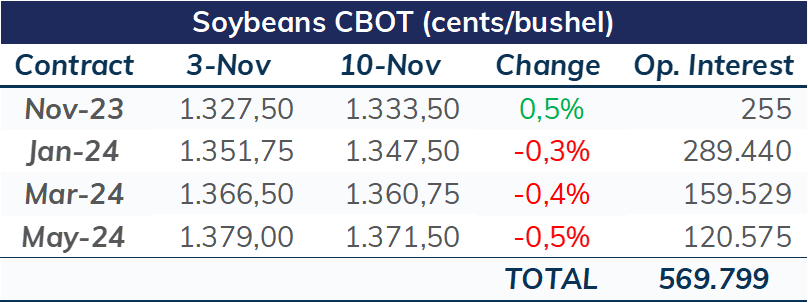
Last week, soybean quotes in Chicago fell slightly again, with the January contract ending Friday's session (10) at 1347.5 cents per bushel, a 0.3% drop in the period.
The oilseed still started the week on the rise, amid concerns about Argentina's soybean meal supply, but ended the period with losses after the release of USDA's monthly supply and demand report and despite reports of soybean sales from the US to China.
In addition to the lower soybean meal production in Argentina, which is expected to return to normal after the 2023/24 crop within the normal range, the demand for soybean oil in the US remains very positive amidst the increase in renewable diesel production. This situation reinforces the focus on soybean derivatives balances.
Thus, the attention to the 2023/24 production in South America is high, with concerns about the forecasts of hot and dry weather in much of Brazil in the next two weeks.
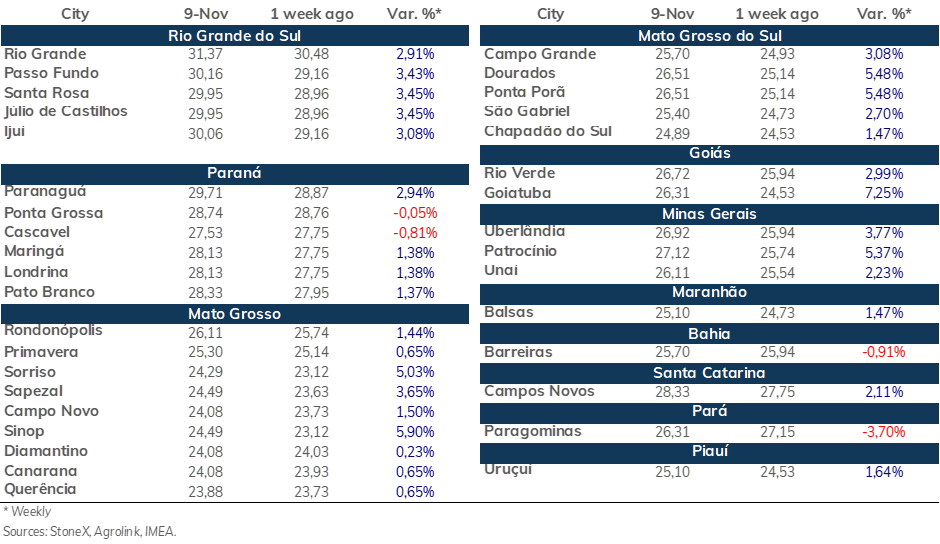
The planting of Brazilian soybeans is already behind schedule, with the crop progress report from StoneX last Friday (10) indicating a completion percentage of 59.3%, compared to 70.7% in the same week last year.
The delay does not mean negative impacts on the soybean crop, but the lack of rain can harm the productive potential, even if the crops are not in the most critical phases, such as grain filling.
This year, the prospects are still for growth in the soybean area in Brazil and Argentina, with corn losing ground to the oilseed in a context of tighter margins for the producer. The planting of the Argentine crop has begun, reaching 6.1% of the total last Wednesday (08), according to the Buenos Aires Exchange. There have been advances in the north of La Pampa, in the west of Buenos Aires, south of Córdoba and Entre Rios, where there were rains, with the surface moisture allowing the start of sowing.
In the US, soybean harvest reached 91% of the total on Sunday, November 5, a volume above the five-year average for the period, at 86%, but below what was recorded in the same period of 2022, at 93%.
The harvest period in the US tends to weigh on prices at CBOT, while sales and exports gain strength amid greater availability of grains.
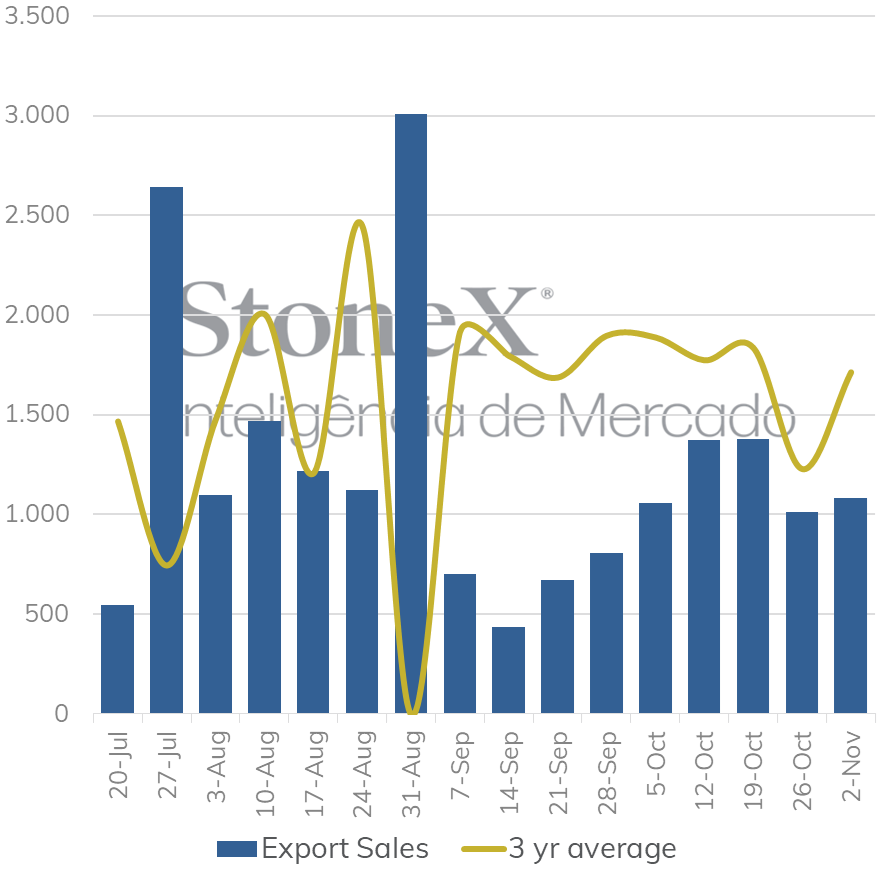
Last week, significant soybean sales volumes from the US to China were announced in the USDA's daily reporting system. Thus, the next weekly export sales release for the country, referring to the week ending on 11/09, should fetch quite a significant volume.
In the week ended on 11/02, trade reached 1.08 million tonnes for the 2023/24 crop, bringing the total to 24.2 million tonnes, still below the level recorded in the same period last year, which reached 32.9 million tonnes. However, it is important to remember that the USDA estimates lower US exports in the 2023/24 cycle.
On Thursday (09), the USDA updated its supply and demand report, raising the estimate for US production in 2023/24 to 112.4 million tonnes due to positive revisions in productivity. This result exceeded market expectations, which were betting on stability, around the last USDA figure of 111.7 million tonnes.
There were no changes in the expected demand variables for the US 2023/24 crop, with the increased production reflected in a hike in ending stocks estimated at 6.67 million tonnes.
This review for the American crop weighed on quotes in Chicago, even with the country's pent-up supply and demand balance, despite the increase in production.
On Friday (10), the soybean quotes salvaged part of the previous losses after rumors of new sales of American soybeans to China. It should be noted that these recent sales to China contribute to salvaging the accumulated volume of negotiations. Still, expectations point to weaker exports than the previous crop, at least for now.
This week, the attention should be very focused on the weather in South America, with several Brazilian states facing a heatwave, which is expected to last for the next few days, at a time when climate concerns have been gaining strength.