- World production estimated above consumption in 2023/24, according to the USDA;
- US harvest progress;
- StoneX estimates a new record crop for Brazil in 2023/24;
- USDA increases production for the US in 2023/24;
- Weak accumulated sales of exports from the US.
- Sales of significant volumes of soybean from the US to China;
- Heated American domestic consumption;
- Argentina may run out of soybeans for crushing in the coming weeks;
- Irregular rains in some Brazilian producing areas, with planting delays;
- Losses of productive potential in the Brazilian crop.
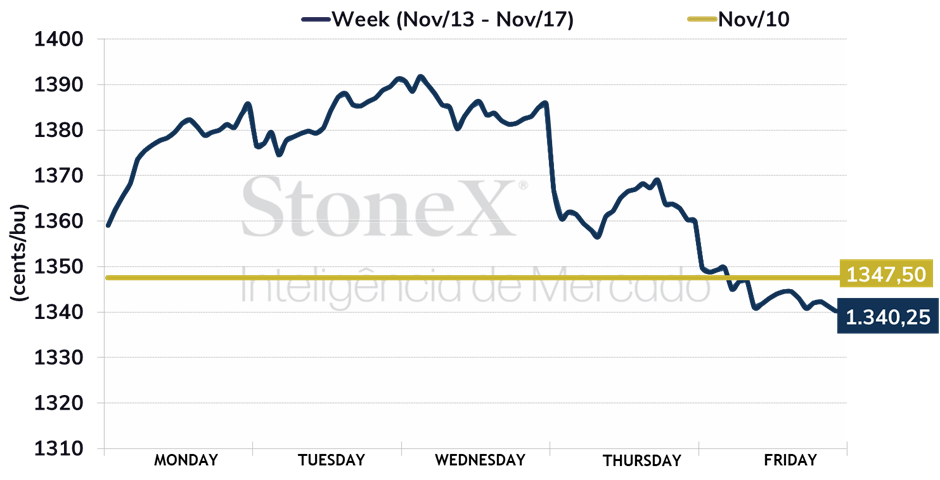
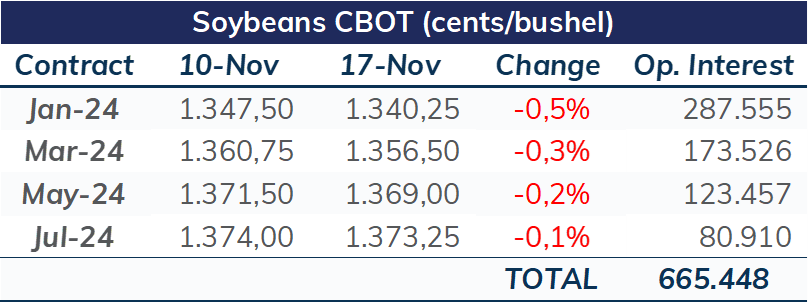
The soybean quotes started the previous week higher, falling in the last two sessions, ending the seven days with a 0.5% loss. The expiry for January ended Friday (17) at 1340.25 cents per bushel.
On the bullish side, concerns about the weather in Brazil and the potential lack of soybeans in Argentina for crushing stand out. In addition, the prospects for domestic consumption in the US remain positive.
On the other hand, after the euphoria of considerable purchases of American soybeans by China, the trade returned to monitor the pace of sales in the US, with the harvest nearing its end and Brazil still shipping significant volumes of the oilseed.
The harvest of the American soybean 2023/24 crop reached 95% of the total area on Sunday (12), a percentage above the five-year average for the period, at 91%, and slightly below last year at the same time, at 96%.
With the hike in soybean volume in the US, attention is increasingly turning to the demand side in the country. The National Oilseed Processors Association (NOPA), which represents 95% of the industry, indicated that 5.17 million tonnes of soybeans were crushed in September, a volume above the average market expectations of 5.09 million tonnes. It should be noted that crushing margins in the country are very favorable, contributing to the prospects of annual growth in soybean processing driven by the demand for renewable diesel oil.
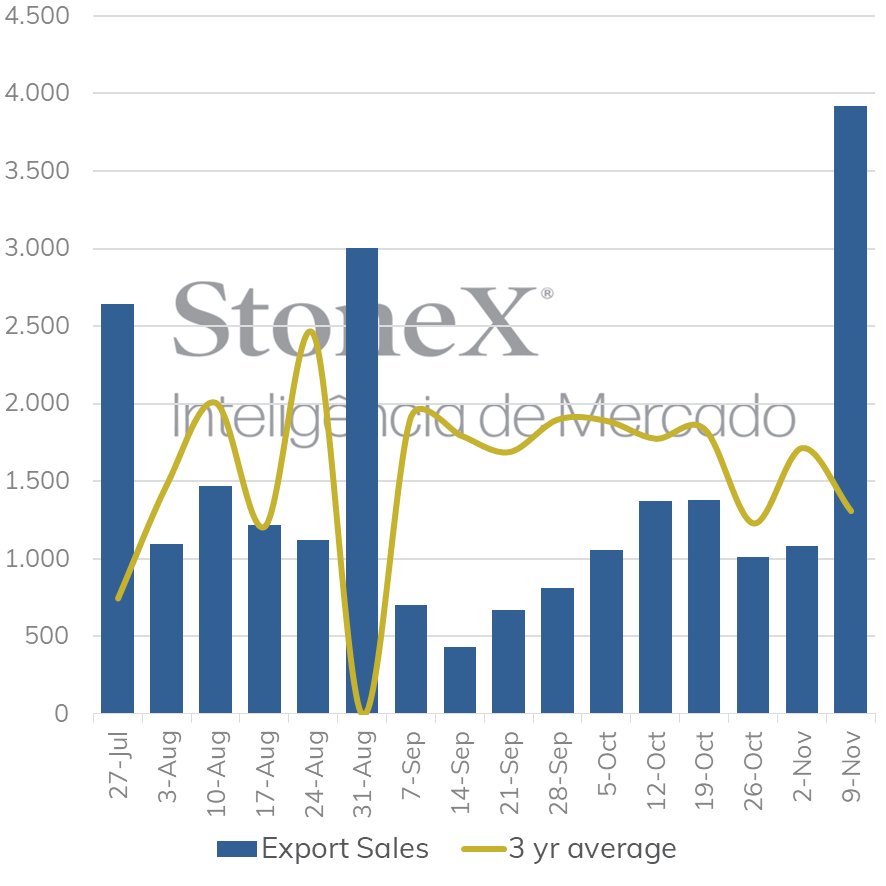
About the exports of the US, sales in the week ended on 11/09 reached 3.92 million tonnes, a volume within the range of estimates, which ranged from 2.9 to 4.5 million tonnes. The trade expected high levels since the USDA's daily reporting system had been signaling these negotiations. Out of this total, 2.6 million were sold to China. Even so, it is worth noting that, in the aggregate, American sales are still behind, even considering the lowest export estimate in the 2023/24 cycle.
Regarding China, the country's purchases will continue to be on the radar. Still, it is worth noting that domestic crushing margins are weaker, which raises concerns about the volumes that will be bought for import.
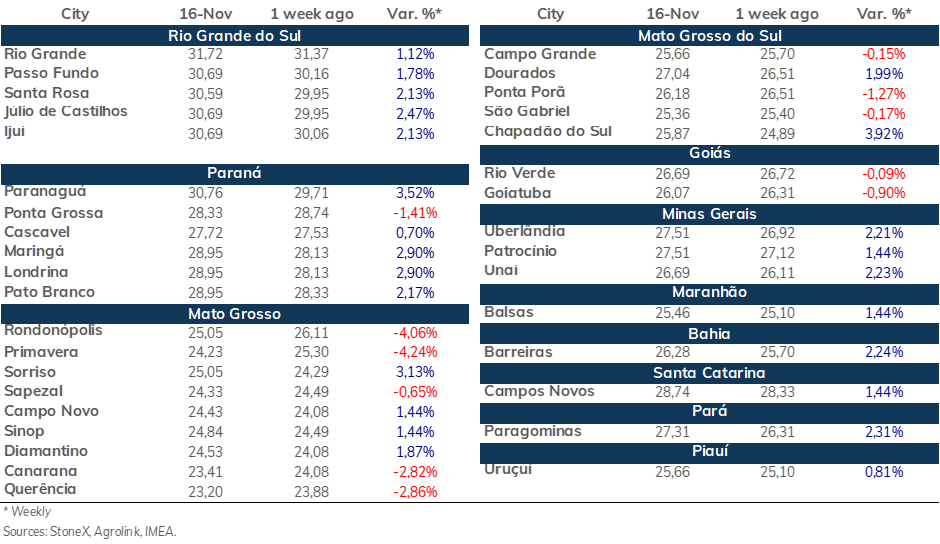
In Brazil, the national soybean planting reached 65.9% on Friday (17), according to StoneX's survey, a delay of 13.3 p.p. compared to the same week last year. In recent days, the weather has maintained the pattern of irregular rains in several states, while temperatures were very high under the influence of a heatwave.
Thus, although it is not possible to speak of very significant crop failures, the loss of productive potential is already being considered in some regions, with rain being very necessary in the coming weeks.
Rain is forecasted in the next 14 days, mainly in the last week of November. These precipitations should occur more widely in larger volumes throughout the Brazilian producing region. Anyway, even with the confirmation of these rains, damages from the weather so far cannot be dismissed. Over the past weekend, there were recorded precipitations in the states of the Midwest, but they were not widespread, with more rain being necessary. Access StoneX's comments on the Brazilian crop at this link: https://stonex.link/xrh6y.
In Argentina, the dry weather also affected the early corn, causing a shift in the area to soybeans. The Buenos Aires Exchange again increased the estimated oilseed area in the 2023/24 crop to 17.3 million hectares, a positive variation of 200 thousand hectares. The planting reached 18% of the total area last Wednesday (15), representing a six percentage point advance compared to last year.
In the week that begins, the weather in Brazil is expected to continue being central, emphasizing that temperatures are returning to normal levels after the sharp heatwave.