- World production estimated above consumption in 2023/24, according to the USDA.
- Record of the most abundant rainfall in Brazil's soybean areas;
- StoneX still estimates a record crop for Brazil in 2023/24;
- USDA increases production for the US in 2023/24;
- Weak accumulated sales of exports from the US.
- Heated American domestic consumption;
- Argentina may run out of soybeans for grinding;
- Need for more rain in Brazilian producing regions;
- Losses of productive potential in the Brazilian crop, with a cut in StoneX's production estimate.
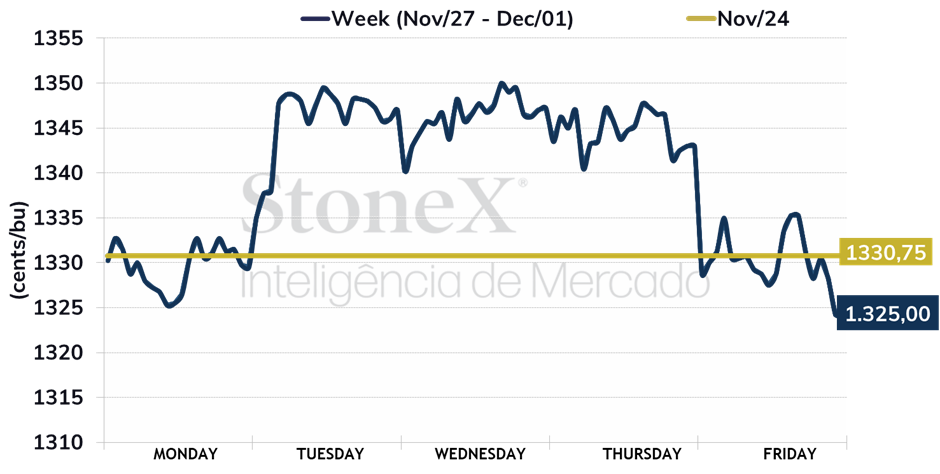
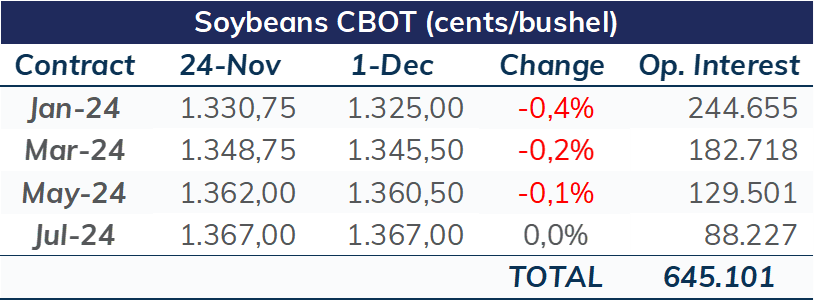
The soybean quotes recorded gains until the middle of last week but fell again and ended the period with a slight decrease. The January contract ended Friday (01) at 1325 cents per bushel, a weekly decrease of 0.4%.
The South American crop continues to be in the spotlight, and weather forecasts and private crop estimate releases for Brazil have influenced prices.
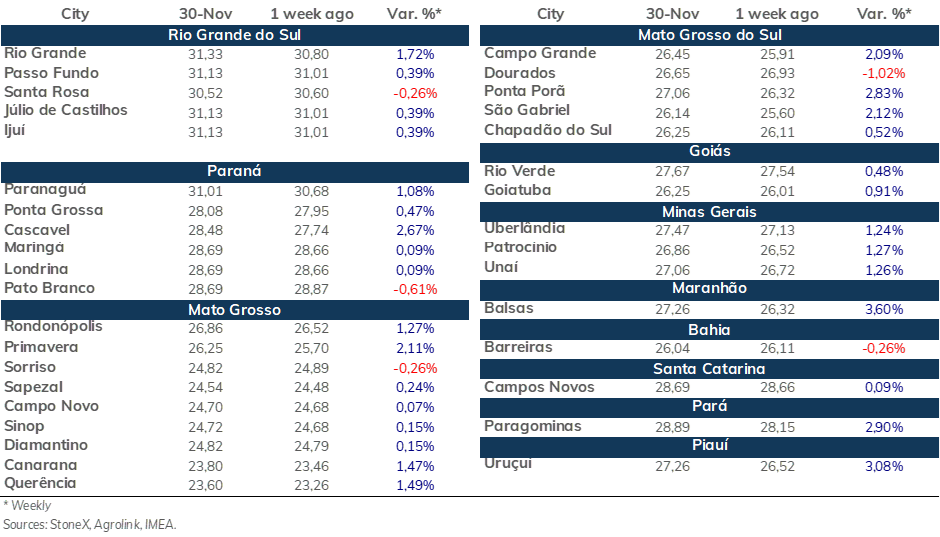
Since the week of November 20, more significant rains have been recorded in the producing regions of the Brazilian Center-West. Still, the accumulated precipitation in November remained well below normal, with emphasis on Mato Grosso, parts of Goiás and Mato Grosso do Sul, and states in the Southeast, MATOPIBA region, and Pará.
Highlight for an agency that released that Brazil's soybean crop for 2023/24 is expected to reach 150.67 million tonnes. According to the source, this figure would be lower than the previous season, which reached 154.1 million tonnes.
This figure was much lower than others disclosed in the market, including the official one from CONAB, which supported prices on the day of disclosure. Nonetheless, the previous estimate was already lower than that of other institutions, and the continued occurrence of rain has once again weighed on prices.
StoneX also released its crop report and reduced the production estimate for the 2023/24 cycle here in Brazil from 165 to 161.8 million tonnes. With the lack of rainfall, the production potential of some states, especially those in Center-West Brazil, was adjusted downwards.
In Mato Grosso, in addition to the reduction in the intended yield, there was a small cut in the acreage, as the weather conditions caused significant planting delays. The national average of planting reached 82.7% last Friday (01), according to StoneX's follow-up, about seven p.p. below last year.
In December, the weather will be crucial to define the productive potential of the Brazilian 2023/24 soybean crop. If the rains continue to be irregular, new crop cuts are expected to occur in the next revisions. As for now, the forecasts for December are more favorable, indicating rain for practically the entire producing region, at least until the middle of the month.
In Argentina, after the initial delays in planting due to the lack of rain until the end of October, 43.8% of the estimated 17.3 million hectares area, as reported by the Buenos Aires Exchange until Wednesday (29), has already been sown, in sympathy with the five-year average for the period.
The weather forecasts indicate rain for Argentina in the coming days. Even the long-term forecasts show a wetter pattern in the coming months, which tends to benefit the country's crop development.
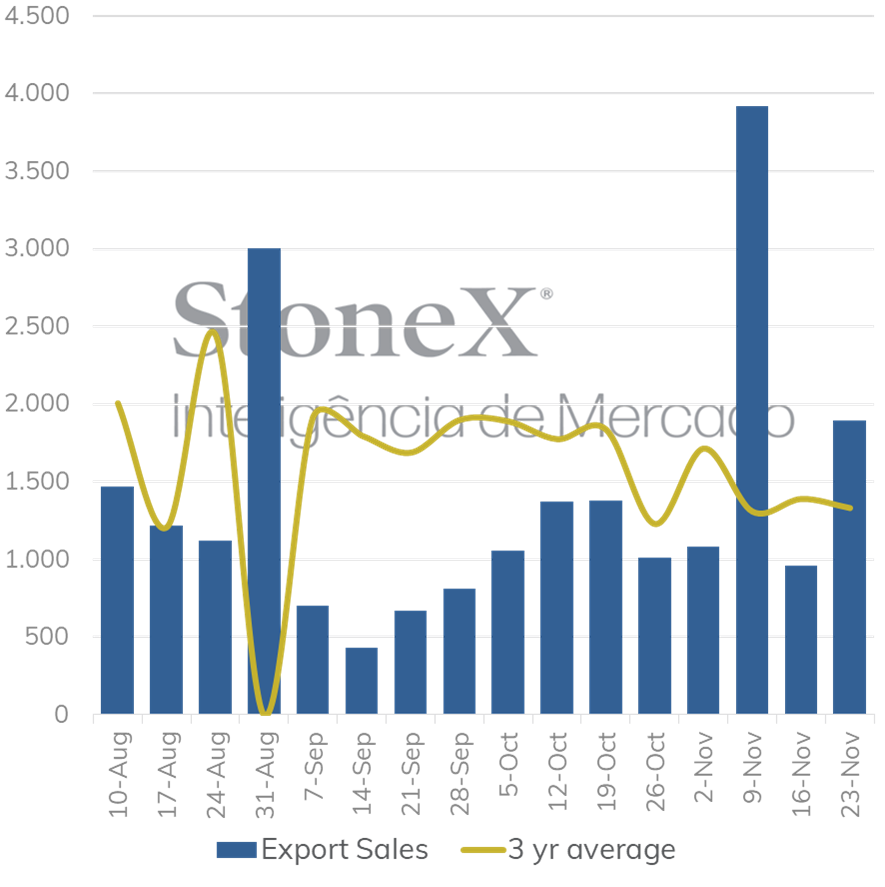
On the demand side, attention continues to be quite focused on American exports. Inspections in the week ended on November 23 were at 1.4 mmt, a slightly lower volume than the previous week but considerably lower than the same period last year. The year-to-date total is also lower, but USDA estimates indicate lower exports in the 2023/24 cycle for the United States. Nonetheless, the months from October to December are the best in terms of volume shipped by the country, with the exports being closely monitored.
Export sales in the same week reached 1.9 million tonnes, exceeding the upper limit of the estimates, which ranged from 850,000 to 1.5 million tonnes. Of this total, 900 tmt were traded with China, but, in the accumulated, Chinese purchases of American soybean are 5.6 million tonnes below the same period of last year.
Regarding soymeal, concerns about Argentina's supply until the next crop harvest around March 2024 persist. With a crop failure of around 60% in the 2022/23 cycle, it is considered that the country will practically run out of soybean to process. The monthly volumes were already lower, likely worsening before the new crop.
This week, the weather in Brazil is expected to remain in the spotlight. In addition, the Conab report will be released on Thursday (07), and the USDA report on Friday (08). The Conab data regarding possible crop adjustments here in Brazil is awaited. For USDA, revisions for the Brazilian crop may also occur, while for the American production, possible new revisions should only appear in the January release.