- World production is estimated to be above consumption in 2023/24, according to the USDA;
- Record of the most abundant rainfall in Brazil's soybean areas;
- StoneX still estimates a record crop for Brazil in 2023/24;
- Full crop potential in Argentina, with good rainfall forecasted;
- Weak accumulated sales of exports from the US to China.
- Increased US domestic consumption;
- Argentina may run out of soybeans for crushing;
- Need for more rain in Brazilian producing regions;
- Cuts in estimated production by CONAB and USDA.
- Production estimate cut by StoneX.
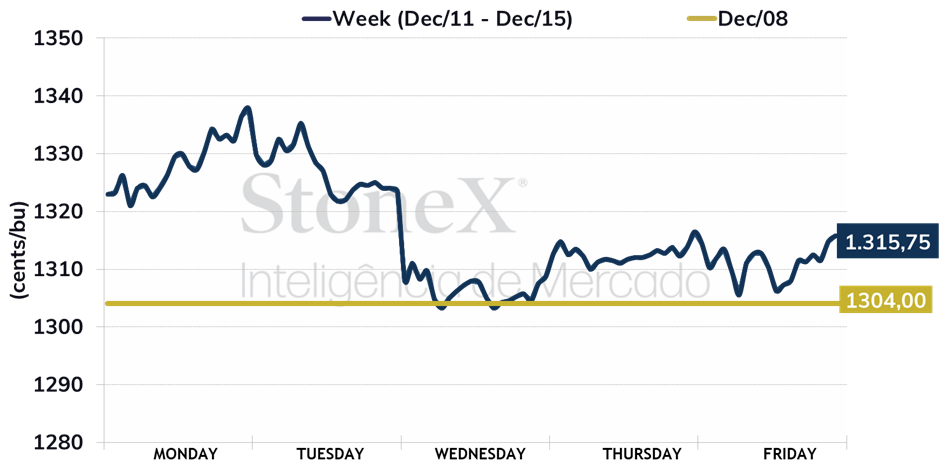
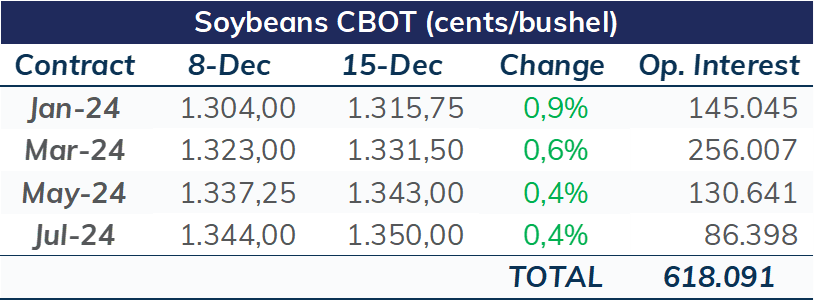
Last week, soybean quotes in Chicago oscillated. They ended the period in positive territory, with the January contract ending Friday (15) at 1315.75 cents per bushel, a gain of 0.9%. This was the first weekly increase after five weeks of losses.
The crop progress in South America continues to be the center of attention, with the weather in Brazil still causing concern. After the quite dry last few months in much of the central and northern regions of the country, while the South continued to record large volumes of precipitation, the rainfall record in December is closely monitored. It has been raining more in practically the entire soybean agricultural belt. However, some areas still have volumes below what is necessary and irregularities amidst very high temperatures, intensifying plant stress.
Thus, new crop estimates are expected, which may fetch further cuts in potential productivity due to the lack of adequate rainfall in several regions. For the next days and weeks, forecasts indicate precipitation throughout the production area, which is very welcome. It should be noted that in later cycle locations, such as parts of the MATOPIBA region and Rio Grande do Sul, the climate will continue to be very important in the coming months as well.
In south Brazil, excessive rainfall has raised concerns about the increased spread of illnesses. The occurrence of Asian rust has already been reported, which this year has advanced due to the combination of moisture and heat. Thus, measures are being taken to control the pest, which, if not combated, results in significant productivity losses.
In Argentina, soybean planting reached 59.5% last Wednesday (13), according to the Buenos Aires Exchange. In general, the situation is quite favorable for the country's crops, with 90% of conditions for cultivation ranging from normal to good. Only in some areas of Entre Rios and Santa Fé is excessive rainfall causing some concern.
On the demand side, Brazilian soybean exports since January reached 99.2 million tonnes by Friday (08), with estimates that shipments in January may exceed 3 million tonnes, which will take the annual volume above 100 million.
With Brazil continuing to ship significant volumes of the oilseed even in the final months of the year, which is not seasonally common but ended up being favored by the record production in the 2022/23 cycle, sales and exports from the US are on the radar. Historically, the best period for the shipment of American soybeans is the last quarter of the year.
In the week ending on 12/07, US export inspections reached 984.4 tmt, nearly half the same week last year. In the accumulated period, 19.7 million tonnes were shipped, a volume lower than a year before, at 23.5 million tonnes. Nonetheless, it is important to remember that USDA's export estimates for the 2023/24 crop are 6.45 million tonnes below the 2022/23 crop.
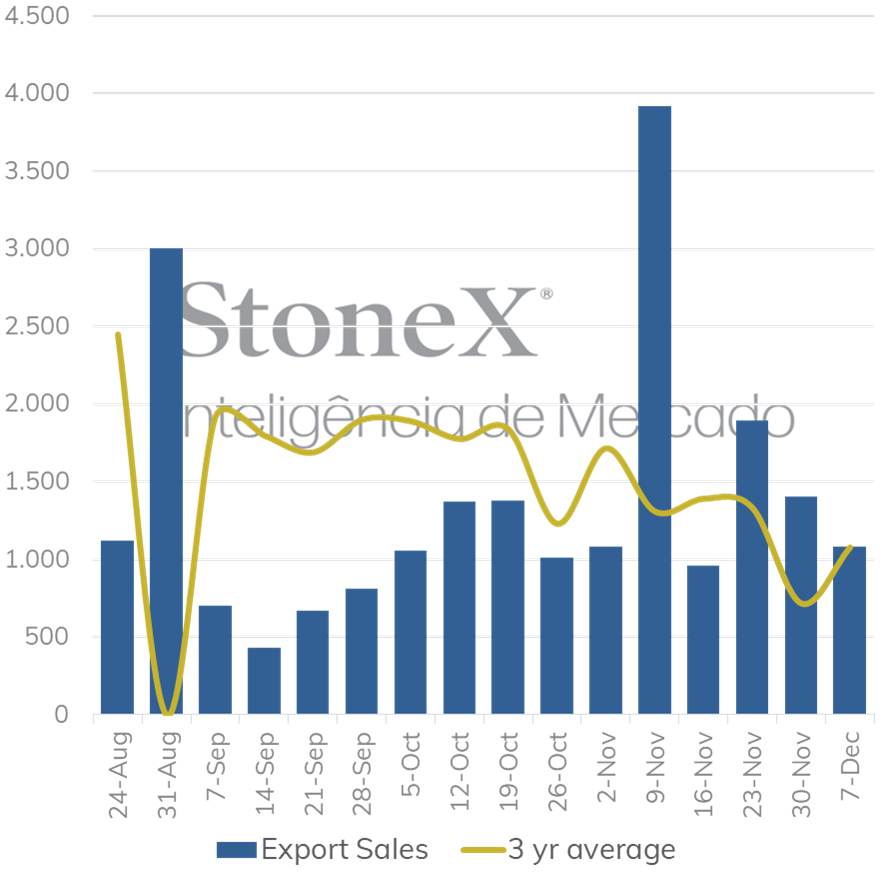
Export sales for the same week were 1.08 mmt, at the lower end of the estimated range, which ranged from 900,000 to 1.8 million tonnes. In the accumulated period, 33.4 million tonnes were traded, below the 41.7 million in the same period last year. Of this annual delay, China is responsible for 6.4 million tonnes less.
In Argentina, the new government maintained the retentions on soybean exports, having increased the percentage for corn and wheat from 12% to 15%. The peso was devalued, inflation is quite high, and changing this scenario will take time. Thus, the behavior of the country's producer in holding back the sale of grains should not change overnight, with the maintenance of the physical volume being considered as insurance.
In the week ahead, the weather in Brazil should continue to be closely monitored, with important regions needing good rainfall until the end of December. Today, the export data from last week will be released, with volumes remaining considerable for December.
On the demand side, the exports from the US continue to be monitored, with the delays and potential crop failures in Brazil potentially fostering American shipments in early 2024.