- World 2023/24 production estimated above consumption, according to the USDA;
- More abundant rainfall in Brazil's soybean areas and good expectations for the coming weeks;
- USDA cuts Brazil's crop by just 1 million tonnes;
- Crop should still be favorable in Argentina;
- Concerns about the pace of world demand;
- Weak US export sales.
- StoneX cuts 2023/24 soybean production again;
- Production cuts estimated by Conab and the USDA;
- Hot, dry weather worsens crop conditions in Argentina;
- Argentine situation still favors holding on to soybeans as insurance.
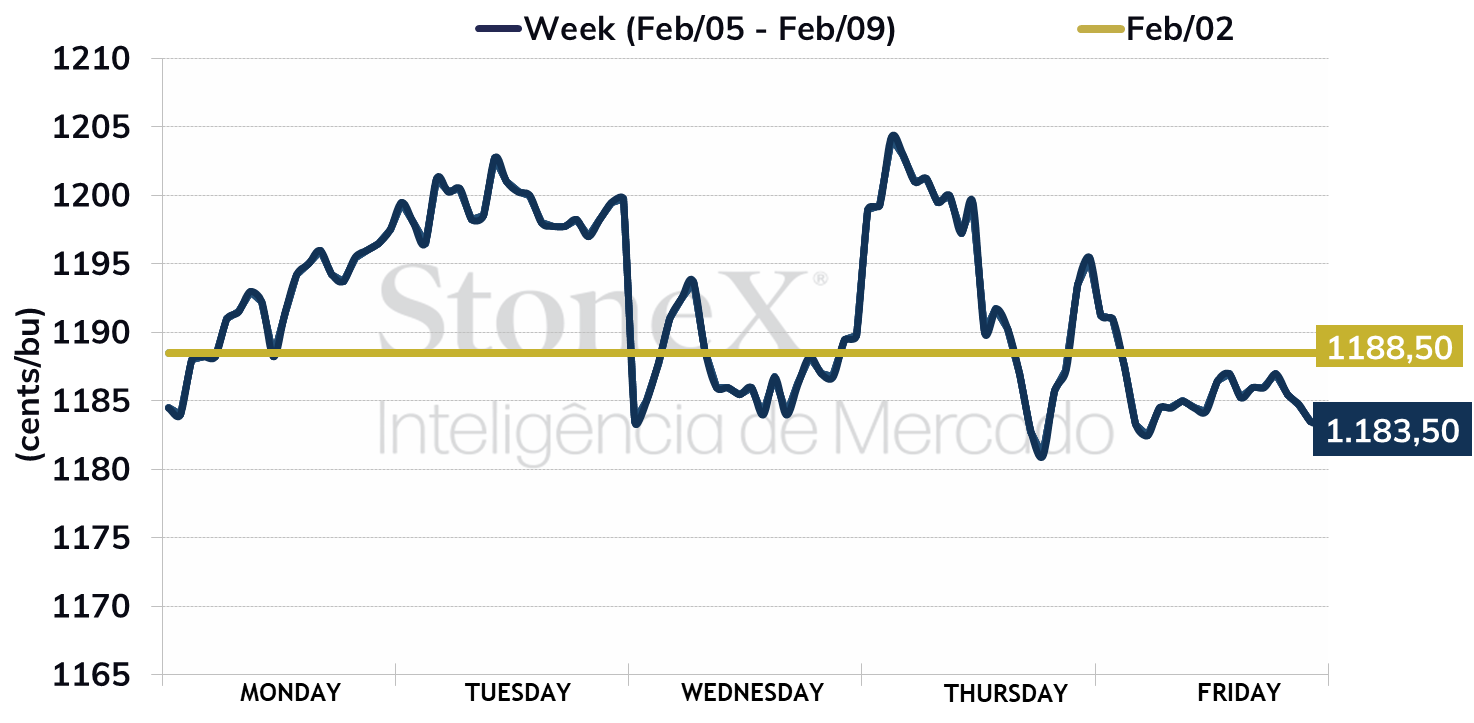
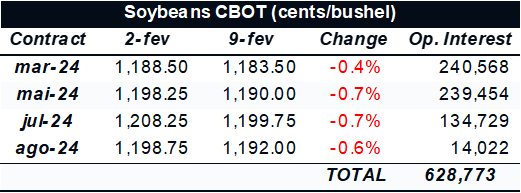
Soybean prices in Chicago ended the week close to stable, with the March contract closing Friday at 1183.5 cents/bushel, a weekly drop of 0.4%.
There were gains in some sessions, especially at the beginning of the week, but on Friday (09), the downward trend prevailed, giving back the previous gains. Following the warmer and drier weather in Argentina, especially in the north of the country, concerns about possible negative impacts have eased, with forecasts of more abundant and regular rainfall in the coming days. As a result, there was no change in the oilseed's global supply and demand scenario, with production estimated to be significantly higher than consumption.
The weather conditions in Argentina worsened in the week ending February 7, according to the Buenos Aires Exchange. The percentage of plants rated good/excellent fell from 36% to 31%, while 47% of crops are in fair condition and 22% in poor/very poor condition (previously 14% were in worse condition). As for the water conditions, 60% of the soils are rated as excellent or adequate, compared to 77% a week earlier.
Even with these worsening conditions, which should have some adverse impact on part of the crops, overall the outlook for production in the country remains positive. Although it is still hot, the forecast for the coming weeks has once again pointed to more rain, with precipitation being reported this past weekend.
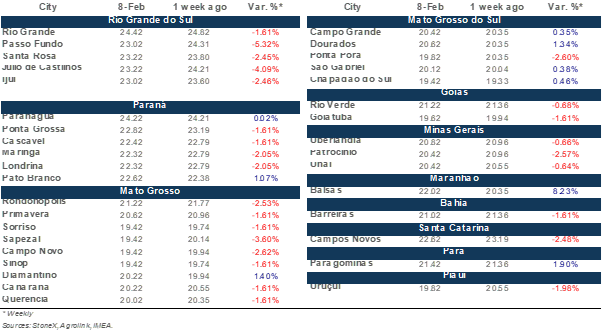
In Brazil, the harvest is underway, while the market monitors the size of the losses in the soybean crop. Estimates vary widely, with the latest figure from StoneX standing at 150.4 million tonnes. Conab released its survey last Thursday (08) and brought new cuts to the estimated production for the 23/24 cycle, due to the weather that affected productivity in several regions, with national production standing at 149.4 million tonnes.
Also noteworthy was the release of the USDA's supply and demand report, which was eagerly awaited in relation to Brazil's production figure. The Department cut Brazil's crop by just 1 million tonnes, to 156 million, which is well above other figures on the market. In addition, there was a revision of Brazil's 22/23 crop, with the USDA increasing production from 160 to 162 million tonnes.
For Argentina, the USDA left the figure unchanged, with 23/24 production estimated at 50 million tonnes.
As a result, the oilseed's global balance remained fairly loose, with production estimated to be around 15 million tonnes higher than consumption.
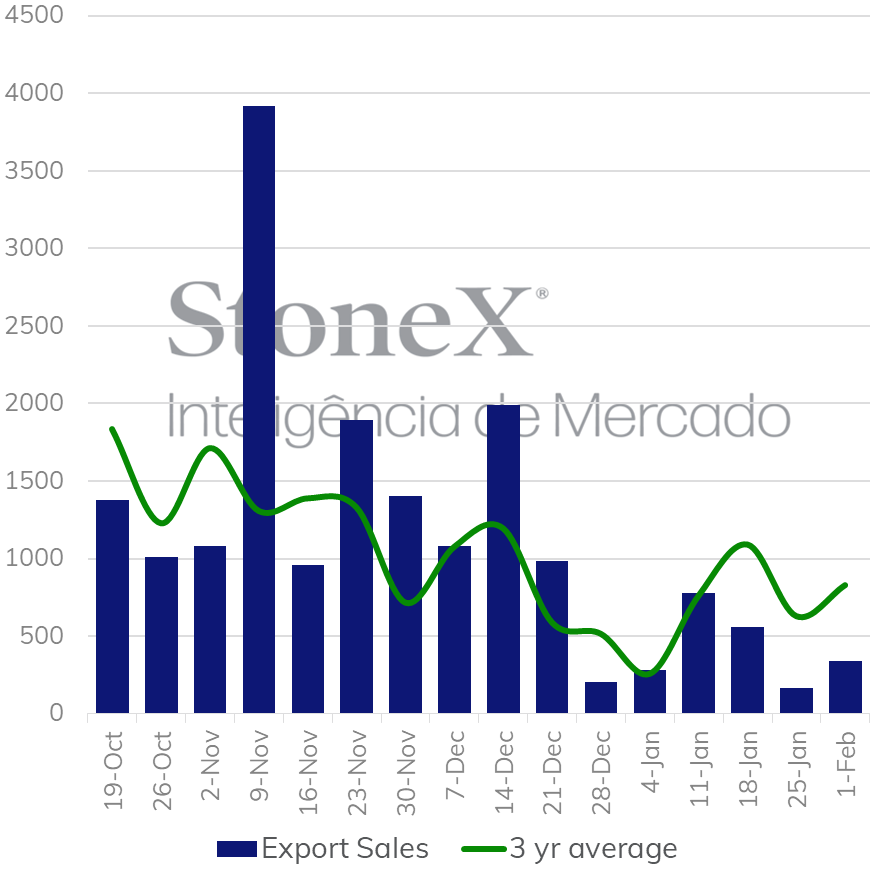
On the demand side, it is worth noting that the USDA reduced its estimate for US exports 23/24, from 47.76 to 46.81 million tonnes, since the weekly pace of sales has been weaker, with Brazilian soybeans being more competitive than US soybeans.
In the week ending February 1st, US export sales reached 340,800 tonnes, again below the minimum estimate, which ranged from 400,000 to 1 million. In total, 38.5 million tonnes were traded, compared to 47.5 million in the same period last year, with China being largely responsible for this difference, having purchased 8.3 million tonnes less than a year ago.
On Friday (9), the market was still absorbing the “disappointment” about the USDA figure for Brazil, which still estimates a crop of 156 million tonnes, the highest of the recently released numbers. Furthermore, the competitiveness of Brazilian soybeans continues to limit the search for the US oilseed, but the moment continues to be one of concerns on the demand side, with Chinese purchases at the center of attention.
This week, the weather in South America and the pace of US export sales should continue to be monitored. In addition to the improved in forecasts for Argentina, the coming weeks also indicate a favorable pattern of precipitation in Brazil, which should benefit regions that still need rain.