- Bearish factors
- World production above consumption in 24/25, according to the USDA;
- Concerns about the pace of global demand;
- Estimate of record production for the Brazilian 24/25 crop;
- Improvement of crop conditions in Argentina;
- China increases retaliatory tariffs against the US.
- Bullish factors
- New incentive measures adopted by the Chinese government;
- Estimate of decline in area in the 25/26 crop in the US;
- Loss of crop potential in Argentine;
- Possible increase in the biodiesel and renewable diesel mandate in the US;
- Possible relaxation/postponement of the taxation of Chinese ships in US ports.
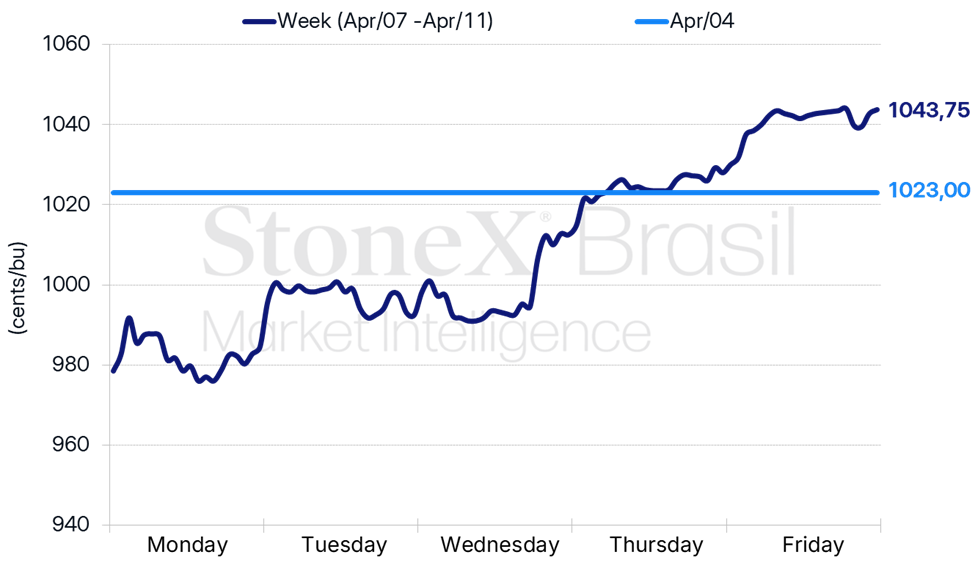
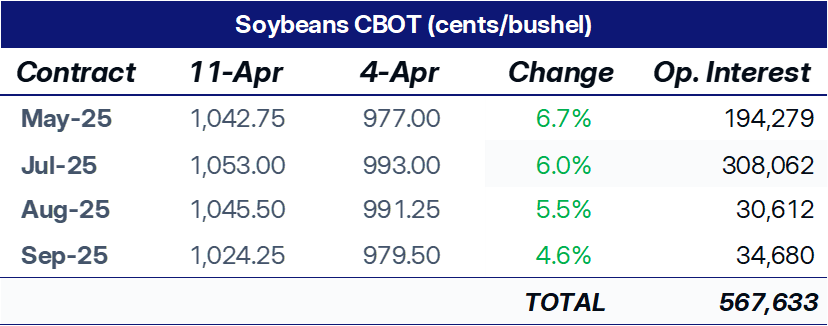
After being heavily pressured by the announcement of broad tariffs by the US and Chinese retaliation, soybean quotes saw a recovery last week in Chicago, with the May expiry closing on Friday (the 11th) at 1042.75 cents per bushel, a rise of 6.7% over the period.
The U.S. tariffs brought a lot of risk aversion to the commodities markets and, in the case of soybean, the Chinese retaliation was another pressure factor, since China is the largest importer of soybean and buys most of the oilseed from Brazil and the U.S. Furthermore, between 2018 and 2019, during Trump's first term, soybean on the CBOT was under significant pressure following Chinese tariffs and the decline in North American exports.
However, in the middle of last week, Trump announced that he would delay the imposition of tariffs for the countries that did not retaliate, which relieved the mood of the markets, with soybean and other riskier assets showing a recovery. Even so, in the case of China, as the country retaliated, the tariffs remain in effect and were increased, with the Chinese retaliation also indicating higher rates, which raises concern for the soybean market, since the American product completely loses competitiveness.
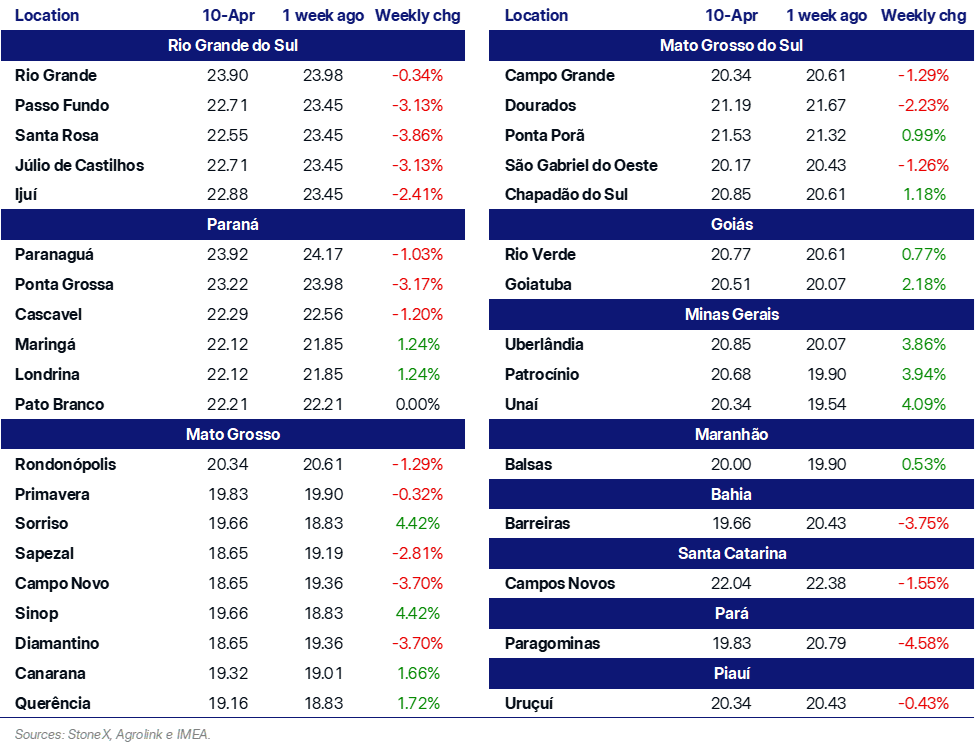
In this context, Brazilian exports of soybean are likely to be strengthened, as there are already rumors of very heated soybean purchases by China in the past week. But it is necessary to remember that the context is different from that observed in the Sino-American trade war that took place in 2018 and 2019. China has reduced its share of North American soybean in its imports and is concentrating more purchases in Brazil. In any case, since 2017, Brazilian exports of soybean have increased by more than 30 million tonnes, while Chinese imports have grown by about 10 million tonnes, with Brazil managing to supply larger quantities of soybean to China and the world in general. Furthermore, increased Chinese demand for Brazilian soybean tends to shift other buyers to the US, without a general decrease in Chinese soybean imports, as occurred between 2018 and 2019, due to the ASF outbreak, which decimated 40% of the country's herd. It is important to highlight that soybean prices in Chicago tend to be pressured downward in the context of a trade war between China and the USA, making the product more competitive for other destinations. In Brazil, basis tend to rise, reacting to higher demand from China.
Despite the dominance of news related to the trade war, it is also worth noting other factors. The USDA released its monthly supply and demand report. On the supply side, there were no major developments, with the production estimates for Brazil and Argentina in the 24/25 cycle being maintained without changes. As for demand, there were some adjustments, but they were small. Highlight for the increase in the US soybean crushing by 270 thousand tonnes, for a total of 65.86 million tonnes in the 24/25 crop. Internal consumption in the U.S. is on the radar, following discussions between producers and biofuels and fossil fuels in the U.S., with possibilities of significant growth in biodiesel and renewable diesel mandates in the country, encouraging crushing, since soybean oil is one of the main feedstocks used.
Last week, it was also reported that the U.S. is considering adjustments to its plans and imposing tarrifs to Chinese-constructed and flagged ships in U.S. ports. Currently, Chinese ships account for more than 50% of cargo transported worldwide, with U.S. shipyards accounting for just 0.01% of the global fleet. The intention would be to surchagge Chinese vessels to encourage shipbuilding in the USA, but the impacts could be enormous, with various sectors indicating that these charges could make the transportation of goods impossible.
US export sales in the week ended on 04/03 reached 172.3 thousand tonnes, a level in line with the usual for this time of year, with China accounting for 141 thousand tonnes. It is noteworthy that no cancellations have been reported from China since the escalation of the tariff war with the US. In total, U.S. soybean sales for the 24/25 crop are at 46.3 million tonnes, a volume that keeps the pace above what is needed to reach the USDA export estimate for the 24/25 cycle, at 49.67 million tonnes.
In Argentina, the Buenos Aires Grain Exchange reported that the soybean harvest began to accelerate, having reached 2.6% of the national area last Wednesday (9). Even so, it is noteworthy that there are delays of 8 p.p. compared to the same period last year. For now, the estimate of the country's production is maintained at 48.6 million e tonnes.
This week, attention should remain focused on the tensions between the US and China, beyond any measures by the US government that might have some impact on the soybean market, such as the issue of Chinese ships. Around here, the negotiations of Brazilian soybean will be even more in the spotlight at this moment of commercial tensions and strong exports from Brazil.