- Bearish factors
- World 2025/26 production still exceeding consumption, according to USDA
- Concerns about the pace of global demand
- Record-high forecast for Brazil’s 2024/25 crop
- Buenos Aires Exchange raises its estimate for Argentina’s harvest
- Accelerated planting in the U.S.
- Avian flu outbreaks in Brazil
- Bullish factors
- Projected drop in U.S. planted area for 2025/26
- EPA announces higher biodiesel and renewable diesel mandates in the U.S.
- Possible relaxation/postponement of tariffs on Chinese vessels at U.S. ports
- Progress in China–U.S. negotiations
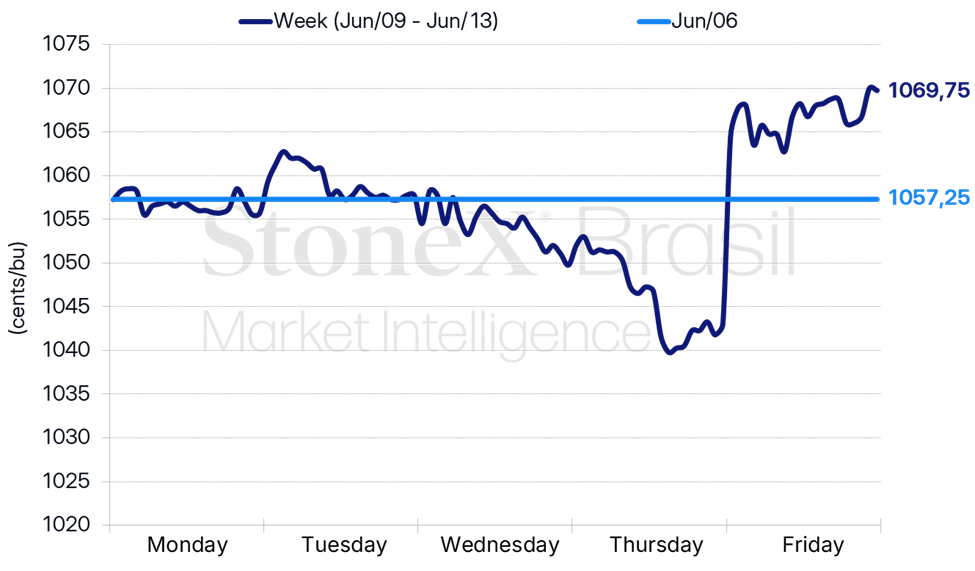
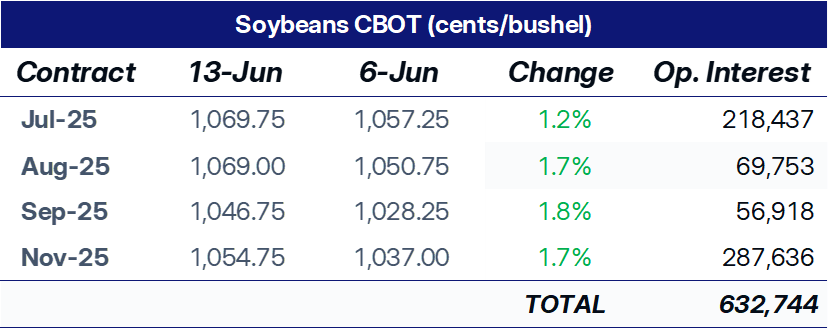
Last week, Chicago soybean futures traded near flat for most sessions, with a slight downward bias. But on Friday the release of U.S. biofuel mandates provided support, driving the July contract to close at 1,069.75 cents per bushel, up 1.2% on the week.
The market kicked off the second week of June on a more optimistic note amid China–U.S. trade talks. However, there were no significant new concessions for agribusiness, so soybean quotes remained largely unchanged. The deal under discussion was broad, touching on issues such as rare-earth minerals.
All eyes were on Friday’s announcement of the Renewable Volume Obligations (RVOs) for 2026 and 2027, which set required blending volumes of renewable fuels in the U.S. The Environmental Protection Agency (EPA) unveiled targets for D4 RINs (biodiesel and renewable diesel/HVO) that exceeded market expectations—5.61 billion gallons, 67.4% above the 2025 target and higher than the 5.25 billion gallons analysts had forecast.
A key proposal alters how RINs are generated for imported biofuels or those produced with foreign feedstocks: such fuels would earn only 50% of the RINs normally granted. In practice, one gallon of U.S.-produced HVO would still generate 1.6 RINs, but an imported or foreign-sourced gallon would yield just 0.8. This change favors domestic feedstocks like soybean oil—prior gains by alternative imported oils should give way, and soybean oil is poised to reclaim market share.
That development gave strong support to soybean oil and soybean futures. Still, the proposal remains subject to revision, and it will be crucial to monitor downstream effects—particularly U.S. exports—to see if the country’s supply-demand balance tightens further.
Regarding exports, U.S. sales in the week ending June 5 totaled 61.4 kt, pushing the 2024/25 season’s cumulative volume to 48.7 mmt—versus the USDA’s 50.35 mmt forecast. With the crop year closing in August, cancellations—common this late—should stay on traders’ radars.
In Brazil, first-week June exports just topped 3 mmt, lifting the January-to-date haul to 54.6 mmt. Port premiums have firmed, yet Brazilian soybean remains slightly more competitive than U.S. soybean for Asian buyers. After this year’s record harvest, shipments should stay robust in the coming months, and 2025 exports are also poised to set a new high.
On Thursday (12th), Conab raised its Brazil 2024/25 soybean output by over 1 mmt to 169.6 mmt, thanks to upward tweaks in yield that lifted the national average to 3.56 t/ha.
In Argentina, the Buenos Aires Exchange reports 93.2% of the 2024/25 crop harvested—2.8 p.p. behind last year—yet a strong average yield has beat initial estimates despite early drought and May’s heavy rains. Reflecting those solid results, the Exchange nudged its soybean forecast up from 50.0 mmt to 50.3 mmt.
The USDA’s June WASDE was neutral, leaving U.S. balances unchanged and Brazil/Argentina 2024/25 outputs at 169 mmt and 49 mmt, respectively—below Conab’s and the Exchange’s figures. It’s rare for USDA Brazil numbers to trail Conab’s, prompting speculation about a possible upward revision in future reports.
This week, markets will stay focused on any U.S.–China developments and progress in the U.S. 2025/26 soybean crop. As of Sunday (8th), planting was 90% complete—above both last year and the five-year average—and conditions improved slightly, with the good/excellent rating up to 68%. States like Ohio and Illinois lag the national good/excellent average but are balanced by stronger performances elsewhere.