- Bearish factors
- World production in 25/26 still surpassing consumption, according to the USDA;
- Concerns about the pace of global demand;
- Estimate of record production for the Brazilian 24/25 crop;
- Argentina ends 24/25 crop above 50 mmt;
- Good crop conditions in the U.S ;
- Favorable weather in the USA.
- Bullish factors
- Decline in area in the 25/26 crop in the US;
- EPA announces an increase in the biodiesel and renewable diesel mandate in the US;
- Approval of the 45Z credit in the US, which should foster soybean oil;
- Progress in negotiations between China and the US;
- Increase of the biodiesel-diesel blend in Brazil.
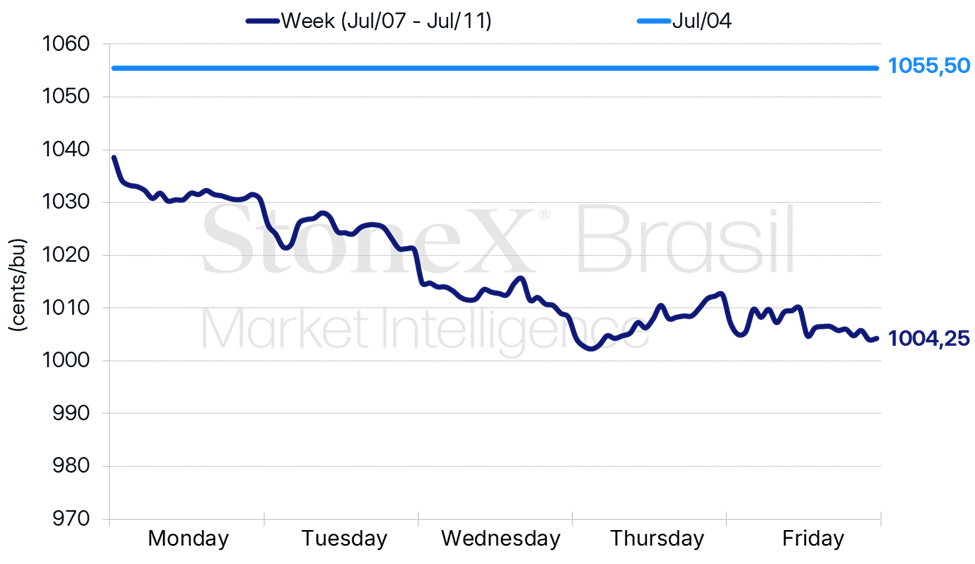
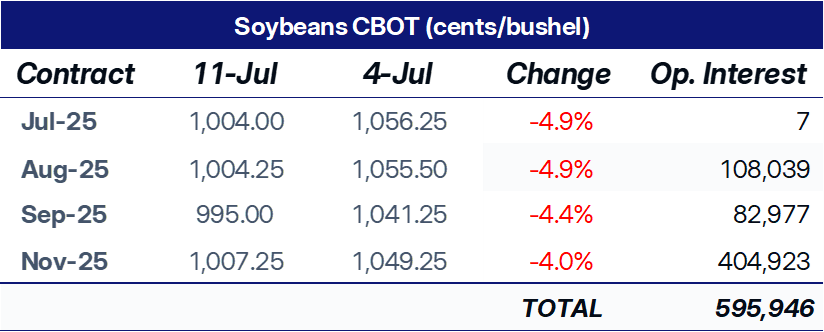
Soybean quotes in Chicago ended last week in negative territory, with the August expiry closing on Friday (the 11th) at 1004.25 cents per bushel, a drop of 4.9% for the period. The market continues monitoring the progress of the U.S. crop, in addition to the U.S. tariff policy. Furthermore, the monthly reports from the USDA and CONAB were released, with updates on crop outlooks.
The Trump administration is sending letters to several trade partners, with the announcement of tariffs, scheduled to take effect in August, including Brazil. This context has brought greater risk aversion to the market, which ends up weighing on commodities in general. However, the behavior of the agents is to wait, given the history of postponements and agreements, which has been occurring. In the specific case of the soybean market, no direct impacts are expected from the tensions between Brazil and the USA, since both countries are net exporters of the commodity. However, the behavior of the exchange rate is on the radar, since right after the announcement of the tariffs on Brazil, the real depreciated, which ends up being favorable for the competitiveness of Brazilian exports compared to American ones.
Regarding the supply and demand fundamentals in the oilseed market, there have been no significant changes, with the scenario indicating a global supply balance without restrictions remaining. The American crop is the main factor that can bring changes on the supply side currently, and conditions remain favorable. In the week ending July 6, the USDA indicated that 66% of the crops were in good/excellent condition, the same percentage as the week before. Even so, the humidity situation in some regions, such as parts of Illinois, is being monitored. It is also worth remembering that the month of August is considered decisive for the productivity of oilseed in the country, as it concentrates the grain filling phase, which requires a rainier climate.
The USDA monthly supply and demand report brought a marginal change in the US 25/26 production estimate, which went from 118.12 to 118 mmt, due to the small acreage adjustment after the data released at the end of June. Even so, there was an increase in the outlook for the country's ending stocks, which rose to 8.44 mmt, due to adjustments on the demand side. The Department cut the exports 25/26 by almost 2 mmt, reaching 47.49 mmt, which was not fully offset by the expected increase in crushing, to 69.13 mmt. The outlook is favorable for the internal processing of the oilseed, due to biofuel policies, with prospects for a considerable increase in mandates and favoring national feedstocks. With this, soybean oil tends to gain ground, encouraging the domestic consumption of soybean.
Regarding the Brazilian 24/25 crop, CONAB updated its monthly survey, showing a slight decrease in production, which went from 169.6 to 169.5 mmt. In any case, this number is a record for the country, being the result of good weather conditions in most of the producing area, with the exception of Rio Grande do Sul, and technological advances in the field.
With this record crop, Brazil should also export the largest volume of soybean in history. In the week ending July 4, soybean shipments reached 1.9 mmt, bringing the total since January to 66.9 million. In this context, it is noteworthy that Chinese imports of soybean remain strong, having reached 12.26 mmt in June, the highest level ever recorded for this month, representing a growth of 10.35% compared to June 2024. The country has been buying a lot of Brazilian soybean, taking advantage of the ample supply with the harvest of a record crop here, in addition to always being concerned about possible escalations in trade tensions with the US, which is the second-largest supplier of the oilseed. In the last quarter of the year, with the harvest of the American crop, the country's soybean has its best period of exports, becoming more competitive. However, if there is a context of taxation, the product may end up more expensive for China, even during this period. With this, the country may be taking precautions and seizing the opportunity to buy a lot from Brazil.
This week, in addition to the geopolitical context, the progress of the US crop should remain on the radar, with the rains that occurred this past weekend having been favorable for increasing moisture in parts of Iowa and Illinois. Some drier areas still remain in regions of the state of Illinois, North Dakota, Indiana, and Michigan. It should be noted that forecasts indicate more widespread rainfall in the Midwest of the country starting next weekend, which should improve humidity conditions.