- Bearish factors
- World production in 25/26 still exceeding consumption, according to the USDA;
- Concerns about the pace of global demand;
- StoneX estimates a record production for the Brazilian crop 25/26;
- StoneX estimates a crop above 120 mmt for the US;
- Good crop conditions in the USA;
- Favorable weather in the USA.
- Bullish factors
- Decrease in area in the 25/26 crop in the US;
- EPA announces increased mandate for biodiesel and renewable diesel in the US;
- Approval of the 45Z credit in the US, which should benefit soybean oil;
- Possible extension of the truce between China and the US;
- Trump says he would like China to buy more soybean from the US;
- Increase of the biodiesel-diesel blend in Brazil;
- Chinese soybean imports are heating up.
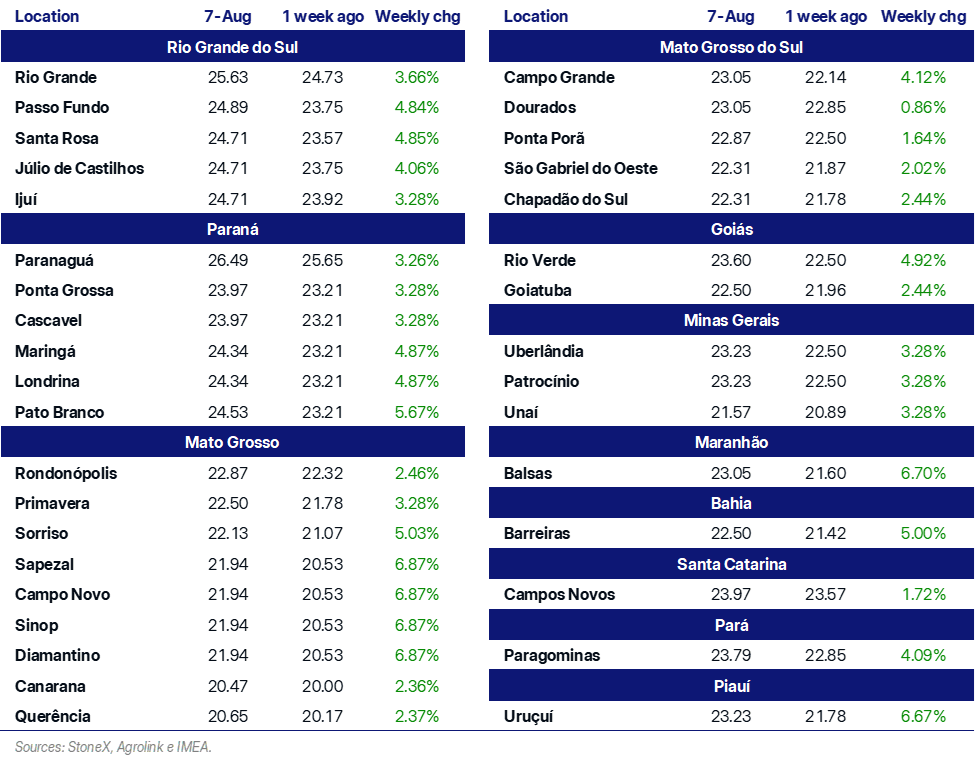
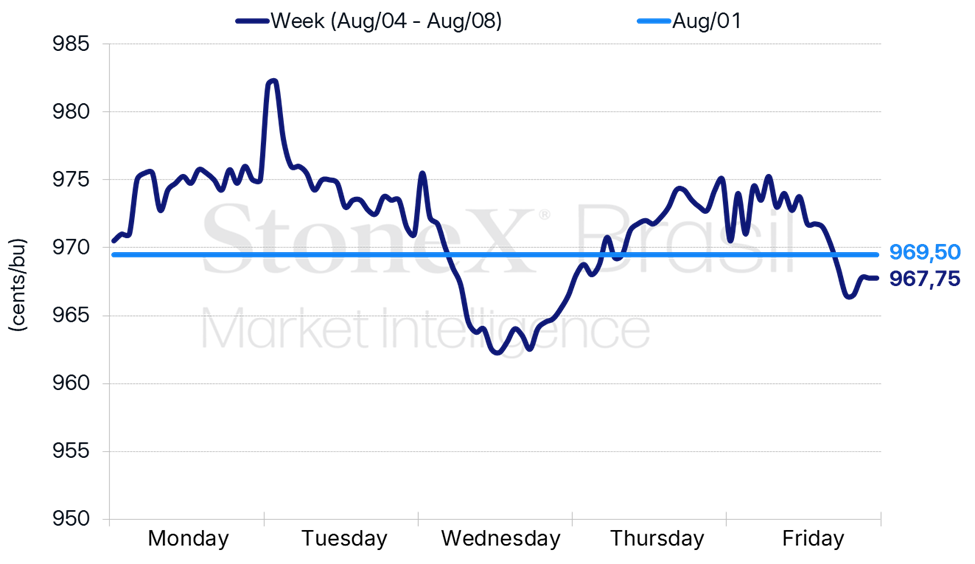
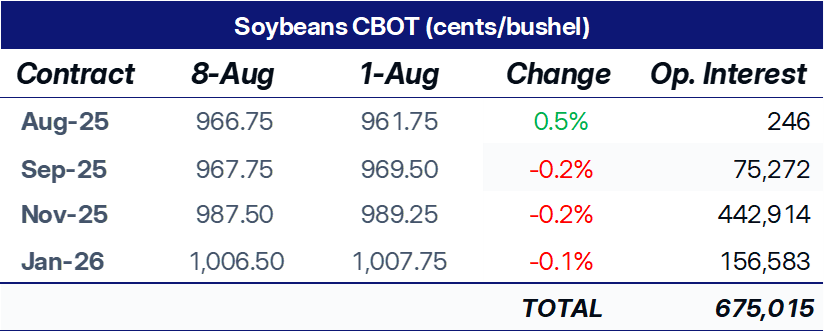
Soybean quotes in Chicago fluctuated around stability last week, remaining below USD 10.00 per bushel. The expiration for September closed Friday at 967.75 cents per bushel, a slight drop of 0.2%. It is noteworthy that a post by Donald Trump, indicating that he would like China to quadruple its purchases of soybean from the US, is providing support to prices at the beginning of this week.
The good progress of the US crop continued to fuel the outlook for a comfortable supply. The G/E percentage of the country's crops stood at 69% on August 3, a drop of 1 p.p. versus a week earlier, but higher than the five-year average and what was recorded in the same period in 2024. With the beginning of August, the correlation between crop conditions and productivity gains relevance and these percentages are considered very favorable. The weather in the coming weeks will be closely monitored, with the grain filling phase underway. Forecasts indicating heavy rains in part of the producing region of the country are on the radar.
StoneX in the US released its yield survey for the 25/26 US crop last week, with the national average estimated at 3.6 tonnes per hectare, which would bring production to 120.43 mmt. This result was above the latest USDA figure, at 118 mmt, considering a yield in the historical trend, at 3.53 tonnes per hectare. This higher production feeds the possibility of a looser balance in the US, even with the good prospects for crushing, given the biofuel policies. The estimates for the country's soybean exports are lower, but the market is monitoring the situation of a possible agreement with China.
In Brazil, soybean exports in July totaled 12.26 mmt, a level above that reached in the same month last year, when they stood at 11.25 mmt. Since January, 77.2 mmt of soybean have been shipped. It is noteworthy that the Chinese demand for the oilseed is strong, and Brazil is the main source of the soybean imported by the country, with this year's record production scenario here favoring this configuration. In July, China's total soybean imports reached 11.67 mmt, a record level for the said month, surpassing the market expectation, which was around 10.5 mmt.
After Brazil, the US is the second largest exporter of soybean to China, but in significantly smaller volumes than those shipped from Brazil. It is also highlighted that the volumes of soybean from the USA exported to China have been decreasing over the years, due to trade tensions between the two countries and with Brazil increasingly expanding its soybean production. In 2024, while Brazil exported 72.5 mmt of soybean to China, U.S. shipments to the country were 27 million. In 2023, when Brazil had harvested a record crop, the exports to China were even greater, reaching 74.5 mmt, compared to 26.4 mmt from the USA. In 2025, with the renewal of the Brazilian soybean production record, this trend may intensify. In the first seven months of this year, Brazil shipped 58 mmt of soybean to China, compared to 55.2 mmt in the same period of 2024.
Even with Brazil's dominance, the market is watching for a possible agreement between the US and China, which could include purchases of larger volumes of US soybean. Trump's statement on a social network that he would like China to quadruple its imports of soybean from the U.S. provides important support to the oilseed prices at the start of this week. This post comes at a time when the truce between China and the US is ending (end scheduled for tomorrow 12).
Despite the immediate reaction in prices, it is important to remember that no official agreement has been announced and that during Trump's first term, China did not meet the agreed volumes of purchases of American agricultural products. China continues buying a lot of soybean from Brazil, with rumors of 28 ships booked last week, in addition to the record of meal purchases from Argentina. In the case of direct meal purchase, this is a less common situation, which should not be sustained, as the country focuses on importing the grain and grinding it internally, especially given the prospects of a large supply around the world.
Thus, the situation between the US and China and a possible agreement will need to be monitored, as nothing has been defined yet. In any case, these speculations should continue to permeate the negotiations this week, not forgetting the release of the USDA's monthly report tomorrow (12), which may bring adjustments to the productivity of American soybean.