- Bearish factors
- World production in 25/26 still exceeding consumption, according to the USDA;
- Concerns about the pace of global demand;
- StoneX estimates a record production for the Brazilian crop 25/26;
- StoneX estimates a crop above 120 mmt for the US;
- Good crop conditions in the USA;
- Favorable weather in the USA;
- USDA estimates record productivity for the US.
- Bullish factors
- Revision of the crop area for the 25/26 season in the US, with a decrease of 1 million hectares;
- EPA announces increased mandate for biodiesel and renewable diesel in the US;
- Approval of the 45Z credit in the US, which should benefit soybean oil;
- Large refineries in the US will be able to absorb exemptions from small ones;
- Trump says he would like China to buy more soybean from the US;
- Increase of the biodiesel-diesel blend in Brazil;
- Chinese soybean imports are heating up.
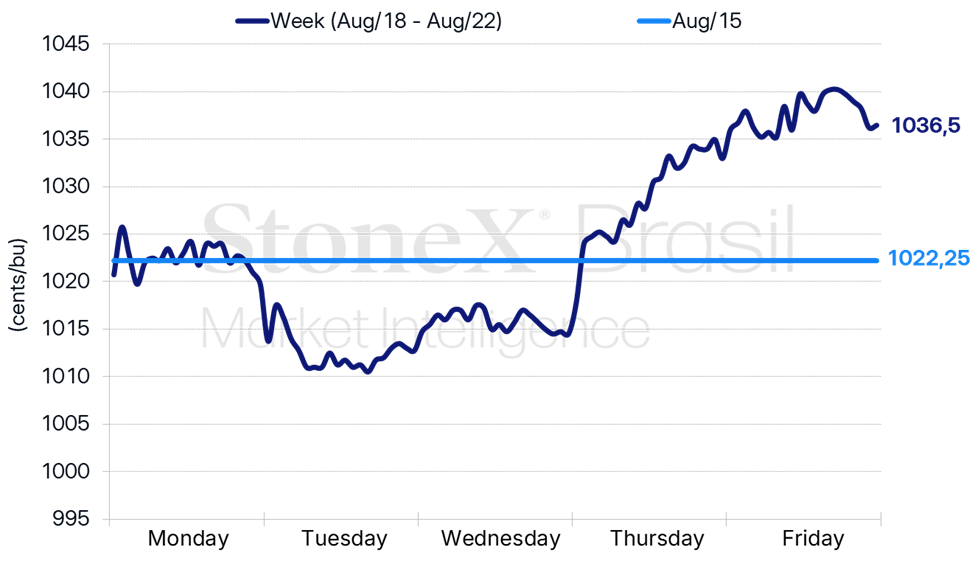
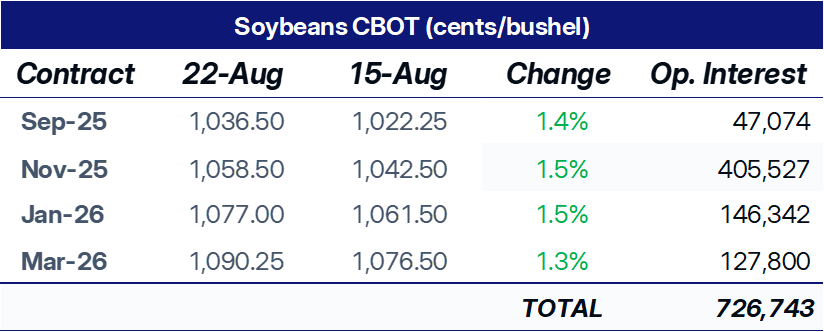
Soybean quotes had another week of gains in Chicago, with the September contract ending Friday (22) at 1036.5 cents per bushel, up 1.4% in the period. The market continued to monitor the progress of the U.S. crop, the tariff issue, as well as the country's biofuel policy.
On the supply side, the US 25/26 crop continues to show signs of robust production, possibly with record yields. Both USDA and StoneX estimate the national trend yield at 3.6 tonnes per hectare. Last week, the famous Pro Farmer Crop Tour was conducted through the main producing states of the Midwest, with the final result indicating an average yield for the country of 3.56 tonnes per hectare. With this yield, the expected production was calculated at 115.56 mmt, highlighting that Pro Farmer considers other information beyond what is collected in the field, such as the crop stage, area adjustments, and historical differences of the tour data versus the USDA. The country's crop conditions remained stable in the week ending August 17, with the G/E percentage at 68%, the same level as last year and above the five-year average for the period, at 62%.
Regarding the demand for U.S. soybean, the progress of export sales is being closely monitored, especially negotiations for the 25/26 crop, which are the lowest in the last five years, with China not having sourced soybean from the U.S. new crop. This scenario raises concern, as the best shipping period for the U.S. is the fourth quarter of the year, right after the harvest and before the entry of a new crop in Brazil.
China has taken advantage of the supply of Brazilian soybean in 2025, with the harvest of a record crop here to secure large volumes of the oilseed, as the country’s monthly imports are on the rise. As a result, the country tends to reduce its needs for American soybean, even at the peak of U.S. exports. At the same time, Brazilian exports have remained strong, with 5.2 mmt shipped in August, up to Augysr 18, bringing the total since January to 82.4 million tonnes.
On the other hand, domestic consumption in the US, with biofuel policies, continues to be the main support factor for soybean oil and also for the country's soybean. On Friday (the 22nd), the Environmental Protection Agency (EPA) announced exemptions for small refineries, equivalent to 5.34 billion RINs, which was considered bearish. It was also announced that RINs prior to 2023 would expire, and could not be used to fulfill mandates. On the other hand, there was an additional proposal, which is still subject to discussions, that the obligations of small refineries would be transferred to large refineries, which if confirmed, would be positive for the consumption of renewable raw materials, including soybean oil.
Regarding Argentina, it is noteworthy that the shipment of soybean meal, totaling 30 thousand tonnes, sold by the country to China had its destination changed to Vietnam, citing “commercial reasons” due to concerns about the product’s quality. This would be the first shipment of soybean meal from Argentina to China since the Asian country approved the Argentine product in 2019.
The prospects for the 25/26 crop in South America are already on the radar. Sowing in Brazil can begin as early as the beginning of September in Mato Grosso, while in Argentina, sowing takes place later, starting in the second half of October. In any case, weather conditions are monitory, with producing regions of Argentina having recorded atypical rainfall in July and August, which tends to favor soil moisture.
In Brazil, weather forecasts indicate the return of rain in September, which, if confirmed, tends to be positive for the progress of soybean sowing, also favoring the window for second crop fields. Last year, there were delays in the start of the sowing due to the historic drought and delay in the return of rainfall. Thus, if the weather is already rainier starting in September, there could be soybean from the new crop available between the end of December and the beginning of January, which is another point to monitor regarding U.S. exports, as their best window would be reduced by the "early" entry of the Brazilian product.