• Arabica coffee rose 13% in 2023 to 188.30 c/lb
• Robusta coffee prices up 58% year-on-year
• Cepea indicator for Arabica coffee down 3%
• Cepea indicator for Robusta coffee up 9% in 2023
• Dollar fell 8% in the period
• Weather and certified stocks supported prices
• Robusta coffee exports rose sharply in 2023
• Imports fell sharply in the US and Europe
• NOAA: La Niña likely to return from August/September/October quarter onwards
• Fed's monetary policy continues to have a strong influence on the dollar
• Expectations of higher interest rate differentials between Brazil and the US tend to favor the Brazilian currency (BRL)
• US Consumer Price Index (CPI) release likely to influence global markets in the week
With volatility, coffee futures prices ended 2023 with significant gains, especially Robusta coffee prices in London. In New York, Arabica futures rose by 13% year-on-year, closing the year quoted at 188.30 c/lb. In London, futures prices for Robusta rose even more sharply, with futures prices rising by almost 58%, closing the year quoted at USD 2,841/t. On the Brazilian market, prices ended the period with mixed results, with the indicator for Arabica showing a slight decline while the indicator for Robusta coffee moved up.
Robusta coffee futures were supported for most of the year, while Arabica futures were under pressure, especially between June and September, due to the harvest of the Brazilian coffee crop. In the first half of the year, Arabica coffee prices fell by 4%, and in the third quarter futures prices fell by a further 8%, closing the first three quarters of the year with a 13% drop. In the last quarter of the year, Arabica futures recovered almost 29%, reflecting the bullish scenario on the Robusta market in London, the occurrence of heat waves, below-average rainfall in Brazil and the sharp drop in certified stocks, which reached the lowest volume since the 90s.
Arabica and Robusta coffee futures prices
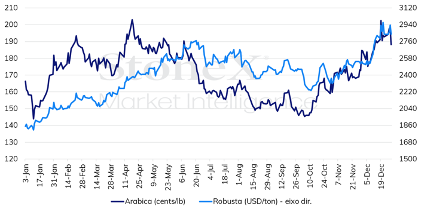
As mentioned above, Robusta futures had bullish fundamentals throughout most of the year. In the first half of the year, the low level of carryover stocks in Vietnam and an intense drop in production in Indonesia - the USDA reported in June that production in the country would fall by more than 2 million bags (18%) due to the negative impacts of La Niña - supported futures in London, which rose 41% in the first half of the year. At the end of the second half, prices began to rise again due to concerns about the impact of El Niño on Robusta production in the main origins: Vietnam, Brazil, and Indonesia. The main producing regions in these countries faced periods of high temperatures and below-average rainfall. In addition, certified stocks of Robusta coffee fell by 495,000 bags (46.2%) to 576,000 bags in 2023. In December, the USDA reduced its projection for Vietnam's 23/25 crop by 3.8 million bags to 27.5 million bags.
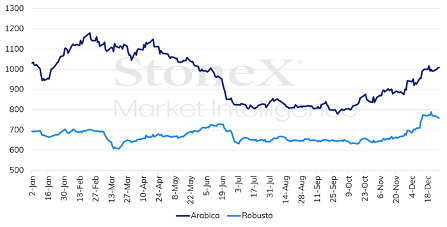
In Brazil, coffee prices ended the year with mixed results. According to Cepea data, the indicator for Arabica coffee fell by 3% over the year, closing the period at BRL 1009.47/bag. On the other hand, the indicator for Robusta coffee rose 9% to BRL 759.05/bag. Despite the advance in prices abroad, the Brazilian domestic market reflected the sharp drop in the dollar over the period, which fell 8% year-on-year to USDBRL 4.85. In addition, arabica coffee prices were pressured mainly by the higher supply due to the 2023 crop, which was not a record, but was larger than in 2022. For Robusta, prices did not increase as much due to the better supply of Arabica, which eased the supply condition for the industry, which had placed Robusta prices at high premiums in the Brazilian market due to the limited supply and high prices of Arabica coffee in the previous year and in the first months of 2023.
Coffee prices on the Brazilian domestic market (BRL/bag)
Looking specifically at the last few weeks of 2023, coffee futures prices showed a significant gain due to the low level of certified stocks, which fell by 563,000 bags (69%) to 251,000 bags for the year, and, above all, the weather conditions in Brazil. A sequence of heatwaves and below-average rainfall in October, November and the first half of December put the market on alert as the crops were and still are going through critical stages of development for the 2024/25 crop.
Certified stocks of Arabica coffee (million bags)
Regarding the weather, it is worth noting that this possible impact of El Niño on Brazilian crops and the possible market reaction had already been anticipated months earlier in some special articles and in various weekly reports published by StoneX. On April 24, 2023, StoneX published the article “El Niño and its possible impact on world coffee production” and on May 23, 2023, the article “How would its occurrence affect agricultural commodities?”.
Coffee demand has been one of the most discussed issues over the last year. Although there is no official data on the pace of consumption in the countries throughout the year, some indicators point to a potentially weakened consumption. This was the case with data on coffee imports in the US and Europe. According to the USDA, the US imported 17.28 million bags between January and October 2023, which represents a drop of 15.2% over the same period in 2022.
US and EU coffee imports (million bags)
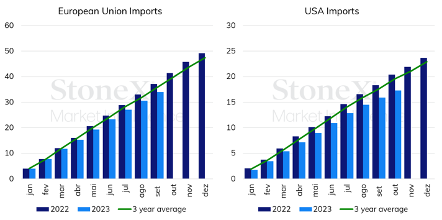
In Europe, Eurostat data indicates that imports into the European Union fell by 8.5% in the year to September, to 34 million bags. In addition to imports, the financial results of some companies linked to the sector indicated a drop in the volume of coffee sold, especially in the US. This condition is associated with the inflation of coffee prices on the shelves in recent years.
Regarding Brazilian exports in 2023, although the December export balance has not yet been released at the time of writing this report, we will analyze Cecafé data up to the month of November and preliminary data from the Secretariat of Foreign Trade (Secex) for the month of December. When we look at Brazil's coffee exports in 2023, it becomes clear how big a role Brazilian Robusta coffee will play in 2023. According to Cecafé data, between January and November 2023, Brazilian Arabica coffee exports totaled 27.5 million bags, which represents a decrease of 12% compared to the same period in 2022.
Brazilian Arabica and Robusta coffee exports (million bags)
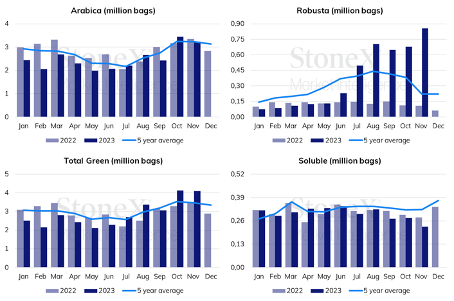
On the other hand, exports of Robusta coffee totaled 4.137 million bags in the period, which represents an increase of 186% compared to the same period last year. A total of 31.64 million bags of raw coffee were exported in the period, indicating a 3.3% drop in exports. For processed coffee, the drop was 2.6% to 3.357 million bags, with losses for both soluble coffee and roasted and ground coffee. For December, official data from Cecafé is not yet available, but preliminary data from Secex points to a 34% increase in exports for the month, to a total of 4.059 million bags. If we add up Secex's export data for December with Cecafé's data, Brazil would have exported 35.7 million bags of raw coffee in 2023, a volume almost unchanged compared to the total exported in 2022.
In 2024, volatility will continue to be one of the main characteristics of coffee price movements. Several factors could impact prices over the coming months, such as expectations for production in Brazil, the weather and certified stocks, among others. About the supply and demand (S&D) balance, in general, the expectation is that 2024/25 will be a year with a less tight S&D balance than in previous years. Taking the USDA as a reference, for 2022/23 the agency indicated a deficit of 4.5 million bags. In 2023/24, the USDA projected a surplus of 4.1 million bags, but adjusted this balance to 1.9 million bags in December. Although there is no official USDA outlook for 2024/25, which will only be released in June, the market expects the balance to be looser due to higher production in Brazil.
However, this optimism about the Brazilian crop may be boosted or challenged by coffee market participants. As is widely known, projections for Brazilian coffee production are characterized by a large discrepancy between estimates and a lack of transparency. In 2023, the difference between the highest and lowest estimates exceeded 20 million bags and in 2024 this scenario is likely to be repeated. Some agents have already published their expectations of over 70 and 75 million bags, while Conab will most likely publish a much lower figure. As a result, one of the focuses of market participants will be to monitor the release of projections. In the coming weeks, several agents are expected to release their crop projections. After carrying out a crop tour, visiting more than 100 producing cities in Brazil, StoneX will release its official projection for the 2024/25 crop in mid-February.
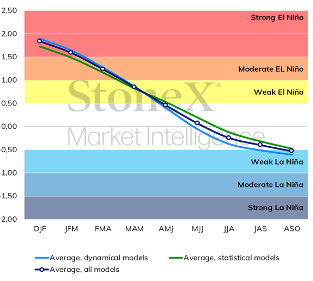
In addition to the projection for Brazil, the weather will continue to be a key factor in coffee price movements. As noted, part of the price increase in 2023 was due to the adverse weather conditions caused by El Niño. Despite the return of rains in recent weeks and the forecast of substantial volumes in the coming weeks, we are still under the effect of El Niño until the March/April/May quarter. In addition, according to the US agency NOAA, there is a high probability that La Niña will return from the August/September/October quarter onwards, which could cause major problems for coffee growing.
Probabilistic El Niño/La Niña forecasts
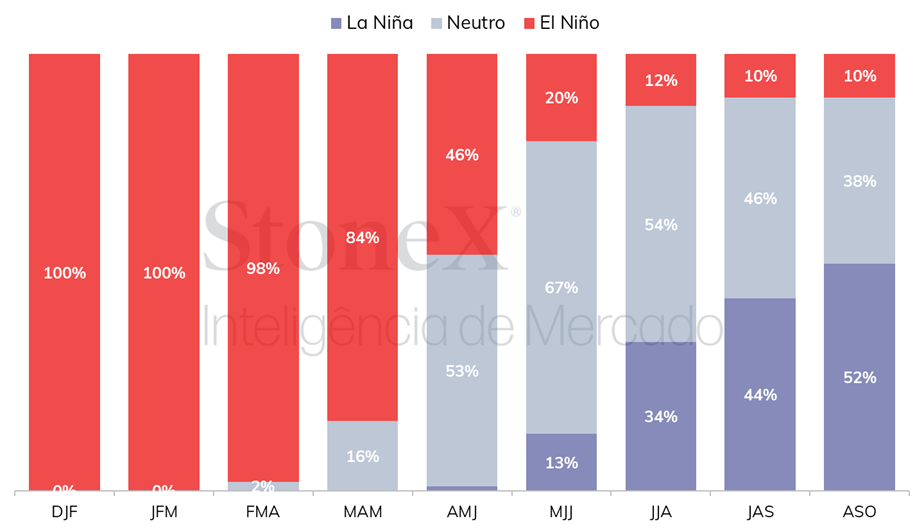
In Brazil, La Niña is associated with delayed rainfall in the coffee belt, a condition that occurred in 2020 and 2021, severely impacting the flowering of Arabica coffee. Worldwide, La Niña is associated with excess rainfall in Colombia and Central America. In Asia, La Niña has caused several problems due to excess rainfall and caused 18% losses in production in Indonesia in 2023. It is therefore crucial to monitor updates to forecast models.
Projected change in the surface temperature of the Pacific Ocean (in ºC)
In 2023, the sharp drop in certified stocks was one of the major factors behind the rise in prices. In 2024, the maintenance of stocks at lower levels tends to support prices, but a possible increase could put pressure on future coffee prices. Certified coffee stocks are associated with price differentials in origins, and weakened differentials tend to favor the certification of new coffees on the exchange.
If this trend continues and differentials fall below the parity level, there could be an increase in certified stocks of coffee from these countries. On the other hand, the stock exchange's new rule prohibiting coffee recertification could help keep stocks at current levels.
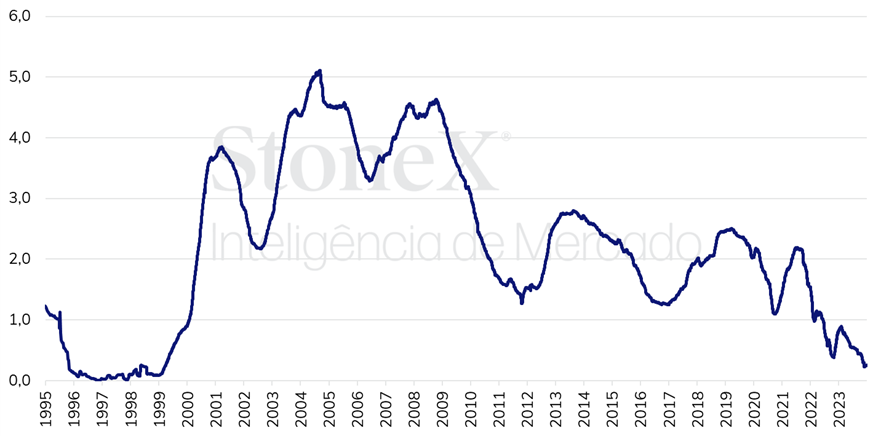
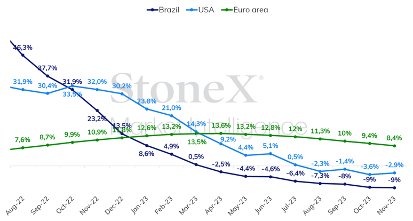
Therefore, the fundamentals for the coffee market remain mixed for the two varieties. While Arabica coffee would have a better supply due to Brazilian production, a condition that still depends on the weather, the balance remains tight for Robusta coffee, even if Brazil has a large production for the type. This condition reflects the problem of Robusta coffee production in Asia, both in Vietnam and Indonesia. In addition, the greater use of Robusta coffee by the industry has contributed to this scenario, which has been characterized by limited supply and heated demand for the variety. Finally, monitoring demand indicators, such as import data and companies' financial results, could indicate a new trend in consumption, which could recover as price inflation recedes.
Coffee price inflation (%)
For much of December, the Brazilian currency market has been influenced mainly by external factors, a trend that extends into early 2024. Discussions about the pace of the slowdown in the US economy and at what point in the year the Federal Reserve will begin to reduce the basic US interest rate have had a major impact on the currency markets.
Generally speaking, the release of data in recent weeks that supports the view that inflation and labor market growth in the US are slowing down helps to support the view held by some members of the Fed that the country's interest rate has remained at a restrictive level for long enough and may begin to ease. The decrease in US interest rates tends to elevate the differential between the expected yields on Brazilian and US assets, which is positive for the Brazilian currency. In addition, this scenario also favors risk assets, such as commodities, which could benefit coffee prices.
On the other hand, some releases on the US economy still suggest a strong economy, such as the December labor market data published last Friday (5), which showed a net creation of 216,000 new jobs in the country against estimates of 170,000. In this context, while a week ago CME FedWatch indicated that there was an 88.5% probability that the Federal Open Market Committee (FOMC) would start cutting the base rate at its March meeting, last Friday this likelihood was 68.3%. As such, the Consumer Inflation Index (CPI) for December in the United States, which will be released next Thursday (11) by the Bureau of Labor Statistics (BLS), is the most eagerly awaited indicator for the week, with its result likely influencing expectations for US monetary policy. The median of projections points to a monthly increase of 0.2%, a slight acceleration in relation to the 0.1% increase registered in November and the highest level since September, when it was 0.4%.