Impacts of Frost on Coffee Production in the Cerrado Mineiro
Translation generated by AI
Last week, some regions, mainly in the Cerrado Mineiro, were impacted by the occurrence of frost that had not been adequately anticipated by predictive climate models, whether American, European, or those used in Brazil, such as those of the National Institute for Space Research (INPE) and INMET. For Patrocínio, the most affected area, forecasts indicated minimum temperatures between 7 and 8 degrees Celsius on the 11th. However, despite not being forecast, frost did occur, negatively affecting the development of coffee plantations and reducing the productive potential of the 2026/27 crop. Reflecting this scenario, in addition to other factors influencing the market but with a strong weight from frost, prices in New York rose by 3,175 points last week, closing on Friday at US¢ 334.20 per pound, an increase of more than 10%. In London, prices also rose, with an increase of USD 557 per metric ton, closing the week at USD 4,067 per ton, equivalent to nearly 16% growth over the period.
At the current stage of Brazilian crops, data from StoneX indicate that as of August 18, 96.3% of the harvest had been completed. The robusta harvest is fully finished, while arabica reached 93.8%. The most delayed areas are in southern Minas Gerais and the Cerrado Mineiro, where 91% of the crop has been harvested. From this point onward, weather conditions become decisive in defining the potential of the harvest, especially the regularity of rainfall. In some robusta areas, flowering has already begun, while in arabica it is about to start. In this context, frost represented an unexpected event, causing significant losses in some parts of the Cerrado Mineiro.
Harvest pace in Brazil
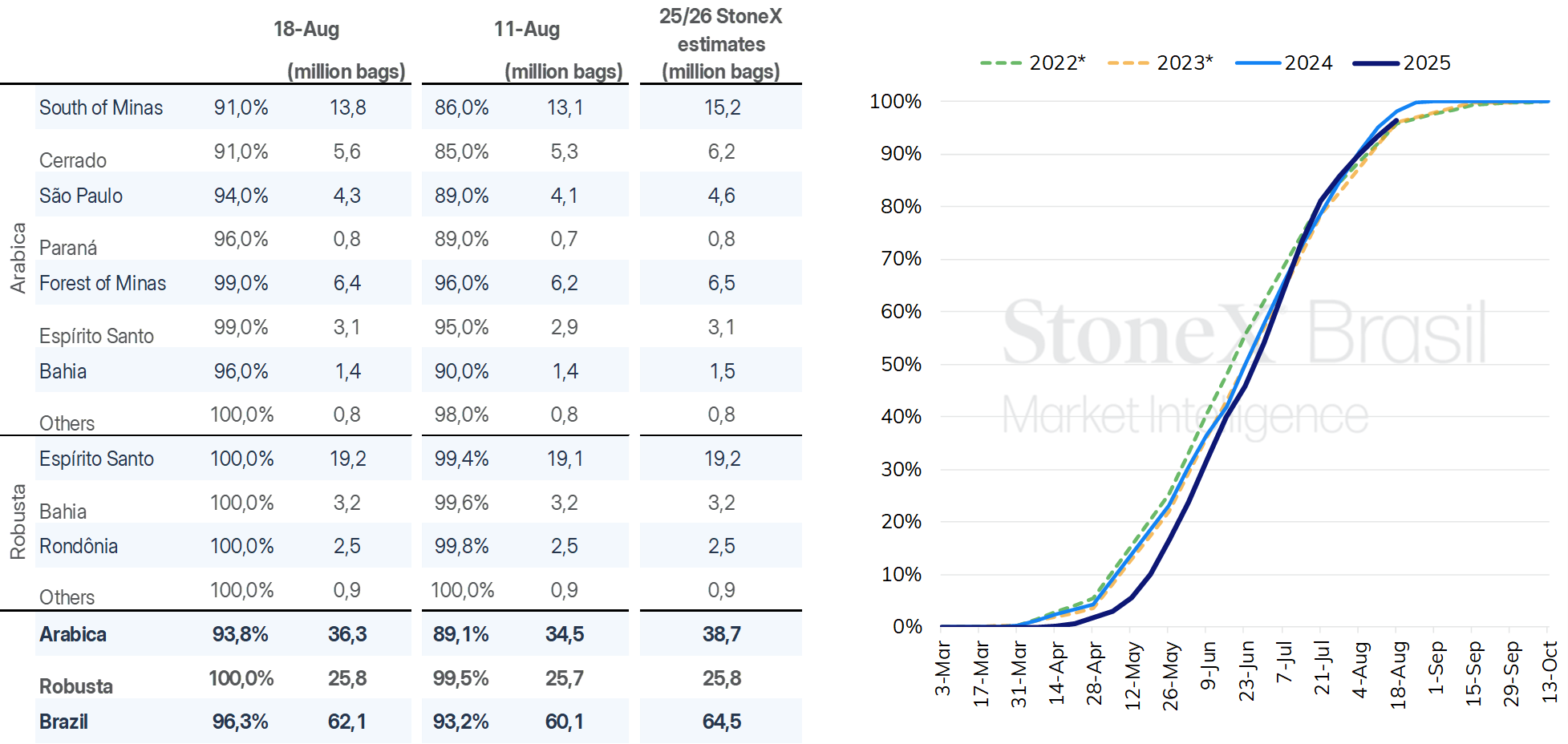
Source: StoneX.
Extreme weather events can be defined as meteorological values that deviate significantly from the expected average. Climate change has intensified the frequency and unpredictability of such phenomena, while concentrating their effects in specific areas. This has resulted in significant economic, ecological, and productive losses, particularly in the most vulnerable regions. This phenomenon was observed in the minimum temperatures recorded on August 11 and 12, 2025, which were approximately 5 degrees below the climatological average for the month in the coffee-producing areas of the Cerrado. Meteorological maps clearly show the extent and locations most affected.
In the state of Minas Gerais, several municipalities in the Cerrado recorded minimum temperatures below 4 °C. Among the most affected were Patrocínio, Perdizes, Ibiá, Serra do Salitre, Araxá, Medeiros, Pratinha, Campos Altos, and Córrego da Anta. Records were also observed in Bambuí, São Roque de Minas, Piumhi, Ilicínea, Nova Resende, Bom Jesus da Penha, as well as specific localities of Passos and Fortaleza de Minas. In the southern part of the state, the lowest temperatures were recorded in Poços de Caldas, Caldas, Ibitiúra de Minas, and Andradas.
Minimum temperatures according to climatology for August (A) and values recorded on the 11th (B) and 12th (C)
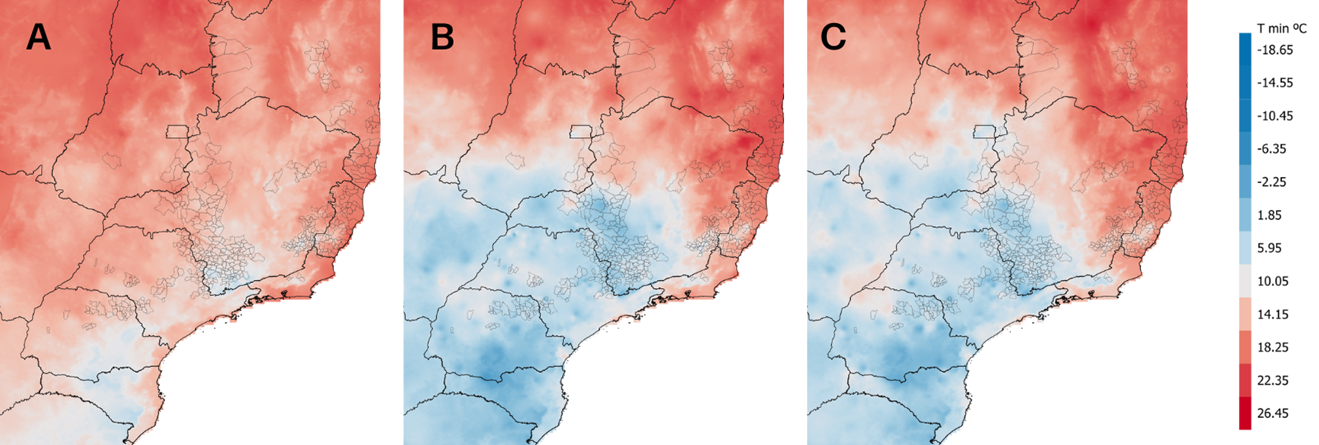
Source: INPE and StoneX. Prepared by: StoneX.
After the event, StoneX conducted a survey to assess the damage to coffee crops and estimate losses. In 2021, a severe frost hit large producing areas in southern Minas Gerais, São Paulo, Paraná, and the Cerrado. In 2025, although frost occurred again, significant losses were restricted to the Cerrado Mineiro. The affected area was smaller and, in general, damages were less severe than those recorded four years earlier. In most of the impacted areas, the frost caused moderate damage, affecting the upper third of the plants, a phenomenon known as “capote frost.” However, in places with topography favorable to frost formation or naturally colder conditions, severe damage was observed.
Frost was identified in municipalities such as Patrocínio, Ibiá, Araxá, Serra do Salitre, Guimarânia, Perdizes, Campos Altos, Monte Carmelo, Romaria, and Indianópolis. Among them, Patrocínio and Ibiá stood out as the most impacted, showing the greatest number of frost points and more severe damage. In these locations, some areas were affected again, partially repeating the 2021 scenario. In the rural neighborhoods of Esmeril and Abacaxi, for example, the extent of the affected areas was similar to that recorded in that year.
StoneX estimates that frost losses in the Cerrado Mineiro amount to 424 thousand bags, equivalent to 3.86% of the region’s total area. This number, however, could increase if floral buds exposed to the cold undergo abortion, even in areas without direct physical damage. The experience of 2022 showed that the effects of the 2021 frost were not limited to the immediate aftermath of the event. The intense cold of 2021 caused severe flower abortion, including in areas not directly hit by frost, significantly reducing the productive potential of the 2022 crop. This time, the cold was less intense and more localized, but there is still a risk of recurrence, since flower buds are more developed and vulnerable.
Monitoring flowering will be essential in the coming days. If rainfall occurs, flowering is likely to advance, making it even more necessary to closely follow developments to assess possible additional impacts.
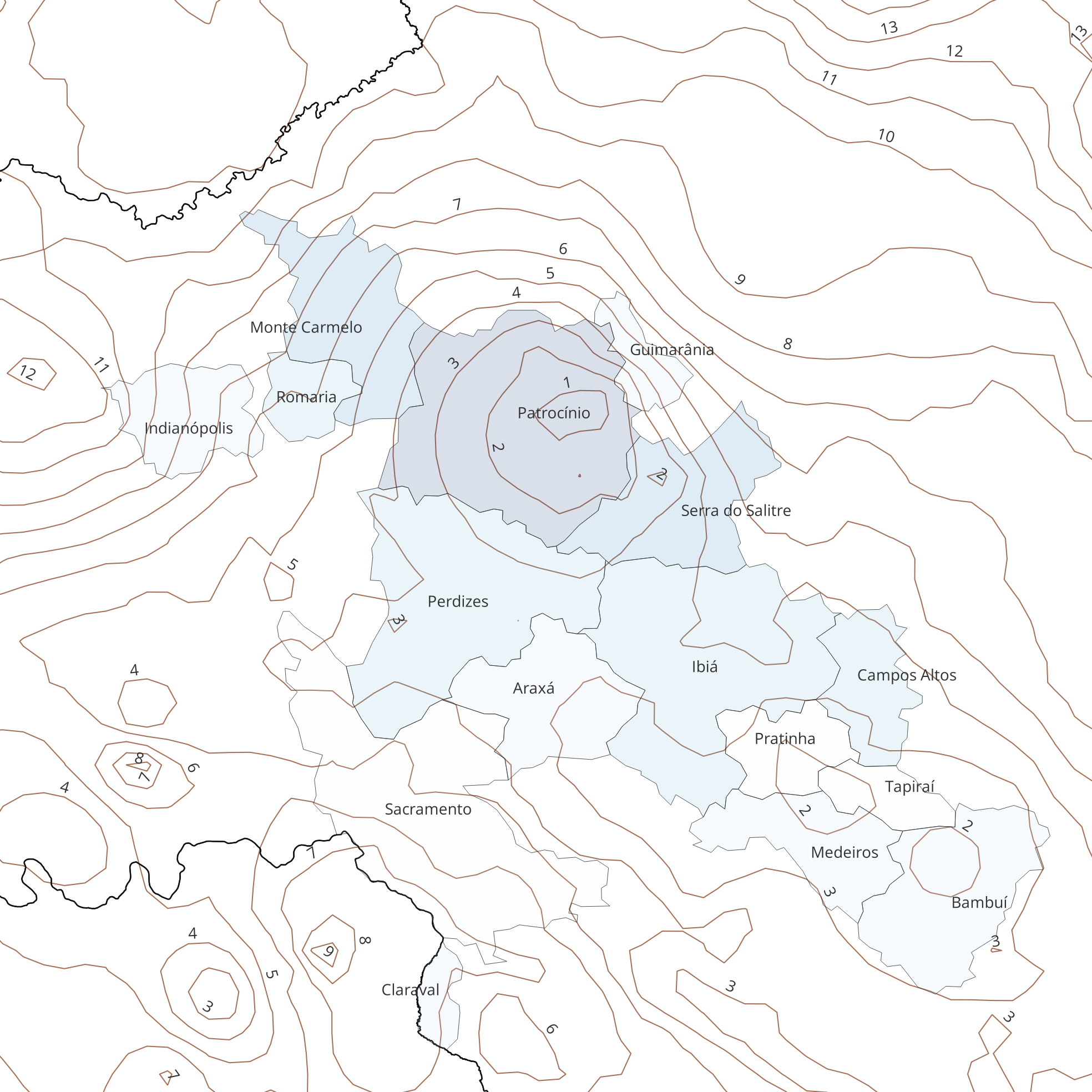
Minimum temperature observed in coffee-producing municipalities of the Cerrado
The isolines represent the minimum temperatures recorded on 08/11. Source: INPE and StoneX. Prepared by: StoneX.