Decrypting AI: Trends Across the Sector

Executive Summary
- Market trading color: Outlook on ETH post Dencun, BTC ETF Flows, options color
- Theme of the week – We explore why AI has been a popular narrative and specific large cap and small cap names
- Sector commentary: Bitcoin's volatility and institutional investments, Ethereum's fee reduction, Solana's DeFi controversies, and NFT regulatory concerns
Market Trading Color (Nolan Aibel)
Many had pegged $ETH (2.50%) to continue momentum after undergoing yesterday’s Dencun upgrade. With this upgrade, L2’s have already seen a 99% decline in median transaction fees. This in theory should sky-rocket activity within the ecosystem, adding even more to their impressive $56.6B in DeFi TVL (a metric that is up nearly 300% in ’24). However, what many are undermining is with this significant reduction in fees, L2s will now be paying much less to Ethereum. Ethereum will need to see more than a 10x surge in ecosystem activity to make up this difference. On top of this, optimism about an $ETH ETF being approved by May 23rd (a date we have never thought to be a high probability) continues to wane. Looking at $ETHE of late, the discount continues to widen from 9% to 15% as investors price in the lower likelihood of this near-term approval. While that is happening, $SOL +12% continues to see network activity skyrocket. Over the past 4 months, Solana DEX volume outweighs Ethereum mainnet by totals of $99B to $32B. Look for $ETH to continue this underperformance $BTC in the short to medium term.
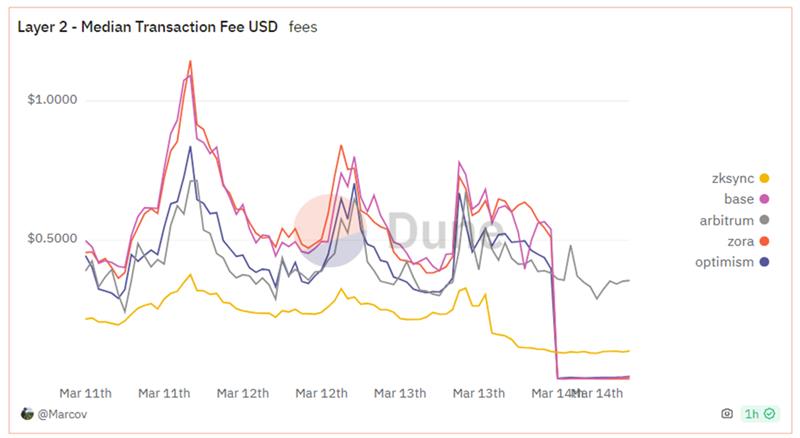
Source: Dune Analytics @Marcov
There seems to be no slowing down of $BTC ETF inflows these days. In just the first three trading days of the week, ETFs have equaled last week’s total inflows with over $2.2B. Blackrock’s $IBIT continues to dominate with over $12B in total inflows. Fidelity’s $FBTC sits in second with nearly $7B. The biggest news over the week came from Grayscale who announce plans for a mini trust that will trade under the ticket $BTC. This ETF would be designed to have a materially lower fee than $GBTC and “through the innovative mechanics of a GBTC “spin-off” — which means a certain amount of the Bitcoin underlying GBTC shares (as of a to-be-determined record date in the future) would be utilized to ‘seed’ the new Grayscale Bitcoin Mini Trust, with shares of the new Grayscale Bitcoin Mini Trust being distributed pro rata to GBTC shareholders as of the record date” While outflows slowed to $70M the day after this news broke, yesterday these outflows picked back up to their usual pace with $277M in outflow. However, over the long term we see this as bullish for the ETF space and $BTC.
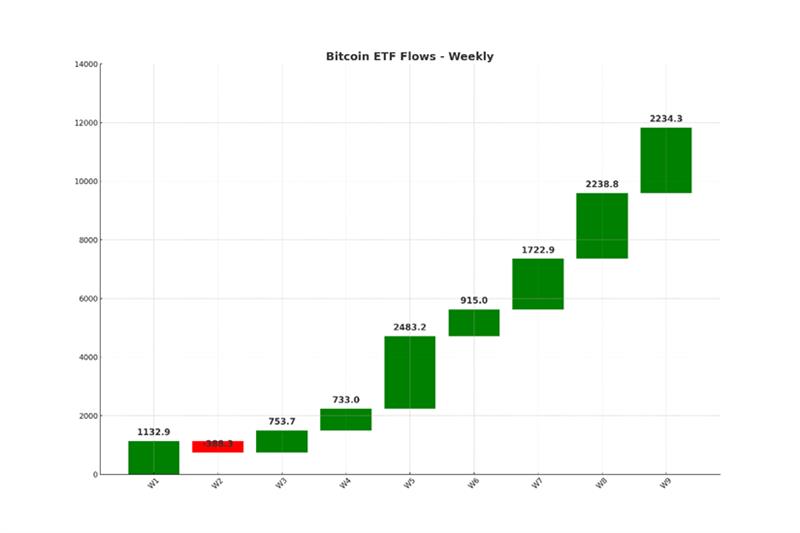
Source: @BTC_Archive
Upside calls continue to dominate option flow with traders seemingly rolling to higher strikes. April’s 90c expiring on the 26th has seen the largest amount of volume of late.
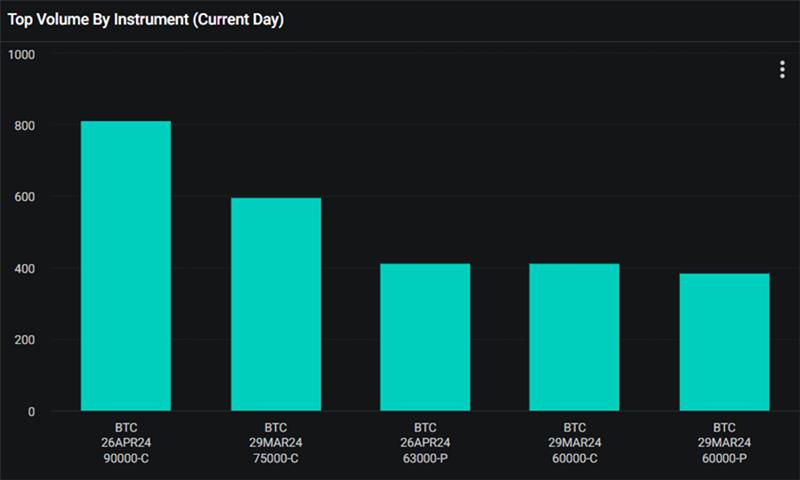
Source: Deribit
Why is everyone talking about AI?
The intersection of artificial intelligence (AI) and cryptocurrency has become a focal point of discussion within the tech community, largely due to the escalating cost of compute in machine learning (ML) systems. A study analyzing 124 ML systems published between 2009 and 2022 revealed a startling trend: the cost of compute for the final training run of these systems has been increasing by approximately 0.49 orders of magnitude per year. This metric is crucial for understanding the development of ML capabilities over time, especially when juxtaposed with performance metrics. While Moore's Law historically dictated a decline in computational costs, the exponential growth in compute spending within the ML domain has outpaced this trend significantly in the past decade. This divergence underscores the real economic implications of ML training runs, shedding light on actors' willingness to invest in this domain, thus necessitating a deeper exploration of dollar costs and their forecasting implications.
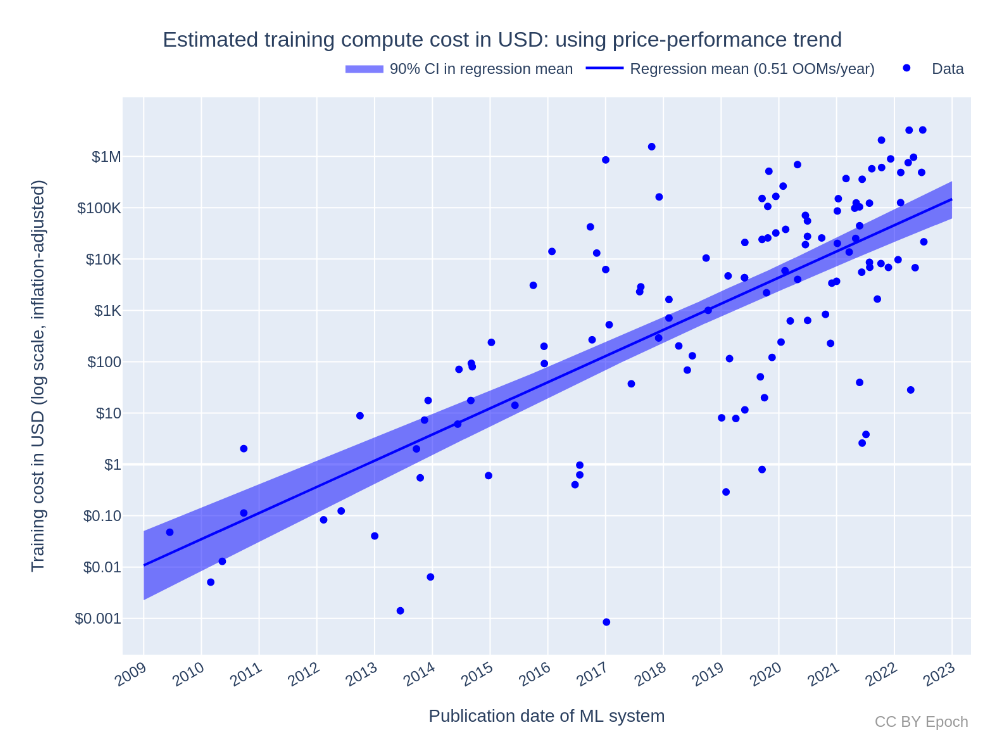
Source: Ben Cottier (2023), “Trends in the Dollar Training Cost of Machine Learning Systems”
Meanwhile, the AI market is experiencing unprecedented growth and innovation across hardware, software, and service segments, projected to reach USD 3,636 billion by 2033 with a compound annual growth rate (CAGR) of 37.3% from 2023 to 2033, according to Allied Market Research. This surge is propelled by widespread adoption across industries and increased investments from both private and government sectors. The conversation around AI has expanded to explore decentralized compute infrastructure and cryptography's role in AI development stages, emphasizing advantages such as reducing censorship risks, increasing accessibility, and facilitating more efficient resource coordination, thus driving further intrigue and exploration at the intersection of AI and cryptocurrency.
Themes we see in AI
Themes observed in AI encompass leveraging decentralized compute infrastructure and cryptography for managing digital rights, exploring peer-to-peer generative AI, sharing models and data, and incorporating technologies on decentralized physical infrastructure (DePIN). Discussions with peers and founders have highlighted the potential of blockchain infrastructure across various AI development stages, from data collection and labeling to model training and inference.
Examining the top AI and Big Data Tokens by market capitalization alongside smaller cap tokens recommended by industry peers and crypto communities, key themes in AI platforms emerge:
- The focus is on GPU distributed networks. Render leads this narrative, addressing both AI and DePIN narratives simultaneously, while Bittensor, with its subnets, Fetch.ai, and Theta Network with Edge Node, have also allocated more resources towards this field.
- Autonomous agent-based systems can imply various functionalities. For most platforms, it typically refers to AI chatbots, even as simple as a Chat-GPT wrapper, capable of interacting with other bots and smart contracts. Autonolas utilizes bots for DAO automation, NEAR and others envision using private data to train bots for personal assistants and planners, and PAAL AI alongside others, provides a bot enabling users to make trades.
Below are brief notes on a variety of protocols and platforms. These notes are not intended to provide an in-depth analysis but rather to act as exploratory points that may prompt secondary and thoughtful questions about the names, exploring different approaches and buildouts that advance AI capabilities.
NEAR Protocol ($NEAR)
- NEAR’s vision is to harness the power of AI to empower individuals to control their digital identities and data, introducing user-owned AI where self-sovereign operating systems enable users to manage their own AI, which screens and determines content, providing a trustless infrastructure.
- “NEAR aims to become a fully sovereign operating system equipped with a personal AI assistant that optimizes for users’ needs without disclosing private information about their data or assets. It should also interact and transact with other people’s AIs and community AIs peer-to-peer. This concept is referred to as "user-owned AI." ––Illia Polosukhin, Co-Founder of NEAR and CEO of NEAR Foundation.
- Co-founder Polosukhin is speaking at the NVIDIA conference on March 20th alongside CEOs of other AI companies, including NVIDIA, a catalyst associating the name with AI.
- NEAR is aligned with Ethereum, collaborating with Polygon on zkWASM prover, Eigen Labs on Fast Finality, and building NEAR data availability.
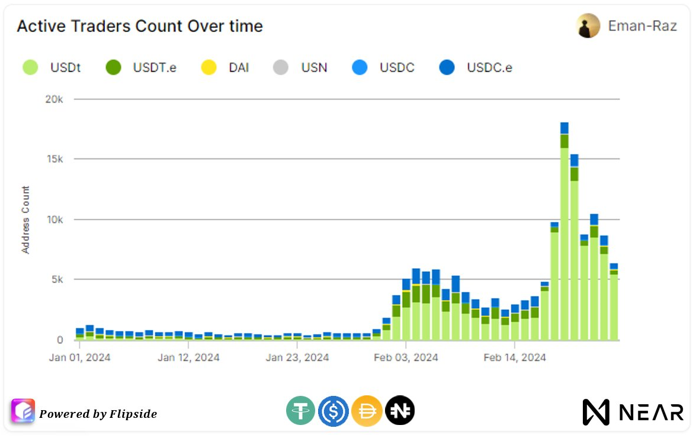
- NEAR is experiencing explosive user growth, with over 30M monthly active wallets and over 1M daily active users and has seen the creation of 12M new wallets year-to-date.
- TVL has nearly tripled to $200M, with a stablecoin market cap exceeding $100M and a 1800% growth in stablecoin usage.
-
NEAR claims that NEAR DA is up to 85,000x cheaper than posting blob submissions on Ethereum and 30x cheaper than doing the same on Celestia.
Source: NEAR Foundation
Render ($RNDR)
- Render Network is a blockchain-based platform facilitating decentralized GPU rendering and AI processing, enhancing efficiency and transparency in digital content creation.
- Switched over to Solana from Ethereum on November 2nd, 2023.
- On Render, every component involved in a training or inference step can be tagged, hashed, and provided with a receipt, enabling direct royalty payouts to contributors. This underscores the intrinsic value of an NFT, focusing on the underlying data and 3D scene rather than just the JPEG image.
- Render Network has expanded to AI in addition to its existing use for decentralized 3D rendering. High-end GPU power (like H100 models used in Data Centers) aren’t always necessary for tasks such as inference, diffusion, and text-to-video processing, with many developers preferring to use less powerful, consumer-grade GPUs at greater scale (over 250 million addressable units). This highlights the massive opportunities for leveraging the scale of latent consumer compute for AI applications outside of LLM training that don’t require the highest performance GPUs.
- Growth in new diffusion-based models like Sora show how the Render Network’s infrastructure can be used in applications like diffusion video, complementing the network’s use for decentralized GPU rendering.
- The Render Network's Burn Mint Equilibrium emissions, activated on Solana in late 2023, enable on-chain payment in RENDER tokens for rendering and AI jobs, ensuring supply-demand equilibrium, with plans for native RENDER liquidity and automated burn in the future. Currently 32k Render have been burned.
- Render has an app on the Apple App Store called [Archive], exclusively available for Apple Vision Pro, and has partnered with Google to develop an A3 GPU supercomputer for AI and content creation. Additionally, Microsoft and Google are both collaborating with the Render Network to integrate Azure (featuring Microsoft’s NVIDIA GPUs) and Google’s A2 instances, enhancing the Render Network's capabilities.
Bittensor ($TAO)
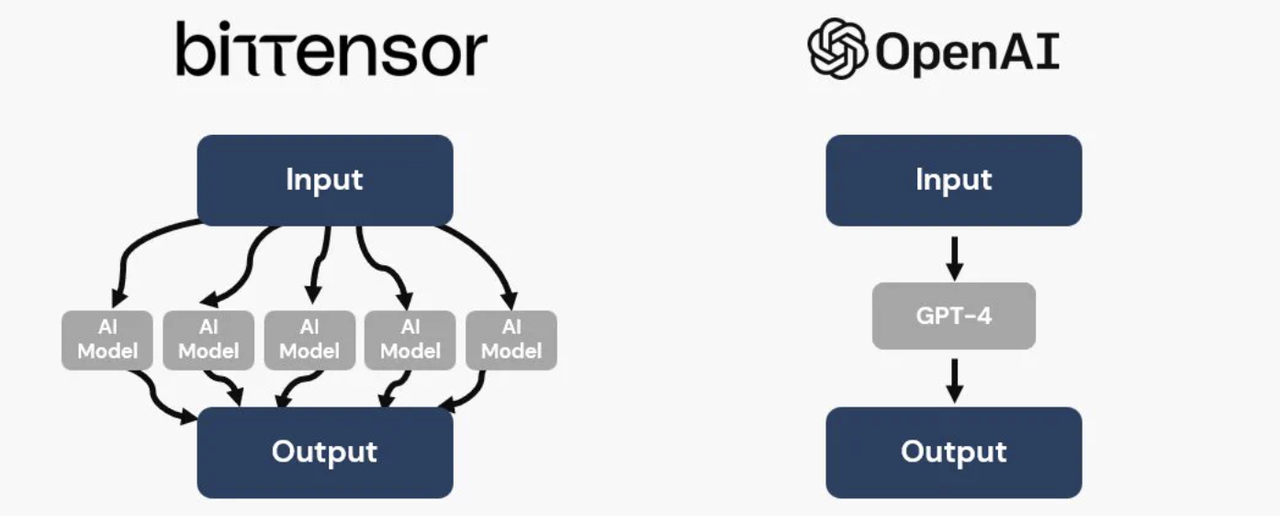
- Bittensor is a decentralized protocol with subnets designed to produce decentralized intelligence. These subnets operate as competitive markets where participants are incentivized to produce the best intelligence. Running on blockchain, subnets form the core of the Bittensor ecosystem, with participants rewarded in TAO token.
Source: Bittensor
- Every day, 7,200 TAO is distributed to subnets, benefiting both miners and validators. Of this, 18% is allocated to the subnet owner, while 42% is distributed to miners and another 42% to validators.
- The platform's separation of core functioning from validation systems enables flexibility in programming languages and off-chain tools.
- Bittensor and Nous Research have recently partnered to launch the Leaderboard Subnet, aimed at fostering a competitive yet collaborative environment for AI developers. This platform, under Bittensor's umbrella, leverages the capabilities of the Cortex subnet to generate synthetic data, providing a robust benchmark for evaluating AI model performance.
- Bittensor currently operates 32 subnets with various functions. However, there is a proposal to increase the number of subnets to 48 due to the significant rise in the cost of registering a subnet, driven by the increasing price of the TAO token. Below are examples of some of the functions:
- Text Generation (S1): a subnetwork dedicated to text-based prompts
- Machine Translation (S2): Focused on the translation of text from one language to another through ML algos
- Data Scraping (S3): aggregates and consolidates data from various sources
- Image Generation (S4): Similar to MidJourney, this subnet transforms text prompts into images
- The rest of the subnets can be found here
Fetch.ai ($FET)
- Fetch AI (FET) is an Ethereum token that powers Fetch.ai, a decentralized machine learning platform for applications such as asset trading, gig economy work, and energy grid optimization.
- The platform is built on the Cosmos blockchain and uses AI to help people automate everyday takes like booking a holiday or a flight. Fetch.ai focuses on use cases like optimizing DeFi trading services.
- Within the Fetch.ai network, software agents represent and act on behalf of their owners, autonomously delivering optimized services across different ecosystems, benefiting suppliers and consumers.
- The most used and interactive bot has recorded 7.31k interactions, despite lacking a “read me” document commonly used for understanding software. It was last updated 6 months ago.
- Fetch.ai lost a court case in the UK, and the founder mentioned that the UK business had depleted its funds and was operating with borrowed money. However, Sheikh clarified that the foundation, which oversees the FET cryptocurrency tokens, remains unaffected by the UK administration as the UK business primarily facilitates transactions for the foundation and holds its intellectual property.
- As of March 5th, the launch of Fetch Compute, a $100 million project, aims to deploy NVIDIA H200, H100, and A100 GPUs to create a platform for developers and users to access computing power. Beginning March 7, 2024, users staking Fetch.ai’s native coin, $FET, will earn Fetch Compute Credits as rewards, which they can use to pay for GPU utilization on the Fetch Compute network.
Theta Network ($THETA)
- Theta Network operates as a decentralized video delivery network, encouraging the sharing of bandwidth, improving streaming quality, and democratizing content distribution. With a significant emphasis on AI and 3D rendering, Theta utilizes distributed GPU power to lead the way with advanced rendering capabilities, establishing new benchmarks in digital content creation and delivery.
- Fully compatible with Ethereum, Theta supports Turing complete smart contracts, paving the way for a variety of Web3 applications such as NFTs, decentralized exchanges (DEX/DeFi), and decentralized autonomous organizations (DAOs).
- Collaborations with Lionsgate, MGM Studios, NASA, and integration with platforms like CONtv Anime and Samsung VR highlight Theta's commitment to content delivery.
- Theta Labs' innovation in 3D rendering and VR streaming is protected by four U.S. patents.
- Set to launch on May 1, 2024, the Theta EdgeCloud platform is for AI computing and 3D rendering. By leveraging distributed GPU power for efficient and cost-effective AI compute tasks, including pioneering text-to-3D rendering capabilities, Theta Network is transitioning towards infrastructure for AI and 3D applications.
- Launched on Dec 1, 2022, the Theta Metachain is a "chain of chains" allowing for permissionless horizontal scaling, EVM-compatible and using TFuel as the gas token consists of a main chain and unlimited subchains, with prospects for enhanced security through zk-rollup extensions.
- Theta is set to launch a pilot version of the Theta Edge Node for mobile Android devices in the coming months, aiming to assess the potential of utilizing up to 3.9 billion active Google Android devices for specific AI computation tasks. With Android dominating 70% of the global mobile operating system market across 190 countries, it offers an optimal platform for evaluating mobile CPU/GPU capabilities.
PAAL AI ($PAAL)
- Paal As A Service (PaaS) offers AI-driven solutions across various domains, such as online betting, financial trading, digital collectibles, and Software as a Service (SaaS) applications, featuring advanced web AI capabilities and conversational bots. It includes pre-built bots for Twitter, buy alerts, stake alerts, a sniper bot, and custom bots.
- PaalX Wallet provides advanced crypto trading functions and autonomous AI trading, serving as a gateway to “intelligent” crypto trading, integrating research tools, market analysis, and trade execution
- PaalBetBot promises a user-friendly sports betting interface with live updates and secure transactions
- 50% of certain earnings are allocated to stakers, promoting participation and stability derived from profits from partnerships, a 1% trading tax, and potential growth from subscription services and product commissions.
- Staking Pools offer various APYs, allowing stakers to choose a pool that fits their investment strategy, with earnings from Paal's revenue streams contributing to the rewards within these pools.
- Tokenomics include 1 billion tokens, taxing 4% to buys and sell, where 1% goes to marketing and user acquisition, 1% goes to development, 1% goes to the team, and 1% goes to the ecosystem.
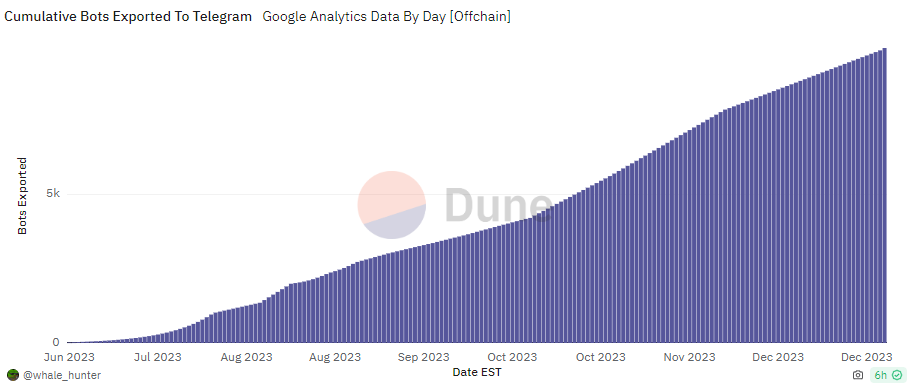
- The 7-day Moving Average for daily revenue is 42 ETH or roughly $168k. Lifetime total fees stand at 3,896 ETH, with a 92.8% ETH rewards share when staking PAAL for 56 days. There are three lock-up periods for stakers: 14 days, 28 days, and 56 days.
 Source: Dune Analytics @whale_hunter
OpSec ($OPSEC)
- Provides AI-focused smart contract libraries, WebAssembly support for enhanced compatibility, and integrated development environments (IDEs) with debugging tools and AI libraries for simplified development workflows.
- OpSec Features: Offers on-chain model deployment, decentralized GPU resources, privacy-preserving AI integration, AI oracles, and cross-chain AI workflows for comprehensive AI support within blockchain ecosystems.
- Privacy Layer: Zero-knowledge proofs, secure multi-party computing, and other privacy-preserving technologies are implemented at the privacy layer for sensitive AI calculations.
- OpSec Cloudverse: Connecting people through cloud-based products ranging from nodes, to validators, mining opportunities and computational protocols with 6 chains live
- OpSec VPS (Operations Security Virtual Private Server) are used for security-hardened infrastructure, performance, and automation tools designed to facilitate complex tasks like operating blockchain nodes or handling resource-intensive computations like machine learning models or large sale data processing
- OpSec GPU offers a decentralized method of GPU solutions by utilizing blockchain technology to provide a safe, adaptable, and affordable substitute. OpSec GPU marketplace connects individuals and organizations with spare GPU capacity to those seeking computational resources
- OneSec, leveraging IPFS and decentralized storage for permanent accessibility, offering easy deployment, CI/CD integration, DNS resolution, and autonomy
- Consists of a Core Consensus Layer handling basic blockchain functions, an AI Execution Layer facilitating AI model operation, a Privacy Layer implementing privacy-preserving technologies, and a Connectivity Layer enabling cross-chain communication for AI applications.
- OpSec employs a version of Delegated Proof of Stake (DPoS) to enhance security and handle AI workloads, featuring Validator Specialization where nodes focus on AI-related tasks based on reputation and computing capabilities, alongside Byzantine Fault Tolerance (BFT) to preserve network integrity in the presence of malfunctioning nodes.
- Team was recently revealed at ETH Denver.
- Integrated with Optimism, Celestia, Starknet, Base, Avail, and others.
Sources: NEAR, Render, Bittensor, Theta Network, Fetch.ai, Paal AI, OPSEC
Sector Commentary
- Layer One / Altcoins
- Bitcoin ($BTC): Bitcoin's Wild Four Hours: New Record of $73K, Tumble to $69K, Rebound to $71K, $360M in Liquidations (link)
- Bitcoin ($BTC): This Bitcoin Bull Run Is Breeding Millionaire Whales at Slower Pace, Data Show (link)
- Bitcoin ($BTC): Bernstein Is 'Now More Convinced' That Bitcoin Will Hit $150K After Massive Rally (link)
- Bitcoin ($BTC): Bitcoin investment vehicles amass over 1 million BTC, worth around $67 billion (link)
- Ethereum ($ETH): Ethereum Blockchain Counts Down to 'Dencun' Upgrade, Set to Reduce Fees (link)
- Ethereum ($ETH): Op-Ed: 5 Things to Know About Ethereum's Latest, Greatest Upgrade: Dencun (link)
- Ethereum ($ETH): Ether Put Demand Signals Weakness After $4K Price Breakout (link)
- Ripple ($XRP): XRP Jumps 20% After Mysterious Binance Transfers as Crypto Rally Expands to Laggards (link)
- Avalanche ($AVAX): AVAX's 28% Advance Led CoinDesk 20 Gainers Last Week: CoinDesk Indices Market Update (link)
- DeFi
- AI / NFTs / Web3
- Protocol Village: Elixir, Decentralized Network for Orderbook Exchanges, Raises $8M (link)
- Anatoly Yakovenko explains how Bonk contributed to the Solana phone's sellout success (link)
- NFT Providers May Need Registration to Comply With UK Money Laundering Rules (link)
- Solana NFT marketplace Tensor issuing TNSR governance token (link)
- RWA / Metaverse / Gaming
- Digital Infrastructure: Capital Markets / Exchanges / DAOs / Mining
- BlackRock's Bitcoin ETF Nears 200K BTC, Passing Michael Saylor's MicroStrategy (link)
- Spot bitcoin ETFs have been an ‘absurd’ success and blown away expectations in just two months (link)
- Last week, spot ETFs saw netflows of +30K BTC, including 1.5M BTC by US entities (link)
- MicroStrategy ‘Not Resting on Its Laurels’ as Bitcoin Hits All-Time High: Canaccord (link)
- 'Bitcoin Is Going to Eat Gold': MicroStrategy’s Michael Saylor (link)
- MicroStrategy Acquires 12,000 More BTC With Convertible Senior Notes Proceeds (link)
- VanEck drops BTC ETF fees to zero until March 31, 2025 (link)
- Grayscale Plans Low-Fee GBTC Spinoff: the Bitcoin Mini Trust (link)
- Goldman, BNY Mellon, Others Test Interbank Blockchain Network (link)
- Pantera Capital targets US$250 mln Solana purchase from FTX assets (link)
- Arca: “That’s Our Two Satoshis” - Memecoins Are Back! (link)
- UK’s FCA Opens the Door for Institutional Investors to Build Crypto-Backed ETN Market (link)
- DeVol Network: Exploring the Superiority of Crypto Options Over Perpetual Swaps (link)
- El Salvador Is Sitting on $84M Profit From Its Bitcoin Holdings (link)
- Thailand’s SEC Greenlights Investment From Institutional and Wealthy Individuals in Crypto ETFs (link)
- JP Morgan CEO says he'll defend people's right to buy bitcoin (link)
- U.S. President Again Proposes Crypto Mining Tax, 'Wash Sale Rule' for Digital Assets in New Budget (link)
- EU Parliament Approves New Sanctions Laws That Also Apply to Crypto (link)
- Sweden’s Central Bank Chief Wants 'as Little Bitcoin as Possible' in Country's Financial System: Bloomberg (link)
- Bitcoin Fog Founder Convicted of Money Laundering (link)
- Final arguments begin in COPA case against Craig Wright over BTC claims (link)