DePIN-dable Networks - Hardware Costs & Implementation

Executive Summary
- Theme of the week – DePIN hardware costs, adoption, and ease of implementation
- Sector commentary: Bitcoin shows mixed signals amid geopolitical tensions, U.S. election, and Ethereum stakers show long-term confidence
The Essence of DePIN: Building Tomorrow’s Infrastructure
We believe AI and Decentralized Physical Infrastructure Networks (DePIN) are going to continue to do well this cycle. As the demand for AI and advanced technologies continues to rise, DePIN overlaps naturally with these sectors. AI applications are rapidly developing, and their reliance on data processing and storage makes decentralized solutions even more crucial.
DePIN projects like Helium and Geodnet complement AI by providing decentralized wireless networks and data collection infrastructure, which can be used to support smart cities, IoT devices, and AI-driven applications. DePIN offers a decentralized solution for building and maintaining critical infrastructure—such as cloud storage, wireless networks, and data collection—that traditionally requires massive investments from governments or large corporations.
For instance, Filecoin rewards storage providers for offering decentralized cloud storage, while Helium incentivizes users to deploy IoT and 5G wireless networks. Each project within DePIN takes a unique approach, so we decided to explore the differences between some of the largest projects, along with the costs and complexity of setting up the hardware. The table below provides an overview of the key metrics, with a detailed breakdown underneath.
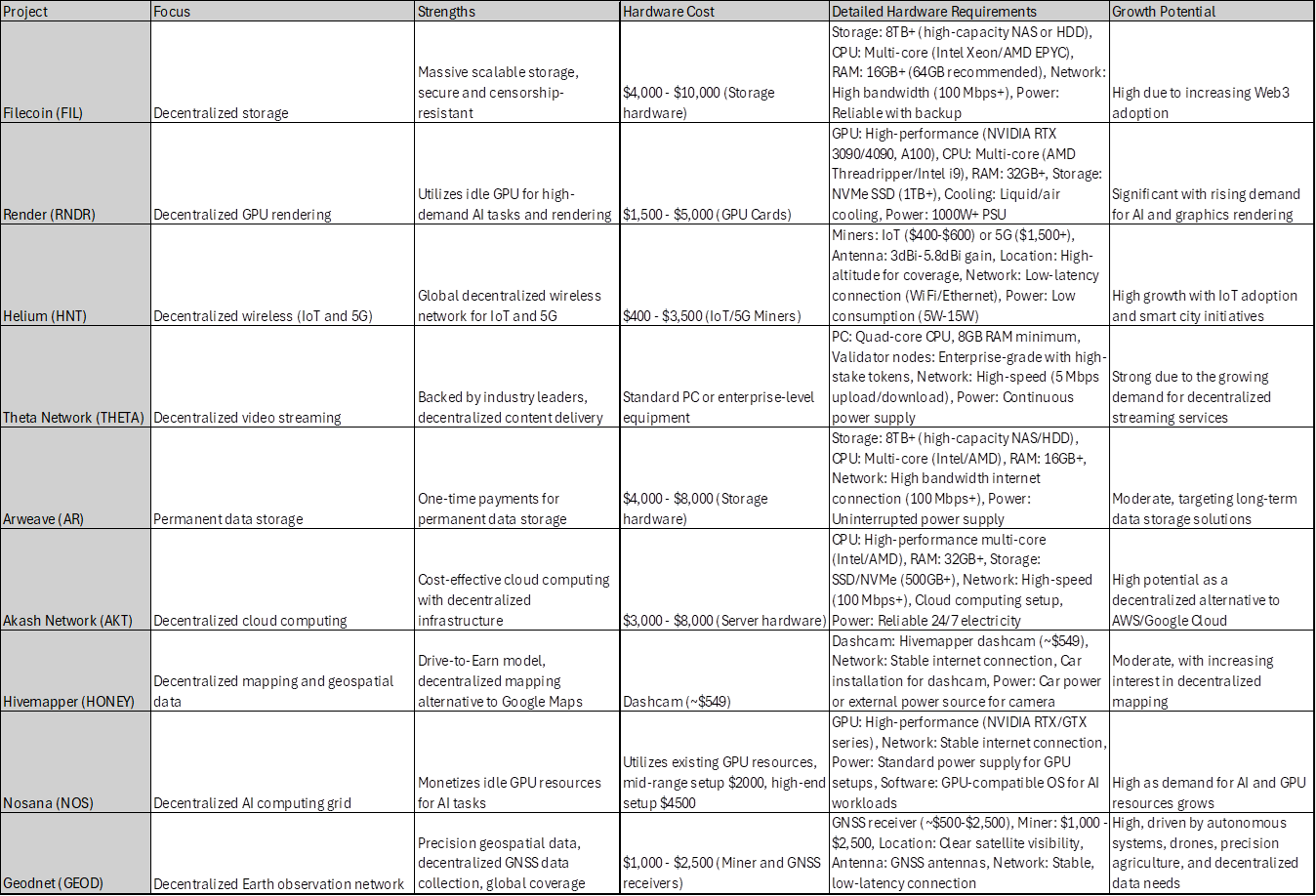
Source: StoneX Digital
Filecoin (FIL): Decentralized Cloud Storage
As one of the foundational DePIN projects, Filecoin has established itself as a leader in decentralized cloud storage. It enables businesses and individuals to contribute excess storage and earn FIL tokens. As a decentralized counterpart to Amazon Web Services (AWS) services, Filecoin provides a scalable, secure, and censorship-resistant storage network.
Key Metrics from Filecoin Plus (Fil+):
- Total Allocators Datacap: 612.19 PiB
- Remaining Datacap Allowance: 220.68 PiB (36% of total available storage)
- Used Datacap Allowance: 391.51 PiB (64% allocated)
- Total Clients Served: 3,767
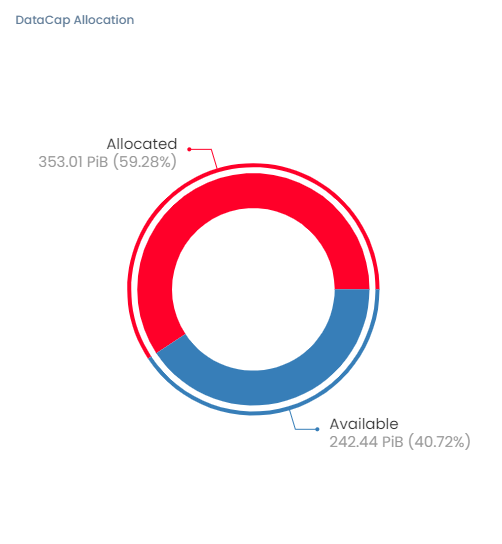
Source: datacapstats.io
These metrics show that 64% of Filecoin’s datacap allocation has been utilized, with 36% still available, reflecting the network's capacity for handling increasing storage needs. Additionally, Filecoin's governance structure allows for further datacap expansion through the Filecoin Plus program, which ensures that as demand rises, more storage resources can be allocated. Supported by Filecoin's Proof-of-Storage and Proof-of-Replication mechanisms, the network maintains high data reliability and redundancy, providing a scalable and secure environment for decentralized storage.
Setup Information:
- Setup Requirements: Running a Filecoin node requires robust hardware, including 8TB+ of storage, multi-core processors like Intel Xeon or AMD EPYC, and 16GB to 64GB of RAM.
- Cost: Initial setup costs range between $4,000 and $10,000, depending on the configuration and scale of storage capacity.
- Setup Time: It typically takes 4 to 8 hours to set up a Filecoin node, requiring knowledge of Linux and storage systems.
- Complexity: 8/10 – Filecoin is one of the more complex DePIN projects due to the hardware requirements and technical expertise needed for system management and optimization.
Filecoin’s Fil+ initiative adds another layer of trust and efficiency by allocating storage to approved clients and storage providers, ensuring that high-quality data is stored and managed. The system incentivizes legitimate, high-value data while keeping costs low for clients and providers. With nearly 600 PiB of storage allocated, Filecoin is scaling rapidly, serving thousands of clients across its decentralized infrastructure.
Filecoin's success lies in its decentralized approach to cloud storage, making it a compelling alternative to centralized providers. With over 59% of its storage capacity utilized, the network proves its value and efficiency while leaving room for future growth.
Render (RNDR): Decentralized GPU Rendering
Render operates a decentralized GPU rendering network, where participants contribute their idle GPU power for 3D rendering, AI processing, and video production. The demand for rendering services has increased significantly with the rapid rise of industries like gaming, cinematic visual effects, and metaverse development. Render's model enables users to monetize unused GPU resources while providing distributed computing power to those in need.
Recent metrics from Render’s dashboard highlight the network's activity:
- Total Frames Rendered: 37,913,372 that’s equivalent to rendering over 26,000 full-length feature films at 24 frames per second, assuming an average film length of two hours.
- Total Nodes Since Inception: 5,600
- Latest Node Operator Reward: 21,250 RNDR
These figures illustrate the scale and effectiveness of the Render network in distributing rendering tasks across a vast pool of GPU operators.
Setup and Technical Requirements:
- Setup Requirements: To participate, users must have high-performance GPUs, such as the NVIDIA RTX 3090 or 4090, and a powerful CPU and 32GB+ RAM. The GPU must be capable of handling intensive graphics rendering tasks.
- Cost: The primary cost lies in acquiring a high-end GPU. Typical hardware setup costs range between $1,500 and $5,000, depending on the GPU model and accompanying components.
- Setup Time: Setting up a GPU for the Render network, including hardware installation and software configuration, can take 3 to 6 hours.
- Complexity: 7/10—While the software side is relatively simple for users familiar with GPU rendering environments, optimizing GPU performance and network integration can be complex.
The onboarding of 5,600 nodes since inception demonstrate the growing scale of Render’s decentralized approach to distributed computing. As 37.9 million frames have been processed, the platform’s ability to offload compute-heavy tasks to individual node operators showcases the network’s efficiency and growing potential in the rendering space.
Render's appeal lies not only in GPU owners' ability to monetize idle resources but also in the growing demand for high-quality graphics rendering in entertainment, VR, metaverse development, and AI projects. Its decentralized model allows for scalable, on-demand rendering services without the need for massive, centralized data centers.
Akash Network (AKT): Decentralized Cloud Computing
Akash Network provides decentralized cloud computing solutions by allowing users to rent out their unused compute resources, creating a decentralized alternative to traditional cloud services like AWS and Google Cloud. Akash connects individuals and businesses looking for affordable cloud computing resources with providers who have spare capacity, leveraging a marketplace model.
Recent network data reveals the current demand for computing resources:

Source: stats.akash.network
The demand side of Akash represents users who need cloud computing power for their workloads. These can range from running applications, performing data analytics, training machine learning models, rendering videos, or other complex computing tasks. Instead of relying on centralized cloud providers, users rent resources from Akash’s decentralized network of providers.
The metrics above show 536 active leases, meaning 536 unique contracts have been set up where users actively rent compute, storage, and GPU resources from providers. The growth in leased resources, such as CPU (+4.88%), GPU (+0.63%), and storage (+1.64%), indicates increasing demand as more users are choosing Akash for cloud services, thanks to its affordability and decentralization.
Setup and Technical Requirements:
- Setup Requirements: To provide services, participants must have a server infrastructure with a multi-core CPU (e.g., Intel or AMD processors), GPU resources for higher computational tasks, and ample storage and RAM. Providers can lease everything from basic computing power to high-performance GPU processing.
- Cost: Providers can expect varying costs depending on the scale of their infrastructure. Depending on hardware requirements, particularly if GPU processing is involved, initial investment can range from $3,000 to $10,000.
- Setup Time: The time required to set up a node depends on the complexity of the hardware and software integration. Most setups take 4 to 8 hours.
- Complexity: 6/10 - Akash is moderately complex. Setting up involves network configurations, server maintenance, and marketplace participation, but Akash provides clear documentation and tools to assist with the process.
Arweave (AR): Permanent, Decentralized Data Storage
Arweave takes the concept of decentralized storage one step further by offering permanent data storage. Its unique consensus mechanism, Proof-of-Access, ensures that once data is uploaded to the Arweave blockchain, it is stored permanently. This appeals to sectors like archives, media, and knowledge preservation, where data permanence is crucial.
- Setup Requirements: High-capacity 8TB+ storage hardware, a multi-core CPU, and a minimum of 16GB RAM.
- Cost: Entry costs for storage nodes range from $4,000 to $8,000, making it somewhat comparable to Filecoin but optimized for long-term, low-retrieval data.
- Setup Time: Similar to Filecoin, setting up an Arweave node takes 4 to 8 hours.
- Complexity: 7/10 - While the hardware setup mirrors Filecoin’s, the concept of permanent storage and Proof-of-Access introduces some additional layers of complexity for long-term storage providers.
Helium (HNT): Decentralized Wireless Networks for IoT and 5G
Helium has become one of the most well-known decentralized wireless networks, providing global IoT and 5G coverage through community-operated hotspots. Participants can set up IoT-compatible hotspots or 5G nodes, contributing to the network while earning HNT tokens for their coverage and data transfer contributions.
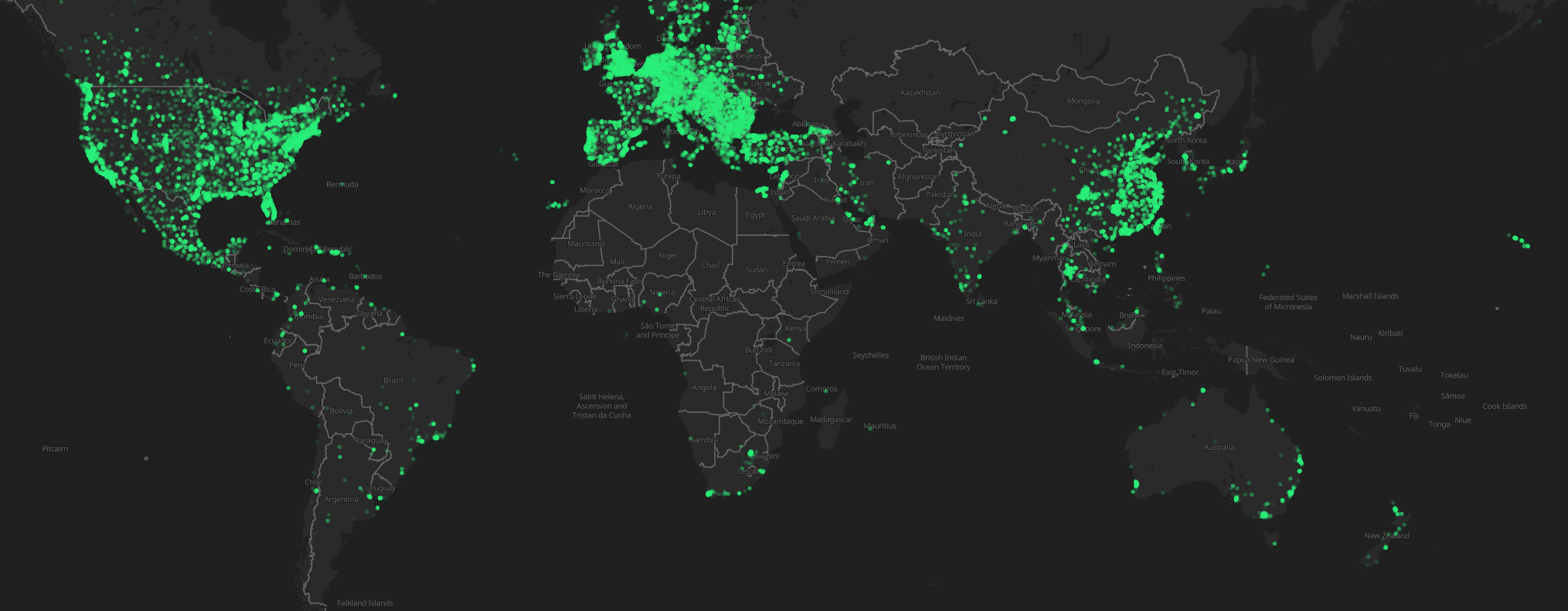
Source: Helium Hotspot Map – explorer.Helium.com
The current network boasts:
- IoT Hotspots: 356,851 active hotspots
- Mobile 5G Hotspots: 19,919 active hotspots
These numbers reflect the widespread deployment of Helium nodes across both IoT and 5G networks, highlighting the significant growth of the decentralized telecom network. Helium’s dual-token system—IOT tokens for IoT network operators and MOBILE tokens for 5G participants—drives incentives and compensates contributors based on network usage.
- Setup Requirements:
- For IoT, users need LoRaWAN-compatible hotspots priced between $400 and $600.
- For 5G, participants must install CBRS-compatible radios and antennas, which cost between $1,500 and $3,500.
- Cost: The entry barrier for IoT hotspots is relatively low, making them accessible to a wide range of participants. However, 5G setups require more technical equipment and higher initial investments.
- Setup Time: IoT nodes can be up and running in 1 to 2 hours, while 5G nodes may require 3 to 5 hours for installation and network configuration.
- Complexity:
- IoT hotspots: 3/10 – Easy to set up with basic knowledge.
- 5G nodes: 6/10 – Requires more technical expertise but still manageable for tech-savvy users.
Helium’s success lies in its ability to engage everyday users in building a decentralized telecom infrastructure. Its Proof-of-Coverage (PoC) model ensures that nodes are rewarded based on the quality of coverage they provide. As Helium expands, it represents a promising shift toward community-driven networks, allowing individuals to contribute to and benefit from wireless infrastructure in a decentralized economy.
Hivemapper (HONEY): Decentralized Mapping via Dashcam
Hivemapper is a decentralized alternative to traditional mapping services like Google Maps. Users contribute by attaching Hivemapper dashcams to their cars, capturing street-level imagery while they drive, and earning HONEY tokens in return.
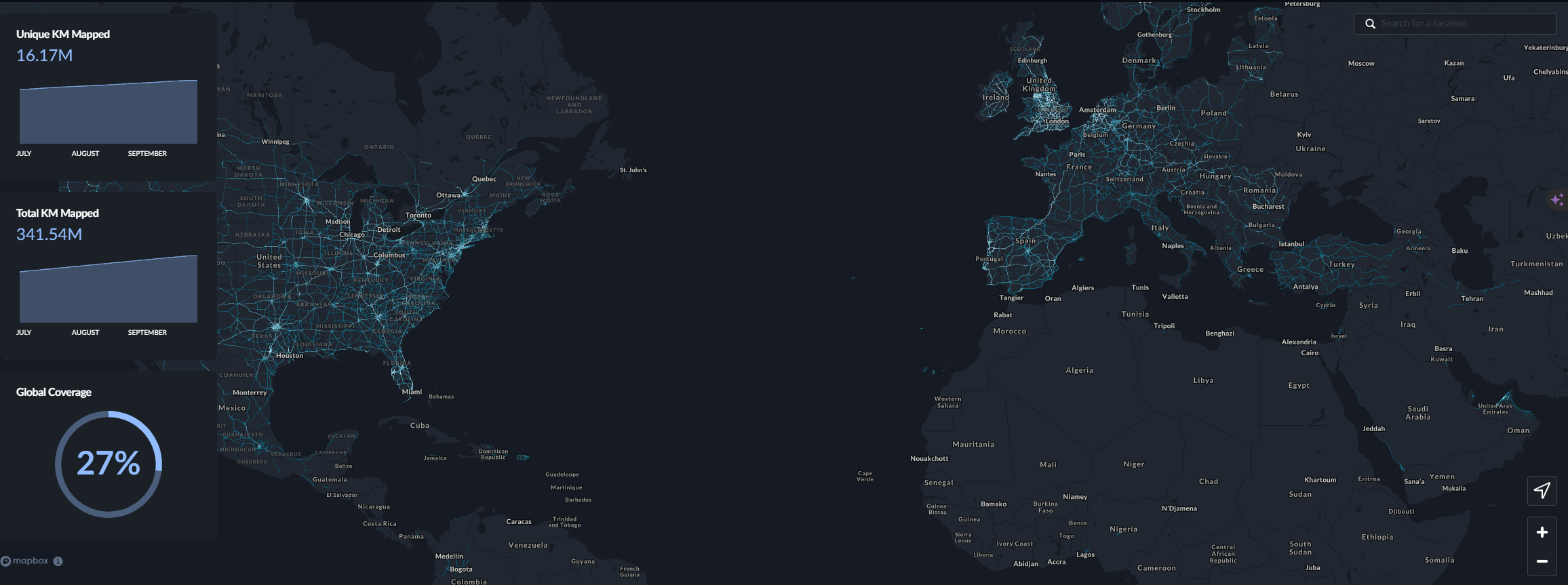
Source: beemaps.com
With over 341 million kilometers mapped globally and 27% global coverage, Hivemapper has made significant strides in covering key regions, with particularly strong coverage in North America and Europe. In the United States, 36% of the country has been mapped, while Canada follows closely with 33%. Europe has 29% coverage, and East Asia leads with 42%, showcasing the platform's global reach and growing adoption.
- Setup Requirements: Users need to install a Hivemapper dashcam, which costs around $549, and ensure they have internet connectivity to upload the data.
- Cost: The primary cost is the dashcam, making the setup relatively affordable compared to other DePIN projects.
- Setup Time: Setting up the dashcam and configuring the system takes 1 to 2 hours.
- Complexity: 2/10—Hivemapper is highly accessible and requires minimal technical expertise, making it appealing to a broad user base. Users can easily contribute by driving around their local areas and uploading the captured data.
With growing global participation, Hivemapper’s decentralized mapping approach is set to challenge traditional mapping solutions. It provides a real-time, crowd-sourced map that is constantly updated, fueled by user contributions and incentivized by the tokenized reward system. As the global coverage increases, Hivemapper’s potential to reshape the industry becomes more apparent, particularly as it expands across major regions like East Asia and North America.
Geodnet: Geospatial Data Mining
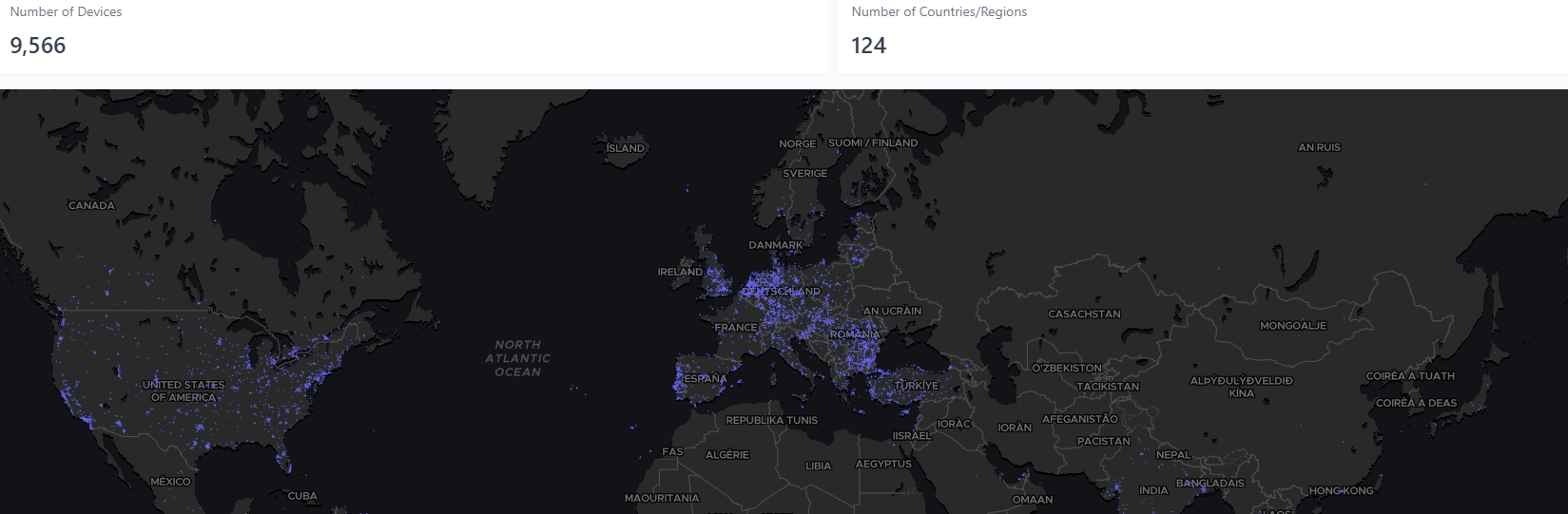
Geodnet is at the forefront of decentralized geospatial data collection, offering Real-Time Kinematics (RTK) for applications in precision agriculture, autonomous vehicles, and surveying. With 9,566 devices across 124 countries, Geodnet’s global network rapidly expands, creating a distributed geospatial infrastructure that offers highly accurate location data.
Source: depinscan.io
The map shows strong coverage in the United States and Europe, particularly Germany, France, and the UK, highlighting areas with high geospatial data demand. The system relies on Global navigation satellite system (GNSS) receivers and satellite miners, with hardware costs ranging from $1,000 to $2,500.
- Setup Requirements: Geodnet requires the installation of GNSS receivers and satellite miners placed in areas with a clear line of sight for satellite connectivity.
- Cost: Hardware investments are relatively moderate, with costs between $1,000 and $2,500, depending on the quality and accuracy of the equipment.
- Setup Time: Installing a Geodnet node is straightforward and takes 1 to 3 hours. The most important factor is optimizing the satellite antenna placement for the best connection.
- Complexity: 5/10—Geodnet’s setup is moderately challenging, especially when it comes to calibrating satellite equipment, but it is accessible to users with basic technical knowledge.
Participants are rewarded with GEOD tokens, distributed through a Proof-of-Location (PoL) and Proof-of-Accuracy (PoA) model. These mechanisms ensure that the data provided by Geodnet nodes is accurate and verifiable, creating a decentralized geospatial network that supports industries such as autonomous driving, precision farming, and surveying. With nearly 10,000 nodes already deployed globally, Geodnet continues to grow its influence, cementing its place as a leader in decentralized geospatial data.
For those wanting a deeper dive, our report, "StoneX Digital Asset Weekly: Paving the Way—A Guide to Decentralized Physical Infrastructure (DePIN)," explores these networks in more detail. DePIN represents a paradigm shift in how we build, maintain, and reward contributions to physical infrastructure, setting the stage for the next wave of decentralized technology.
Sector Commentary
- Layer One / Altcoins
- Bitcoin ($BTC): Bitcoin Coinbase premium turns negative as BTC price stalls under $63K (link)
- Bitcoin ($BTC): Bullish Bitcoin Hopes Dented as China Eases Stimulus Plans (link)
- Bitcoin ($BTC): Bitcoin Up 40% YTD, but Gold Wins on Risk-Adjusted Returns (link)
- Bitcoin ($BTC): U.S. Election 2024: Bitcoin and S&P 500 Options Diverge, Hinting at Major Market Moves (link)
- Bitcoin ($BTC): Bitcoin, Gold Could Benefit From Rising Geopolitical Tension and U.S. Election: JPMorgan (link)
- Bitcoin ($BTC): Waning China stock rally could drive investment back into crypto, QCP Capital claims (link)
- Bitcoin ($BTC): Bullish bitcoin Q4 thesis bolstered by FTX repayment developments, K33 analysts say (link)
- Bitcoin ($BTC): Bitcoin price faltered at $64K again — Here’s why (link)
- Ethereum ($ETH): ETH users stake 28.9% of supply, signal ‘long-term’ confidence (link)
- Ethereum ($ETH): Ethereum Proposal Could Increase Throughput by 50% (link)
- Solana ($SOL): Solana to Outperform Ethereum, Bitcoin in 2025 if Trump Reelected: Standard Chartered (link)
- Solana ($SOL): Solana dominates token launches, accounting for over 87% of new tokens in 2024 (link)
- Altcoins: CoinDesk 20 Performance Update: Index Drops 1.2%, With NEAR and RENDER Posting Biggest Declines (link)
- Altcoins: Blockworks OxResearch Newsletter – Who cares about a memecoin supercycle? (link)
- DeFi / Stablecoins
- Web3 / AI / NFTs
- RWA / Tokenization / Metaverse / Gaming
- Digital Infrastructure: Capital Markets / Exchanges / DAOs / Mining
- Op-Ed: Decentralization maximalism is dead. Long live permissionless maxis. (link)
- Binance, FalconX and the Curious Case of 1.35M Missing Solana Tokens (link)
- CoinDesk Crypto for Advisors: Crypto as a Growth Driver (link)
- Crypto Investors Mostly DCA Into Their Coins, Finds Kraken (link)
- MicroStrategy Surges to 6-Month High as Bitcoin Wrestles With Key Moving Average (link)
- Japan's Metaplanet Buys Another $6.7M Worth of Bitcoin (link)
- US spot bitcoin ETFs saw $235 million in net inflows yesterday, led by Fidelity’s FBTC (link)
- Spot Crypto ETFs Prompted Bitwise to Rethink Its Fund Lineup (link)
- Ether ETFs See Zero Flows for Second Time as Bitcoin ETFs Post Biggest Inflows in 6 Days (link)
- Bitcoin miner revenues continue to decline in September as network hash rate rises (link)
- Bitcoin Miners at a Crossroads: Gain Market Share or Go All-In on AI? (link)
- Delaware Judge Approves FTX Estate’s Bankruptcy Plan (link)
- Hong Kong Gearing Up to Approve More Cryptocurrency Exchange Licenses by Year-End: SFC (link)
- Crypto.com Sues SEC, Chair Gary Gensler After Receiving Wells Notice (link)
- Szabo or NSA? New report revisits Bitcoin creator mystery (link)