Fantom’s Sonic Boom: A Surge in Speed, Price, and Potential

Executive Summary
- Market trading color: BTC and large-cap assets surged amid ETF inflows, short covering, and optimism about Trump’s polling
- Theme of the week – Fantom's Sonic upgrade boosts scalability, developer engagement, and market relevance, driving renewed ecosystem potential
- Sector commentary: Bitcoin nears record highs amid ETF flows; Ethereum sees low staking yields; Solana and DeFi gain momentum
Market Trading Color (Eric Rose)
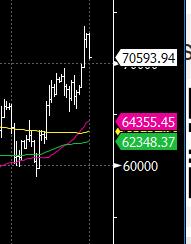
It’s been a strong week for digital assets, especially among large-cap tokens. BTC, ETH, and SOL have each moved higher by 5-10%, with BTC drawing the most attention. BTC is under close watch as it nears its all-time high around 73,800. On Tuesday, we saw a swift surge from 69,500 to 73,500, driven by the liquidation of leveraged short positions, which spurred an influx of cover bids. Prices have eased back to 72,200 at the time of writing, but there’s optimism that we may soon break through this ceiling. Significant short perpetual interest has rebuilt in the 73,200-73,600 range, so any approach to that level could trigger another wave of short covering, potentially pushing prices higher.
Taking a step back, many have questioned the recent surge in BTC price over the past month. We offer two thoughts, though we admit it's challenging to discern a clear rationale behind any asset price movement. First, ETF inflows have been notable. When these products launched earlier this year, there was a striking influx as pent-up demand for accessible, liquid BTC exposure attracted new investors. After the initial euphoria and corresponding price increase, inflows were mostly mixed over the past 3-4 months. However, October has seen a significant uptick, with over $5.3b in net creations. We've received several inquiries about the basis trade (long ETF/short CME future) and whether this demand is related to traditional hedge funds setting up this trade. While this strategy does present an appealing return profile, we note that CME open interest is around $13b in notional value, which has remained relatively steady throughout the month.
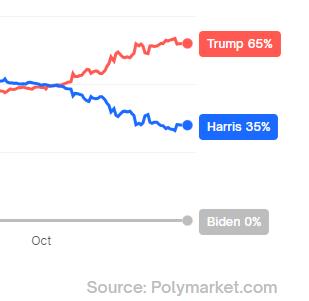
Our second thought is that the correlation between the rise in BTC (and other digital assets) and Donald Trump’s polling gains is notable. While the prevailing view is that a potential Trump administration would be bullish for the digital ecosystem, many see this overlap as mutually reinforcing. Any relief from existing litigations across the space, as well as a reprieve from the broader Operation Chokepoint 2.0, would indeed be a welcome development.
Source: Bloomberg
As we know, correlation does not imply causation. However, as the investment community considers assets that might benefit from a potential Trump administration, BTC and other digital assets appear to be a high-beta play on that outcome.
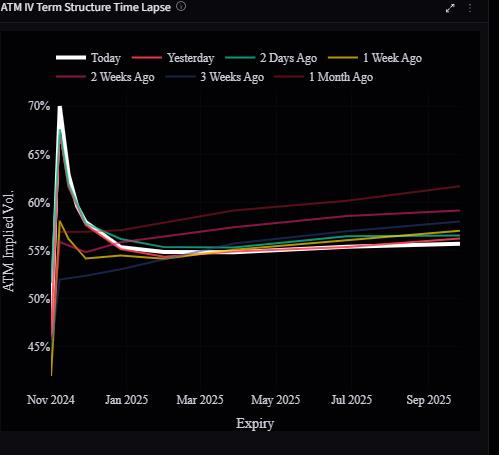
Speaking of election outcomes, a quick look at the options market shows a sizable move being implied by the election results. We estimate that November 8th expiry options are now pricing in an ~8% move in BTC tied to the election. Given the recent swing in polling toward Trump and the BTC price increase over the past month, November 8th or November 15th puts and put spreads might be worth considering as potential short-term hedges.
Source: TheTie
Key Takeaways
- Fantom's Price Surge & Market Relevance
Fantom (FTM) has seen a price rise of over 193.91% Y/Y, reaching $0.6803, in anticipation of the Sonic upgrade. Although Total Value Locked (TVL) remains below its 2021 peak of $8 billion, developer activity and strategic updates signal renewed potential for the ecosystem. - Sonic Upgrade’s Core Enhancements
The Sonic upgrade addresses Fantom's scalability and transaction speed, bringing up to 2,100 transactions per second (TPS) with sub-second finality. - Developer Incentives and Engagement
Initiatives like the Sonic Boom Bounty Program and the S Token Airdrop aim to attract developers by rewarding innovation and adoption. Over 212 code commits were recorded in October 2024—an increase of 37.7%—demonstrating growing developer interest. - Economic Model through Gas Monetization (GasM)
Sonic’s GasM program enables approved applications to earn up to 90% of transaction fees, while non-participants contribute to deflationary pressure through fee burning. This structure supports high-engagement projects and attracts developers.
Overview of Fantom: A Layer 1 Repositioning for Growth
Fantom launched in 2018 to address the blockchain trilemma—the challenge of balancing decentralization, security, and scalability. Its Lachesis consensus mechanism allowed validators to process blocks independently, reducing the time required for transaction finality. This differentiated Fantom from slower networks and positioned it as a scalable alternative to Ethereum and other Layer 1 blockchains.
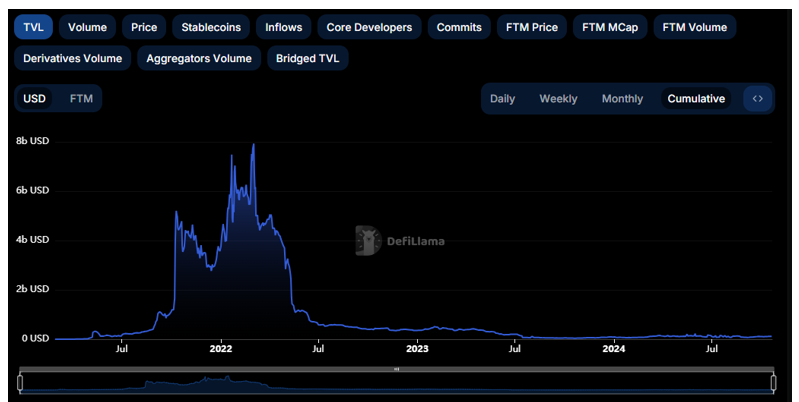
Fantom peaked in 2021, with TVL soaring to nearly $8 billion as the network attracted over 400 projects. However, a series of market shocks, including major collapses across the crypto ecosystem in 2022, severely impacted Fantom’s activity and capital inflows. Among these setbacks, the Multichain Bridge hack in July 2023 was particularly significant. The Multichain cross-chain bridge protocol experienced a major security breach, resulting in unauthorized withdrawals exceeding $125 million, with nearly $120 million originating from Multichain’s Fantom bridge. This breach led to a sharp decline in Fantom’s TVL, with a 30% drop following the incident as users and liquidity fled from the ecosystem. In response, Fantom has been actively working on a decentralized solution to address security vulnerabilities in cross-chain transactions, an effort which we explore later.
Source: Defillama
Sonic: The Upgrade That Could Redefine Fantom
The Sonic upgrade addresses several of Fantom's current scalability and transaction speed limitations. It represents the next evolution of the Opera mainnet, Fantom’s existing blockchain infrastructure, which will continue to operate temporarily while Sonic gradually transitions into the network’s primary infrastructure.
Key Features of the Sonic Upgrade:
- Transaction Throughput: Sonic will process up to 2,100 TPS, improving from the current 21 TPS on the Opera chain. This 100x increase in throughput positions Sonic as a highly scalable Layer 1 solution, capable of supporting applications that require high transaction speeds, such as financial markets, AI-driven applications, and gaming platforms. For comparison, Ethereum’s current capacity is around 15 TPS. While Solana can achieve TPS rates in the range of 3,000 to 5,000 TPS under real-world conditions.
- Transaction Finality: Sonic aims to provide sub-second finality (~700 milliseconds), enhancing the network’s efficiency for latency-sensitive applications. This improvement is comparable to fast finality times achieved by layer 1 chains like Solana, which also emphasize low-latency performance.
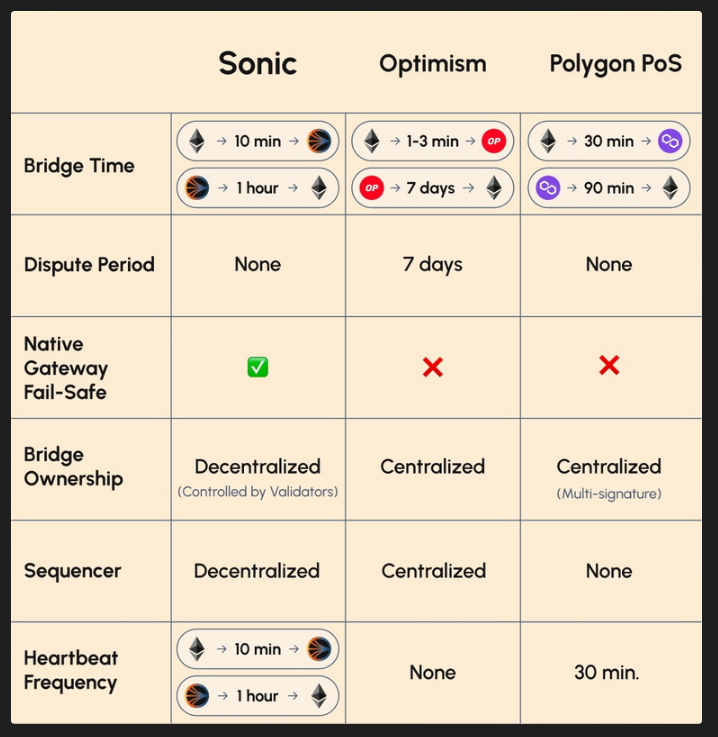
- Decentralized Security with the Sonic Gateway: Sonic introduces the Sonic Gateway, a decentralized bridge connecting Ethereum and Sonic. Unlike centralized bridges prone to vulnerabilities and hacks, Sonic’s bridge features a fail-safe mechanism that allows users to recover their funds during a network failure. The Gateway also processes transactions from Ethereum to Sonic in about 10 minutes, while reverse transactions from Sonic to Ethereum take up to 1 hour.
Source: soniclabs.com
Validator Efficiency and Scalability: A Key Differentiator
The Sonic upgrade goes beyond transaction speed, introducing substantial improvements in validator operations and network efficiency. Key improvements include:
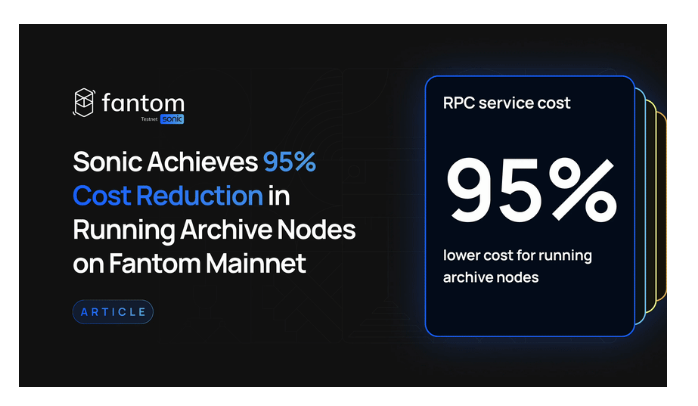
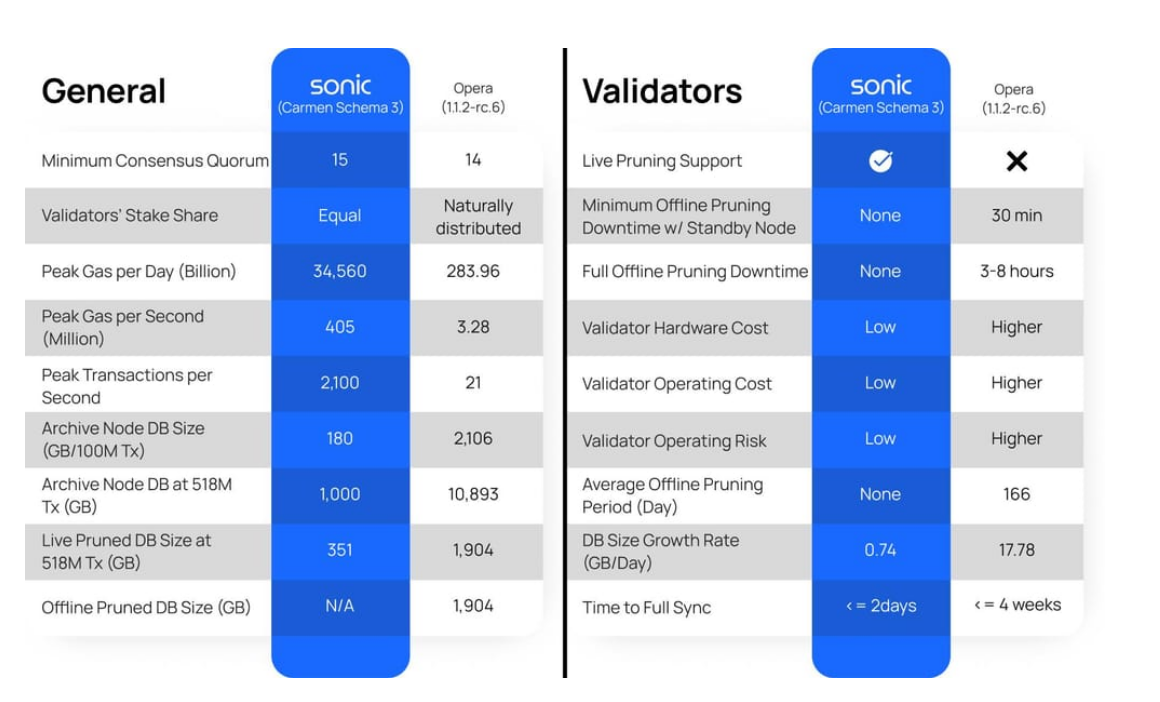
- Database Efficiency: Sonic's archive node database size has been reduced by approximately 95% compared to Opera, with Sonic's archive node database for 100 million transactions totaling 180 GB versus 2,106 GB on Opera. This optimization dramatically lowers storage costs and improves efficiency for validator operators.
Source: fantom.foundation
- Pruning and Syncing Improvements: Sonic features live pruning support, eliminating downtime during pruning activities, whereas Opera validators require 3-8 hours of offline pruning downtime. Sonic also boasts a time-to-full-sync of ≤2 days, compared to Opera’s 4-week synchronization time, significantly enhancing uptime and reducing operational delays.
- Gas Processing Capacity: Sonic can handle 405 million gas per second, substantially increasing from Opera’s 3.28 million gas per second. This higher gas capacity ensures the network can support complex transactions and high-throughput dApps without experiencing congestion or latency issues.
Table Comparison of Sonic vs. Opera Validators:
Source: fantom.foundation
Sonic Gems and the S Token Airdrop
The Sonic Boom Bounty Program is structured around two core incentives: Sonic Gems and the S token airdrop. Here’s how they work:
- Sonic Gems: Points awarded to developers for building dApps on the Sonic network. Sonic Gems act as a competitive scoring metric, enabling projects to accumulate points based on their innovation and performance. Up to 30 top projects will receive Sonic Gems, which they can later distribute to users to incentivize adoption and engagement.
- S Token Airdrop: The S token is a new utility token introduced as part of the Sonic ecosystem. Existing FTM holders will be able to convert their tokens to S at a 1:1 ratio upon Sonic’s launch, providing continuity for the Fantom community. A total of 190,500,000 S tokens are allocated for this airdrop, aimed at rewarding developers and promoting early adoption of dApps on Sonic. Projects that earn Sonic Gems are eligible to receive S tokens,
Gas Monetization Program (GasM)
The Gas Monetization (GasM) initiative on the Sonic network represents a shift in how transaction fees are allocated and utilized within the ecosystem. Unlike traditional gas fee structures, Sonic’s GasM program is designed to incentivize developers by offering them a direct revenue stream from the gas fees generated by their applications.
Here’s how the program works if a user submits a transaction on an app:
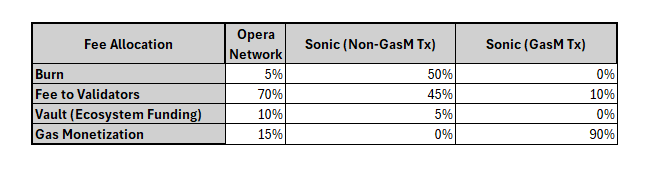
- For Non-GasM Participants: 50% of each transaction fee will be burned, permanently removing these tokens from circulation to create deflationary pressure. The remaining 45% of the fee is allocated to validators, supporting network security and incentivizing validator participation. The last 5% is directed to the Ecosystem Vault, which funds various network initiatives.
- For GasM Participants: Protocols that qualify under the GasM program can earn up to 90% of the gas fees generated by their dApps, creating an ongoing revenue stream that rewards high-usage applications. This “cash-back” model is exclusive to applications approved through a governance vote, requiring at least 55% approval and a 10% quorum to ensure community alignment. The remaining 10% of these GasM transactions go to validators, maintaining their role in network security.
Potential Gas Fee Allocations:
Source: StoneX Digital / fantom.network
This new allocation strategy emphasizes two goals:
- Supporting High-Engagement Projects: By allocating up to 90% of gas fees to GasM participants, Sonic encourages developers to build applications that drive user engagement and generate high transaction volumes. This model rewards developers for contributing to the network’s activity and incentivizes existing and new projects to migrate to Sonic from other platforms.
- Balancing Ecosystem Economics: For non-GasM transactions, a significant portion of fees (50%) is burned, thereby reducing the overall token supply. This burn mechanism is aimed at balancing supply with demand, potentially increasing the value of the S token over time by creating scarcity. Validators continue to receive a notable share (45%) of non-GasM transaction fees, maintaining the network’s security incentives.
Developer Activity and Ecosystem Revival
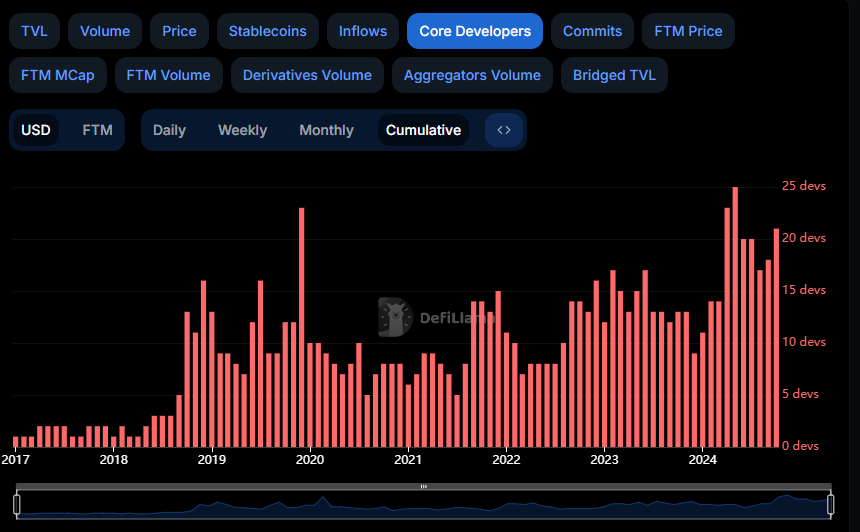
Fantom is showing signs of revival as developer activity rises, driven by the upcoming Sonic upgrade. On-chain data from DeFiLlama and Token Terminal reveal a 37.7% increase in code commits over the last 30 days, with 212 total contributions in October 2024. This uptick suggests a renewed developer focus and alignment with Sonic, positioning Fantom for ecosystem expansion.
- Ethereum: Leads with 145 core developers.
- Solana: Has around 45 core developers, strong in DeFi and NFTs.
- Fantom: Approximately 20 core developers, yet recent spikes in activity highlight its potential to attract projects and boost user engagement.
Source: Defillama.com
Tokenomics and Funding Programs
Sonic’s approach to tokenomics is designed to support network growth while balancing supply and demand. The tokenomics model introduces mechanisms like airdrops, staking rewards, and a structured burn strategy to manage the S token’s value over time.
Airdrop Program and Initial Supply Allocation
- 6% Airdrop Allocation: Six months after Sonic’s launch, 6% of the total supply, equivalent to 190.5 million S tokens, will be minted and allocated to an airdrop program aimed at incentivizing adoption across both the Fantom Opera and Sonic networks.
- Vesting Schedule: The airdrop features a nine-month vesting schedule for 75% of the allocated tokens. Any unclaimed or forfeited tokens during this period will be burned.
- Sonic will annually mint 1.5% of its initial supply for six years to fund global adoption, innovation programs, and developer education, with an annual burn of unused tokens to prevent inflation.
Staking and Validator Rewards
Sonic’s staking model is streamlined with a 14-day lock-up period and 7-day withdrawal window to encourage liquidity and attract participation in the growing liquid staking market, valued at over $500 million.
- Validator Rewards: During Sonic’s initial four years, block rewards are sourced from the existing FTM supply transferred from the Opera network. Validators will earn an annual target reward rate of 3.5% when 50% of the network is staked, with a dynamic adjustment mechanism based on staking levels (e.g., 1.75% APR if all tokens are staked, or 7% APR if only 25% are staked).
Pro-Trump Bet on Polymarket Raises Attention Ahead of U.S. Election
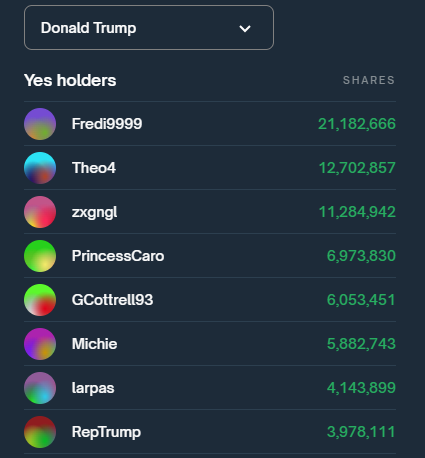
In the lead-up to the 2024 U.S. presidential election, decentralized prediction platform Polymarket has identified betting activity favoring Donald Trump. A French trader reportedly placed around $28 million in pro-Trump bets, utilizing multiple accounts—such as Fredi9999, Theo4, PrincessCaro, and Michie—to diversify his positions and manage exposure without distorting the market.
Polymarket's Current Odds
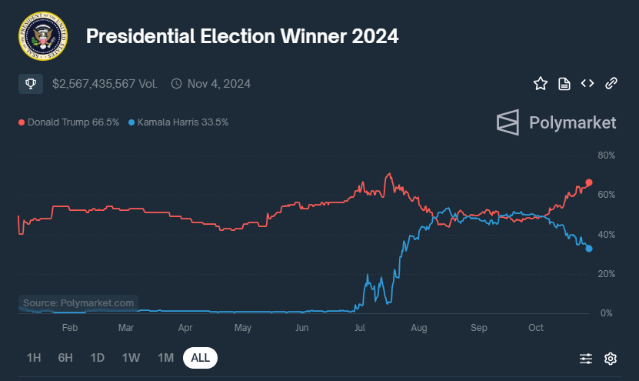
According to late-October data, Polymarket currently reflects a strong probability of a Trump victory, showing him at 66.5% odds compared to Kamala Harris's 33.5%. This prediction market approach relies heavily on real-money wagers, demonstrating that participants believe Trump has a significant edge.
Source: polymarket.com
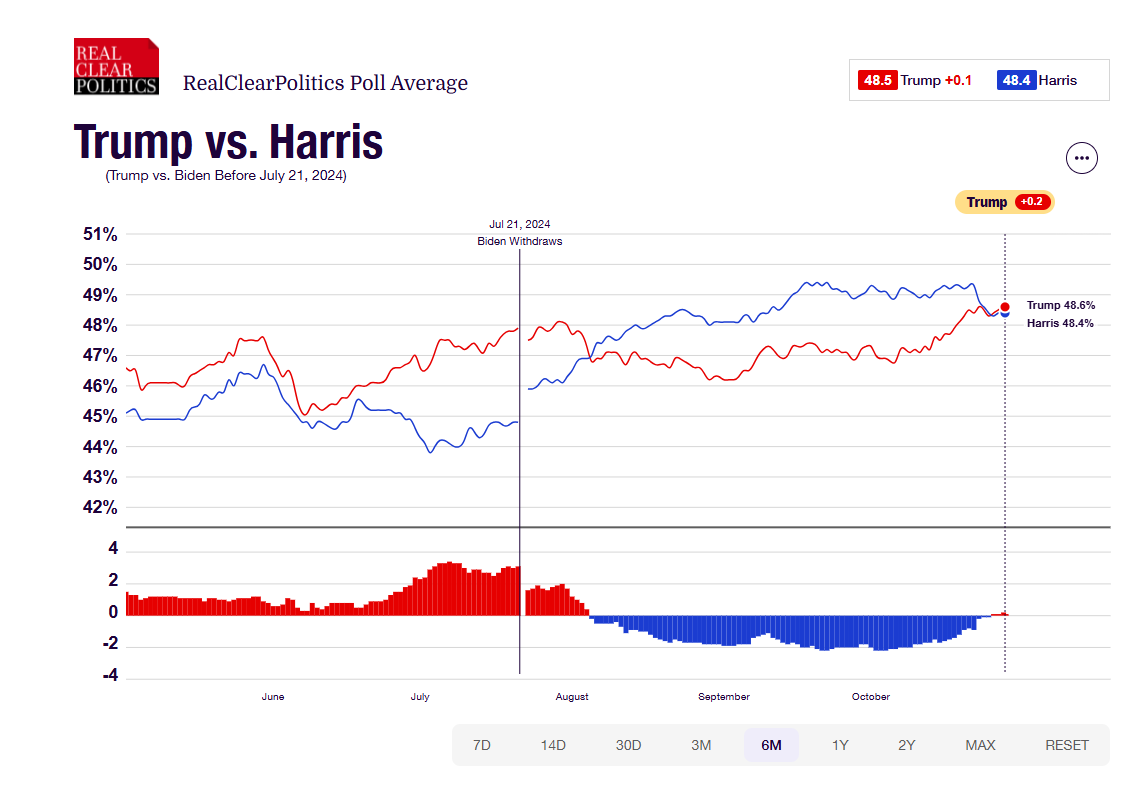
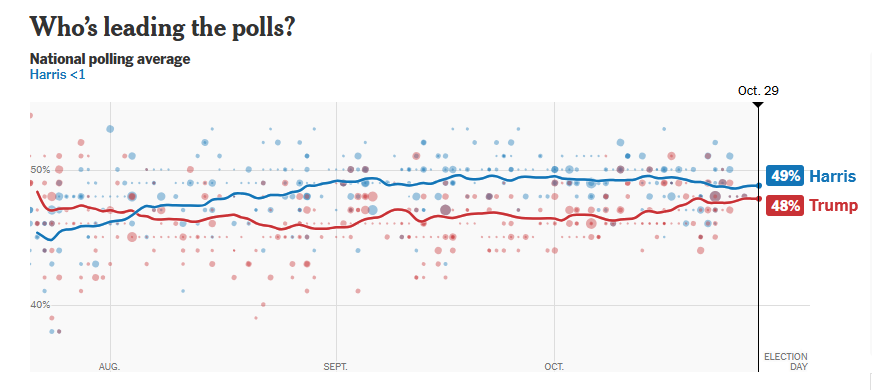
Comparison to National Polls: In contrast, national polling data from RealClearPolitics and The New York Times illustrate a much narrower gap. For example:
- RealClearPolitics polling average, as of late October, shows Trump slightly leading Harris with 48.6% to 48.4%. RCP’s data is an average of multiple national polls, including surveys from various pollsters, which provides a balanced view by averaging results from diverse methodologies.
Source: realclearpolling.com
- New York Times Polling indicates an even closer race, with Harris slightly ahead at 49% compared to Trump’s 48%.
Source: nytimes.com
What Drives the Discrepancy? The variance between Polymarket's odds and traditional polling averages could be attributed to several factors:
- Market Sentiment vs. Public Opinion: Prediction markets are influenced by the financial risk that participants are willing to take. This risk may reflect their confidence or inside information but is not necessarily representative of broader public opinion.
- Polling Limitations: Traditional polls may only partially capture the sentiment of specific voter demographics overrepresented in prediction markets. Additionally, polls are subject to sampling error and may need to catch up to rapid shifts in voter sentiment.
- Trader Bias and Speculation: Polymarket's traders might be influenced by speculation rather than empirical data, especially given the trader’s extensive financial background and significant investment in a pro-Trump outcome. This approach contrasts with polling methodologies that attempt to mitigate biases.
Sector Commentary
- Layer One / Altcoins
- Bitcoin ($BTC): Record BTC price in sight as bitcoin ETF flows surge (link)
- Bitcoin ($BTC): Here Are 3 Reasons Why Bitcoin Open Interest Set Record Highs as BTC Price Surge to $71K (link)
- Bitcoin ($BTC): Bitcoin Tops $73.5K, Climbing Just Shy of New Record High (link)
- Bitcoin ($BTC): ‘Trump trade’ and derivatives market optimism help bitcoin gain ground ahead of US election: analysts (link)
- Bitcoin ($BTC): Bitcoin trader sees all-time high ‘this week’ as BTC price nears $73K (link)
- Ethereum ($ETH): Ethereum’s staking rewards rate remains at around 3%, lower than other proof-of-stake chains (link)
- Ethereum ($ETH): Ethereum community doesn't need to 'justify the inadequacies of the present' when building the future, Vitalik Buterin says (link)
- Ethereum ($ETH): Ethereum mainnet issues drive users to Layer 2s and Solana, analyst says (link)
- Solana ($SOL): VanEck begins SOL staking with Kiln partnership (link)
- Dogecoin ($DOGE): Dogecoin Bets Spike to $1.3B as Trump Popularity Sees DOGE Rocket 15% (link)
- Altcoins: CoinDesk 20 Performance Update: APT Surges 10.9% as All Index Constituents Trade Higher (link)
- DeFi / Stablecoins
- Web3 / AI / NFTs
- RWA / Tokenization / Metaverse / Gaming
- Digital Infrastructure: Capital Markets / Exchanges / DAOs / Mining
- Arthur Hayes and the Lessons of Decentralization (link)
- Crypto for Advisors: Bitcoin on The Balance Sheet (link)
- MicroStrategy's leveraged bitcoin strategy has its stock outpacing BTC this year (link)
- MicroStrategy’s Current Premium Relative to Its Bitcoin Stack Is Unlikely to Last: Steno Research (link)
- Coinbase Revenue May be Hurt by Lower Trading Volumes, Regulatory Uncertainty, Analysts Say (link)
- Crypto Stocks MicroStrategy, Coinbase and Marathon Post Just Modest Gains as Bitcoin Eyes Record High (link)
- Emory University Joins Bitcoin ETF Rush, Reporting $16M Holding in Grayscale Vehicle (link)
- Grayscale’s Bitcoin, Ether 'mini’ ETFs pulled $750M in first 3 months (link)
- Op-Ed: The Scoop: Spot ETF flows indicate 'Uptober' after all (link)
- US spot bitcoin ETFs saw $479 million in net inflows yesterday, highest in two weeks (link)
- Bitcoin Miner HIVE Poised to Double Its Hashrate by Next Year, Cantor Says Initiating Stock at 'Overweight' (link)
- BTC Miner Core Scientific Uniquely Positioned to Capture AI Demand, Initiate at Buy: Jefferies (link)
- Bhutan government moves $66 million in bitcoin to Binance deposit address: Arkham (link)
- From $8,000 to $53 million: Bitcoin wallet dormant since 2012 wakes up (link)
- FTX estate sues KuCoin to recover over $50M in assets (link)
- FTX's $228M Settlement With Bybit Brings Conclusion of Epic Liquidation Closer (link)