MegaETH: Ethereum’s Need for Speed

Executive Summary
- Market trading color: Markets remain choppy amid tariffs, regulation news, and shifting sentiment, with Bitcoin dominance rising
-
Theme of the week – MegaETH aims to deliver ultra-low latency Layer-2 scaling, enabling real-time trading with testnet in a few weeks
- Links of the week: Bitcoin rally nears, hedge funds short ETH, Solana DEX volume rises, and crypto regulation debates intensify
Market Trading Color
Another week where sentiment seemed to flow in waves almost daily. The majority of the action we’re referring to didn’t start until Sunday night. Despite attending the Super Bowl, President Trump couldn’t help but mention new 25% tariffs on steel and aluminum. This sent BTC spiraling from $99,000 down to below $95,000. What was encouraging, though, was the pace of Bitcoin’s recovery this time compared to previous instances when tariffs were introduced or mentioned. By the time Monday’s trading session ended, BTC showed a daily green candle, seemingly on its way to flipping $100,000 once again.
However, this was short-lived once news spread that Binance had sold off a portion of its reserves. On top of this, yesterday’s CPI data coming in hotter than expected did not help the crypto market. While gold rallied, Bitcoin lagged and sold off over the course of the day. The outlook was bleak until late afternoon when news broke that 21Shares submitted a proposal to the SEC to incorporate staking in their ETH ETF. This sparked renewed excitement and even a jolt in ETHBTC and ETH beta for the time being. That was until DJT announced new rounds of tariffs coming this afternoon.
That is where the crypto market currently stands: incredibly choppy with no real end in sight for now. The macro outlook isn’t favorable, with further rate cuts being either priced out completely or pushed further down the line. However, there is hope that with the latest macro news behind us and the market digesting it, the positive crypto-specific news this administration releases will actually take the market higher. Alongside this, many are looking for the next natural buyer. We expect that to be large asset managers, corporates, and treasuries. VanEck published an analysis yesterday of the 20 state-level Bitcoin reserve bills. In their conclusion, they believe that if enacted, this could drive $23 billion in buying pressure on BTC.

Source: VanEck
While the positive news out of the White House we’re referring to above is the implementation of a stablecoin bill and the continued clarity surrounding crypto regulations, the industry took a step forward this week with the appointment of ai16z’s Brian Quintenz as CFTC head. On Quintenz, CFTC Chair Caroline Pham stated, "I worked with Brian on important initiatives that he led to success when he was a CFTC Commissioner. He will do the same for crypto and innovation.”
It's no secret that amongst this chop, Bitcoin dominance has continued to risen. Bitcoin has acted as a safe haven of sorts while alts have bled relentlessly. Using ETH vol as a proxy for alts and higher beta, you could see the vast decoupling from the king that is Bitcoin. Bitcoin 1D implied is screening near yearly lows around 57 despite the madness in the market of late.
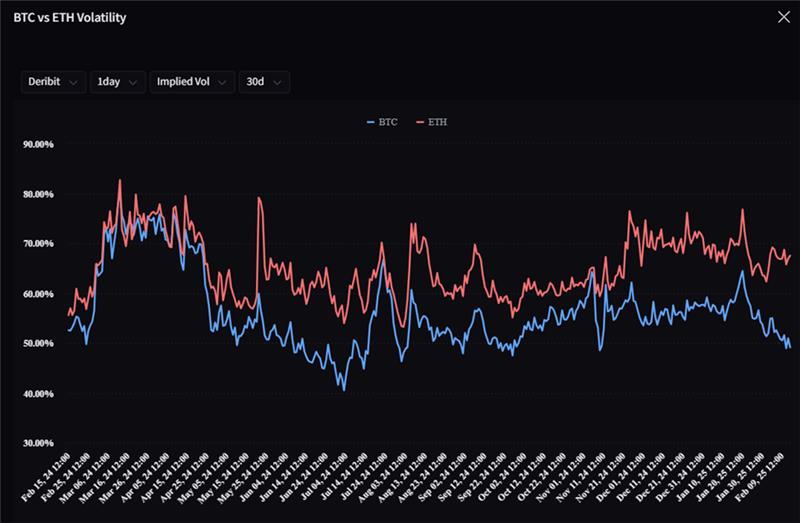
Source: TheTie
MegaETH: Driving Real-Time Performance on Ethereum
As Ethereum’s Layer-2 ecosystem continues to fragment, with multiple solutions competing for market share, MegaETH has emerged with a bold promise: near-instant block times (10ms) and throughput of up to 100,000 transactions per second (TPS). These technical benchmarks aim to address one of Ethereum’s most pressing challenges, scalability, while unlocking a new class of on-chain applications, particularly in high-frequency trading, gaming, and decentralized finance (DeFi).
At a time when Ethereum’s core developers and the Ethereum Foundation are actively discussing ways to enhance on-chain throughput and optimize the network’s modular economics, MegaETH offers an alternative path, one that prioritizes ultra-low latency and high throughput. This focus on speed and efficiency positions MegaETH as a compelling option for real-time applications that require near-instant settlement.
With testnet reportedly launching in a few weeks, and the suite of MegaMafia projects already in development, any positive sentiment and shift of excitement towards Ethereum and MegaETH will be monitored by our team.
Why MegaETH Matters to the Digital Asset Ecosystem
Ethereum’s roadmap has long emphasized L2 scaling solutions, leveraging rollups to achieve lower fees and higher throughput. Existing optimistic and zero-knowledge (ZK) rollups (e.g., Optimism, Arbitrum, and StarkNet) already process a growing share of Ethereum transactions. However, these solutions typically settle on Ethereum at timescales of minutes to hours, making them less suitable for real-time use cases such as algorithmic trading or rapid in-game interactions.
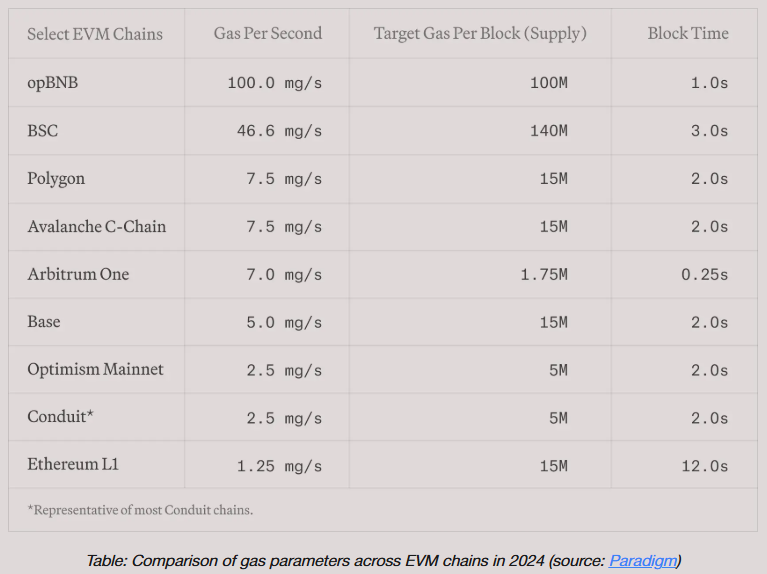
As the table above illustrates, even the fastest existing EVM chains face significant limitations in terms of throughput and block processing times. While opBNB achieves a relatively high gas rate of 100 MGas/s, this still falls short of Web2 performance standards. For context, this translates to only 650 Uniswap swaps or 3,700 ERC-20 transfers per second, whereas modern database servers routinely exceed one million transactions per second in TPC-C benchmarks.
MegaETH is specifically engineered for high-velocity markets by offering:
- Ultra-low latency: 10ms block times, enabling near-instant confirmations.
- High throughput: Up to 100,000 TPS, supporting multiple complex dApps running in parallel.
- Broad user alignment: A capital structure designed to involve thousands of individual investors early on.
By outpacing existing EVM chains in performance and scalability, MegaETH unlocks new opportunities for real-time financial instruments, hyper-interactive gaming economies, and rapid on-chain liquidity provisioning. As Ethereum developers continue exploring ways to improve its modular stack and economic efficiency, MegaETH could be a layer that positions itself as a key enabler of on-chain applications that demand Web2-level performance.
The MegaMafia: 15 Projects Poised for High-Velocity Applications
MegaETH has assembled a cohort of 15 projects, collectively known as the “MegaMafia,” each exploring use cases that demand swift execution and high throughput.
- GTE: The world’s fastest decentralized trading venue, engineered for speed and designed for professional traders with uncompromised performance.
- Teko: The first real-time lending market, enabling an unlimited range of assets to be borrowed while protecting lenders with hyper-efficient liquidations and custom-tailored risk profiles.
- Euphoria: Derivative trading as a mobile-first consumer experience, using novel financial primitives to create synthetic counterparties without liquidity fragmentation.
- Showdown: An onchain trading card game built by top-ranked Hearthstone and Magic players, blending strategic depth with blockchain mechanics.
- Cap: A stablecoin engine with adaptive yield, enabling interest-bearing decentralized stablecoins that scales.
These projects underscore MegaETH’s core philosophy: high-speed settlement opens the door to new product categories that are not feasible on slower networks.
Architectural Overview: Four Node Types for Parallel Efficiency
Structurally, MegaETH is an optimistic rollup anchored to Ethereum for security (settlement) and leveraging EigenDA for data availability. The network operates with four specialized node types:
- Sequencer: Processes transactions in parallel and orders them. Initially, a single MegaETH-operated sequencer ensures consistency. Due to parallel execution, sequencers demand hardware resources roughly 10x greater than a Solana full node.
- Prover: Generates optimistic fraud proofs, verifying block contents without fully re-executing transactions. Collateralized to disincentivize malicious behavior, provers serve as the watchdogs for the sequencer’s outputs.
- Replica Node: Applies state diffs delivered by the sequencer, relying on valid proofs from provers instead of re-executing transactions. Ideal for application front ends, RPC infrastructure, and developer tooling.
- Full Node: Replays transactions to validate state changes without requiring the heavy hardware of the sequencer. Critical for real-time validity for market makers, bridge operators, and institutional participants.
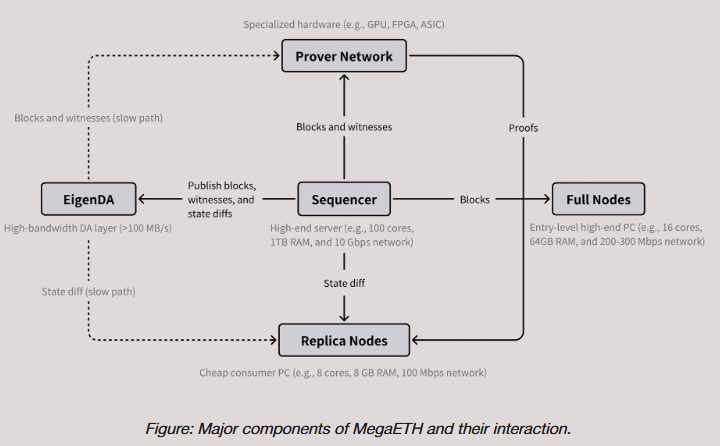
Source: Megaeth.com
This specialized node design aims to maximize throughput while maintaining trustless guarantees consistent with Ethereum’s security model.
Links of the Week
- StoneX Digital Top 10 Links of the Week
- Bitcoin ($BTC): Bitcoin all-time high due in '2-3 weeks' as traders see BTC copying gold (link)
- Ethereum ($ETH): Hedge Funds Are Short Ether CME Futures Like Never Before. Is It Carry Trade or Outright Bearish Bets? (link)
- Solana ($SOL): Solana DEX Volume Tops $60M as It Looks to Extend 4-Month Winning Streak Over Ethereum (link)
- Crypto Ecosystem Growth Slowed in January Even as Total Market Cap Rose, JPMorgan Says (link)
- Strategy's Michael Saylor posts BTC chart after one-week break (link)
- Analysts Give XRP, Dogecoin, Litecoin ETFs ‘High Odds’ of Approval (link)
- Forbes Electing Crypto Series: Trump’s First 100 Days—The High-Roller Crypto Bet (link)
- OpenSea denies NFT airdrop rumors, calls website a test page (link)
- Fed Chair Powell calls for ‘fresh look’ at debanking amid crypto industry concerns (link)
- What the Binance and SEC’s temporary ceasefire means for other crypto cases (link)