POL Fiction: Unpacking Polygon's Next Chapter
Executive Summary
- Market trading color: Recent outflows from spot ETFs, September vs October price performance historically, the slow bleed for ETHBTC and recent spot buying we've seen at these levels
- Theme of the week – Polygon's POL token transition enhances governance, staking, and ecosystem expansion within the AggLayer initiative
- Sector commentary: Bitcoin's volatility, Ethereum revenue drop, Ripple's smart contracts, Solana's decline
Market Trading Color (Nolan Aibel)
The crypto market has taken a hit over the past week alongside the stock market. $BTC and $ETH are both down over 6% on the week having touched monthly lows Tuesday night. On the move downward, $BTC had no problem breaking through support near $57,200, liquidating nearly $200M along the way. There’s not much leverage built up now below, some are targeting a test of $52,000 before the next move higher. Resistance lies ahead at $60,000. September has historically been a poor one price wise as Bitcoin performance on the month has been negative 6 out of the past 7 years. With geopolitical tension and signs of economic weakness persisting, this year may continue that trend. ETFs have struggled of late. Over the past 7 days, BTC ETFs have seen a total outflow of 12,840 BTC ($804M). ETH ETFs have seen $89M of outflows over the same time period. It is a little worrying to see outflows pick up as volumes dwindle. These products likely need sustained positive price action in BTC to see traditional investors climb down the market cap and gather real interest. If this does happen, $ETHE outflows would be a thing in the past, bullish. That good news is that price action has turned around tremendously in October as BTC price performance has been in the green by double digits the past 5 years.
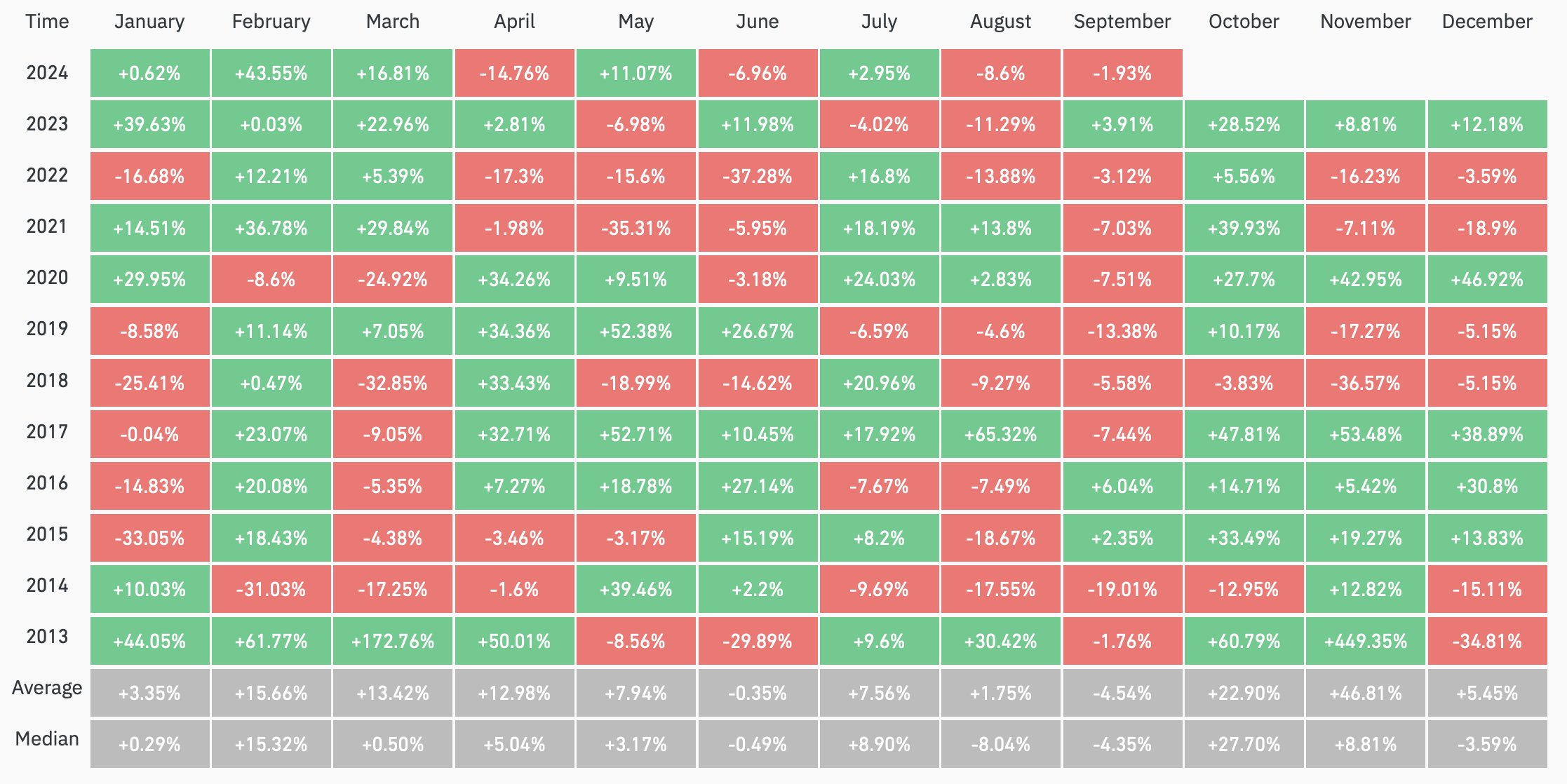
Source: Coinglass
Can ETHBTC really bleed much lower than it is now? Over the past 6 months the ratio is down nearly 26% sitting at 0.04219. That leads us to our call we are hosting with Matt Sigel, Head of Digital Assets Research at Van Eck on Tuesday. Matt and David Kroger, StoneX Digital Data Analyst, will dive into ETH as an investment. It’s important to understand that ETH is viewed as important infrastructure within the ecosystem and why big-name companies and projects choose to build on Ethereum. Security, Decentralization, and deflationary nature trump execution prices and speed in many scenarios.
We have seen a good amount of BTC spot volume since the dip Tuesday. Coinbase seemingly has as well. The below chart showcases that Coinbase saw the largest amount of spot buying in a month. The majority of economic data this week has been poor yet BTC has refused to sink below $55,000. StoneX is looking toward two key metrics in tomorrow’s jobs report. The jobless rate and payroll employment growth. The market will use these to determine the probability of a 50 bps cut in September.
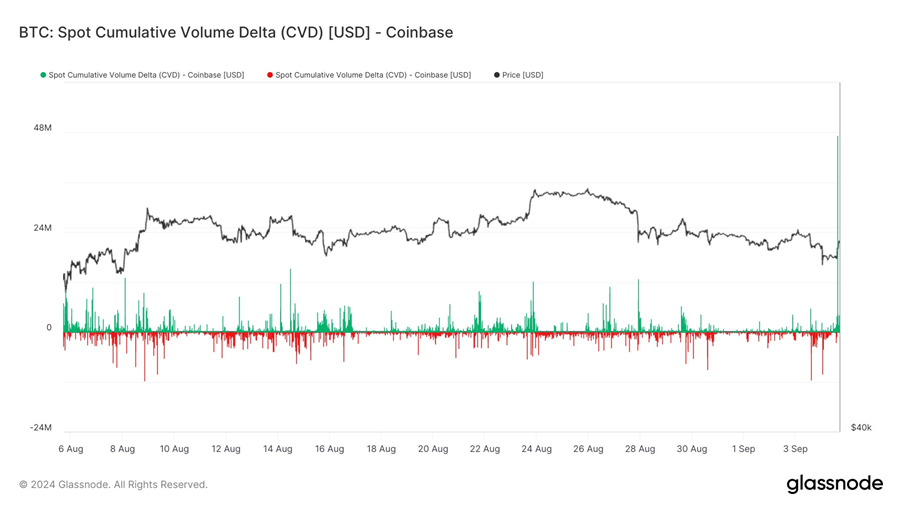
Source: Glassnode
The Transition to POL: A Strategic Upgrade for Polygon
Polygon has undergone a significant transformation as it transitions from MATIC to POL, a move that took place on September 4th. This transition is part of Polygon’s broader AggLayer initiative, a comprehensive upgrade designed to expand Polygon’s influence within the Ethereum ecosystem. POL, as a "hyperproductive token," will play a crucial role in decentralized governance, staking, and securing chains within the AggLayer—a network of aggregated blockchains that Polygon aims to establish.
While this evolution strengthens Polygon’s position in Ethereum’s scaling strategy, it also introduces new dynamics, including concerns about POL lowering Ethereum’s overall value capture. Starting September 4, 2024, POL will serve as the native gas and staking token on Polygon PoS, requiring validators to stake POL to secure the network and earn protocol rewards.
The AggLayer initiative is already attracting significant partnerships, including integrations with TON Blockchain, Ronin Network, and OKX, positioning Polygon for new user growth.
Understanding the AggLayer and Its Advantages
As part of Polygon 2.0, the AggLayer advances blockchain scalability, user experience (UX), and liquidity management. It is designed to create an aggregated environment where multiple chains—whether L1 or L2 networks—can interact seamlessly, offering a unified user experience while preserving the sovereignty of each individual chain.
The AggLayer leverages Zero-Knowledge (ZK) proofs to build a blockchain ecosystem that functions as a single, cohesive network, despite comprising multiple interconnected chains. This horizontally scalable multichain framework allows POL to perform various critical functions, including block generation, ZK proof generation, and participation in Data Availability Committees (DACs). By 2025, these roles are expected to expand further, further driving the importance of POL to the ecosystem.
This architecture offers several key advantages:
- Unified Liquidity and Capital Efficiency:
- The AggLayer allows different chains within the ecosystem to share liquidity, enhancing capital efficiency. This unified liquidity pool enables dApps and protocols to access a larger market without cumbersome bridging, often resulting in fragmented liquidity and poor user experiences.
- Improved User Experience:
- The AggLayer aims to offer a user experience akin to the seamlessness of the Internet. Users can interact with dApps across chains without requiring manual bridging or complex transactions. This results in near-instant, atomic transactions that can be executed in less than one second, providing a truly frictionless experience.
- Sovereignty for Chains:
- Despite the unified environment, each chain within the AggLayer maintains full sovereignty. L1s and L2s connected to the AggLayer can still operate independently while benefiting from the shared security, liquidity, and enhanced UX that the AggLayer provides.
- Developer Reach and Accessibility:
- For developers, the AggLayer offers the advantage of reaching a broader audience. Even if a dApp is deployed on a specific chain, users from other chains within the AggLayer can easily interact with it, removing the barriers traditionally associated with cross-chain interactions.
Governance and Community-Led Development
Beyond the concerns about detracting value from Ethereum there are also concerns about centralization risks. POL is intended to empower its holders with governance rights, particularly over the Community Treasury, which funds protocol development, research, and adoption initiatives. However, the distribution of POL ownership is highly concentrated. According to the latest data, the top 10 holders control 91.14% of the total POL supply. This concentration of ownership raises concerns about the distribution of governance power within the network, implying that a small number of entities have significant influence over key decisions.
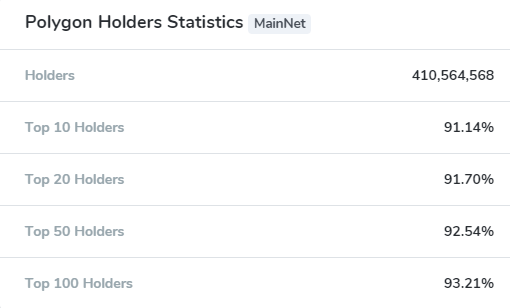
Source: coincarp.com
L2 Solutions and Ethereum
L2 solutions like Arbitrum, Optimism, Base, and the newly upgraded Polygon PoS have been instrumental in scaling Ethereum by handling transactions off-chain and settling them on-chain. This approach preserves Ethereum’s security and decentralization while significantly reducing transaction costs and increasing throughput. However, the rapid growth of L2s raises important questions about whether these solutions are extractive or symbiotic to Ethereum.
To better understand this dynamic, let's examine key metrics comparing Ethereum with its leading L2s: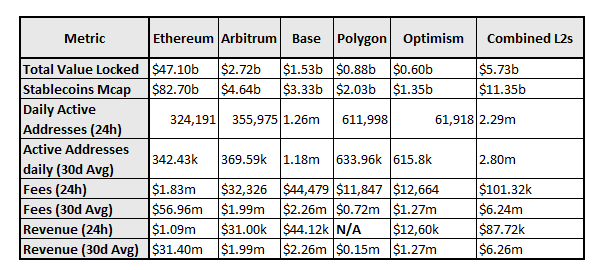
Source: DefiLlama, Token Terminal
- Total Value Locked (TVL): The combined TVL of the top L2s stands at $5.73 billion, representing 12.17% of Ethereum’s $47.10 billion TVL. This shows the significant value locked on these secondary layers, independent of the Ethereum mainnet.
- Daily Active Addresses: L2 networks boast 2.29 million daily active addresses, far surpassing Ethereum’s 324,191. This disparity suggests higher user activity on L2s, driven by lower transaction costs and faster processing times.
- Transaction Fees: Despite their high activity levels, L2s generate $101.32k in daily fees, just 5.53% of the $1.83 million generated by Ethereum. For a detailed exploration of why L2s produce lower fee revenue despite higher usage, refer to our previous report, StoneX Digital Asset Weekly: Reduced Costs, Increased Activity - Ethereum's L2 Post-Dencun (March 21, 2024).
- Revenue: L2 networks generate $87.72k in daily revenue, accounting for 8.05% of Ethereum’s $1.09 million daily revenue.
These metrics underscore the evolving role of L2s in Ethereum’s scaling strategy, particularly following the Dencun upgrade and introduction of data blobs, which further reduced transaction costs on L2s.
Economic Implications: Staking and Long-Term Value
- ETH Staking: A substantial portion of ETH is locked in staking contracts, with platforms like Lido and EigenLayer managing $24.658 billion and $11.838 billion in staked ETH, respectively. This staking reduces ETH’s circulating supply, bolstering its scarcity and value. ETH also remains a cornerstone in DeFi, with significant amounts locked in protocols like Aave ($9.655 billion TVL) and Uniswap ($3.619 billion TVL).
- POL Staking: As POL becomes central to the AggLayer, its staking mechanisms must evolve to offer competitive yields and attract validators. However, without a burn mechanism akin to EIP-1559, POL may lack the same deflationary potential as ETH. The success of POL staking will hinge on providing sufficient incentives within the expanding AggLayer ecosystem, especially as POL takes on additional roles in governance and network operations.
Sector Commentary
- Layer One / Altcoins
- Bitcoin ($BTC): Bitcoin Could Drop 20% After Fed Rate Cuts in Bearish Case, but Weak September Presents Buying Opportunity: Analysts (link)
- Bitcoin ($BTC): Crypto Tuesday Crumble Sends Bitcoin Below $58K, Ether to 7-Month Low (link)
- Bitcoin ($BTC): Bitcoin Margin Longs on Bitfinex Defy Bearish Seasonality (link)
- Bitcoin ($BTC): Key Week for Bitcoin and the Dollar Index (link)
- Bitcoin ($BTC): Bitcoin network hashrate reaches new all-time high (link)
- Bitcoin ($BTC): Bitcoin ‘new’ investor spike echoes 2019 BTC price peak — Analysis (link)
- Ethereum ($ETH): Ethereum layer-1 network revenue collapses — What’s causing it? (link)
- Ethereum ($ETH): Ether trails bitcoin and solana in 2024. What that means for crypto portfolios (link)
- Ripple ($XRP): Ripple Will Soon Add Ethereum Compatible Smart Contracts to XRP Ledger (link)
- Solana ($SOL): Solana network transactions hit multi-month low in August (link)
- Toncoin ($TON): Most TON Holders In the Red as Price Keeps Falling After Telegram CEO Arrest (link)
- Altcoins: CoinDesk 20 Performance Update: DOT and HBAR Outperform as Index Rises 0.9% (link)
- DeFi
- Web3 / AI / NFTs
- Coindesk Protocol Village: Union, Native to Develop 'Trust-Minimized' Bitcoin L2 Bridges; Security Firm Hypernative Raises $16M (link)
- Qatar Brings in Crypto Rules Framework in a Sign of Web 3 Development in the Middle East (link)
- Blockchain immutability could help prevent censorship scandals, Bernstein analysts say (link)
- RWA / Tokenization / Metaverse / Gaming
- Digital Infrastructure: Capital Markets / Exchanges / DAOs / Mining
- Blockworks Empire Newsletter: Is mass adoption still crypto’s most important goal? (link)
- Bukele was right: El Salvador timed the bitcoin bottom almost perfectly (link)
- Metaplanet Teams Up With SBI VC Trade for Bitcoin Custody (link)
- Bitfarms mines 233 BTC in August as Riot pens open letter in takeover saga (link)
- SEC charges and settles with crypto-focused Galois Capital over custody issues (link)
- SEC Might Challenge FTX Bankruptcy Estate From Paying Back Customers With Stablecoins (link)
- OKX Receives Major Payment Institution License in Singapore (link)
- WazirX Hacker Starts to Move Stolen Ether Using Tornado Cash (link)
- SEC Commissioner Mark Uyeda Calls for S-1 Form Tailored for Digital Assets (link)
- 'Why Are You Doing This to Me?': Detained Binance Exec Begs Prison Guard for Help in New Court Footage (link)