Provided is a link to a discussion on the Bitcoin ETF approval and what we can expect hosted Friday, January 12th. Hosted by Eric Rose, Head of StoneX Digital Execution, and Dean Kordalis, Managing Director of US Institutional Sales & Trading at StoneX, alongside guests Teddy Fusaro, President, and Matt Hougan, CIO, of Bitwise Asset Management: Exploring Bitcoin ETFs Insights
Executive Summary
- Market trading color: ETF flows & options implied volatility
- Theme of the week – Gaming 101: we break down blockchain gaming and the evolution of Game-Fi, highlighting advantages over traditional gaming such as digital asset ownership and transparent, community-driven experiences
- Sector commentary: the price of Bitcoin, Solana mobile 2.0, and more ETF headlines
Market Trading Color
Digital asset prices across the board are down as majors $BTC (0.53%) and $ETH (0.96%) consolidate. After four days of spot ETF trading, net flows grew to $1.2B+. Removing the $1.6B+ in outflows $GBTC has seen (over 30,000 BTC), the total inflows are about $2.8B+. Total trading volume has surpassed $11.9B across all spot ETFs. ETFs have net acquired 27,000+ $BTC in this span. This compares with 6,300 BTC that has been mined since launch, highlighting the potential flow imbalance of BTC buying versus supply created.
Source: TheTie
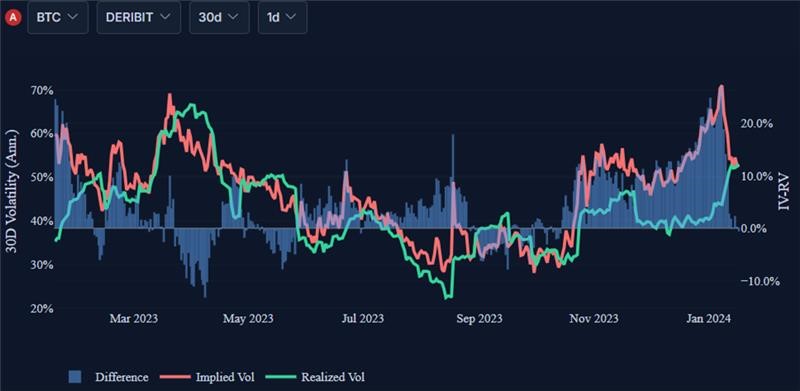
Looking at the options market and the chart above, $BTC implied option volatility collapsed as expected post ETF launch. However, we’ve seen bigger daily moves since approval and realized volatility has converged with 30D implied volatility.
Source: Coinglass
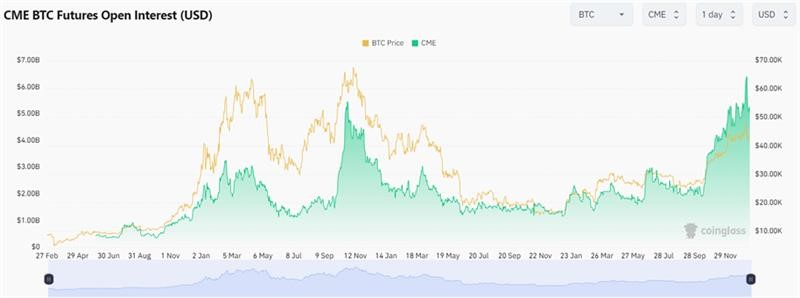
While still elevated, BTC CME open interest is off highs of $6.4B, down to $5B as traditional institutions unwind the ETF narrative trade. This has added to the overall sell pressure weighing $BTC price.
With Grayscale redemptions and institutional unwinding of futures longs, we’ve seen downward pressure on $BTC spot price. $41.5k remains a key support level as prices have bounced off this level numerous times over the past week. Offers are seen to be heavy across orderbooks between $44k-$45k, which could lead to rangebound movement between $41k-$45k in the near term.
$ETH has outperformed $BTC since approval, with the $ETH/$BTC ratio moving from an 18-month low of .048 up to .062 before settling around .059. If the “next ETF” narrative continues to gain traction, that could favor $ETH outperforming $BTC in the near to medium term.
Pressing Play on Gaming's Future: Blockchain Gaming
Why Game on Blockchain?
At its core the reason to game on chain provides advantages than traditional gaming companies do not offer. These include:
-
Digital Asset Ownership: Blockchain gaming ensures robust and immutable ownership guarantees for digital assets, whether acquired through purchase or earned in-game.
-
Open and Permissionless Marketplaces: The blockchain gaming landscape fosters open and permissionless marketplaces, offering players greater control over their in-game assets.
-
Interoperability: Projects like Sandbox Season 3 exemplify blockchain's interoperability, allowing NFTs from communities like Bored Apes and Moonbirds to become playable assets in their game.
-
Transparency and Provable Scarcity: Cryptocurrencies provide gamers with a robust and composable digital identity, fostering a thriving ecosystem akin to platforms like Steam. Players customize profiles and form communities based on shared interests.
-
Community Building and Customizability: Blockchain-based games empower users to extend or modify the game, promoting community-driven modifications (mods). This approach aligns incentives between modders and developers, allowing players to shape the canonical game experience and contribute to an interoperable metaverse vision.
History of Game-Fi
Game-Fi 1.0 was characterized by bad graphics, Ponzinomics, lack of enjoyment, and scalability issues. Play-to-earn emerged during this era, suggesting players could earn a living through in-game tokens and assets.
-
Game designs are shaped by constraints, with on-chain gaming often featuring turn-based real-time strategy games due to gas cost limitations.
-
On-chain games are embracing web2 centralization, sacrificing the unique features blockchain offers.
-
Game mechanics incentivize new players to prioritize token collection over gameplay, aiming for initial token price pumps for profit.
-
Putting an entire game on a blockchain raises concerns for traditional developers due to blockchain's limitations in speed, scalability, and storage, crucial for a smooth gaming experience.
-
The user experience (UX) of most crypto-native applications is often subpar, adding to the challenging onboarding process.
Game-Fi 2.0 marks a shift towards more traditional gaming experiences, exemplified by titles like Bigtime, Illuvium, and Phantom Galaxies, emphasizing gameplay over earning incentives. Major Web 2.0 entities such as Ubisoft, Epic Games, Animoca Brands, Tencent, and Unity have entered the crypto gaming space, promising AAA-level game quality.
-
The onboarding process for Game-Fi 2.0 has been streamlined, eliminating the need for players to connect wallets or acquire NFTs before diving into gameplay.
-
Accessibility has expanded to popular Web2 distribution platforms like Google Play, AppStore, and the Epic Games Store.
-
Many games offer optional blockchain features, allowing players to enjoy the experience without the responsibilities of digital asset ownership.
-
Developers have removed blockchain-related terms from their materials, highlighting a seamless and user-friendly interface.
In the past year, notable advancements have enhanced the Game-Fi landscape. Improved developer tools, faster and cheaper transactions with Layer 2 solutions, flexible wallet authentication through account abstraction, and reduced interruptions from MetaMask contribute to a more user-friendly experience. Rather than reverting to Web2 infrastructure, these innovations maintain blockchain's decentralization ethos while enhancing ease of use for players.
How Big is Gaming?
Gaming, particularly in the context of Game-Fi, has garnered substantial attention from venture capitalists, with over 160 rounds and $892M raised, with a third of the investments as seed rounds averaging $6 million each in year 2023. Advancements in blockchain infrastructure now enable the development of fully on-chain Multiplayer Online Battle Arenas (MOBAs) and First Person Shooters (FPS).
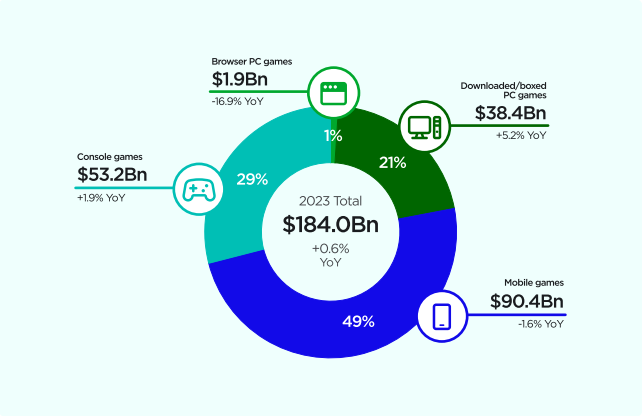
In terms of the broader gaming industry, the global video games market is projected to reach $249.6 billion in 2023, with an expected annual growth rate of 9.32% through 2028, reaching a projected market volume of $389.70 billion, as reported by Statista Market Insights and Forbes Business Insights projects gaming to grow to $665.77 billion by 2030.
By device type, the market is segmented into PC/MMO, tablet, mobile phone, and TV/console, with mobile phones expected to dominate. This is attributed to the rising ownership of smartphones, which constitute 48% of the industry. The growth is driven by the increasing prevalence of mobile cellular subscriptions, as indicated by Fortune Business Insights. North America captures 24.0% of the revenue share, with over 65% of Americans playing video games, according to the Entertainment Software Association. Asia Pacific holds a substantial revenue share of over 48.0%, with a predicted CAGR of around 14.0% from 2023 to 2030, driven by the popularity of gaming in countries like China, Japan, and South Korea, as reported by Grand View Research.
Source: NewZoo Global Games Market Report
When comparing the on-chain gaming ecosystem to publicly traded companies, the vast difference in market capitalization becomes apparent. Electronic Arts (EA) boasts a market cap of $37 billion, while Take-Two Interactive (TTWO) follows closely at $27 billion. Excluding Microsoft (MSFT) from the equation, with its substantial $2.8 trillion market cap (which includes the acquisition of ATVI for $69 billion), the traditional gaming giants overshadow the on-chain gaming market.
In contrast, the gaming sector on CoinMarketCap paints a different picture, with a total market cap of $17.8 billion. This figure encompasses 553 tokens, including notable projects like Immutable and The Sandbox. While the on-chain gaming market currently appears smaller relative to traditional gaming giants, the projected growth in the gaming industry suggests that on-chain gaming has the potential to thrive and make significant strides in the future.
On Chain Activity
Source: Artemis
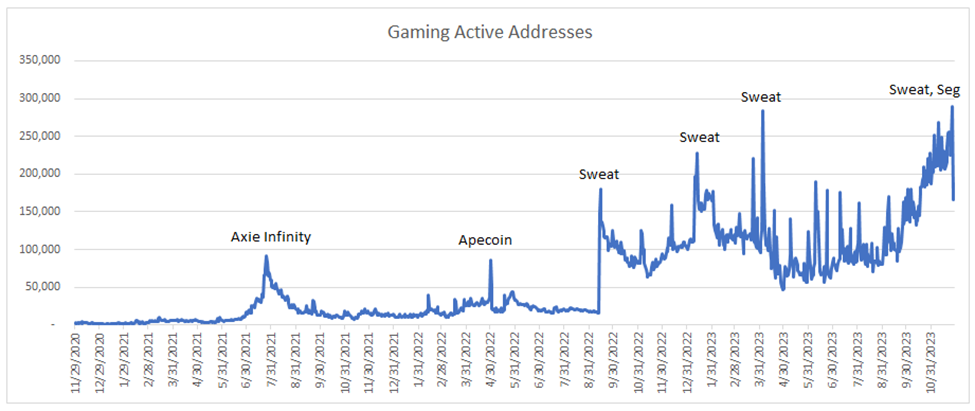
Above is breakdown of active addresses bucketed within the gaming category. Labelled are the spikes and the token responsible for the spike in active addresses. Surprisingly Sweat on NEAR has seen multiple spikes despite being on a less popular chain.
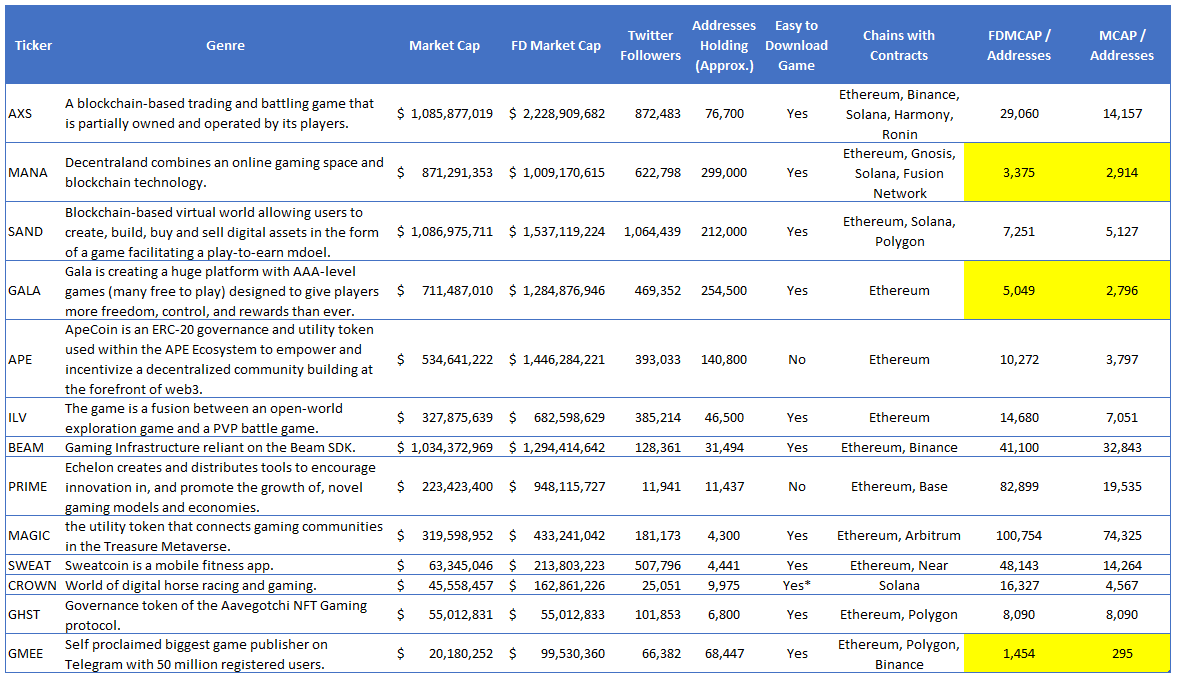
Below is a selection of tickers that were gathered from frequently mentioned names on Twitter, Telegram chats, as well as market cap leaders within the gaming and web3 space.
-
MANA, GALA, and GMEE have the highest number of addresses holding their tokens relative to their market cap (MCAP) and fully diluted market cap (FDMCAP).
-
GMEE experienced a 50% decrease in Twitter followers M/M and a 40% decline in its market cap.
-
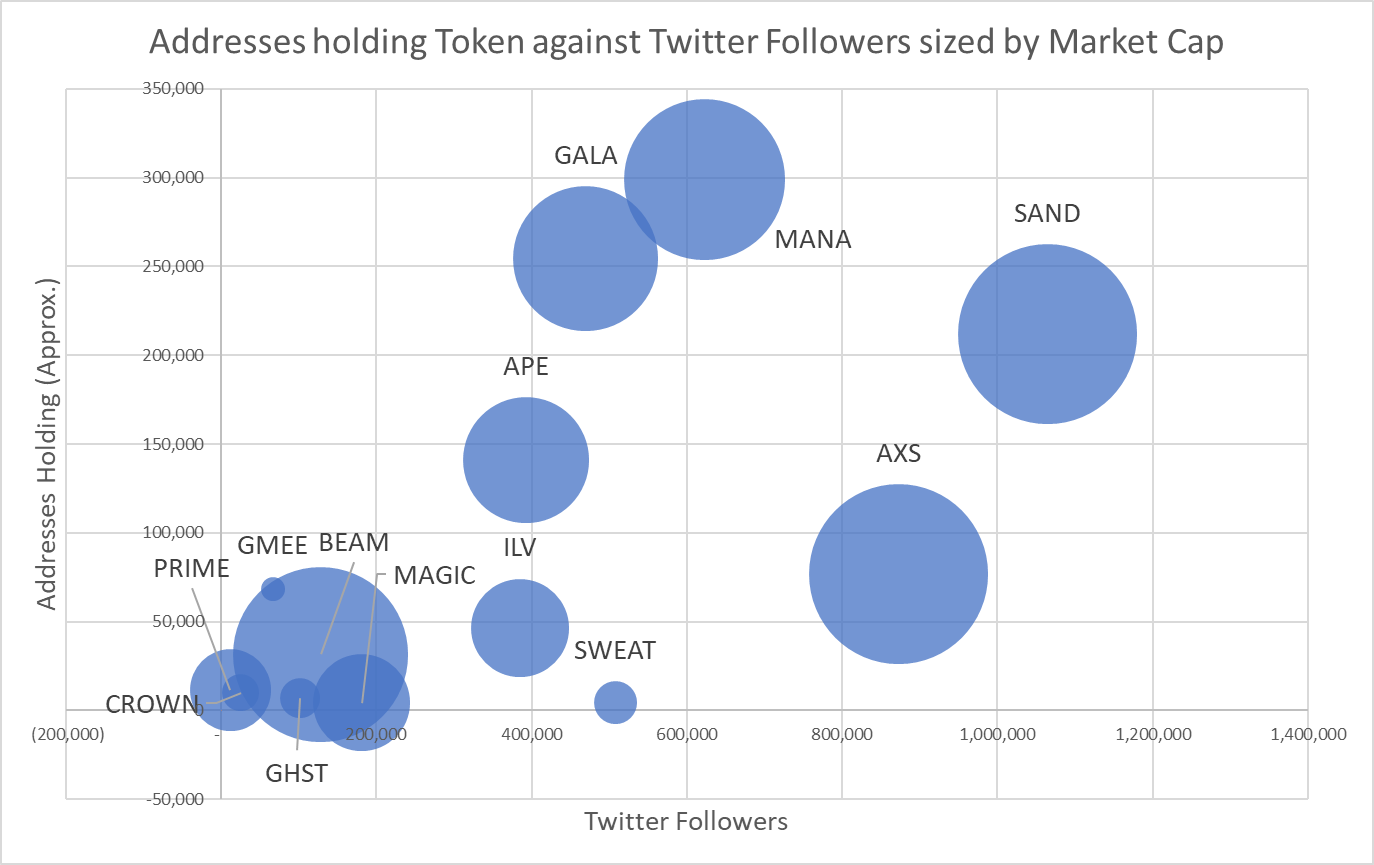
When plotting listed tokens against their address holder count, Twitter followers, in relation to market cap, a trend emerges: higher follower and wallet counts correlate with a higher market cap.
Source: Twitter, Etherscan, CoinMarketCap
-
BEAM is the outlier with a substantial market cap but relatively low holdings and Twitter follower count. This suggests it may be undiscovered by retail or another variable is driving its perceived value.
-
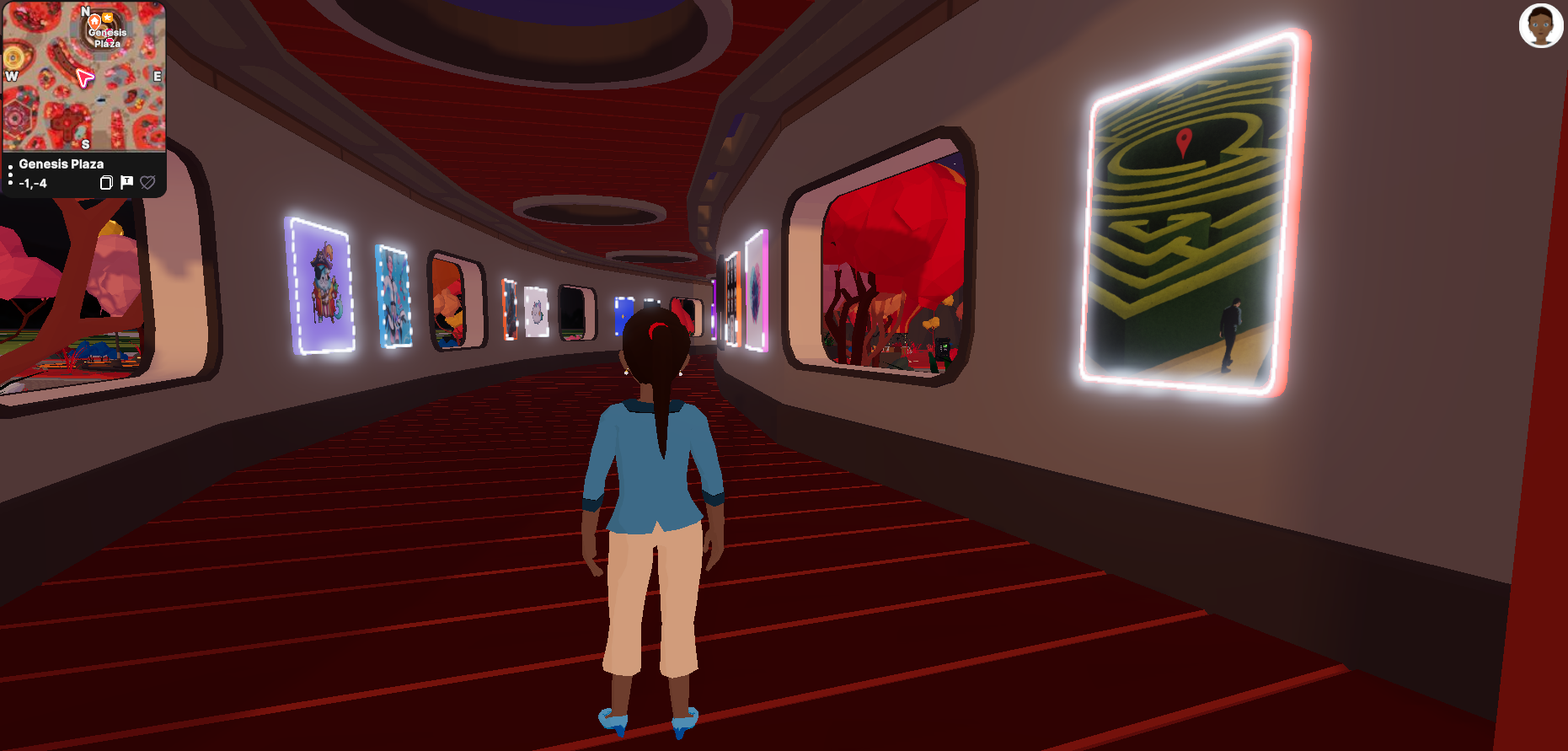
In the realm of gaming, not all websites related to the tokens were accessible or intuitive. Decentraland emerged as the clear leader, taking less than 30 seconds to access the game (screenshot below)
Source: StoneX Digital, Decentraland
Discussions with Thought Leaders
We had the opportunity to talk with Sam Peurifoy, Partner and Head of Interactive at Hivemind, Mark Mi, Business Development for Gaming at the NEAR Foundation, and a variety of the Ava Labs Gaming team. These dynamic individuals brought a wealth of expertise and experience to our discussions. Here are some of our key takeaways:
Sam Peurifoy, Partner, Head of Interactive – Hivemind
-
From an investor’s perspective:
-
From his perspective, there are two high-level trends. Firstly, gaming is becoming an increasingly significant part of the consumer landscape and media. Secondly, there is fierce competition over gaming intellectual property.
-
In the next 5 to 10 years, the demographics of Generation Alpha are expected to comprise 90% to 95% of the population. On-chain metrics indicate that over 40% are somehow related to gaming. Gaming serves as the most accessible and quickest avenue to introduce technology to consumers, progressing through two phases – the procedural side and then gaming itself. This pattern is mirrored in the development of Web3. Gaming already constitutes a substantial portion of blockchain transactions, with AVAX undergoing a significant pivot towards gaming, encompassing both traditional finance (RWA) and gaming. The increased transaction volume is notably observed in the gaming sector.
-
Game7 released a report indicating that all Layer 2s and Layer 3s, with over 50%, now have a dedicated gaming focus. This approach, effective in Web2, has proven successful in Web3 as well. The financial sector recognizes the efficacy of this strategy in the Web3 space. The onboarding vector is still in progress, suggesting ongoing efforts to bring more entities into the gaming-oriented ecosystem.
-
-
From a builder’s perspective:
-
From KapGames, Captain and Company are currently focused on building something that aligns with the prevailing ethos. The first wave of play-to-earn encountered challenges and setbacks, primarily due to a lack of long-term content sustainability. In their approach to economics, there are distinct levels. At the foundational level, there are numerous individuals contributing through small economic value actions. As you ascend the levels, the emphasis shifts towards constructing longer-term values.
-
NetZero gaming, specifically BR1 on Solana, was among the pioneers in exploring the concept. However, their initial attempts were largely deemed uncompelling. The distinctive aspect of the blockchain environment is its inherent division into "haves" and "have nots." Individuals categorize themselves into value adders and value extractors, with the latter forming the majority.
-
Drawing inspiration from games like Sea of Thieves, they adopt a model where the owner of the ship represents Web3, while the rest of the crew members can operate on Web2. This design ensures that only a small percentage, around 5%, needs to be on Web3 (typically 10 team crews with one captain).
-
This “omniportability” of game assets is a fantasy cooked up by middle-of-the-road tech solution grifters and corporate middle managers who duped a ton of VCs that didn’t know any better into buying their vision of a “metaverse” back in 2021.
-
Mark Mi, Gaming BD, NEAR Foundation
-
NEAR at the end of 2023 achieved 4 million monthly active users, primarily driven by a handful of apps, including Comsos (2 million) and Sweat (1 million), along with a few other hypercasual games. They possess strong intellectual property and have undisclosed game projects lined up for announcement.
-
There is significant anticipation for 2024, as the bear market has impacted projects based on the play-to-earn model. In the second half of 2023, there has been a notable shift towards more focused gaming experiences, moving beyond hyper-casual games to heavier gaming. The focus is no longer solely on the web2 versus web3 game dichotomy but on the broader goal of attracting people to gaming.
-
“Have the quality of projects improved over the past year? The answer is no.”
-
Game development is a time-consuming process, typically taking 2-5 years for a game to come to market.
The Gaming team at Ava Labs @GamingOnAvax
-
Crypto market has been on a positive uptrend, allowing for speculators to be more risk on, leading them to the web3 gaming industry.
-
Despite active wallets being relatively low, major gaming projects like TSM/Blitz, Shrapnel, Gunzilla, Beam, etc., are yet to fully launch. However, upcoming games with substantial runway from previous years are reaching a quality level that attracts traditional gamers, encouraging their participation and play.
-
User acquisition is a major concern, and teams adopting traditional web2-like strategies, with proper staffing and execution plans, will distinguish themselves. Additionally, the improved User Experience (UX) in web3 games, attributed partly to wallet and infrastructure providers, results in lower churn rates, creating a more positive onboarding process.
-
By the numbers: 10 dedicated app chains (subnets) for gaming, a 30-day on chain volume of $125B, over $1.3M gaming wallets interacting with dApps, and Avalanche game developers securing over $225M in funding with significant rounds from Shrapnel, Gunzilla Games, and Merit Circle.
Gaming needs to Level Up
Game studios on-chain encounter their own challenges. While straightforward cross-game promotions, such as skins on Fortnite, become popular due to the mutual boost in consumer awareness for both brands involved, these promotions are often intricate to execute from a legal and commercial standpoint, placing them beyond the reach of smaller studios. Studios outside the realm of gaming giants like Blizzard face the additional challenge of competing against marketing budgets that run into hundreds of millions of dollars. Moreover, large studios possess the financial capacity to allocate budgets for beta testing, typically ranging from $2-5 million, and invest tens of millions more to successfully launch the game in the market.
Examining historical trends, the popularity of mods in traditional gaming environments posed challenges related to user engagement and intellectual property control. Strong End User License Agreements (EULAs) and enforcement actions were implemented to curb potential downsides, stifling mod growth and monetization over the past two decades. In response to these limitations, User Generated Content (UGC)-based games emerged as a viable solution, capturing the value created by the community. However, traditional Web2 UGC still grapples with issues such as intolerant EULAs, high take rates, inflexible monetization schemes, and limited creative freedom.
Our team holds an optimistic outlook for various Web3 games, including Illuvium and Shrapnel, in 2024 as the breakout games that could attract the next million users to blockchain. However, we are closely monitoring on-chain metrics and user integration to enhance the overall gaming experience. Based on data and discussions, it appears that browser and mobile-based players in LATAM are poised to be significant winners in this cycle.
Sources: NewZoo Global Games, Artemis, Decentraland, NEAR, Hivemind, Game7
Sector Commentary
-
Layer One / Altcoins
-
Bitcoin ($BTC): Bitcoin rebounds above $43,000 as analysts highlight possible rate pause at Fed's January meeting (link)
-
Bitcoin ($BTC): Will Bitcoin keep dropping because of the ETFs? (link)
-
Bitcoin ($BTC): Will the Next Bitcoin Halving Be Another Hype Cycle? (link)
-
Bitcoin ($BTC): Why is Bitcoin price stuck? (link)
-
Ethereum ($ETH): Ether price gains as network transactions hit multi-year high (link)
-
Ethereum ($ETH): Spot Ethereum ETF not coming 'anytime soon,' says Mark Yusko (link)
-
Avalanche ($AVAX): Avalanche embraces memecoin culture despite criticism (link)
-
Solana ($SOL): Solana Mobile to Sell Second Crypto Smartphone: Source (link)
-
-
DeFi
-
DeFi Fumbled Its Post-FTX Advantage in 2023, but There’s Still Hope for 2024 (link)
-
Uniswap budgets $300K for v4 development with $150M token launch KPI (link)
-
Chainlink integrates with Circle’s CCTP protocol for cross-chain USDC transfers (link)
-
'Very good chance' US will pass stablecoin laws in 2024: Circle CEO (link)
-
Can Crypto Dethrone U.S. Dollar Dominance? Here Is Morgan Stanley's Take (link)
-
-
NFTs / Web3
-
GameStop to shut down NFT marketplace due to regulatory limbo (link)
-
NFTs eye comeback following spot Bitcoin ETF approval (link)
-
Web3 apps saw 124% growth in 2023, led by Near, Klaytn, Arbitrum — DappRadar (link)
-
WalletConnect launches ‘Web3Inbox’ notification app for Web3 users (link)
-
CoinFund leads $11.5 million Series A funding round for decentralized car data network developer (link)
-
-
Metaverse / Gaming
-
Digital Infrastructure: Capital Markets / Exchanges / DAOs / Mining
-
The 4 Factors That Will Determine Which Spot Bitcoin ETFs Win Market Share (link)
-
Coindesk: Latest blockchain tech upgrades, funding announcements and deals (link)
-
Bitcoin Miners May Be Due a Breather After Spot ETF Approval, JPMorgan Says (link)
-
Pantera: “The Year Ahead” (link)
-
Decentral Park Research: The Weekly 265 (link)
-
Re7 Research: The Weekly – 15th January 2023 (“On Solana’s growing stablecoin ecosystem”) (link)
-
BlackRock Wants to Follow Bitcoin ETF With an Ethereum ETF. Marketing It Might Not Be So Simple (link)
-
Cantor Fitzgerald CEO says Tether has the billions of dollars in reserves it claims (link)
-
Elon Musk's X receives money transmitter license in Utah (link)
-
How to simplify crypto derivatives with mobile experience — Interview with Flipster (link)
-
Traders flock to US crypto products after spot ETF approvals — CoinShares (link)
-
Grayscale, BlackRock and Fidelity dominate spot ETF market with nearly 90% of volume on third day of trading (link)
-