StoneX logo

StoneX Digital Asset Weekly Commentary - Parallelized EVMs

By: Stonex Digital LLC, Stonex Digital LLC

Riding the Wave: Trends and Talks on Parallelized EVMs
 
David Kroger
Senior Vice President
StoneX Digital

Market Trading Color
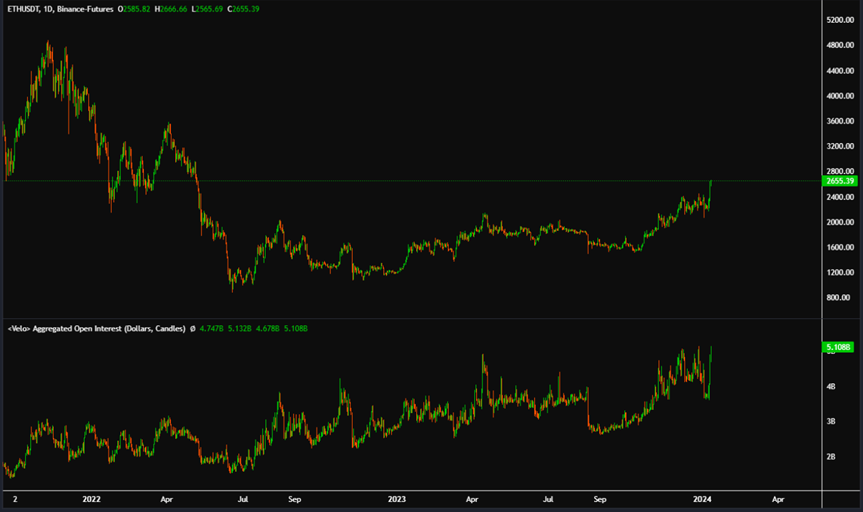
While the fake tweet led to “selling the news,” the real event has been a different story. $BTC is up nearly 8% overnight while $BTC CME future open interest continues to make all-time highs. After publicly shaming Bitcoin as an asset class for years, it was full circle to see Gensler as the deciding vote to get these spot ETFs approved. As spot ETF shares begin trading during today’s session, US inflation rose higher than expected: 3.9% Y/Y vs EST 3.8%. A perfect storm to push this digital currency higher. While $BTC was supposed to be in the spotlight here, $ETH and the tokens in its ecosystem have stolen the show. $ETH has risen 11% over the past 24 hours, pushing ETHBTC ratio higher and above 0.055. While the ratio screens positive over the past month, it is still down over 26% on the year. $ETH open interest is now at an all-time high when calculated in USD (over 5B). With this rotation back toward $ETH, tokens such as $ENS +57%, $ETC +45%, DOT +22%, BLUR +20% and RPL +19% have seen the largest runs.
image-20240111085432-1
Source: TradingView
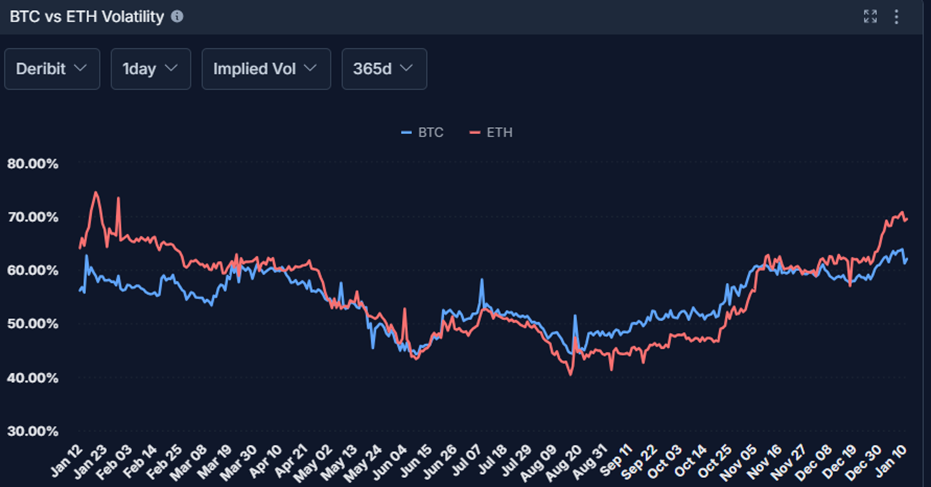
BITO options went out implying ~5% move for approval event last night. With the ETF approval event now past, we believe implied volatility could mean revert back to the low 60's in the near term. ETH implied could continue to outperform BTC.
image-20240111085520-2
Source: TheTie
Riding the Wave: Trends and Talks on Parallelized EVMs
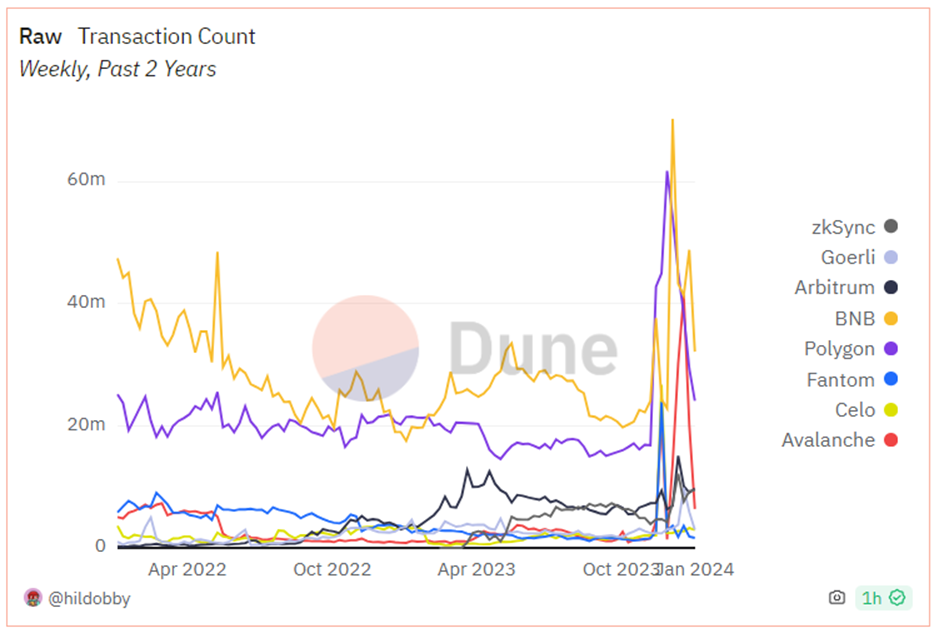
Network congestion, marked by skyrocketing fees and diminished usability, is universally undesirable. The recent demand for inscriptions, introduced in the Bitcoin ecosystem to write metadata to individual satoshis, has caused notable fee spikes in various blockchains. Notably, Avalanche experienced the most pronounced impact in December, witnessing over $39M spent on gas, constituting 76% of all Avalanche fees. This has catalyzed heightened interest in technologies and projects dedicated to tackling the issue of high transaction throughput. Among these solutions, the implementation of Parallel Ethereum Virtual Machine Technology stands out as a promising avenue for alleviating network congestion and enhancing overall transaction efficiency.
image 87626
Source: Dune Analytics
What is a Parallel EVM?

Parallel Ethereum Virtual Machine (Parallel EVM) is an enhanced iteration of the conventional Ethereum Virtual Machine (EVM) employed on the Ethereum blockchain. The key distinction between Parallel EVM and the standard EVM lies in their transaction processing and smart contract execution methods.

In the standard EVM, transactions and smart contracts follow a sequential execution, creating a linear progression. While this straightforward approach may lead to bottlenecks, such as a surge in demand for inscriptions resulting in increased transaction volume, causing delays and heightened gas fees, Parallel EVM effectively addresses and mitigates these issues. Parallel EVM effectively addresses these issues by introducing parallel processing, enabling concurrent execution of multiple transactions, provided they are independent of each other's outcomes. This capability aims to overcome scalability limitations inherent in the standard EVM.
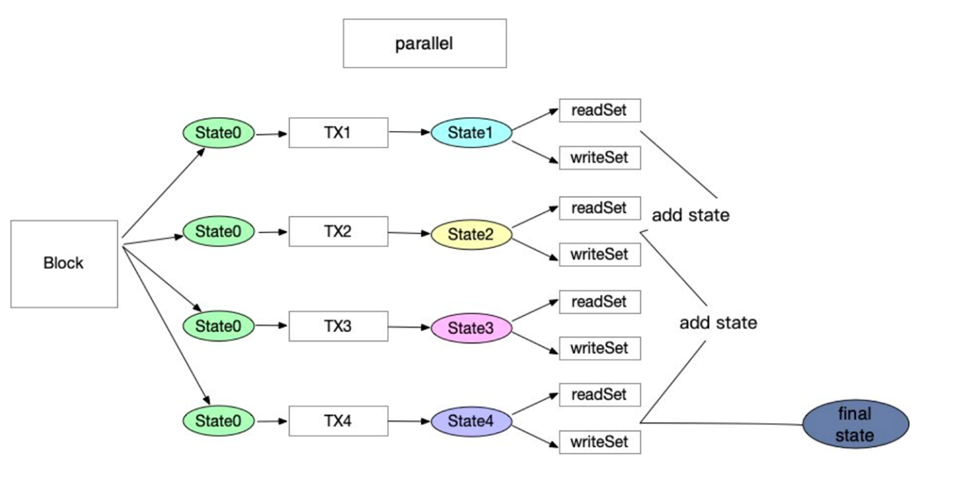
 image 87627
Source: Cryptoeq
  • A block is proposed in the current state, State0
  • State0 is then broken into four different transactions which are grouped together and processed in parallel by different validators on the network: State1, State2, State3, and State4
  • Each state maintains its own set of read operations (readSet) and write operations (writeSet) that represent the transactional history within that state. As transactions progress and execute concurrently, these distinct readSets and writeSets coalesce, working collaboratively to contribute to the final state. The coordination and merging of these sets are crucial in achieving the consistent and accurate end-state across parallel transactions

Within the realm of parallelized EVMs, two primary approaches have emerged: deterministic and speculative parallel execution. The deterministic method uses predefined transaction ordering to prevent conflicts, ensuring a structured and conflict-free execution process. Conversely, speculative scheduling adopts a dynamic approach, running transactions in parallel and addressing conflicts as they arise. These methodologies provide developers with flexibility in selecting the most suitable parallelization strategy for their applications.

While the EVM is fundamental for computations and data storage on the Ethereum blockchain, its sequential transaction ordering has limited scalability. Parallel EVM seeks to overcome this limitation by adopting parallel processing, enhancing the efficiency and scalability of transaction processing and smart contract execution on the Ethereum network. Despite the belief that Directed Acyclic Graph (DAG) technology solves scalability issues present in the standard EVM, there are key differences between these competing technologies.

Parallel EVMs are the new DAGs?

In comparison to parallelized EVMs, DAGs offer an alternative route to achieving scalability. Unlike traditional blockchains that linearly chain blocks, DAG structures link transactions in a graph format, allowing for the concurrent addition of multiple transactions, resulting in increased transaction speed and scalability.
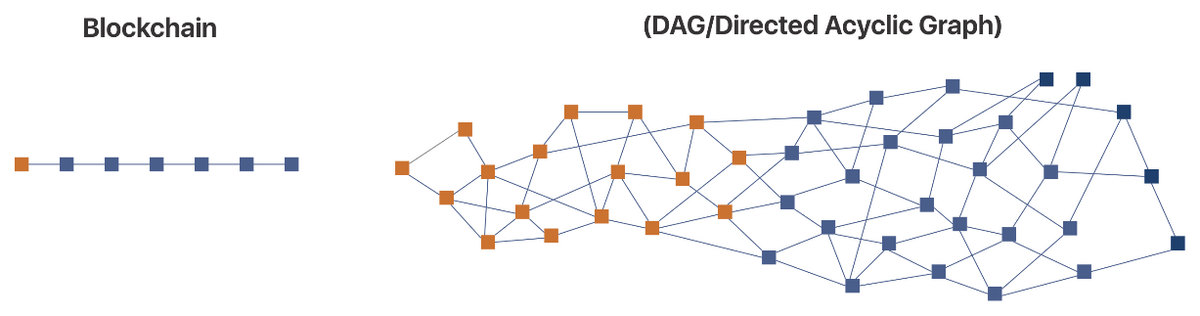
image-20240111080752-1

Source: Central Blockchain Council

While this DAG graphic visually resembles a similar flow of transactions to a parallel EVM, it lacks inherent support for smart contracts and decentralized applications to the same extent as Ethereum. Parallelized EVMs strike a balance by retaining Ethereum's smart contract capabilities while enhancing scalability and efficiency through parallel processing.

This unique combination makes parallelized EVMs well-suited for complex decentralized applications demanding both smart contract functionality and high transaction throughput. Additionally, parallelized EVMs maintain compatibility with the existing Ethereum ecosystem, crucial for developers and users entrenched in Ethereum-based applications. This compatibility facilitates a smoother transition and integration for existing decentralized applications, a challenge often faced in DAG-based systems.

Differing Types of Technology

In the expansive landscape of the digital asset ecosystem, numerous teams and chains are introducing competing parallel EVM technologies. Among these, Block-STM and Polygon’s Parallel Blocks stand out as notable players, especially considering that leaders by market cap, such as tokens Aptos and Polygon, aim to implement these technologies to enhance network productivity and speed.

Block-STM:

Below is a paraphrased excerpt from the Block-STM white paper:

Block-STM is a parallel execution engine for smart contracts built around the principles of Software Transactional Memory. The goal of this technology is to accelerate the in-memory execution of transactions via parallelism. STM libraries aim to instrument memory access to detect conflicts. STM libraries with optimistic concurrency control record memory accesses, validate every transaction post execution, and abort and re-execute transactions when validation surfaces a conflict. This leads to a final outcome that is equivalent to the sequential execution of transactions in the present order in which they appear in the block.

Source: Block-STM (arxiv.org).

When the Aptos team implemented Block-STM into their open-source codebase, they compared the system with each block containing 10k transactions with the number of accounts determining the number of conflicts (2 accounts is close to sequential). In scenarios of low conflicting transactions, Block STM demonstrates a 16x improvement in speed compared to sequential execution when employing 32 threads. In situations with high conflicting transactions, Block-STM achieves a speedup of over 8x.
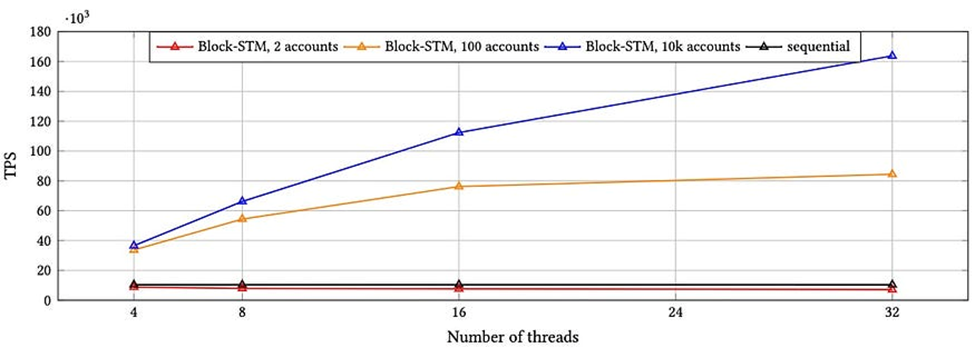
image 87632Source: Aptos Labs

Parallel Aware Blocks

In contrast to the original design of Block-STM, the Polygon researchers implemented a minimal metadata approach. Instead of encountering conflicts and requiring re-execution by multiple nodes, their approach involves first reading and writing all transactions on the Polygon chain. These transactions are then recorded in a DAG, enabling the validation process to check for dependencies and take note of them. This minimal metadata approach involves appending information about dependencies to the block, reducing redundancy and computational overhead.

The ongoing parallel EVM efforts have not yet increased capacity, but Polygon is actively laying the groundwork for this enhancement. The subsequent phase of the initiative aims to parallelize block building, enhancing efficiency for validators in constructing blocks and consequently increasing overall capacity.

Another important consideration is the introduction of the concept of making block building 'parallel-aware.' This implies that it may become feasible to include more transactions in a block if Block-STM determines their independence, allowing parallel execution.

While the focus is on highlighting Aptos and Polygon, it is noteworthy that numerous projects are either implementing variations of Block-STM or introducing their own parallel EVM technology. The chart below provides insights into other frequently mentioned players in the parallel EVM space, highlighting key distinctions in implemented technologies and their expected transactions per second (TPS).
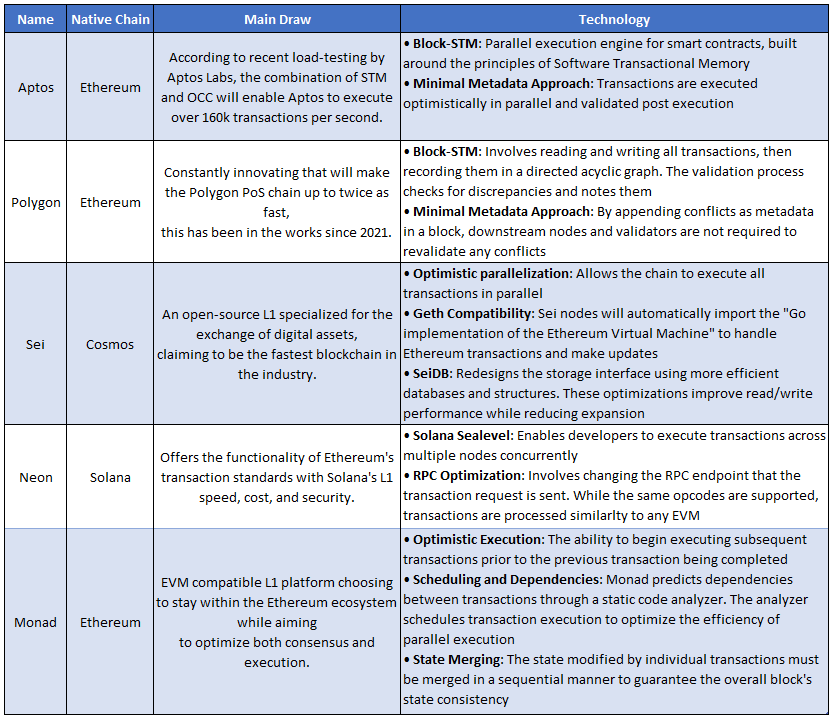
image-20240111080916-2

Sector Commentary

  • Layer One / Altcoins

    • Bitcoin ($BTC): Bitcoin Jumps, Then Dumps to $45K as Fake News About Spot Bitcoin Approval Liquidates $50M (link)
    • Bitcoin ($BTC): SEC Has Not Approved Bitcoin ETFs, but Its Hacked X Account Briefly Said Otherwise (link)
    • Bitcoin ($BTC): Lawyers, politicians call for investigation of SEC over Bitcoin ETF post (link)
    • Bitcoin ($BTC): Spot Bitcoin ETF incoming? Outcomes investors may see from the SEC this week (link)
    • Bitcoin ($BTC): What are Bitcoin CME gaps and how to trade them? (link)
    • Bitcoin ($BTC): Honduras special zone officially recognizes Bitcoin as a unit of account (link)
    • Ethereum ($ETH): Bitcoin ETF Fever Drives Ethereum to 32-Month Low Versus BTC (link)
    • Solana ($SOL): Solana now boasts more than 2,500 monthly active developers (link)
    • Polygon ($MATIC): Fox Corporation collaborates with Polygon Labs to launch blockchain-based media platform Verify (link)
    • AI Tokens: AI tokens had 3rd highest returns of any category in 3 months – Binance (link)
    • Cosmos ($ATOM): Cosmos developers propose reducing ATOM inflation rate (link)
    • Arbitrum ($ARB): Arbitrum TVL, ARB price doubled in a month – What’s next? (link)
  • DeFi
    • Stablecoin inflows to exchanges spike as traders prepare for spot Bitcoin ETF decision (link)
    • DeFi lending service raises $6.1M to improve capital efficiency (link)
    • Celsius creditors who withdrew 90 days before bankruptcy are asked to send money back (link)
    • Curve Finance debt will cause ‘one more stress test’ in February – Analyst (link)
  • NFTs / Web3
    • Bitcoin Ordinals proponents should demand a new Bitcoin fork (link)
    • Bitcoin Ordinals versus off-chain NFT storage: Execs explain how to choose (link)
    • This Web3 security tool protects users against phishing and drainers in real-time (link)
    • What 3 things should Web3 founders think about in 2024? (link)
    • What is VeChain, and how does it work? (link)
  • Metaverse / Gaming
    • Bitcoin blockchain hosts classic SNES games (link)
    • Ready Player One author, producer to bring IP to metaverse (link)
  • Digital Infrastructure: Capital Markets / Exchanges / DAOs / Mining
    • Spot Bitcoin ETF applicants slash sponsor fees, with Bitwise dropping to 0.20% (link)
    • Jane Street Emerges as Broker of Choice for Bitcoin-ETF Issuers (link)
    • Valkyrie ‘95% Sure’ Bitcoin ETFs Will Begin Trading on Thursday (link)
    • VanEck CEO says its spot bitcoin ETF should trade on Thursday: CNBC (link)
    • Spot Bitcoin ETF issuers file amended S-1 applications – Now await SEC approval (link)
    • SEC reissues crypto ‘FOMO’ warning amid hope for spot Bitcoin ETFs (link)
    • MicroStrategy is already up nearly $1B from Bitcoin in 2024 (link)
    • Bitcoin miner Core Scientific completes $55M equity offering (link)
    • Genesis creditors group calls foul on Digital Currency Group repayment (link)
    • BitLicense oversight in New York faces critical review (link)
    • FINRA adds crypto assets section to its annual oversight report (link)

Sources: Polygon, Aptos Labs, Ethereum Foundation
  • Digital Assets

Cryptocurrency is a digital representation of value that functions as a medium of exchange, a unit of account, or a store of value, but it does not have legal tender status. Cryptocurrencies are sometimes exchanged for government backed currencies (known as fiat) or other currencies around the world, but they are not generally backed or supported by any government or central bank. Their value is completely derived by market forces of supply and demand, and they are more volatile than traditional currencies. Cryptocurrencies are not covered by either FDIC or SIPC insurance. Legislative and regulatory changes or actions at the state, federal, or international level may adversely affect the use, transfer, exchange, and value of cryptocurrency.

Purchasing cryptocurrencies comes with a number of risks, including volatile market price swings or flash crashes, market manipulation, and cybersecurity risks. In addition, cryptocurrency markets and exchanges may not be regulated with the same controls or customer protections available in equity, option, futures, or foreign exchange investing.

This material contained herein is intended for Institutional and Investment Professional Use Only and may not be distributed to the investing public. The views expressed are those of the author and are current only through the date stated. These views are subject to change at any time based upon market or other conditions, and StoneX Group Inc. disclaims any responsibility to update such views. Past performance is no guarantee of future results.

The StoneX Group Inc. group of companies provides financial services worldwide through its subsidiaries, including physical commodities, securities, exchange-traded and over-the-counter derivatives, risk management, global payments and foreign exchange products in accordance with applicable law in the jurisdictions where services are provided. StoneX Digital LLC is a subsidiary of StoneX Group Inc. and is dedicated to providing institutional clients with access to multiple products and services for digital assets.

StoneX Financial Inc. does not act as counterparty or custodian to any virtual currency transaction(s) offered through its affiliate StoneX Digital LLC and this content should not be construed as a solicitation for futures or securities accounts.

The authors responsible for the preparation of this commentary hereby certify that all the views Cryptocurrency is a digital representation of value that functions as a medium of exchange, a unit of account, or a store of value, but it does not have legal tender status. Cryptocurrencies are sometimes exchanged for government backed currencies (known as fiat) or other currencies around the world, but they are not generally backed or supported by any government or central bank. Their value is completely derived by market forces of supply and demand, and they are more volatile than traditional currencies. Cryptocurrencies are not covered by either FDIC or SIPC insurance. Legislative and regulatory changes or actions at the state, federal, or international level may adversely affect the use, transfer, exchange, and value of cryptocurrency.

Purchasing cryptocurrencies comes with a number of risks, including volatile market price swings or flash crashes, market manipulation, and cybersecurity risks. In addition, cryptocurrency markets and exchanges may not be regulated with the same controls or customer protections available in equity, option, futures, or foreign exchange investing. Cryptocurrencies are not regulated by the Securities Exchange Commission (SEC), FINRA, or the Commodity Futures Trading Commission (CFTC).

This material contained herein is intended for Institutional and Investment Professional Use Only and may not be distributed to the investing public. The views expressed are those of the author and are current only through the date stated. These views are subject to change at any time based upon market or other conditions, and StoneX Group Inc. disclaims any responsibility to update such views. Past performance is no guarantee of future results.

The StoneX Group Inc. group of companies provides financial services worldwide through its subsidiaries, including physical commodities, securities, exchange-traded and over-the- counter derivatives, risk management, global payments and foreign exchange products in accordance with applicable law in the jurisdictions where services are provided. StoneX Digital LLC (“SXD”) is a subsidiary of StoneX Group Inc. and is dedicated to providing institutional clients with access to multiple products and services for digital assets. SXD is not a registered broker-dealer or futures commission merchant subject to federal securities or commodity regulations and does not solicit securities or futures. SXD seeks to provide institutional clients the flexibility and tools to interact with markets on their terms and enable them to trade cryptocurrencies.

Options are not suitable for all investors. There are risks involved in any option strategy. Individuals should not enter into option transactions until they have read and understood the option disclosure document titled "Characteristics and Risks of Standardized Options," which outlines the purposes and risks of option transactions.

Exchange Traded Funds (ETFs) are subject to market risk, including the possible loss of principal. The value of the portfolio will fluctuate with the value of the underlying securities. ETFs trade like a stock, and there will be brokerage commissions associated with buying and selling exchange traded funds unless trading occurs in a fee-based account. ETFs may trade for less than their net asset value. Investors should consider an ETF’s investment objective, risks, charges, and expenses carefully before investing.

© 2026 StoneX Group Inc. All Rights Reserved.

Satellite view of Earth at night showing illuminated cities across Asia and the Middle East

Discover more insights

Our subscribers have access to comprehensive market analysis from StoneX spanning commodities, equities, currencies and more.

StoneX: We open markets

Our market expertise, advanced platforms, global reach, culture of full transparency and commitment to our clients’ success all set us apart in the financial marketplace.

Reach

With access to 40+ derivatives exchanges, 180+ foreign exchange markets, nearly every global securities marketplace and numerous bi-lateral liquidity venues, StoneX’s digital network and deep relationships can take clients anywhere they want to go.

Transparency

As a publicly traded company meeting the highest standards of regulatory compliance in the markets we serve, our financials and record of accomplishment are matters of public record. StoneX’s commitment to “doing the right thing over the easy thing” sets us apart in the industry and helps us build respect, client trust and new partnerships.

Expertise

From our proprietary Market Intelligence platform, to “boots on the ground” expertise from award-winning traders and professionals, we connect our clients directly to actionable insights they can use to make more informed decisions and achieve their goals in the global markets.