On May 27, the last sugar mill in operation wrapped up work for the 2023/24 (Oct-Sept) crop in Yunnan province in southern China, bringing the Chinese cycle to a close. Across the country, sugar production reached 9.96 million tonnes, an increase of almost 1.0 million (+11.2%) compared to 2022/23, when there was a significant drop and the volume produced was the lowest since 2015/16.
The output was slightly below the early estimates of China's Ministry of Agriculture, which called for 10.0 million tonnes in 2023/24. It is understood that the country could potentially achieve a supply above this level, but this did not happen, especially due to a production that was below its potential in Yunnan, China's second largest producer. This region produced 2.0 million tonnes of sugar in 2023/24, an increase of only 1.0% compared to the previous cycle.
Chinese producers had hoped that Yunnan would register a more significant increase in the current cycle, since the other two major producers in the south of China (Guangdong and Guangxi) had higher growth rates. In Guangdong, sugar production rose by around 3.4% to over 500,000 tonnes. In Guangxi, the end of the 2023/24 crop (which took place in the last week of April) saw excellent results, reaching 6.2 MMT of sugar production, an annual increase of 17.3%.
Sugar production in China in 2023/24 (MMT) and annual change by province
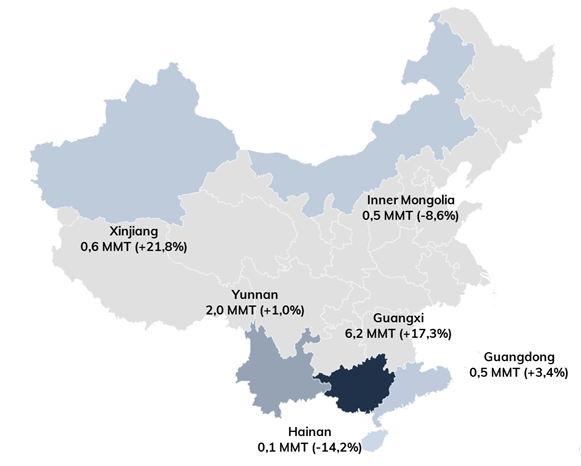
Source: China Sugar Commission. Design: StoneX.
As mentioned, in 2022/23 China faced significant productivity problems due to two back-to-back years of below-average rainfall, which even reduced the harvest duration, which was already slowing down substantially in March/23. For the following crop, sugarcane acreage rose by around 5.3%, stimulated by sugar prices and domestic production needs, as stocks also fell to historic lows. At the end of 2023, rains were above average, especially in Guangxi, which allowed for a combination of increased area and productivity: in this province, the main producer, crushing reached 51.2 million tonnes of cane, an increase of nearly 10.0 MMT.
In China's northern sugar beet regions, the results were mixed. However, the gains in Xinjiang, which increased production by more than 20%, more than outweighed the losses in Inner Mongolia.
The Chinese Ministry of Agriculture's May report estimated growth of around 1.0 million tonnes for the coming 2024/25 season, which should reach a record 11.0 MMT. This volume would be the result of a 20% expansion in the sugar beet area and the prospect of an increase in sugarcane productivity, since the weather has been favorable for sugarcane plantations in southern China for the second year in a row.
Sugar production in China (million tonnes)
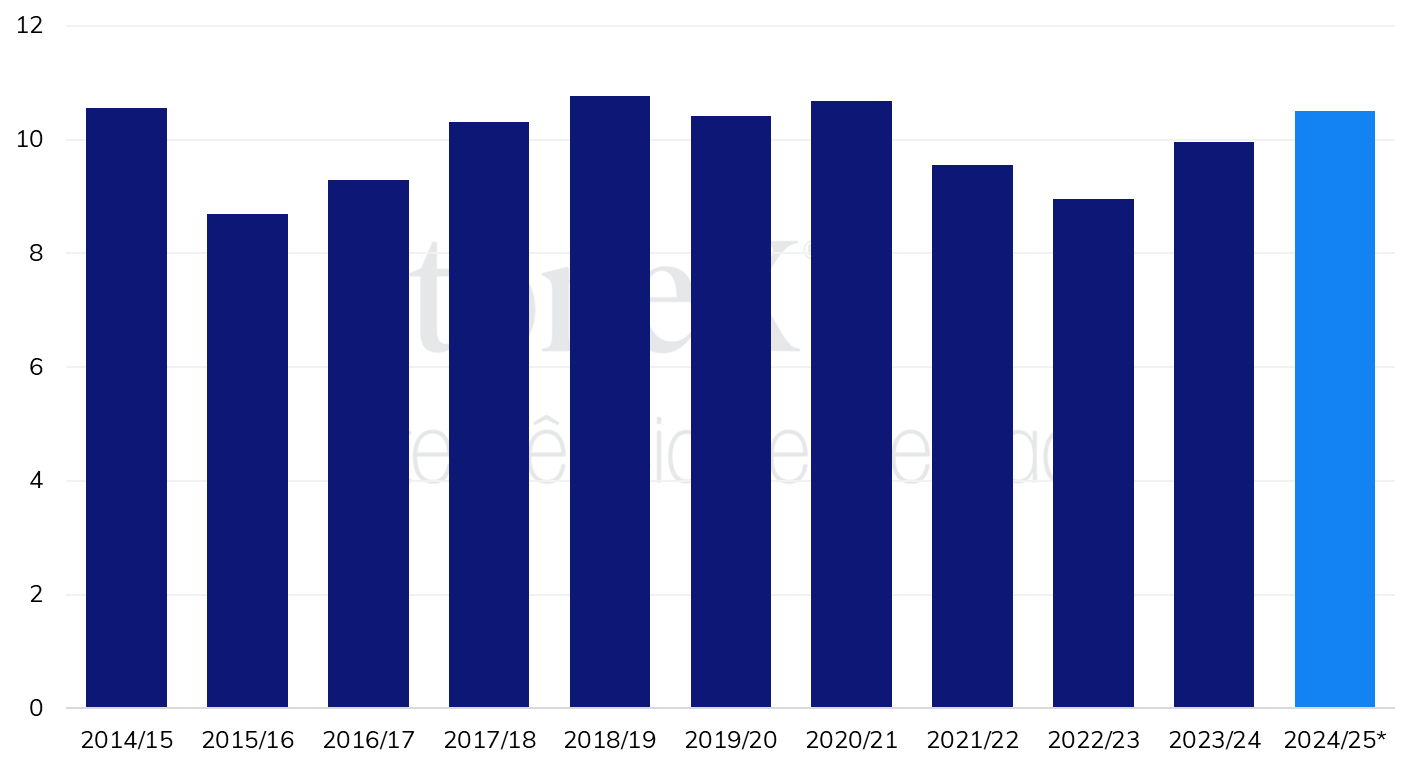
 *StoneX estimates. Sources: China Sugar Commission, China Ministry of Agriculture. Design: StoneX.
In its first estimate released in May/24 for the Global Sugar Balance of 2024/25 (Oct-Sept), StoneX projects production at 10.5 million tonnes in China, which would still be an increase. Beyond optimism in the sector, the volume will depend on capacity, which has already proved limited this year, especially in Yunnan. In Xinjiang, it is also understood that the production level reached in 2023/24 is very close to the capacity limit. In this sense, it is possible that China will produce volumes well above 10.0 MMT, also because the weather is already favorable in 2024. In April and May, before the sugarcane regions' wet season (June-September), the volume of rainfall weighted by sugarcane area was double that of last year. As such, the optimistic projections for 2024/25 in China have so far proved to be realistic.
Rainfall weighted by sugarcane areas in China* (mm)
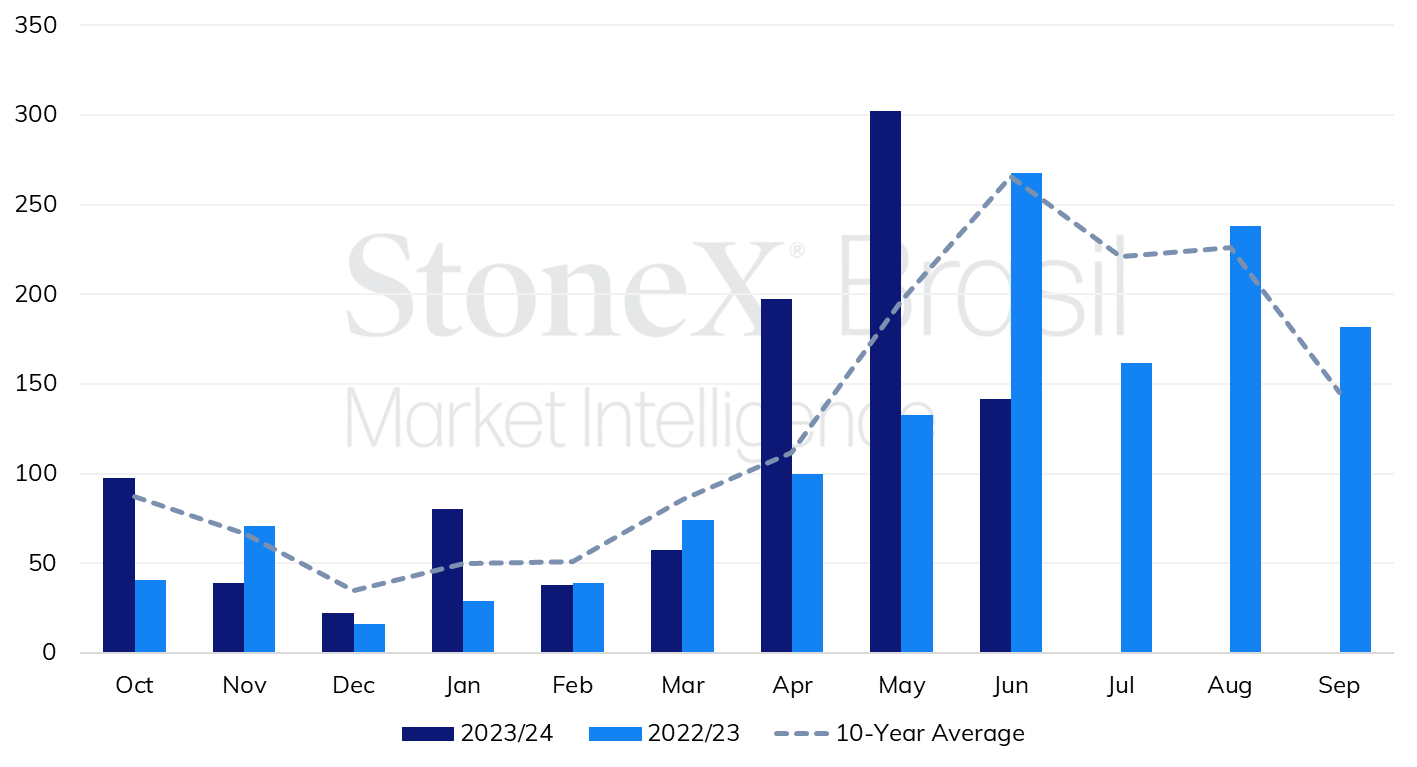 *Data up to June 9, 2024. Source: Refinitiv. Design: StoneX.
Daily recap
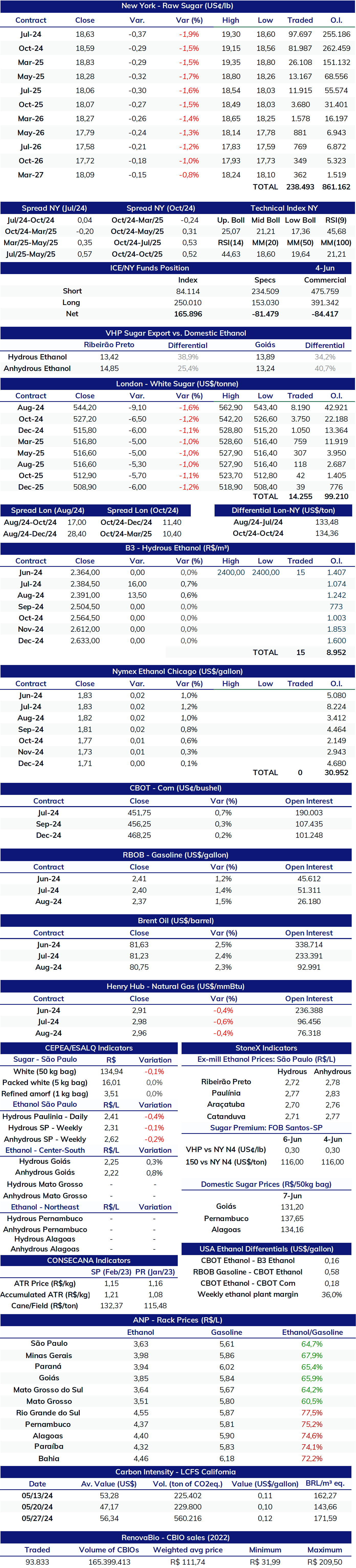
On Monday (10), the prices of raw and white sugar posted a day of declines on the futures markets. Raw #11 fell by 1.95%, ending the day at US¢18.63/lb for SBN4, while white ended the day at US$544.2/t (-1.64%) for SWQ4. In terms of the macroeconomic scenario, the weather until next Wednesday (12) should be cause for apprehension, as investors await the release of inflation data from the United States, as well as the interest rate decision by the US monetary authority. Pressure from Brazilian imports, which have benefited even more from the recent devaluation of the Brazilian real against the dollar, should continue to be a factor limiting gains for sugar until the end of the Brazilian crop. In addition, the early start of the monsoon season in Southeast Asia continues to be a bearish factor for prices.