According to data from the Brazilian Sugarcane and Bioenergy Industry Association (UNICA), corn ethanol production began in December 2013. Since then, grain-based ethanol output has grown rapidly in recent years, rising from 37,040 m³ in its debut season of 2013/14 (Apr-Mar) to 6.3 million m³ in 2023/24 and is expected to reach 8.0 million m³ in 2024/25, according to StoneX estimates.
As a result, the share of the biofuel produced from this grain in the total supply of ethanol in the Center-South rose in 10 years from 0.1% to 18.7%, and should reach 24.9% in the current 2024/25 crop.
Trends in corn ethanol production (Mm³) and share in total ethanol output (%)
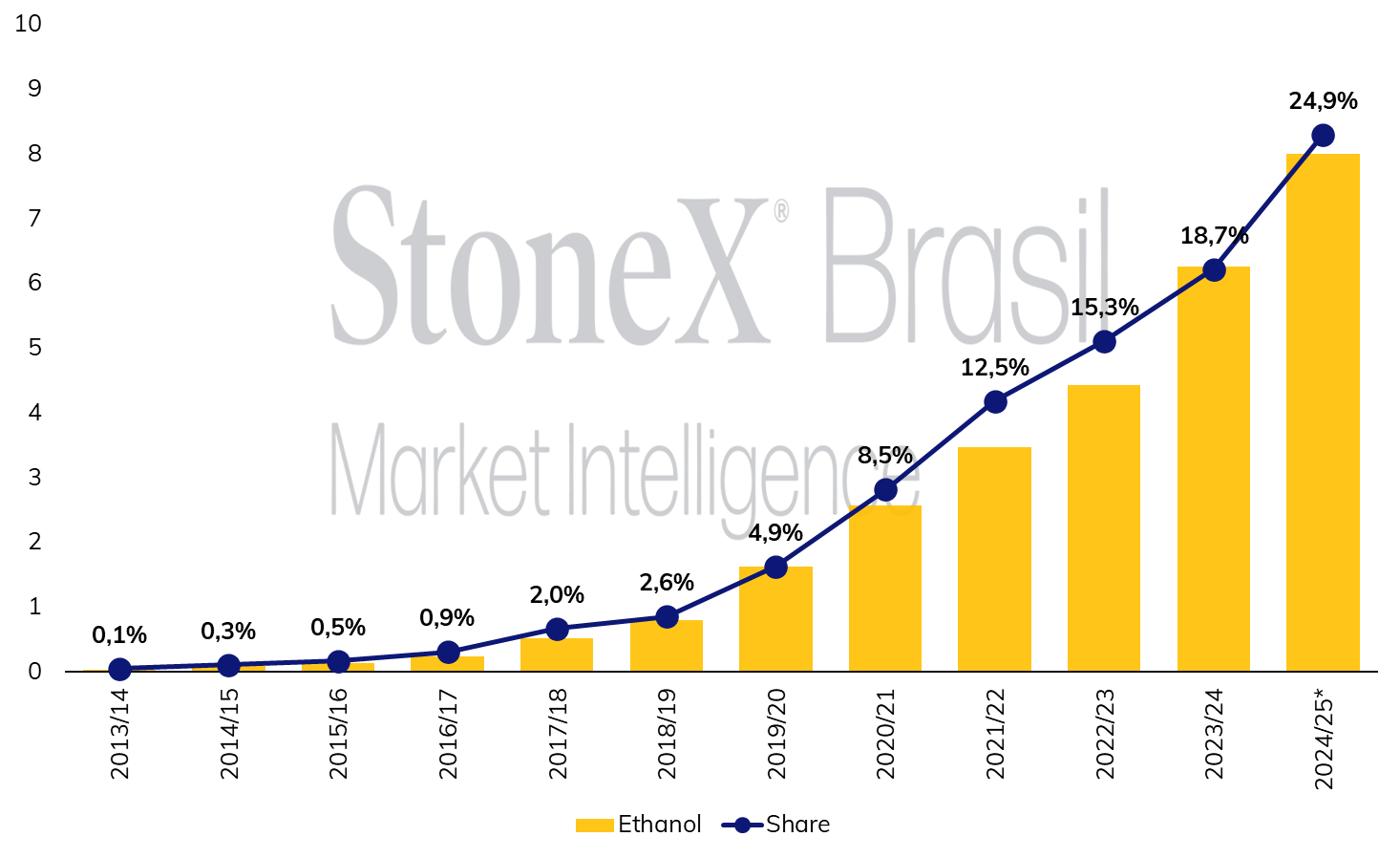
 Source: UNICA and StoneX. *Estimate and Design: StoneX.
For the 2024/25 crop, StoneX already points to a 41.4% increase in ethanol production from corn, which should reach 8.0 million m³ by the end of the cycle. According to UNICA's crop monitoring data, from April to July 2024, 2.46 million m³ of corn ethanol were distilled - an annual growth of 26.3% and compared to the three-year average, the sector recorded an increase of 71.9%.
Monthly corn ethanol production ('000 m³)
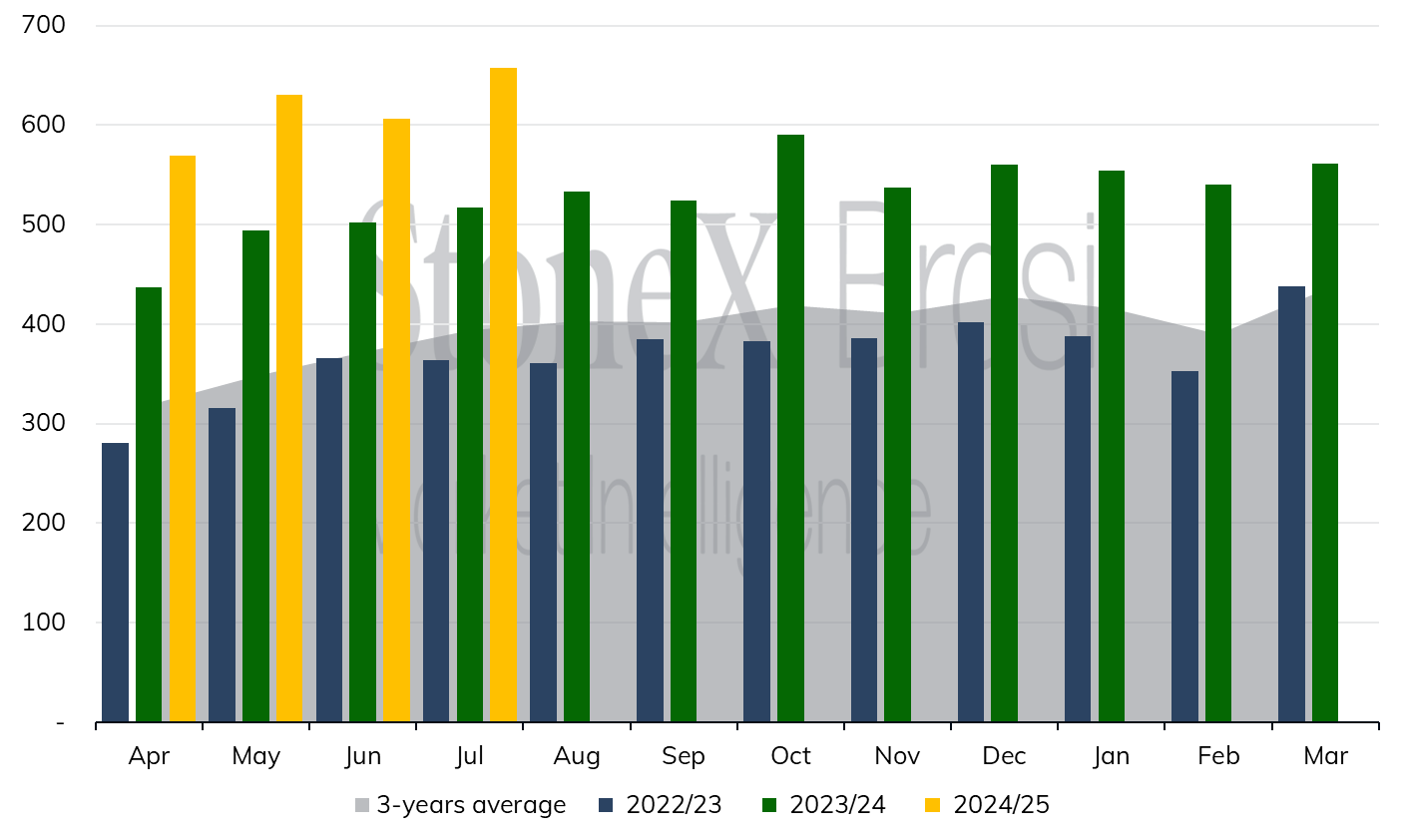 Source: UNICA. Design: StoneX.
Looking at production by type of ethanol, hydrous production has been the highlight of the current crop. By the end of July, production of this biofuel totaled 1.62 million m³ - an average of 202,800 m³ offered per two-week period - so far this year, hydrous production has increased by 47.9%.
The growth in hydrous fuel production is in line with the favorable parity levels for the biofuel at filling stations, especially in the states of the Midwest, the main region producing corn ethanol. According to the ANP's weekly data, parity in Goiás is 67%, in Mato Grosso do Sul, 65.6%, and in Mato Grosso, the main producer, parity is 60.6% - the lowest value of all the states in the Center-South.
Two-week production of hydrous corn ethanol ('000 m³)
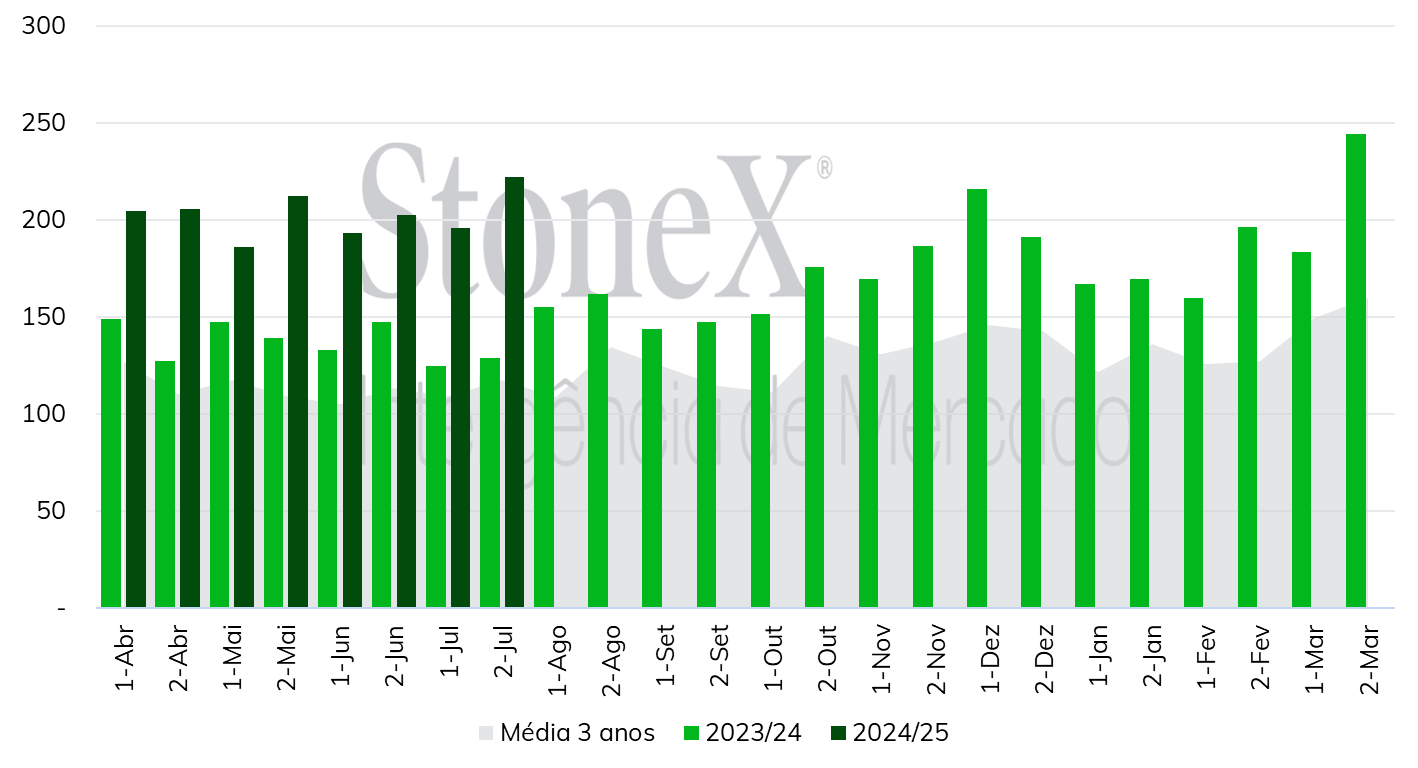

 Source: UNICA. Design: StoneX.
The production of anhydrous from corn has so far totaled 841,400 m³, which is slightly lower than in the same period in 2023. Compared to the average of the last three years, the volume of anhydrous has grown by 60.7%.
Two-week production of anhydrous from corn ('000 m³)
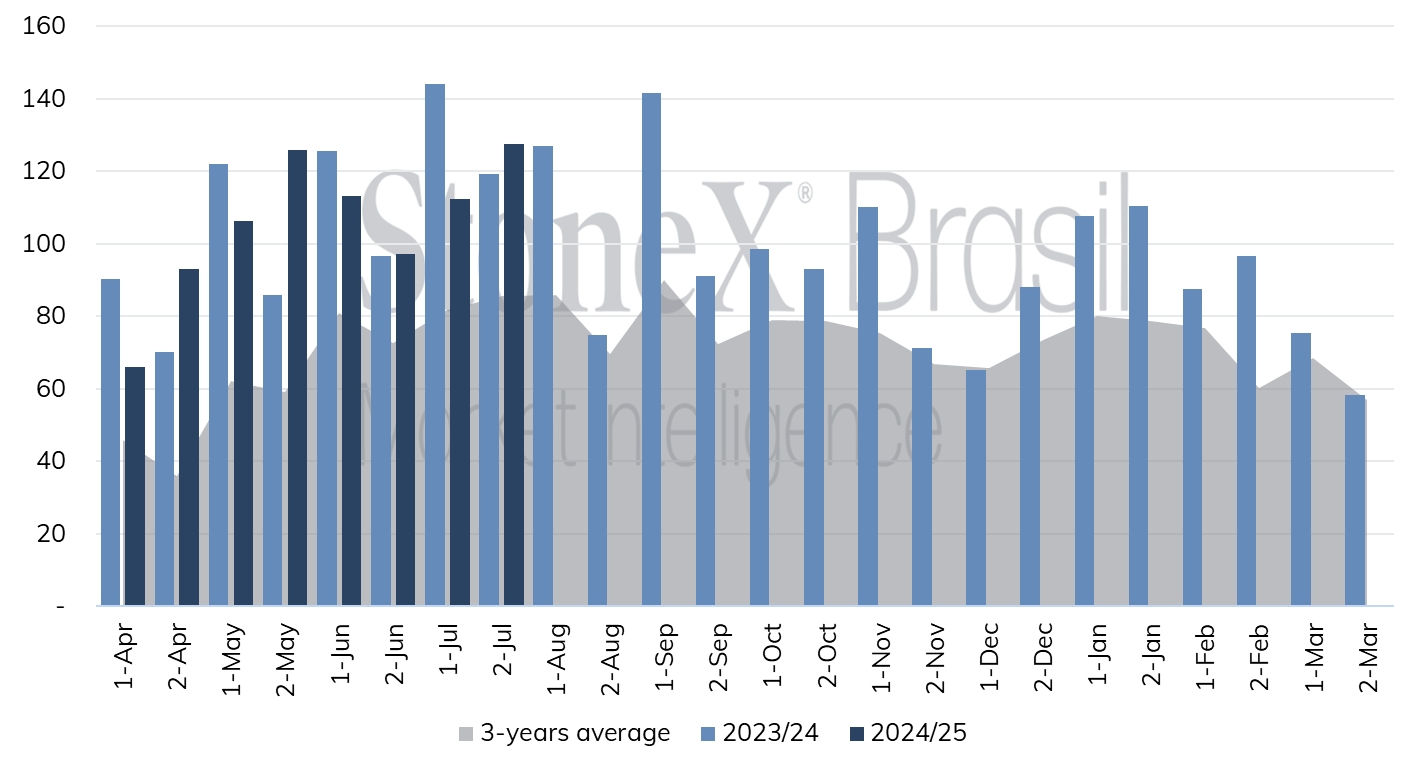 Source: UNICA. Design: StoneX.
The grain-based ethanol distillation sector has been growing exponentially in the Midwest region of Brazil, and is expected to become increasingly important in the country's alcohol market, with new plants expected to open in the coming years and production capacity expected to increase in other regions of Brazil.
According to the ANP, the state of Mato Grosso concentrates most of the plants in operation. According to the agency's most recent data, Mato Grosso has a production capacity of 31,500 m³/day, with 13 units in operation. In second place is the state of Goiás, with a capacity of 10,500 m³/day and a total of 6 production units. In total, Brazil has an operating capacity of 49,700 m³/day.
Looking at the projects listed with the ANP, which include building a new facility and expanding production capacity, by the end of 2026, Brazil should be adding 24,300 m³/day in dedicated plants.
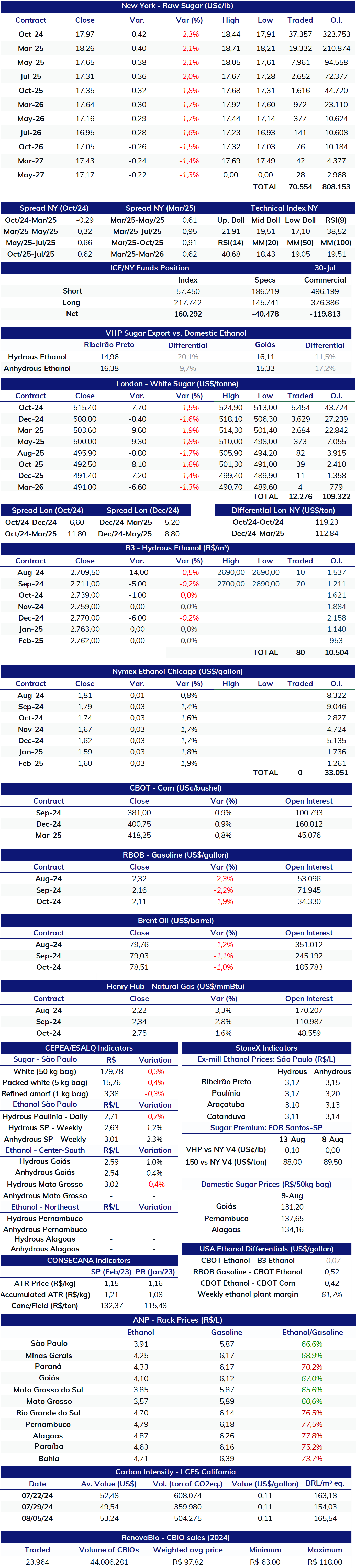
Daily recap
At the time of writing (14), the prices of raw and white sugar recorded a day of retraction on the futures markets, one day after the release of milling data for the second half of July/24. Raw sugar fell by 2.28%, ending the day at US$ 17.92/lb, while white sugar ended the day at US$ 515.4/t (-1.47%). The market seems to be reacting more decisively to the release of UNICA's data last Tuesday (14) - which indicated sugar production of 3.6 MMt in the second half of July, just 2.16% below the record 2023/24 crop. Also newsworthy is the release of an interview with Raízen's CEO - Ricardo Mussa, who indicated that the company (responsible for 84.2 MMt of cane in the 2023/24 crop) should see only a slight drop in 2024/25, producing around 83 MMt. The CEO points out that the company will have a smaller reduction than other players in the sector, but Raízen's large market share signals to the market a higher-than-expected availability of cane, which tends to be reinforced by the UNICA report released this week.