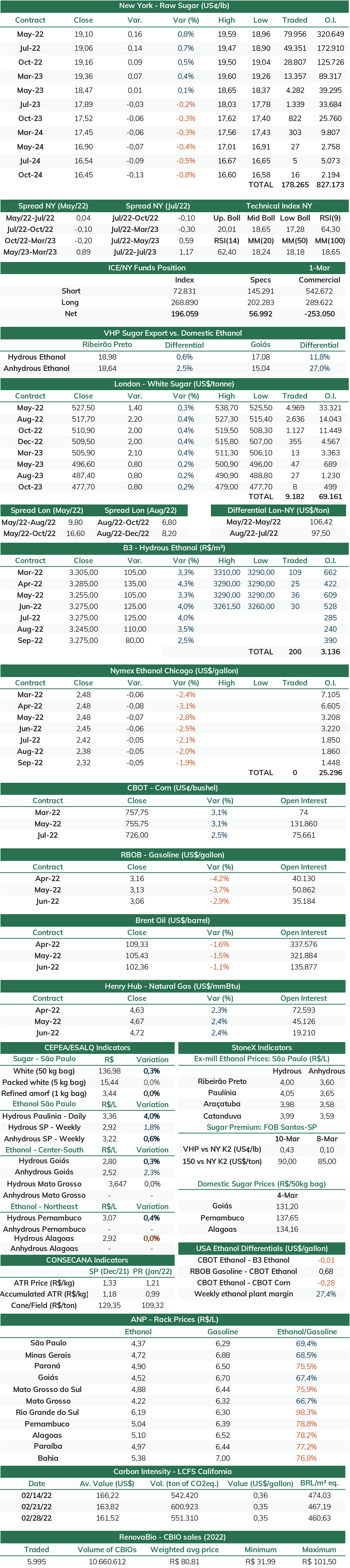
The week started with Brent’s front-month contract again operating closer to USD 105/barrel, while the market evaluates the talks between Russia and Ukraine. This situation brings relative relief to the Brazilian fuel market, even though the gasoline A price difference with the international market is BRL 0.3134/liter, according to a StoneX analysis.
Following the latest Petrobras readjustment on quotes at refineries, the selling price at pumps also found support. According to data from the ANP for last week, hydrous rose by 0.5% at São Paulo stations, while gasoline posted weekly gains of 0.7%, leading parity between the two fuels to 69,3%, a level that makes fuel alcohol more attractive.
However, the impacts of recent geopolitical tensions over prices at stations will be more accurately assessed from this week onwards. It is worth remembering that we estimate alcohol taking on a greater share in Otto cycle fuel consumption over the coming months. In light of ethanol’s competitiveness gain, ex-mill hydrous and anhydrous based in Ribeirão Preto already reach BRL 4.10/liter and BRL 3.90/liter, respectively.
Regarding sugar, the front-month #11 contract closed the session quoted at 19.13 c/lb on the ICE/NY, accumulating losses of 0.6% in relation to last Friday. Raw sugar’s movement seems to reflect the very S&D fundamentals, amid optimism about Indian exports, which justifies the recent drop of the spread between the first two contracts, standing at an inversion of 0.03 c/lb.
It is noteworthy that the N2-V2 differential in New York consolidated at a 0.09 c/lb carry in yesterday’s session, highlighting a more comfortable global balance over a medium-term horizon. The Brazilian fuel market, however, is a point of attention in this analysis, since hydrous operates at levels close to the #11 May/22 contract, while the anhydrous premium sits at 3.8%.
In addition to rising sugar fixations for export by the Center-South, the final consumer’s lack of capitalization tends to pressure demand for fuels, which leads us to maintain our estimate that the sugar-directed mix will be 45.5% in 2022/23 (Apr-Mar). So far, we have kept our projection that demand for Otto cycle fuel in the Center-South will have an annual growth of only 0.2%, estimated at 38.6 million m³.
Although the ANP has not disclose official data for February, UNICA figures showed consumption at 1.9 million m³ of ethanol in the region, a volume that represents a monthly increase of 13.9%. Specifically, demand for anhydrous reached 842,000 m³, while demand for hydrous totaled 1.1 million m³ (+5.9% and 20.8%, respectively).
It is clear, however, that recent fuel appreciation should negatively affect urban mobility, a trend that will depend on prospects for Brent crude, as well as policies to mitigate the impacts on the final consumer’s purchasing power, like the bill that zeroed federal taxes and changed the collection of the ICMS tax on diesel last Friday. If the same strategy were used for gasoline, the price reduction could reach BRL 0.69/liter.
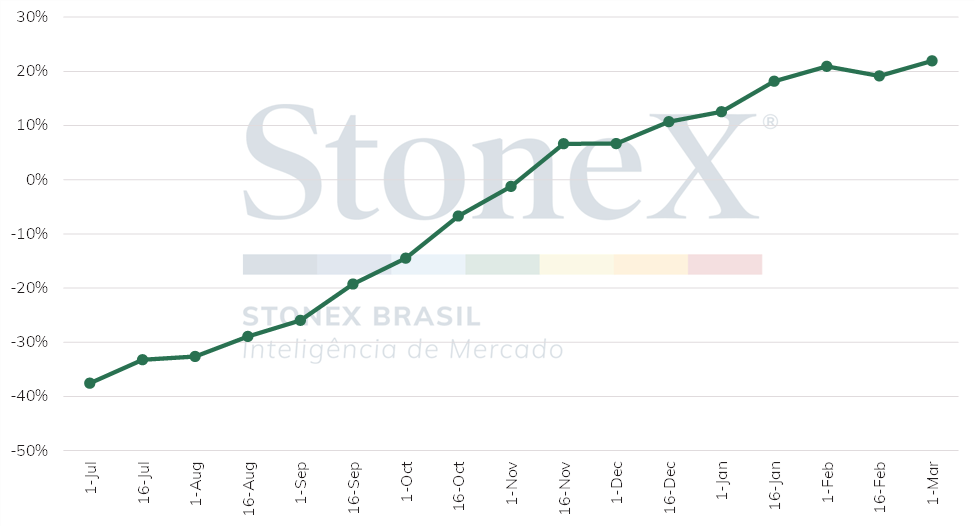
The comfortable stocks of ethanol in the Center-South should also limit stronger price rallies. Up to the second half of February, for example, hydrous and anhydrous storage were 7.0% and 47.6% above the volume recorded in the same period of the 2020/21 cycle (Apr-Mar).
Change of total ethanol stocks in relation to the 2020/21 cycle in CS Brazil (%)
Source: MAPA Design: StoneX.
In addition to this situation, the market is also attentive to the spread of Covid-19 in China, which may pressure oil and other commodities’ consumption in the short term, given the intensified policy of social isolation for disease control. The evolution of the pandemic picture will be closely monitored in order to provide clearer perspectives for the energy sector.