Excessive rainfall on Thai cane fields hindered the harvest progress during the 2021/22 cycle (Oct-Sept). In the Central region of the country, for example, rains in January 2022 exceeded the normal levels by 92%. In the sugarcane areas of the Northeast, precipitations were in line with the historical average.
Even though data for February have not been released, forecasts by the country’s Meteorology Department (TMD) indicated regular rainfall in such areas, Thailand’s main sugarcane centers. Given adverse weather conditions, it seems likely that the country will have the potential to produce 9.9 million tonnes of sugar in 2021/22 (Oct-Sept), a volume that represents an annual increase of 31.1%, but still stands 10.5% below the 10-year average.
For the current month, TMD weather models point to above-normal rainfall by30% in the Northeast and Central regions of the country. Between April and May, moisture should remain abundant over the main sugarcane areas of Thailand, with a volume projected to exceed the historical average by 10% to 20%.
Such a perspective should further pressure current cycle fieldwork, but ensure a favorable environment for the development of sugarcane that will be processed in 2022/23 (Oct-Sept). In fact, the country’s farmers were waiting to see how the weather would behave to define their planting intentions, with sugarcane having an advantage amid attractive prices and regular rainfall.
It is worth remembering that the price paid to producers should remain attractive in the next cycle, with talk of around THB 1,200/t, depending on the quality of the product and if burning is adopted as a method of harvesting. In addition, a smaller exportable surplus in India can also allow for higher profits at Thai mills, a perspective that should stimulate production next season.
On the other hand, the price of cassava has also been operating at a high level in 2022, with an 11.3% increase in the annual comparison. Taking these points into account, our preliminary expectation is that sugar supply has the potential to reach between 12 and 13 million tonnes in Thailand in 2022/23. However, high production costs can still limit this number.
Even if sugarcane area grows in the current cycle, weather conditions throughout the season and barriers in the fertilizer market can still pressure the crops’ productive potential, a trend that will need to be evaluated over the coming months. On a long-term horizon, some indications already point to the possibility of steady expansion of Thailand’s sugarcane area, to increase ethanol production and achieve decarbonization plans for the transport sector.
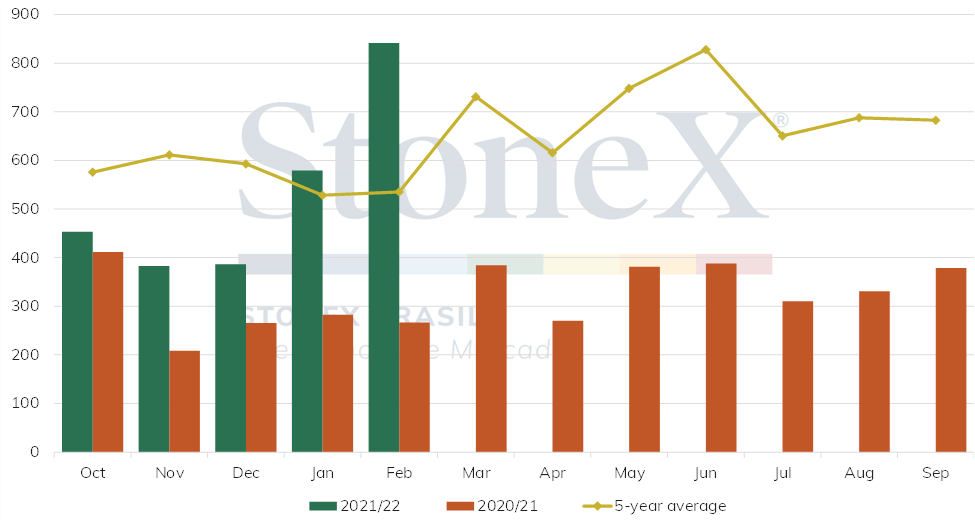
Considering the 2021/22 cycle, Thai exports reached 2.6 million tonnes between October 2021 and February 2022, a volume that represents an annual increase of 84.2%, but which is 7.1% below the five-year average. StoneX contacts in Asia expect about 7.0 million tonnes of sugar to be directed abroad by the end of the season.
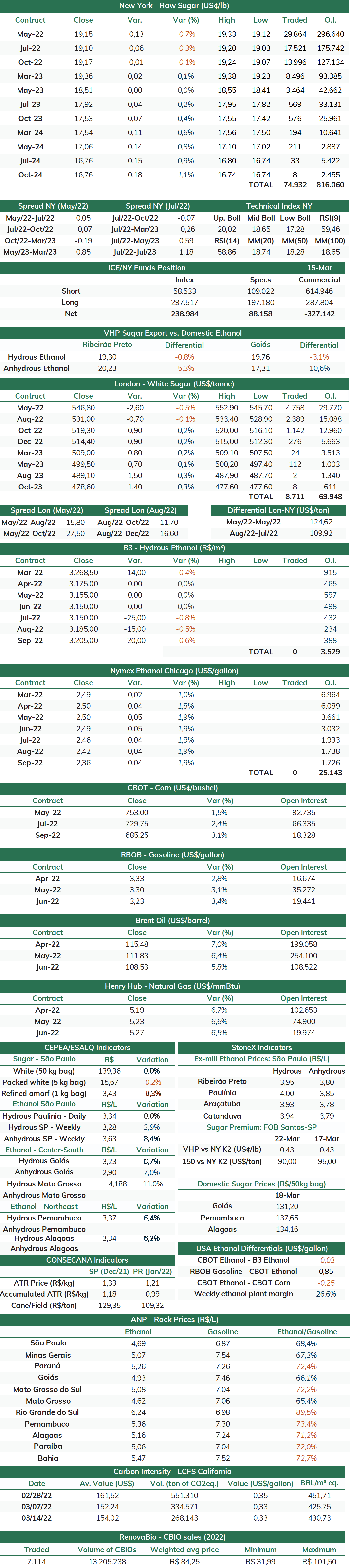
Regarding Tuesday’s trading session, the #11 front-month contract operated with low volatility, closing at 19.15 c/lb on the ICE/NY, a daily decline of 0.7%.
Thailand sugar exports (000 tonnes)
Source: TSMC. Design: StoneX.
Update: ethanol import window
Last Monday (21), Brazil’s Foreign Trade Chamber (Camex) decided to zero the import tax for sugar and ethanol until December of this year. Previously, the ethanol tax rate from countries outside Mercosur was 18%. This aims to make fuel prices at Brazilian posts cheaper, with estimates pointing to a reduction of BRL 0.20 per gasoline liter, but the measure still needs to be published in the government’s Official Journal on Wednesday (23) to enter into force. However, some points need to be considered in this analysis.
Until then, our calculations pointed to a closed import arbitrage for purchases of US ethanol. In Suape/PE and Paulínia/SP, for example, the domestic price was 20.2% and 27.6% lower than US ethanol placed in these respective markets. By zeroing the import tax, spot acquisitions remain unattractive, with the window being closed in the North and Northeast and Center-South of the country.
This perspective also remains for purchases made based on future contracts, with an open arbitrage only for purchases of the US product in October 2022 in Suape/PE, by 0.7%. However, depending on freight, foreign exchange and ethanol price movements in the US, the measure may stimulate a higher level of international purchases in the coming months. It should be considered, however, that the price of ethanol on the Brazilian market can be pressured from the beginning of the 2022/23 crop (Apr-Mar) in the Center-South, especially when we analyze the lower demand for fuels in the domestic market.