On Tuesday (17), the Indian Sugar Mills Association (ISMA) released its monitoring of the 2022/23 (Oct-Sept) sugar crop. Production until January 15, 2023, already totals 15.68 million tonnes, 4.0% ahead of the same period in 2022. In the first half of the month, 3.61 million tonnes of sugar were produced, against 3.53 last year (+2.4%). The progress of the current season is in line with initial market expectations of an increase in cultivated area and the number of plants in operation, which so far are 515 units, up from 507 in January 2022.
Data by state brings mixed tones to the full picture of Indian sugar production. In Uttar Pradesh, until the first half of January, 4.07 million tonnes of sugar were produced, just 50,000 tonnes above last year. In the region, fewer mills are operating (117 against 120 in 2022), and the crop seems to be losing steam, or at least it should end in stability compared to the 2021/22 season, when Uttar Pradesh produced 10.2 million tonnes of sugar (an annual drop of 7.8%).
In the southernmost states of India, the situation could be critical although the numbers so far seem to point to the opposite. In Maharashtra, 6.03 million tonnes of sugar were produced up to January 15, a two-week growth of 1.35 million tonnes and an annual change of 2.6%. In Karnataka, 3.36 million tonnes have already been produced, 2.8% above 2021/22. In both regions, the harvest started late in 2022/23, due to excessive rainfall between September and November, which are key months for the final development of sugarcane fields.
The big question is not only the progress of the crop, but its duration, especially in Maharashtra where there were mills crushing until mid-June in the 2021/22 cycle, making it a production record of 13.7 million tonnes in the state. In the current season, operations are unlikely to last that long, causing the final tail of the cycle to have a lower sugar volume. Therefore, even though 2022/23 is ahead of 2021/22, the clarification of the volumes produced in this harvest peak and its duration will be decisive for its closure.
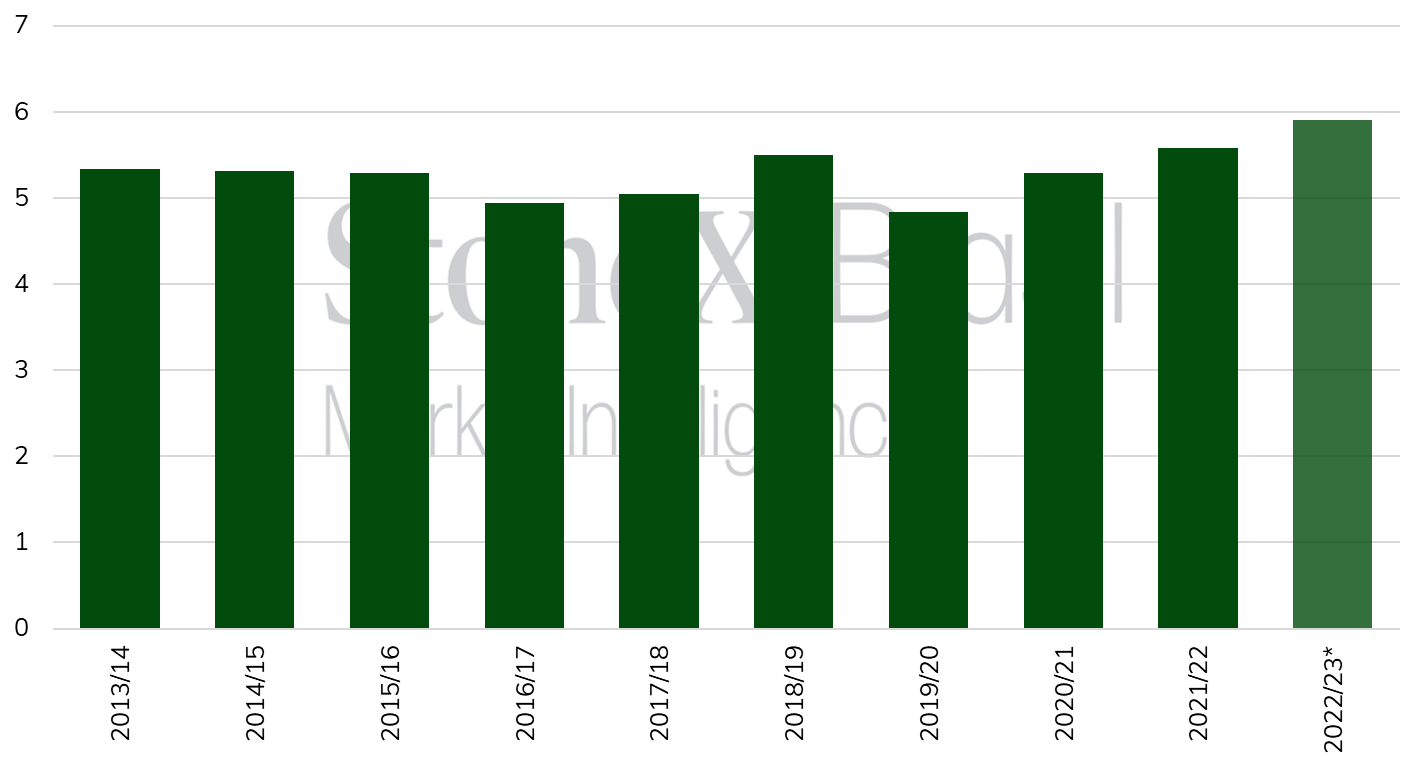
According to the ISMA, the sugarcane planted area should grow to 5.9 million hectares in 2022/23, 5.7% greater than the previous season. This would be the largest planting for sugarcane in India, which is stimulated by government incentives (Fair Remunerative Price) and by derivatives. Sugar has remained extremely attractive on the international market in recent months and the ethanol sector is expected to demand greater volumes of feedstock each year: in the current cycle, 4.5 million tonnes of equivalent sugar should be directed towards producing the biofuel.
Sugarcane planted area in India (million hectares)
*ISMA estimate. Sources: ISMA & StoneX. Design: StoneX.
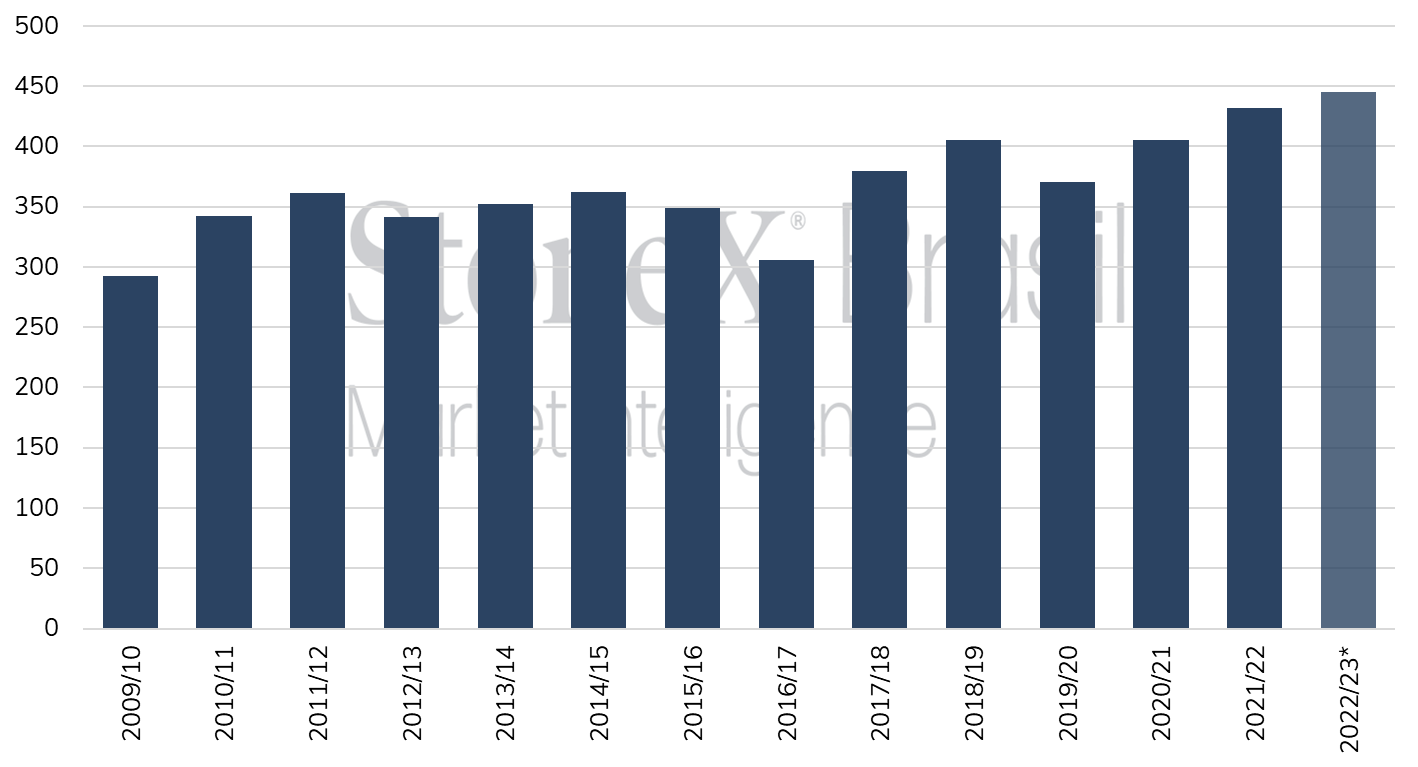
Sugarcane availability has also increased in recent years, having reached a record in 2021/22 (Oct-Sept). According to the Ministry of Agriculture and Farmers' Welfare, India produced 431.8 million tonnes of sugarcane in 2021/22, almost 26 million above the previous crop. For 2022/23, the agency's estimates point to 465 million tonnes, something that at the moment does not seem feasible, as it would be an annual growth of 7.7%, that is, above the increase in area, which would probably imply higher productivity, which should not be the case according to the information coming from producers. Therefore, it is unlikely that sugarcane production will exceed 450 million tonnes in the current season, with the chance of being even less bulky than 2021/22.
Sugarcane production in India (million tonnes)
*StoneX estimate. Source: India’s Ministry of Agriculture and Farmers' Welfare. Design: StoneX.
Considering these productivity losses, especially in Maharashtra, sugar production estimates for India have been cut down and the futures market already seems to reflect a potential drop in Indian supply. A few months ago, it was understood that the first quarter of 2023 would be the time for an increase in immediate sugar stocks, a fact that has now been discarded by agents precisely because of the problems in India. If there is a crop failure in the country, it is possible that even with the beginning of the 2023/24 crop in Center-South Brazil (Apr-Mar), the second quarter of 2023 will continue to be in deficit, a question that is not yet certain.
Above-average rainfall in unwanted months in southern India is likely to disrupt sugarcane productivity. But, in addition, the results during the cane crop are disappointing in terms of the sugar recovery, another elemental factor to understand the end of the crop in India. Therefore, the likely scenario in the country seems to be one of lower productivity (in terms of cane and sugar) and shorter duration. In this sense, part of the market already works with an Indian sugar production below 35 million tonnes, which would be supported by a season lasting until mid-March only, unlike 2021/22, which lasted until June. The estimates that remain above 36 million tonnes still bet on a productive peak well above last year and a loss of speed from March, but without interruption of operations by the mills, that is, without a crop failure. It is worth emphasizing that most agents are already working with a smaller 2022/23 crop.
At this moment, the important thing to analyze is exports and, therefore, the impact of this context on prices in the medium term. If in fact production is below 35 million tonnes, it is very unlikely that the Indian government will release the new export quota, since in the first phase 6.15 million tonnes of sugar have already been released, of which 5.5 million are already committed and 1.8 million tonnes shipped by the end of 2022.
Therefore, until a better crop does not materialize in India, new export lots will not be opened, or will be in smaller volumes. In a scenario where India is out of the market until September, there is a relevant bullish factor until then. For 2023/24 (Oct-Sept), there is an early perception that the country will face a sugarcane crop under El Niño (which tends to bring less rainfall) and with the need for even more ethanol, since the target for 2024 is a blend rate of 15% in gasoline. As such, it is already possible to outline a path of challenges for the sugar-ethanol sector in India in the coming months and years.
Market wrap-up
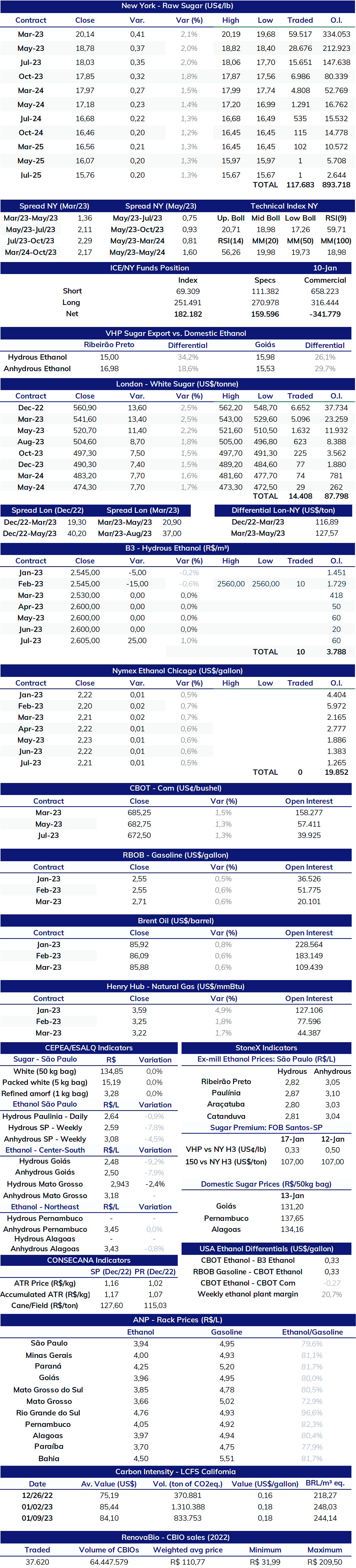
On Thursday (17), sugar had another day of aggressive changes in the futures markets. At the end of the session on ICE, NY#11 was priced at 20.14 c/lb, up 41 points (+2.08%) compared to the close last Friday (13), the last trading session. In London, white sugar closed 1.41% higher, quoted at USD 560.90/t.
What is new for the market, even with the ISMA data bringing sugar production above last year, are new estimates pointing to a reduction in Indian production. The spreads reinforce this context of possible higher supply in the medium term, since March/23-May/23 in New York hit 136 points in the day's trading session. While the most liquid contract did not have major difficulties in surpassing the 20.00 c/lb level again, May/23 seems to continue finding resistance at 19.00 c/lb, having closed at 18.78 c/lb.
indicators