Ethanol
According to data released by the Ministry of Agriculture and Livestock (MAPA), total ethanol stocks in Brazil totaled 7.97 million m³ at the end of the first two-week period of August, 2.7% above the three-year average, but 2.4% below last year. This figure is the result of a 6.8% drop in hydrous stocks compared to 2023, but an annual increase in the volume of anhydrous stocks, which is 4.8% higher.
In the Brazilian Center-South, stocks of hydrous alcohol from 2023/24 (Apr-Mar) to 2024/25 were 1.54 million m³, an all-time record. Despite domestic market outputs that were 21% higher than in 2022/23, the last crop also saw high production, due to record crushing and growth in the corn ethanol sector, and demand that was below potential as it was slow to respond to parity levels.
However, the pace of purchases by distributors grew in 2024/25, with a two-week average of 914,000 m³ of hydrous sales on the domestic market until the first half of August. This brought accumulated domestic sales to 8.23 million m³ in the period, an annual increase of 44% and the second highest figure in the historical series to date.
Accumulated sales of hydrous ethanol on the domestic market in the Center-South (million m³)
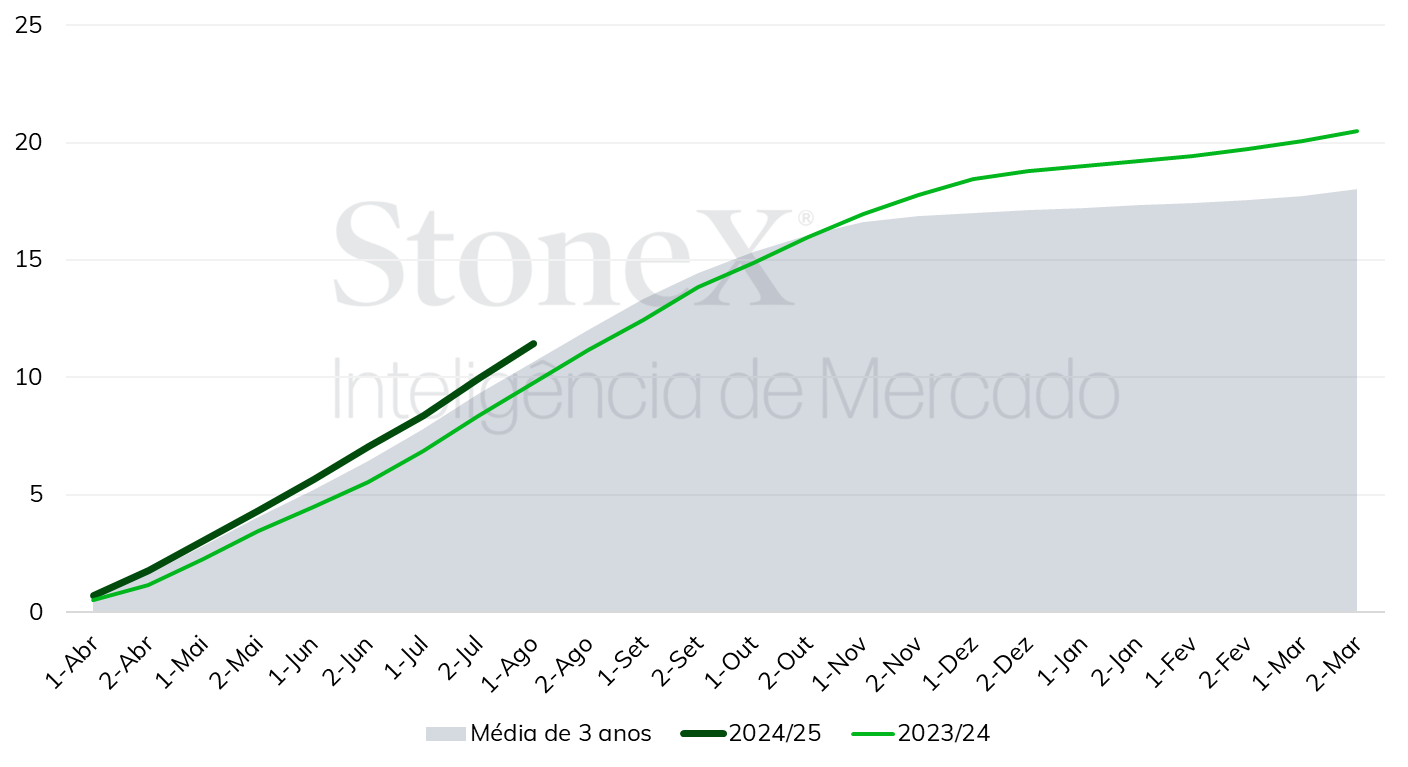
Source: UNICA. Design: StoneX.
In this sense, demand is growing at a faster rate than supply, consequently putting pressure on product stocks, despite 17% higher production due to earlier crushing than last year, a similar production mix compared to 2023/24 by the mills, and strongly expanding corn ethanol. According to MAPA, stocks of hydrous ethanol stood at 4.6 million m³ in the first two-week period of August, down 7% year-on-year.
Hydrous ethanol stocks in the Center-South (million m³)
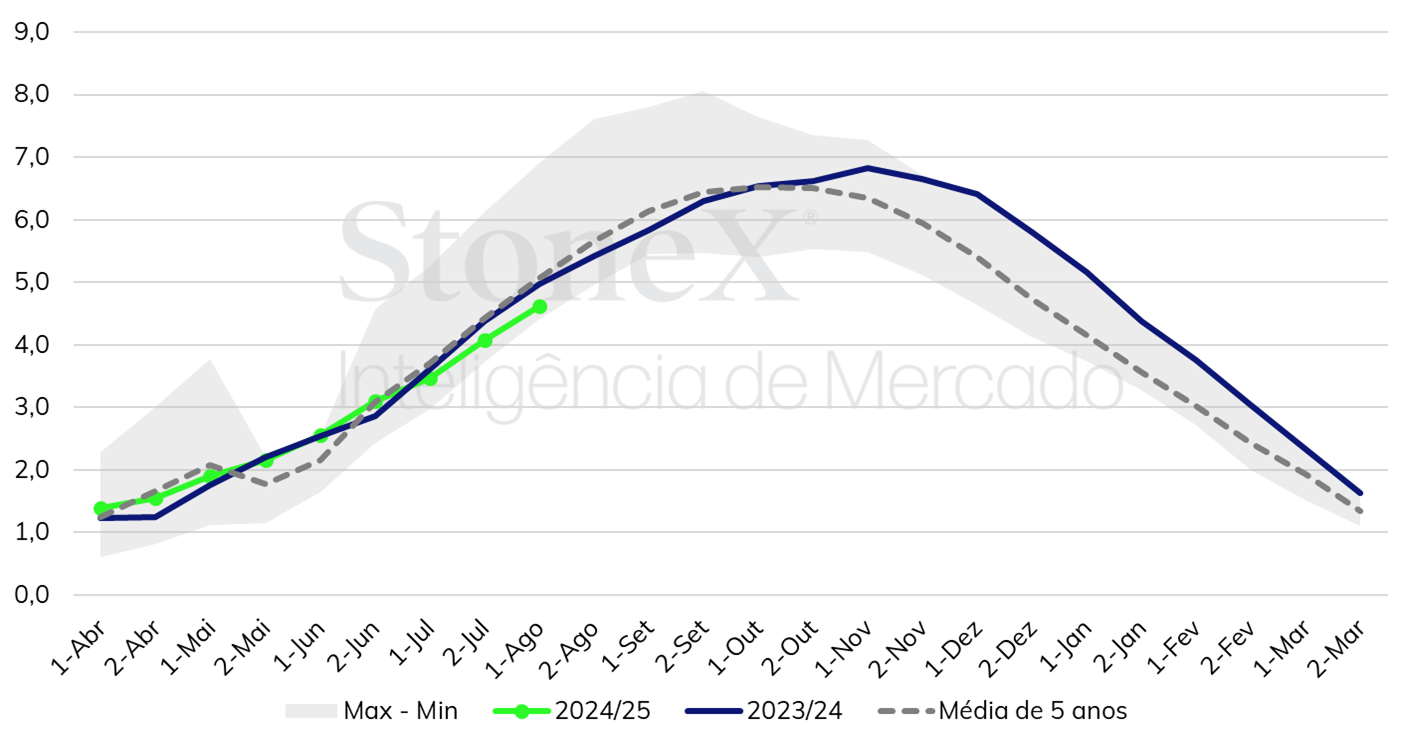
Sources: MAPA, UNICA. Design: StoneX.
For anhydrous, the scenario has been the opposite on the demand side. This is because, in the Center-South, sales of gasoline by fuel distributors in the current crop year 2024/25, according to ANP data up to July, are 9.1% lower than in 2023/24. In the period, anhydrous sales at the mills fell by 3%, something reflected in production, which was 6% lower in the first four months of the cycle, and in exports, which were 20% lower than in 2023/24 until the first half of August. As a result, stocks of the product are still higher than last year at 3.21 million m³ (+6.1%), despite losing the advantage at each two-period due to lower production, and should remain at normal levels until the end of the cycle.
Anhydrous ethanol stocks in the Center-South (million m³)
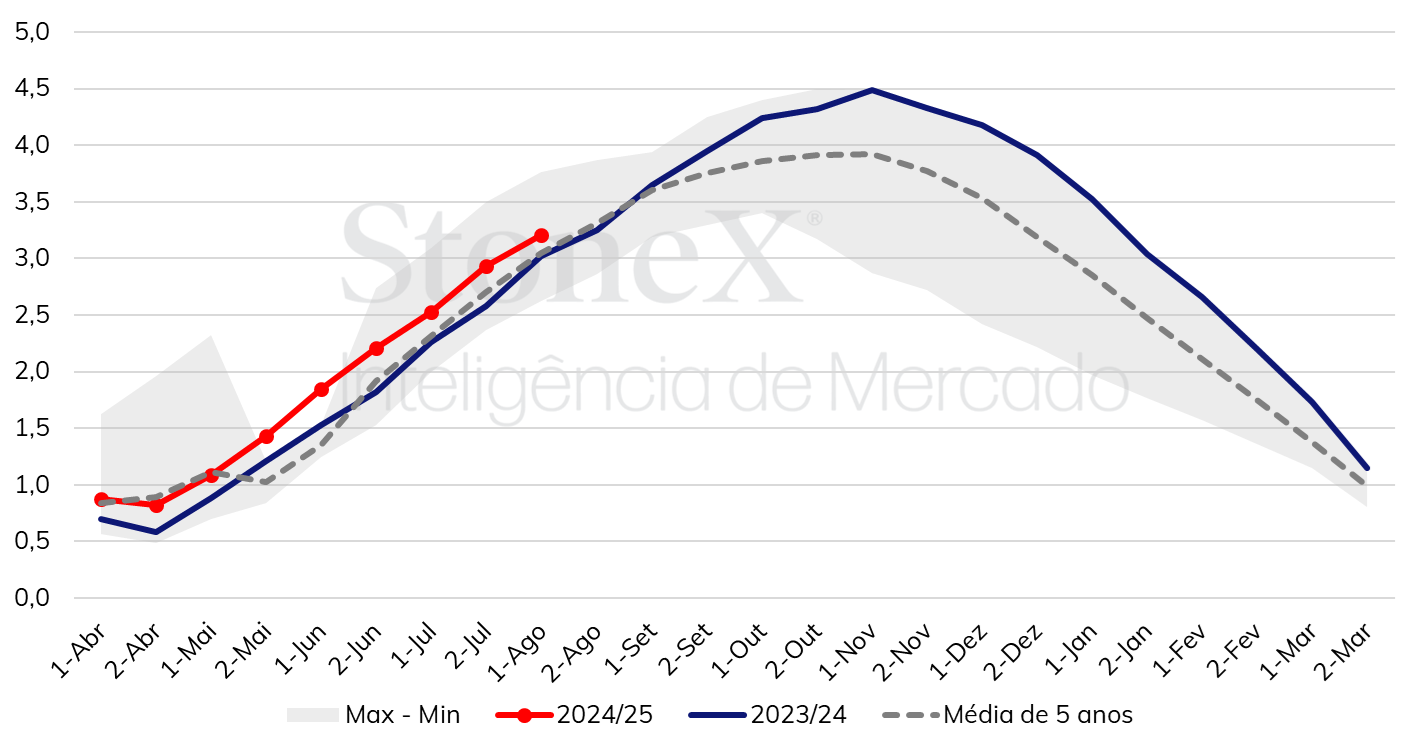 Sources: MAPA, UNICA. Design: StoneX.
Sugar
In the 2023/24 cycle (Apr-Mar), sugar stocks reached all-time highs in Brazil, responding to the record performance of the season in the Center-South (CS). In November, stock levels of the commodity hit 16 million tonnes, an unprecedented figure, and in an atypical period of growth in supply, since, seasonally, the harvest is already in the inter-crop period. Last year, in line with the record productivity and high availability of sugarcane, a significant number of mills in the CS were still operating in December, which is also unusual.
At the same time, prices on the international market encouraged the maximization of the sugar-directed mix, which led to monthly records in sugar production at the peak of the crop (July-September), consequently increasing Brazil's exportable surplus. On the other hand, October was a cruel month for the sector, since lineup volumes at Brazilian ports were at their highest, but several days of rain in Santos at the time delayed shipments and appointment of new cargoes, thereby increasing stocks on the domestic market, making it difficult for sugar to arrive at destinations (where demand was supported) and therefore representing a bullish factor on NY#11.
On the other hand, the dry weather from November onwards, despite hindering the development of the 2024/25 cane, allowed the disposal of these accumulated stocks. In all the months from November/23 to July/24, exports of sugar (according to the MDIC) were record-breaking. Even so, due to the high supply in the Center-South, the ending stocks of the region for 2023/24 reached record levels, despite the closing figure indicated by MAPA of 2.9 MMt. Considering the beginning stocks released by UNICA for 2023/24, at 3.16 million tons, plus the cycle's supply - production of 42.43 MMt - and removing total demand (domestic consumption given by UNICA, at 8.69 MMt, and exports released by MDIC, at 32.3 million tonnes), ending stocks in the CS should have ended at just over 4.7 million tonnes last season.
Brazil's monthly sugar exports (million tonnes)*
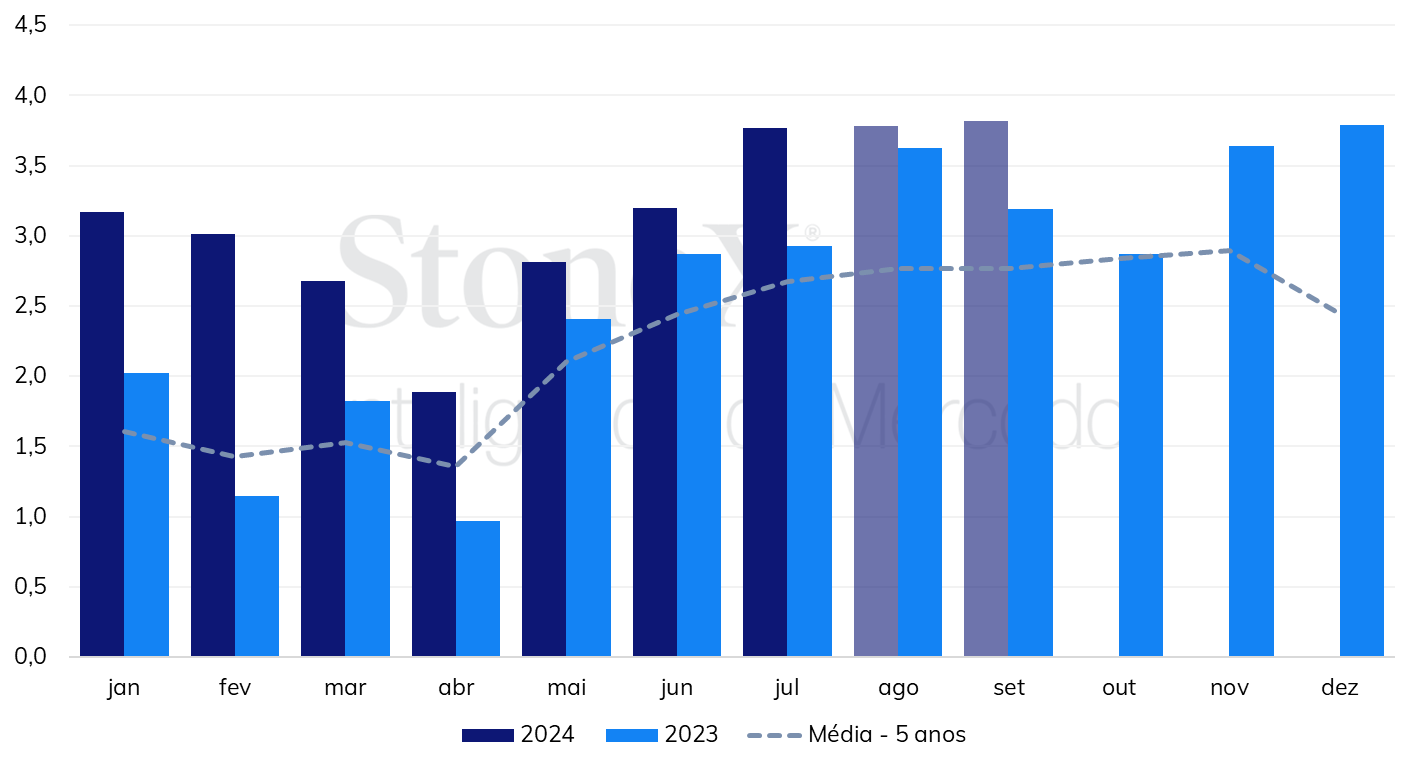 StoneX estimates for August and September. Source: MDIC. Design: StoneX.
For August and September, current levels of production and stocks could lead to a repeat of the exports seen in July, between 3.7-3.8 million tonnes (volumes indicated by the lineup, for example), following the seasonal movement of peak shipments (July-Nov). However, the amount exported in September will depend on the weather and the length of the crop itself, which is already rumored to be “dying a sudden death”, i.e. ending quickly and early. If it fails to rain next month, it is likely that the volume mentioned will be close to that in September, since, according to shipping agency Williams, 3.3 MMt of sugar has already been nominated for shipment in September.
Sugar lineup in Brazil (million tonnes)
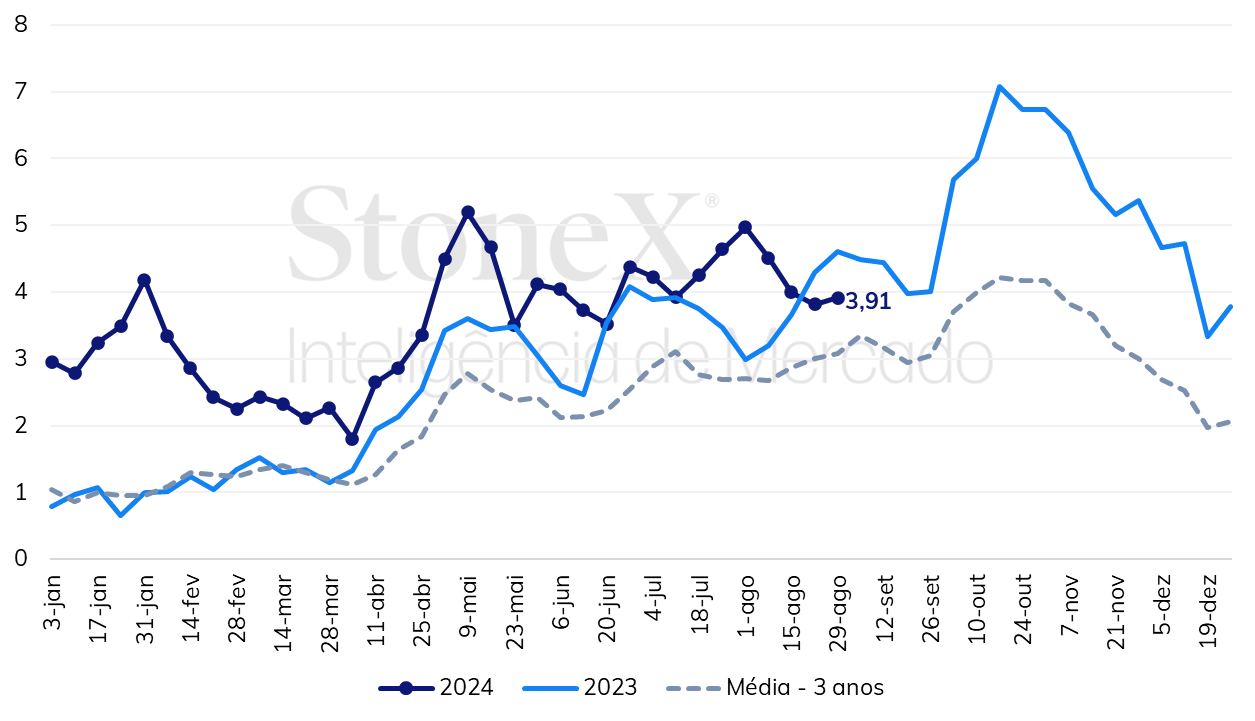 Source: Williams. Design: StoneX.
Finally, sugar stocks in the Center-South, despite being at an all-time high at the end of the crop year, have been narrowing the gap compared to the last cycle. By the first two weeks of August, sugar production was 5.4% higher than in 2023/24, also losing the advantage in annual terms, since it was already 16% higher at the end of June. As a result, at the end of August stocks should be close to 13 million tonnes, 7% higher than last year - compared to July, which was 23% higher. In this sense, it is likely that the volume of sugar stockpiled in Brazil is heading towards normalized levels, a factor directly linked to record exports this year and potentially lower production until the end of the crop.
Monthly sugar stocks in the Center-South (million tonnes)*
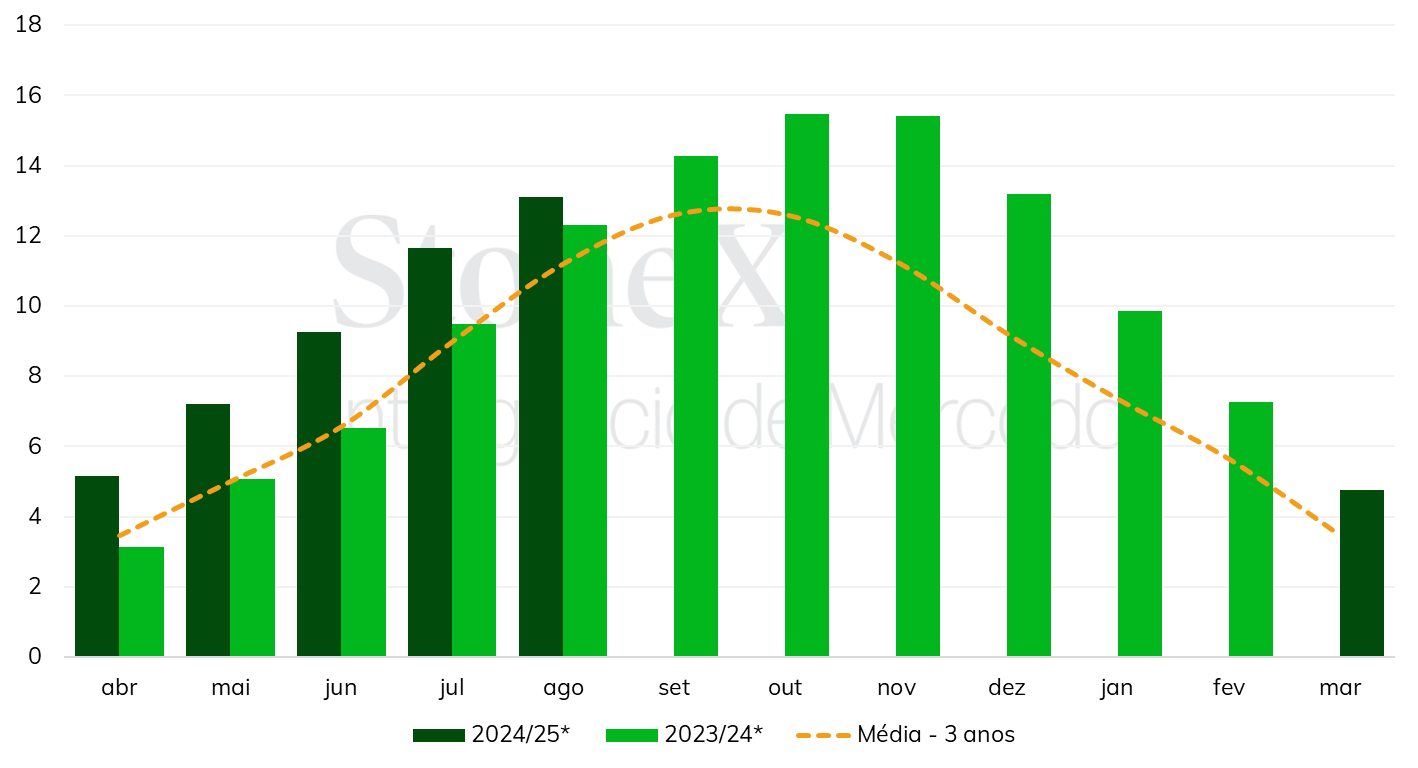 StoneX estimates as of March/24. Sources: UNICA, MAPA. Design: StoneX.
- Weekly recap
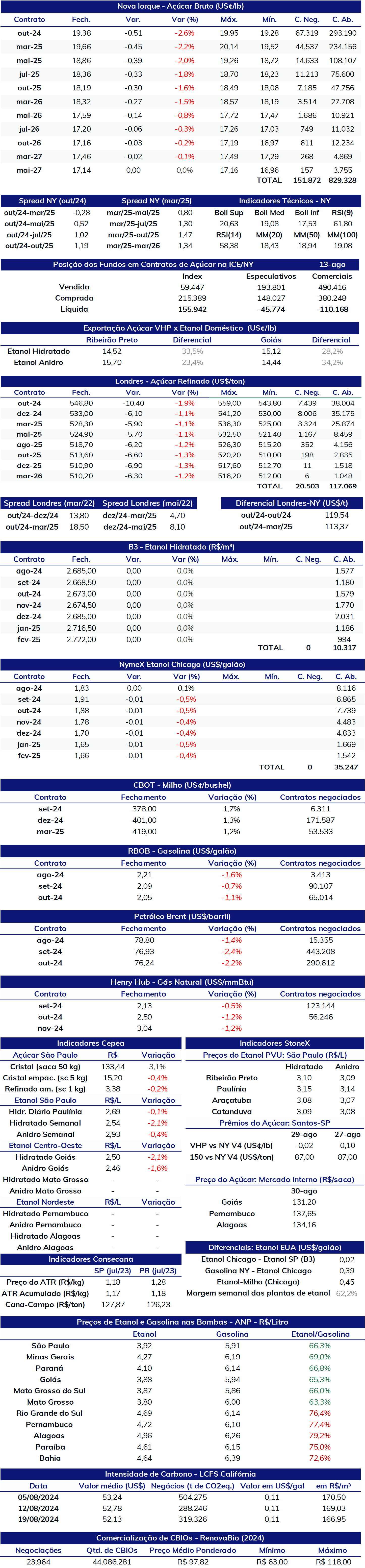
Last week, sugar prices registered a significant advance in response to concerns about the crop in the Brazilian Center-South, a context exacerbated by the incidence of fires in the country's main producing regions. According to Orplana, 80,000 hectares of sugarcane have been affected, which represents more than 1% of the Center-South area, including areas to be harvested and other areas where sugarcane is regrowing, which could also affect the 2025/26 season (Apr-Mar). For raw sugar SBV4, prices ended the week at US¢19.38/lb, up 5.4% over the period, the highest since early July for the October contract. Sugar remained under significant downward pressure until mid-August due to more favorable weather in South Asia, as well as the more favorable outlook for the global balance in 2024/25 (Oct-Sept) as a whole. The greater concern about the Brazilian crop, however, has cooled the market's bearish outlook, a scenario that should continue to be monitored, given the concerns about a “sudden death” of the 2024/25 crop in the Brazilian Center-South, after a faster start compared to 2023/24 and the effects of dry weather on productivity.
- Indian government to clear ethanol production from sugar diversion for next cycle
Last Thursday (29), the Indian government announced the release of ethanol production from sugarcane juice and B molasses in the 2024/25 crop (Oct-Sept). In December 2023, the Indian government had limited ethanol production using these methods, which divert feedstock from sugar production, in order to ensure domestic availability, as it feared a worse crop due to El Niño in 2023. At the time, the limitation caused a sharp drop in sugar prices, because it limited the prospects of a drop in production in India, a context corroborated by the actions of speculators. With the release announced for next season, the deviation from sugar to ethanol is expected to grow, considering the target of a 20% ethanol blend in India by 2024/25.
- UNICA releases follow-up for the first half of August
Last Wednesday, the Brazilian Sugarcane and Bioenergy Industry Association (UNICA) released its two-week crop follow-up report for the first half of August 2024. During this period, 43.8 million tonnes of sugarcane were crushed, a drop of 8.6% compared to the same period in 2023. The current season already totals 377.4 million tonnes - still 4.8% above the record crop of 2023/24, but losing momentum compared to the previous season since the first two weeks of July. With crushing of 43.8 million tonnes, a sugar mix of 49.27% and TRS of 151.09 kg/t, sugar production for the period was 3.11 million tonnes, down 10% on 2023/24, but still 5.2% above the average for the last three years. A point of attention in this context is the sugar-directed mix, which was down 1.55 p.p. compared to the same period in 2023.
- IKAR estimates drop in Russian sugar production
In the last week of July, sugar mills in Russia began harvesting for the 2024/25 season (Aug/Jul). The initial outlook for Russian sugar production was positive, before the seasonal rainy season, as the area planted with sugar beet grew by 7% to 1.14 million hectares. However, the months of rain in Russia were not positive for the areas, with a prolonged drought in 2024. So far, 2.55 million tonnes of feedstock have been harvested, with productivity falling sharply in some regions. As a result, IKAR (the Russian Institute for the Study of Agricultural Economics) estimates a production of 6.1 million tonnes for 2024/25, which would mean a drop of almost 10% compared to 2023/24.
- Ethanol movements during the week
Last week (30), hydrous ethanol prices registered a slight recovery trend, in response to the drop at the end of the previous week - which saw a lower volume of trading. The indication for ex-mill hydrous based in Ribeirão Preto went from BRL 3.00/liter on August 26 to records of BRL 3.10/liter at the end of the period (the 30th), returning to the level seen at the beginning of the month. Despite the faster progress of the 2024/25 crop, high demand continues to support prices, which should remain bullish until the end of the season. Parity levels favor the biofuel in much of the Center-South and the shorter end to the crop should still have a positive impact on prices.
- Hydrous outflows remain high in the first half of August
According to UNICA data released last Wednesday (28), sales of hydrous ethanol remained high during the first half of August, following the scenario that has been observed throughout the 2024/25 crop - which has seen an increase in sales due to the favorable parity at the pumps. The Association announced that hydrous outflows in the period amounted to 897,000 m³, an year-on-year increase of 19%. For anhydrous ethanol, there was a slight increase of 1.2% in sales, which stood at 483,000 m³ for the two-week period.