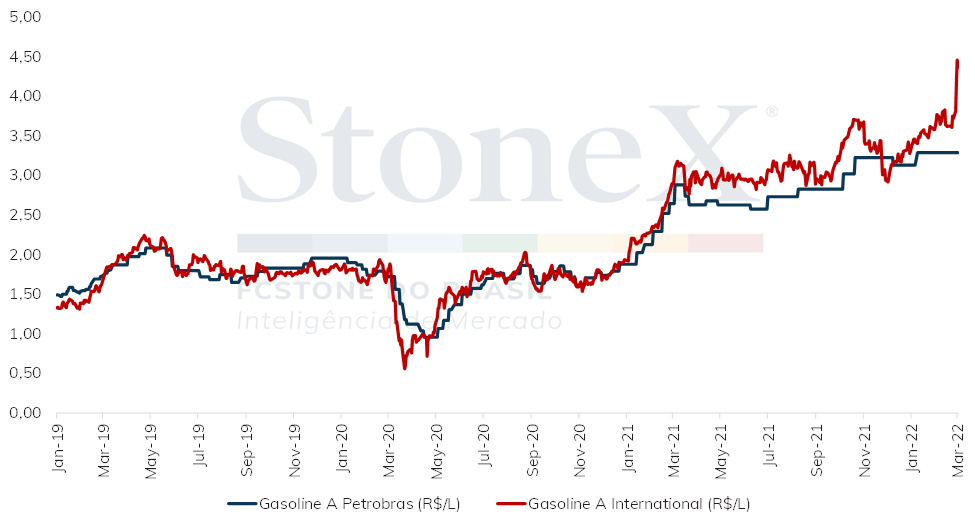
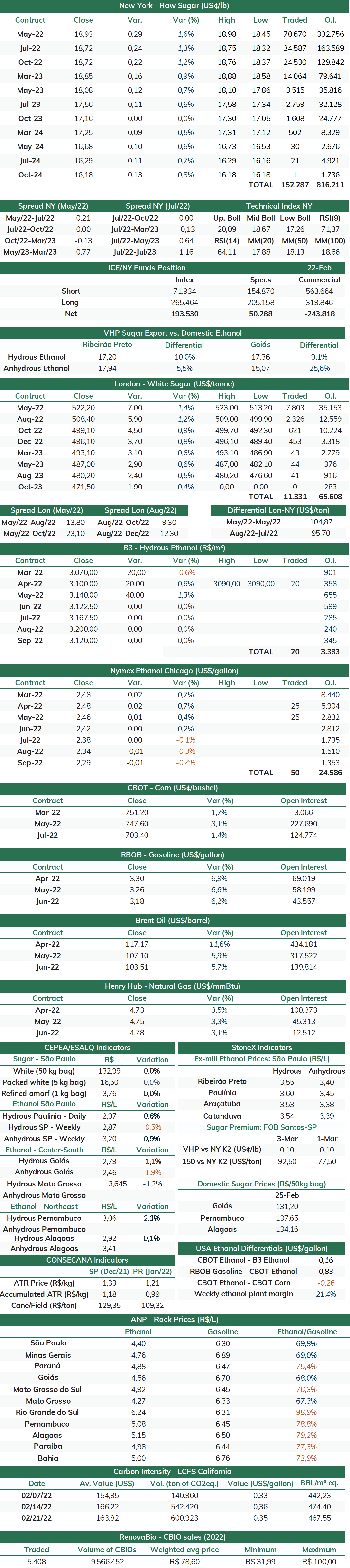
Keeping the exchange rate and the mandatory renewable volume obligations (RVO) constant, if there is a 10% increase in ULSD, this difference may reach -BRL 1.273/liter. In the case of a 20% valuation, the difference should be -BRL 1.738/liter. Considering an exchange rate of BRL 5.414, the current price difference would be -BRL 1.154/liter. Assuming increases of 10% and 20%, this differential could reach -BRL 1.654/liter and -BRL 2.156/liter, respectively.
This whole situation, in turn, acts as a factor for diesel prices in the domestic market, which can lead to higher transport and harvesting costs, as well as freight costs.
The outlook for the exchange rate in 2022 has risks for both sides, that is, for a more significant appreciation of the Brazilian real and a devaluation. On the one hand, the Russian military invasion of Ukraine is raising global tensions and causing a risk-off behavior and the pursuit of security assets such as gold, public debt securities, and currencies such as the yen, the Swiss franc, and the US dollar. Assets from emerging economies usually perform poorly in times of global stress like these, as investors often withdraw their investments from riskier locations and redirect them to stronger economies.
Moreover, the escalating prices of food, metal, and, above all, energy commodities should pressure inflation rates globally, which can push the Federal Reserve to be firmer in its monetary tightening to try and contain the highest price acceleration in decades in the United States. Higher interest rates in the US make financial securities more profitable, attracting capital there and favoring a dollar appreciation.
However, Brazil still offers a high yield differential with most countries and should also continue to raise its basic interest rate in order to reduce inflationary pressures caused by the increase of commodity prices. The high yield differential helps to attract investors to Brazil and acts in favor of a reduction in the exchange rate.
Finally, since Brazil is an important producer and exporter of various commodities, the recent difficulties created by the conflict in Eastern Europe have attracted a huge flow of investment to the national sector, both through new productive investments, and investments in related shares in the Stock Exchange. Commodity-exporting countries’ currencies, such as the Brazil real, are appreciating against the dollar even as the risk-off behavior grows stronger, given the opportunity for gains that they offer in this scenario.
The prospects for economic activity in Brazil in 2022 are not positive, due to the numerous challenges that should curb the GDP pace of expansion. In the international context, the military conflict between Russia and Ukraine, whose outcome is uncertain at the moment, has reinforced some concerns about difficulties that began with the Covid-19 pandemic, such as global logistics chains overload and cost increase, shortage of major inputs for the durable goods industry, reduced stocks and a mismatch between strong demand and limited supply. In addition, there is the possibility of a reduction in supply of important agricultural, metal and, above all, energy commodities, causing a rapid increase in their prices which will probably be reflected in global inflation rates.
The National Broad Consumer Price Index (IPCA) in 2021 was 10.06%, a rate that is considered high. As such, it is possible that the Central Bank of Brazil will continue its policy of significant monetary tightening, readjusting the basic interest rate (Selic) at a significantly contractionary level in order to try to contain this acceleration of prices and limiting the credit potential for consumption and investment in the country. Moreover, despite the recent reduction in the unemployment rate, average labor income is in sharp decline, with a drop of 10.7% over twelve months. The reduction in wages amid rising interest rates and high inflation erodes workers’ real income, limiting the economy’s ability to recover.
The sectoral indicators of production also reveal weakness in economic activity. In the beginning of the year, there was severe drought in Southern Brazil, which affected agricultural production. Industrial production achieved positive rates in just three months of 2021, while retail sales performed positively in just two of the last six months. Only services have been presenting better results, but their capacity for recovery and growth with vaccination against coronavirus and reopening with the sectors seems to be exhausting. While Internet and related services are highlighted, face-to-face services are still below February 2020 levels.
In the political context, the great focus has been on rising fuel prices. Concerned about the decline in his popularity during the election year, President Jair Bolsonaro, has made Petrobras and its fuel pricing policy a frequent target of criticism. Polls reveal that inflation is one of the topics of major voter concern, and fuels are among the products that suffered the highest price increase and most contributed to the acceleration of official inflation. According to the Brazilian Institute of Geography and Statistics (IBGE), in the last 12 months, ethanol has risen 55.0%, diesel oil is up 45.7%, gasoline is up 42.7%, and car gas is up 35.6%.
After months of criticism and bluster, the Chief of Staff articulated a presentation of two proposed constitutional amendment (PEC), one in the Lower and one in the Upper House, to seek ways to reduce or zero tax rates on fuels and bottled gas in 2022 and 2023 to reduce its price without the need to indicate another revenue or expense cut to compensate for the drop in tax collection, i.e., without having to comply with the Tax Liability Law. However, after examining with the Presidents of the Legislative, it was decided that the focus would be two draft laws that were already under way in the Federal Senate and that deal with the same subject, by Senator Jean Paul Prates (PT-RN), in order to contain fuel readjustments in a faster way that requires a smaller number of votes.
The first project (PL 1472/2021) proposes the creation of a Fuel Price Stabilization Fund, which would be financed by a new oil export tax, in addition to changing Petrobras’ pricing policy for its national costs, rather than international parity. The measure is criticized by the Ministries of Economy and Mines & Energy, who fear an outflow of foreign investment. The second project (PLP 11/2020) changes the taxation format of the ICMS state tax on fuels. It proposes that there is a single-phase rate (i.e., one single taxpayer has the responsibility for recollection over the entire chain) of ICMS for fuels. In this case, the measure faces resistance from governors and mayors, who fear losing tax autonomy. There was not enough consensus to approve the projects on February 23, and the vote was postponed to March 08.
The constant changes in the Budget and government priorities for purposes clearly oriented to the October election reduce the government’s credibility and raise the fiscal risk, which may increase the risk premium requirements of investors and weaken the Brazilian currency. In its January meeting minutes, the Copom warned that “even fiscal policies that have bearish effects on inflation in the short term can cause deterioration in risk premiums, increased inflation expectations, and, consequently, a bullish effect on forward inflation.”
Impacts on the sugar-energy market