- Another week of dry conditions in the main coffee-growing regions.
- Rains should return towards the end of September, but the month will end with a water deficit.
- In the coffee regions, the drought in 2024 has been more intense compared to 2021 and 2023.
- Forecast models indicate that October will be wetter and with more cloud cover, which reduces water loss.
Last week (September 8 - 14) was marked by dry weather and high temperatures in the North, Midwest and Southeast of Brazil. The warm air mass established in the center of the country acts as a barrier, preventing the advance of cold fronts that are being recorded in southern Brazil to lower latitudes (in the north of the country). This mass of warm air is related to temperature anomalies in the South Atlantic and has a significant influence on rainfall patterns in Brazil.
The drought condition is alarming and more intense in the Southeast of Brazil compared to the years 2021 and 2023. Below are maps comparing the Normalized Difference Moisture Index (NDMI) of the current year with 2021 and 2023 - years that recorded drought after the launch of Copernicus Sentinel 2. NDMI is used to monitor the vegetation's water content and track droughts. Values between yellow and red correspond to water stress.
Normalized Difference Moisture Index (NDMI) observed for September 12, 2021 (A), 2023 (B) and 2024 (C)
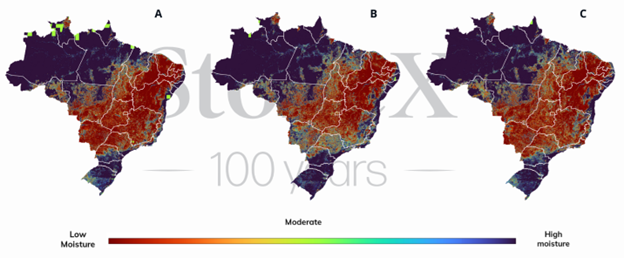
After field visits, our team observed that, in the main regions of the state of Minas Gerais (Sul de Minas and Cerrado) and in São Paulo (Mogiana), the crops are showing symptoms of stress due to the continuous, prolonged and intense drought, and high temperatures, which has reduced the leaf area through defoliation. The high temperatures increase the evapotranspiration of the plants and, even if the crop has an irrigation system, the loss of water to the atmosphere is very intense, which contributes to the defoliation process. In addition, most of the Arabica coffee plantations do not use irrigation systems. The significant loss of leaf area in the flowering stage of coffee can compromise the flowering and the fruit development processes. At this stage, an abundance of photosynthetically active vegetation is crucial for stages of high energy demand, such as fruit formation. However, if the soil has the right nutritional characteristics for coffee, the crop can partially replace the leaf area, as long as the rains return and, in particular, the temperatures are milder.
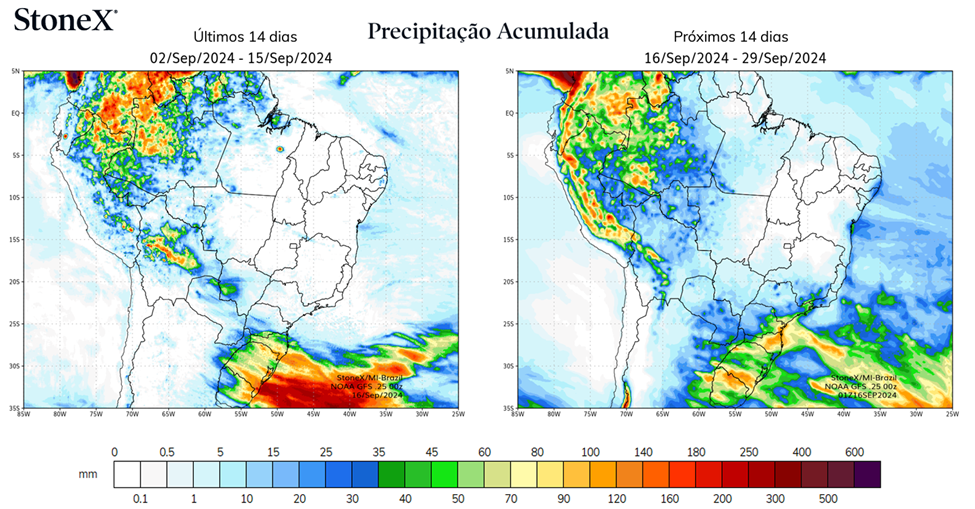
For the next few days of September, the weather is expected to change for the better in terms of moisture (from 5-10 mm to 20-25 mm of accumulated rainfall for the south of Minas Gerais) and temperature, due to greater cloudiness.
However, the month of September will have a water deficit in the monthly accumulation, as there is no forecast that rainfall volumes will reach what is considered normal for the region, which should be more than 45 mm. The municipalities that make up the coffee-growing regions of Paraná and ROSP, in São Paulo, have recorded normal rainfall and will probably exceed the historical average for the month of September.
Accumulated rainfall observed (Sept. 2 - 15) and forecast (Sept. 16 - 29), according to the NOAA GFS model
Source: StoneX.
NOAA points to La Niña starting in September
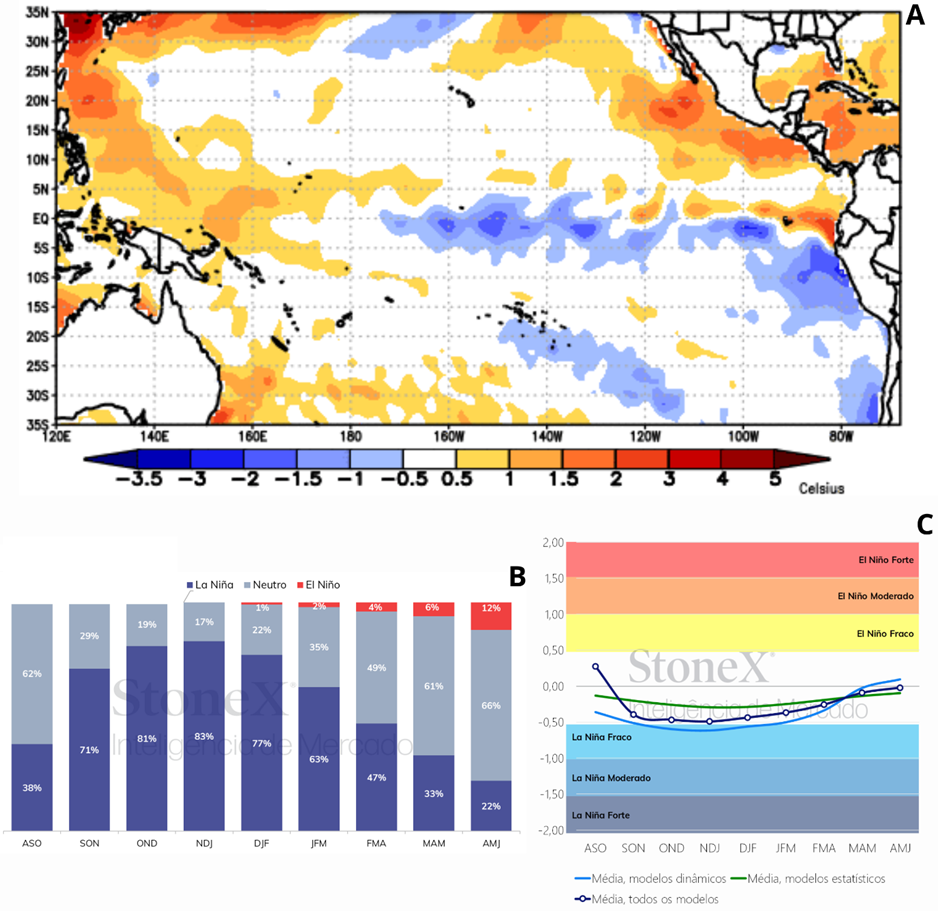
The surface temperature anomaly in the Pacific Ocean, according to NCEP/NOAA and monitored by the Brazilian National Institute for Space Research (INPE) between September 7 and September 14, indicates a significant cooling in the monitored area (between 170°W and 120°W) of the phenomenon known as the El Niño Southern Oscillation (ENSO) and with a 71% probability predicts the emergence of the La Niña phase in the September, October and November (SON) quarter. The average of the dynamic models together indicates that the phenomenon will be of low intensity and short duration, probably returning to a neutral condition in the March, April and May quarter of 2025. It is important to note that temperature variations in the Pacific Ocean can influence the climate in various parts of the world.
The emergence of La Niña, with effects for the months of December, January and February, could favor Brazil, especially for the drought-stricken regions of the Northeast and Southeast, where rainfall volumes tend to be higher and temperatures lower. In the south of Brazil, on the other hand, the patterns change, periods of drought increase and temperatures rise above normal. It is worth remembering that in 2021 this region was very badly affected by the phenomenon.
Pacific Ocean Surface Temperature Anomaly from September 7, 2024 to September 14, 2024 (A), CPC's official ENSO probability forecast (B) and Intensity of the phenomenon (C), based on a consensus of CPC and IRI meteorologists.
Sources: NCEP/ NOAA- EUA Inpe (A), IRI. Design: StoneX
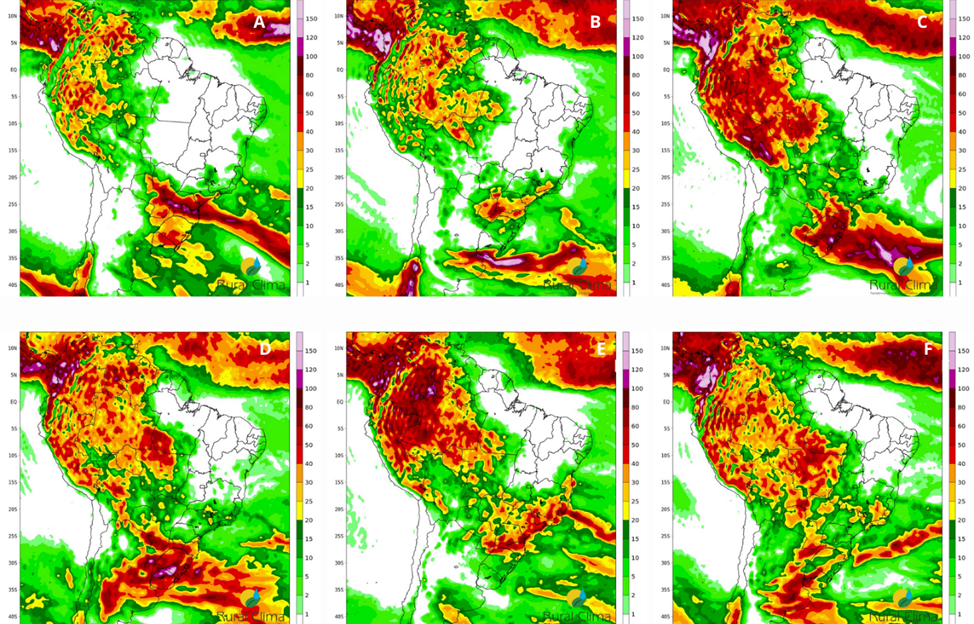
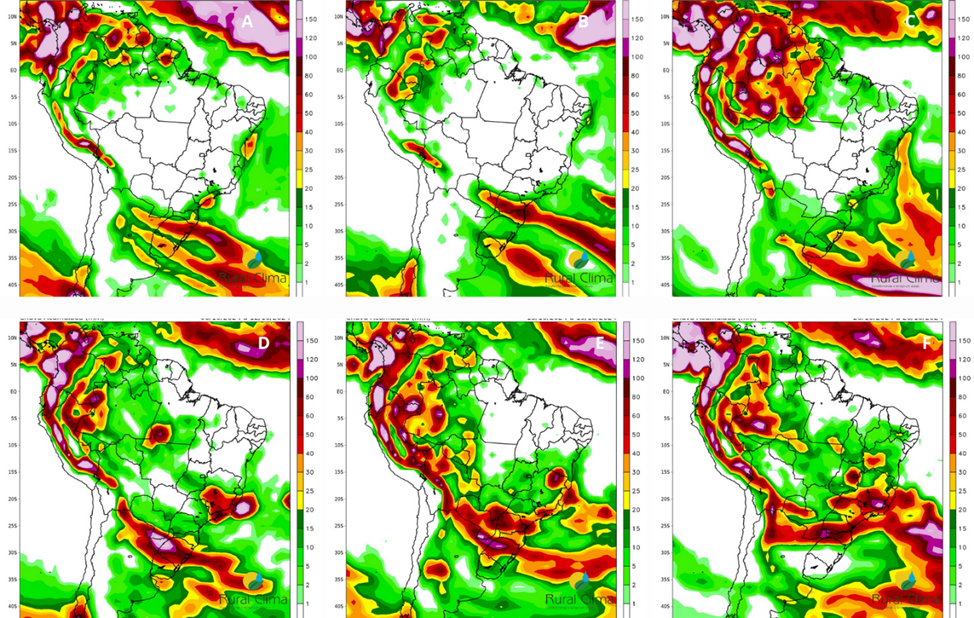
The ECMWF and GFS forecast models differ in terms of volumes and the start of the wet season. However, taken together, we can predict that the coffee-growing regions should receive significant amounts of rain by the second week of October.
Cumulative rainfall forecast (mm) for September and October, according to week: A) 09/15 - 09/21, B) 09/22 - 09/28, C) 09/29 - 10/05, D) 10/06 - 10/12, E) 10/13 - 10/19, F) 10/20 - 10/26
Data from the ECMWF model and run on September 15, 2023
Source: Rural Clima
Data from the GFSv2 model and run on September 15, 2023
Source: Rural Clima
Temperature anomaly forecast for the months of September-October, according to the week: A) 09/15 - 09/21, B) 09/22 - 09/28, C) 09/29 - 10/05, D) 10/06 - 10/12, E) 10/13 - 10/19, F) 10/20 - 10/26. Data from the CFSv2 model run on September 15, 2023
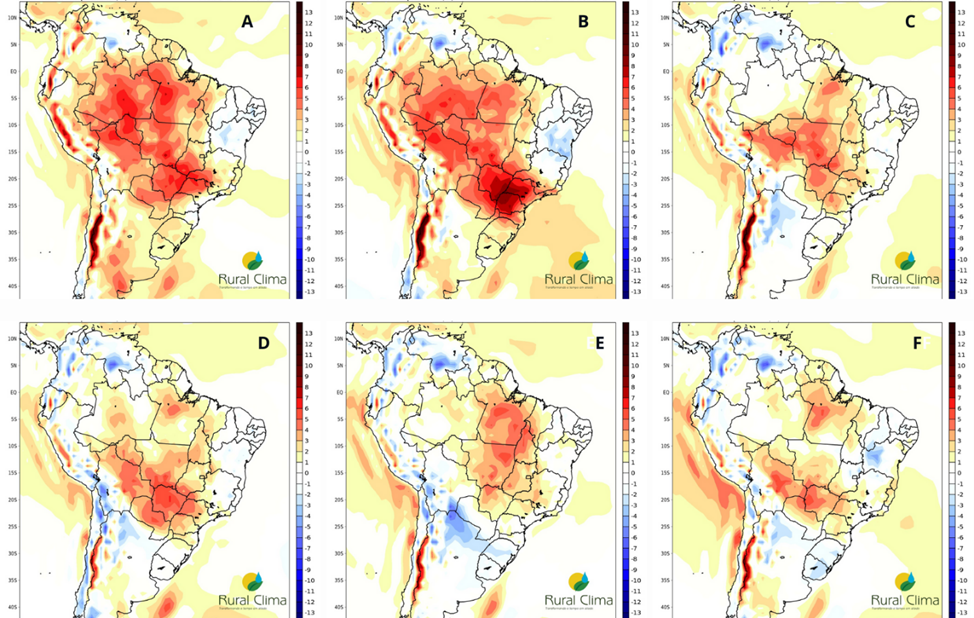
Source: Rural Clima
Although La Niña is generally accompanied by a cooldown in southeastern Brazil and the onset of regular rainfall with the arrival of spring, the execution of 11 ensemble models indicates that, in South America as a whole, rainfall for the months of September, October and November will continue to be below average and the temperature above average.
Multimodel ensemble probabilistic forecast (%) (Beijing, CMCC, CPTEC, ECMWF, Exeter, Melbourne, Montreal, Moscow, Offenbach, Pretoria, Seoul, Tokyo, Toulouse, Washington)
Precipitation forecast for SON - September, October and November
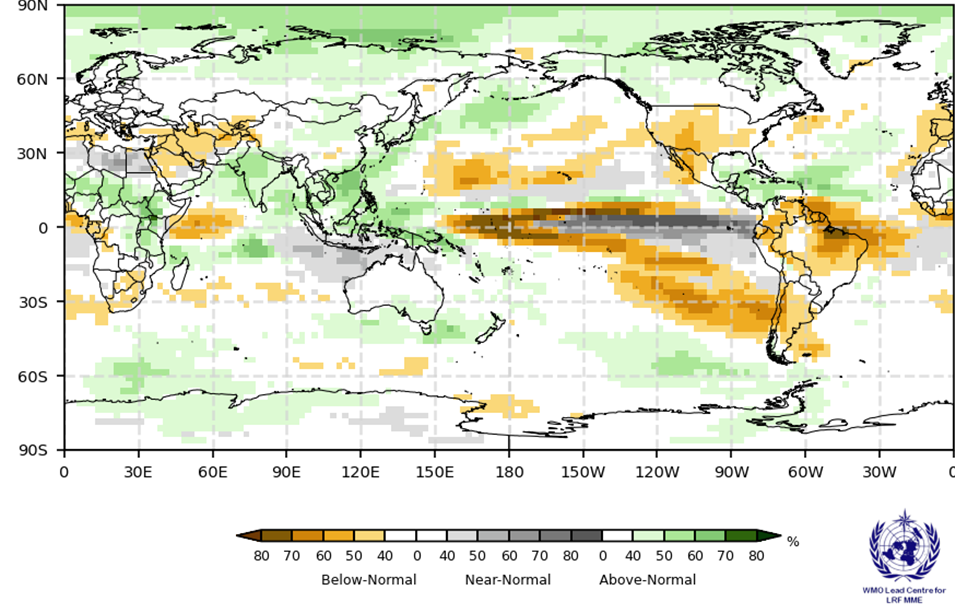
Source: World Meteorological Organization.
Temperature forecast for SON - September, October and November
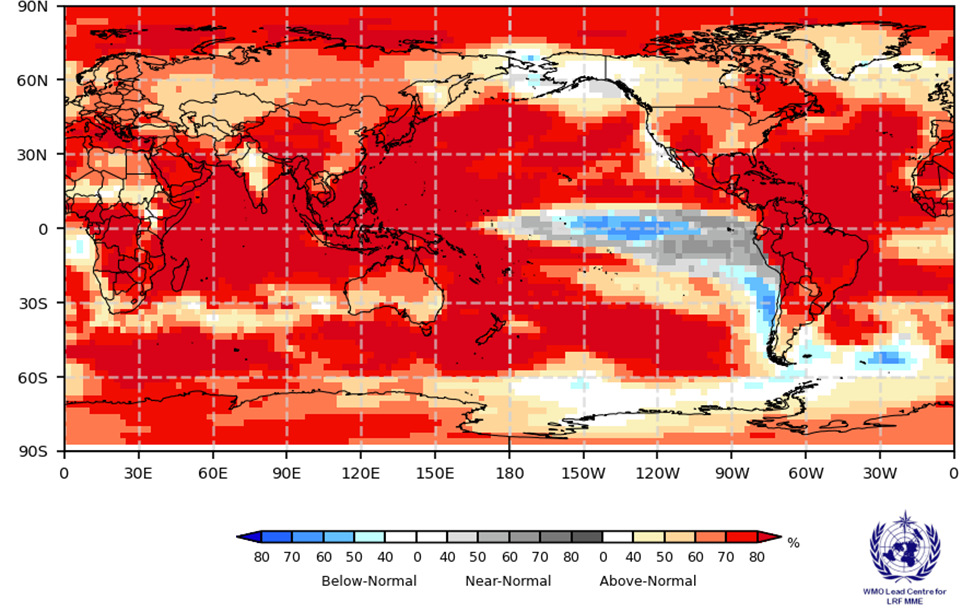
Source: World Meteorological Organization.