• Low moisture levels were the main characteristic of the dry winter in most of Brazil.
• September ended with rains in the main coffee-growing regions, possibly stimulating crop flowering. However, October will start with a new heatwave, affecting some of these regions.
• The precipitation forecast for October indicates above-average volumes, with temperatures slightly higher than normal in most coffee-growing regions.
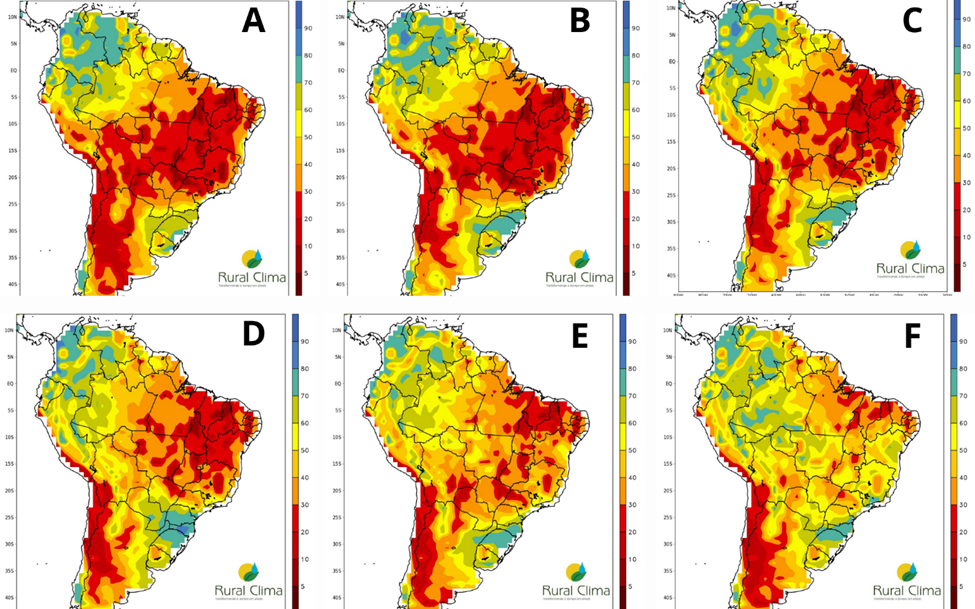
• Soil moisture is expected to exceed 50% in the last week of October.
The dry winter, characteristic of most central regions of Brazil, marked yet another year of extremely low moisture levels, intensifying drought both in spatial terms (increase in affected areas) and temporal terms (more days without significant rainfall). This condition has caused significant economic, social, and environmental losses, as well as limiting favorable conditions for developing perennial tropical crops like coffee. In the producing regions, signs of water stress are already being recorded, such as defoliation and stunting, which could negatively impact the 2025/2026 harvest.
Moisture Index - September 27
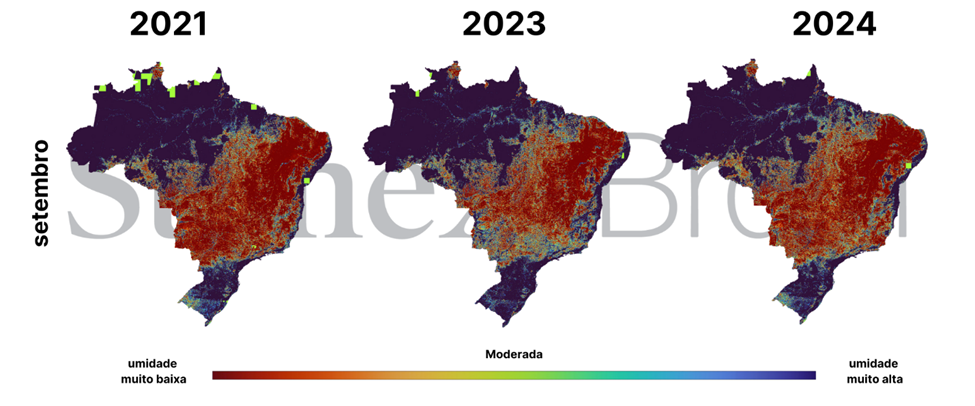
September ended with a higher frequency of cold fronts, some reaching southeastern Brazil, bringing moisture to most coffee-growing regions and temporarily relieving the intense heat. Rainfall of up to 15 mm was recorded in the Cerrado between September 24 and 28, ending 150 days without significant precipitation. These rains likely induced flowering, which should appear 8 to 10 days after the precipitation.
Accumulated precipitation over the last five days – September 30
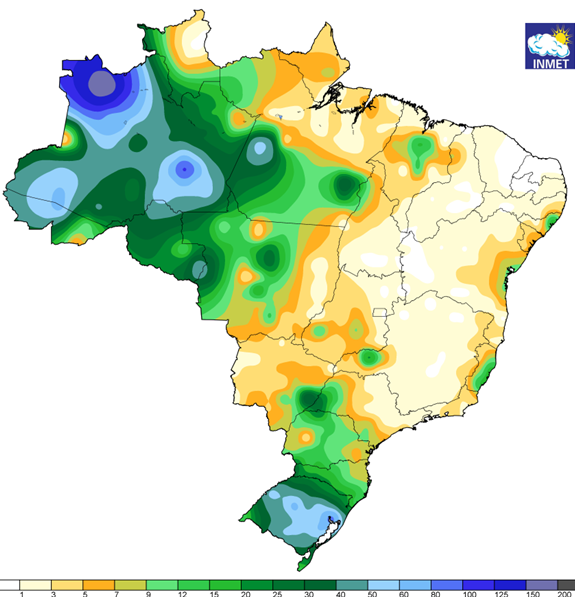
Source: Inmet.
October will start with another heatwave, the eighth recorded this year. Since September 30, maximum temperatures above 40°C have been recorded in Center-West Brazil, and this heatwave is forecasted to expand throughout the country's center region, affecting the state of São Paulo and part of the Cerrado in Minas Gerais. Temperatures are expected to ease starting on 10/10.
Maximum temperature forecast from October 1 to 10, According to the GFS 0.25 model, Oct. 1
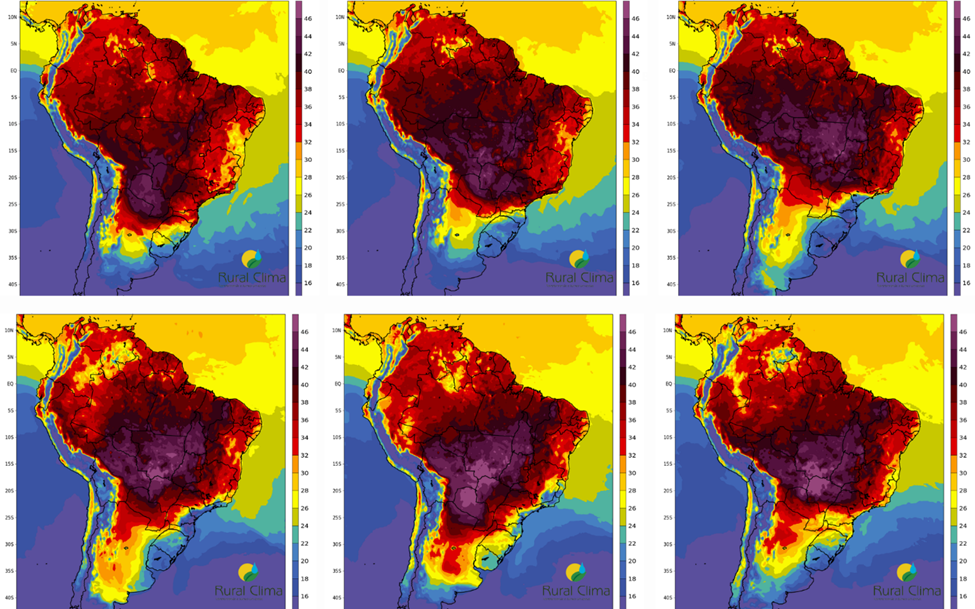
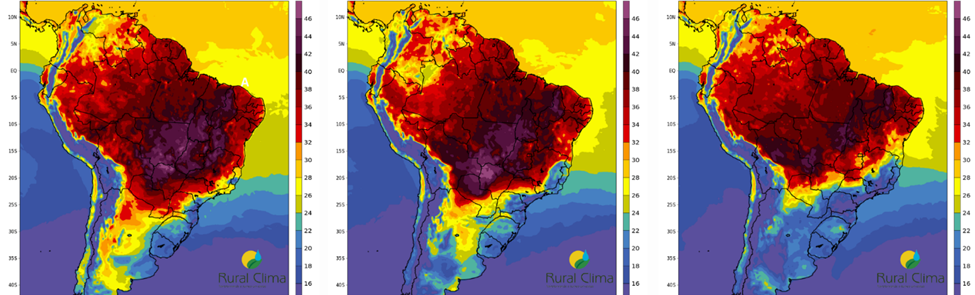
Source: Rural Clima.
October will also begin with a new cold front advancing from the southern region and likely reaching the southeast, bringing heavy rains, some potential storms, and relief from the intense heat for the coffee-growing regions of Matas de Minas and Espírito Santo.
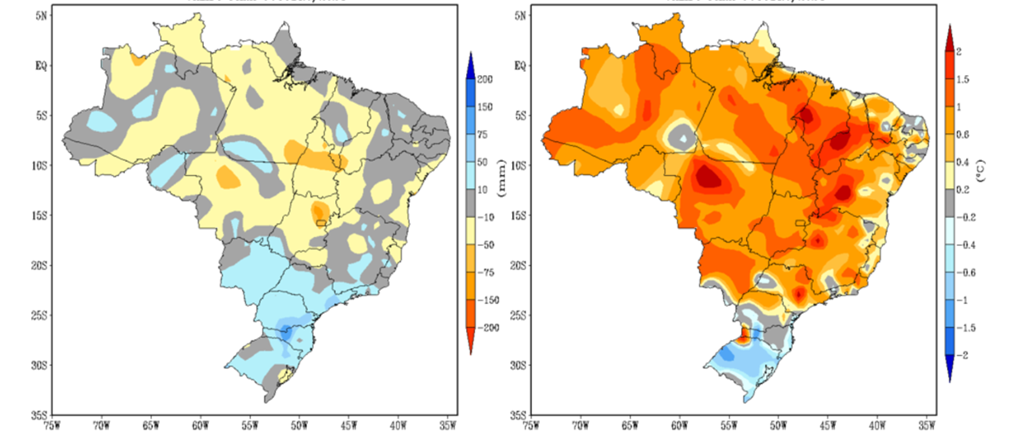
According to Inmet, the month will feature above-average rainfall in most of the South, Southeast, and North regions, as well as in the state of Mato Grosso do Sul, with a gradual return of precipitation in the country's center expected only from the second half of the month.
Precipitation and temperature anomalies forecast (mm and °C) updated in September and valid for October
Source: Inmet
However, for parts of the Northeast, northern Minas Gerais, and the production region known as Matopiba, encompassing the states of Maranhão, Tocantins, Piauí, and Bahia, rainfall is expected to be close to or below the climatological average.
Temperatures for October are expected to be above average in most of the country, and in the Matopiba region, excessive heat is anticipated, probably until the onset of regular rainfall.
However, in terms of soil moisture recovery, forecasts indicate that soil moisture values may exceed 50% in coffee-growing regions, probably in the last week of October (10/27/2024). Before that, rainfall typically occurs in the form of showers, with much of this volume being lost to surface runoff.
Soil Moisture Forecast for the Following Weeks: A) 09/30-10/06, B) 10/07-10/13, C) 10/14-10/20, D) 10/21-10/27, E) 10/28-11/03, F) 11/04-11/10 - According to the GFS v2 Model, 09/30
Source: Rural Clima
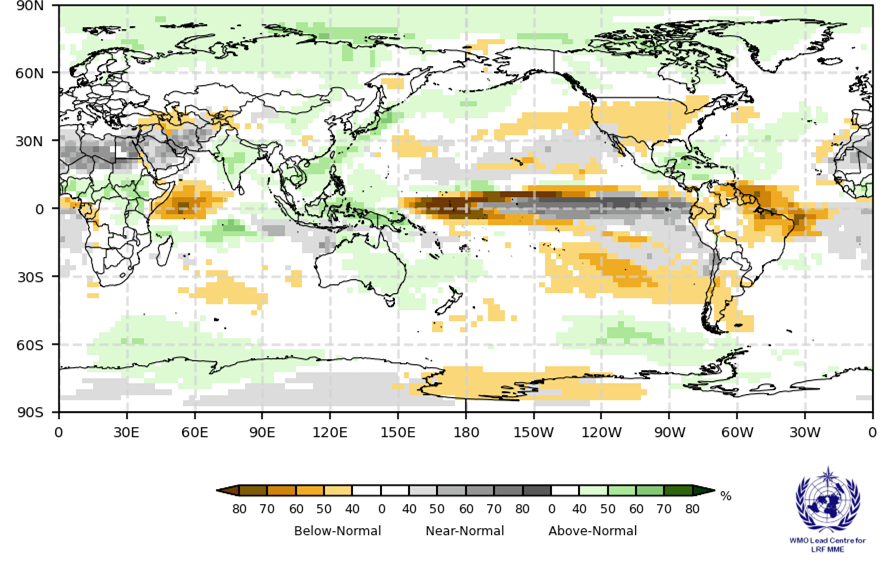
Other sources, such as the World Meteorological Organization (WMO), predict in their probabilistic precipitation model for October that Brazil will present two distinct conditions: one in the Northeast and central part of the country, with precipitation below normal, between 40% and 50%, and another in the South, Southeast, and the state of Mato Grosso do Sul, with precipitation close to normal levels.
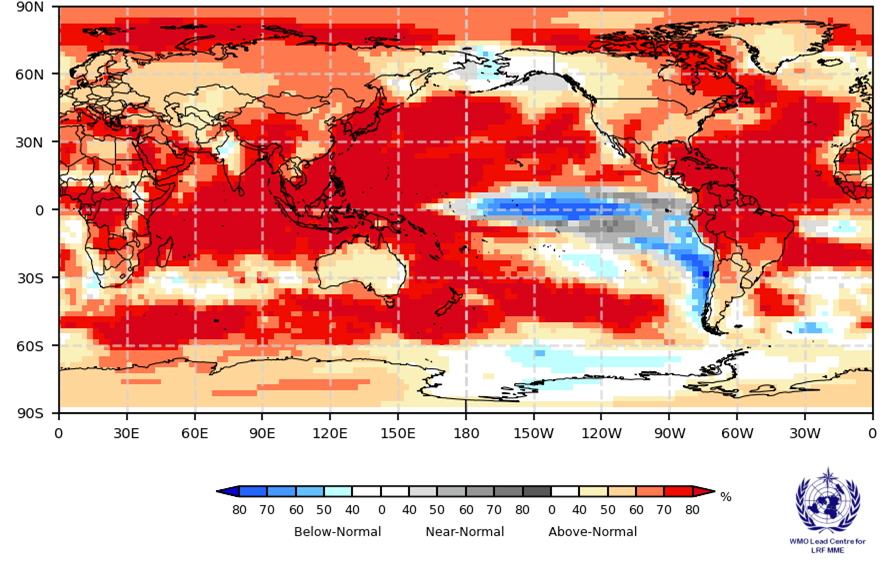
On the other hand, the WMO also points out that the temperature in the Pacific Ocean is below normal, indicating the establishment of La Niña conditions, and above-normal temperatures for the entire North and Northeast regions, with an 80% probability, and for the Southeast, with a 60% probability.
Precipitation and temperature probability forecast (%) for October, based on a multi-model ensemble (Beijing, CMCC, CPTEC, ECMWF, Exeter, Melbourne, Montreal, Moscow, Offenbach, Pretoria, Seoul, Tokyo, Toulouse, Washington).
Source: WMO.
Source: WMO.