

- The amount of rain normally recorded for September will be concentrated in the last few weeks of the month.
- Temperatures will continue to be anomalous; during the month, there will be an increase of 2 to 5 degrees on average in the coffee-growing regions.
- In October, significant amounts of rain are expected, which will be essential for relieving the vegetation's water stress.
The first week of September (September 1-7) in central and southeastern Brazil was marked by dry weather and high temperatures. A warm air mass established in the center of the country acts as a barrier, preventing the advance of cold fronts to lower latitudes (north of the country), which were recorded in southern Brazil.
The month of September is considered a transition from a dry landscape to a wetter one with the end of the winter season. However, the month is expected to remain dry. According to Brazil's Natural Disaster Monitoring Center, analysis of the Integrated Drought Index (IIS3), which represents a region's drought conditions based on the physical characteristics of the soil, water stress, vegetation and rainfall deficit over three consecutive months, classifies the Cerrado Mineiro with extreme drought, southern Minas Gerais and Mogiana with severe drought, and the Matas de Minas and Espírito Santo with moderate drought.
Cemaden: Integrated Drought Index (IIS3)
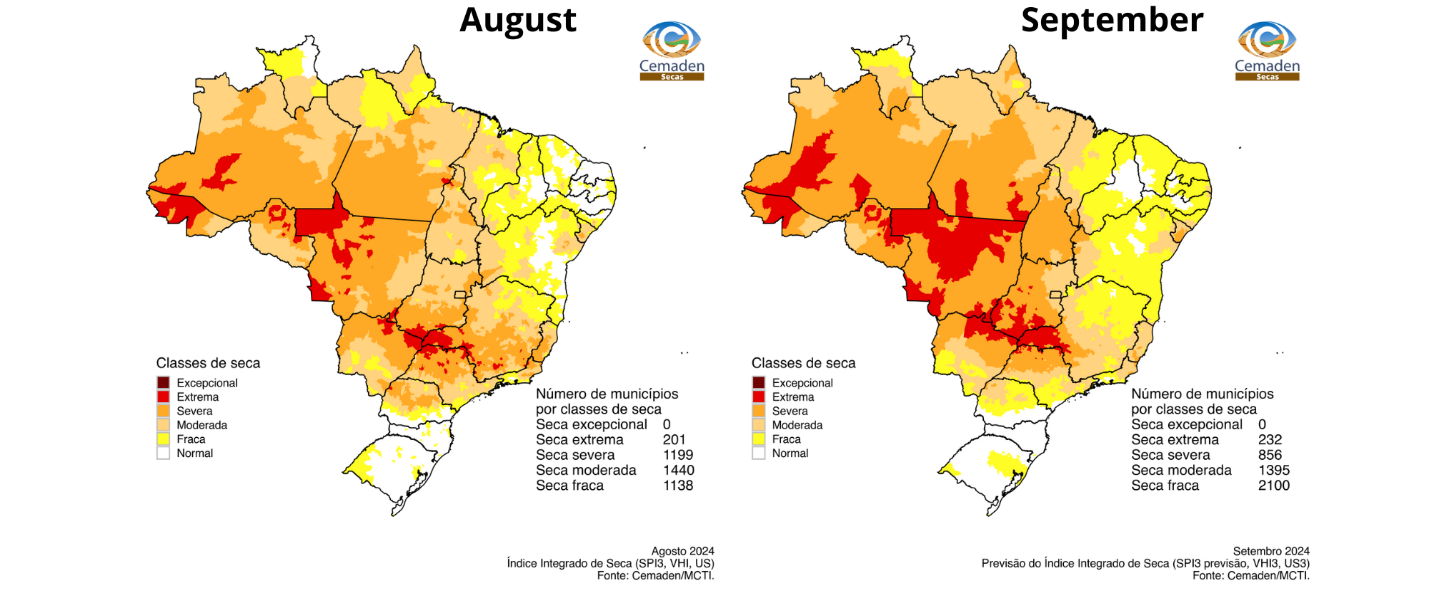
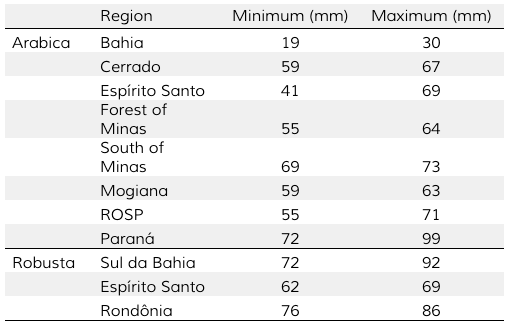
In terms of moisture, according to Cemaden's maps, September will probably present a better scenario for the coffee-growing regions of southern Minas Gerais, Matas de Minas and Espírito Santo than the one recorded in August. This is probably due to the fact that these regions usually receive more rainfall ( over 70 mm per month) than other regions, such as the Cerrado and northern Bahia.
Historical rainfall record (20-year analysis), selection of the maximum and minimum rainfall recorded in the coffee-growing regions for the month of September
Source: StoneX.
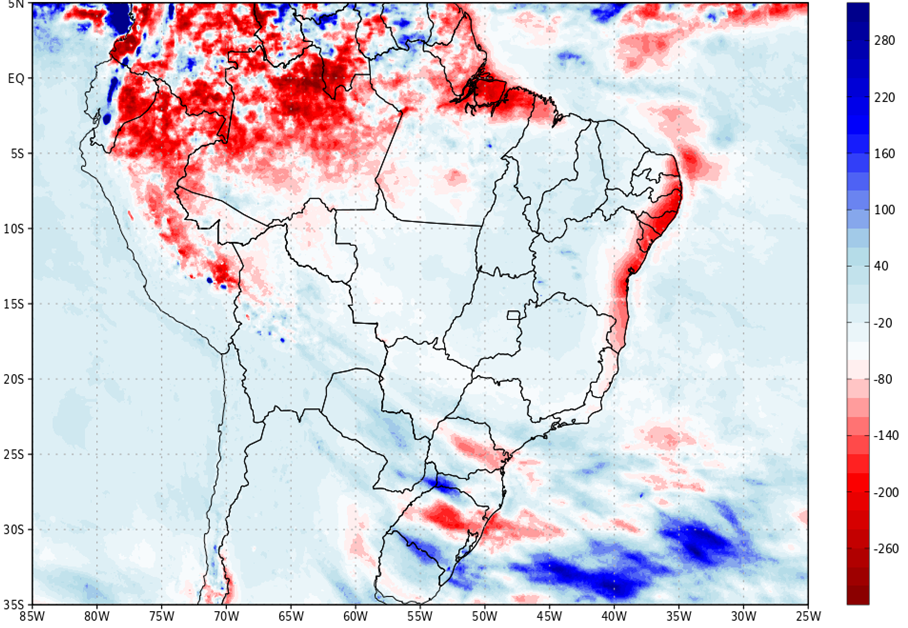
It is important to note that the Cerrado and part of the legal Amazon have shown a negative accumulated rainfall anomaly over the last 60 days compared to historical averages, and representative volumes will probably not be seen until October. Therefore, these regions remain very dry and have high temperatures.
Rainfall anomaly compared to historical average - last 60 days (mm)
Source: StoneX.
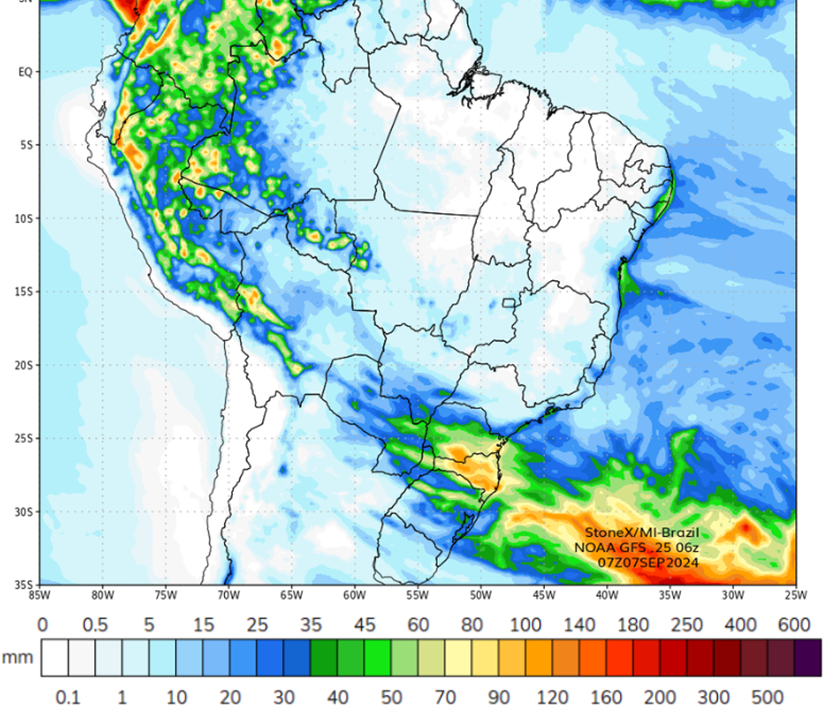
However, according to the CFS model, for the week of September 7 to 19, the Arabica-producing regions of Bahia, southern Espírito Santo, Cerrado Mineiro, Matas de Minas, southern Minas Gerais and the Mogiana region are not forecast to receive significant amounts of rain (more than 15 mm). Paraná and ROSP, on the other hand, will probably see significant rainfall from September 15 onwards. For the regions that produce Robusta, in the municipalities of Rondônia, there will probably be more significant volumes compared to the other regions.
Forecast rainfall for the period from September 7 to 19, according to the NOAA GFS model
Source: StoneX.
Based on this scenario, it could be expected that the rest of the rain normally recorded for the month of September (between 40-50 mm) will only accumulate in the last 10 days of the month.
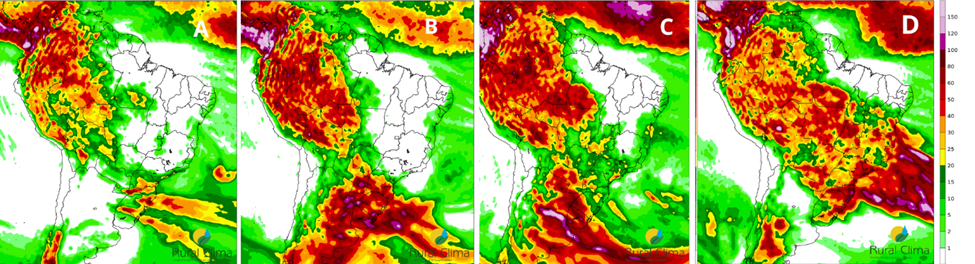
On the other hand, the results of the ECMWF model forecast that moisture representative of the tropics will not arrive until September 28, bringing large volumes of rain, especially to the Cerrado, and with it the recovery of some crops after water stress.
Cumulative rainfall forecast (mm) for the months of September and early October, according to the week: A) 09/21 - 09/27, B) 09/28 - 10/04, C) 10/05 - 10/11, D) 10/12 - 10/18. Data from the ECMWF model run on September 7, 2023
Source: Rural Clima.
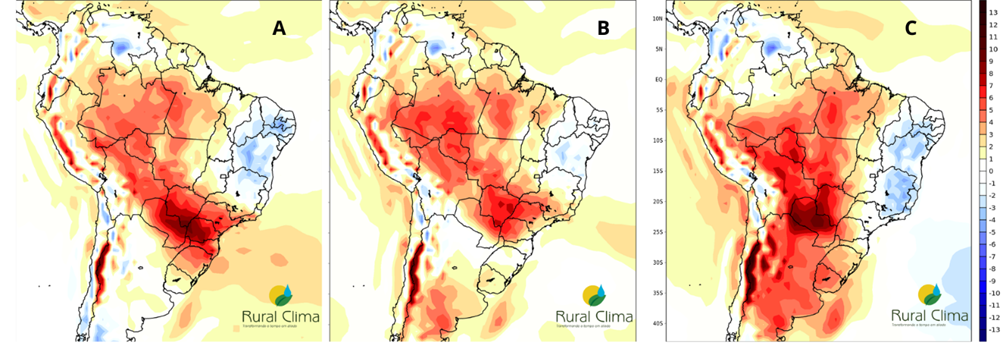
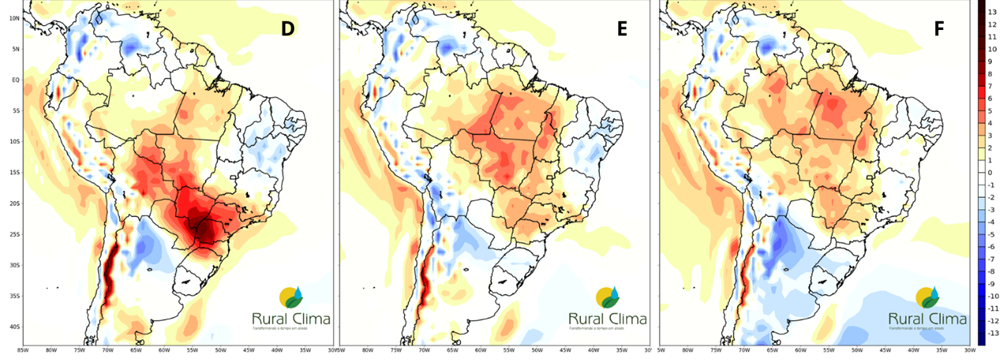
In addition to the predicted water deficit, another meteorological variable with extreme values that is being recorded in Brazil is temperature. According to the GFSv2 model, it is projected that by 9/21 the average temperature will increase by at least two degrees in most coffee-growing regions, and in some, such as the Cerrado Mineiro and Rondônia, the increase will be around five degrees. This will be followed by a week in which temperatures are expected to drop, easing in the Matas de Minas, southern Minas Gerais and Espírito Santo. The month of October will once again begin with anomalies tending to have above-normal temperatures, but not as significant as those in the first weeks of September.
Temperature anomaly forecast at (C) for the months of September and early October, according to the week: A) 09/08 - 09/14, B) 09/15 - 09/21, C) 09/22 - 09/28, D) 09/29 - 10/05, E) 10/06 - 10/12, F) 10/13 - 10/19. Data from the GFS/CFS model run on September 8, 2023
Fonte: Rural Clima.
Source: Rural Clima.
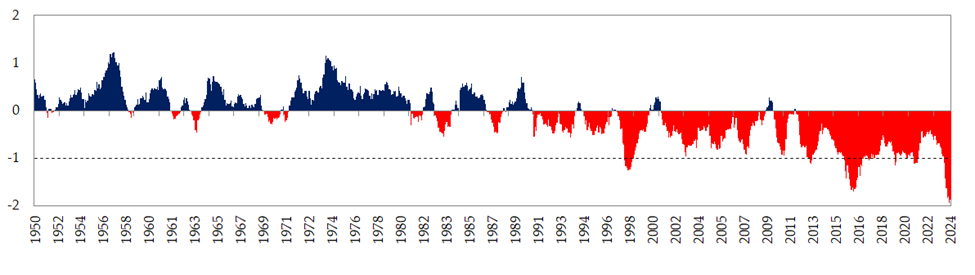
Cemaden reports that droughts in Brazil as a whole are becoming more frequent and intense, extending across the entire territory. The Standardized Precipitation Index and evapotranspiration, which is the amount of water that is lost through evaporation from the surface and transpiration from plants and is strongly related to temperatures, indicate that since 1991, the country has recorded intense and extreme drought events, such as the one in 2024, with greater frequency.
Standardized Precipitation Evapotranspiration Index (SPEI) from 1950 to 2024
Source: Cemaden
With rainfall concentrated in a short period of time, high temperatures and precipitation deficits, Brazilian coffee growers are adopting technologies such as irrigation systems, carrying out activities such as keeping the soil covered with green manure, and even planting trees. These activities are fundamental to coping with climate change and need to be adopted by as many areas as possible for coffee growing to be sustainable.



