
Daily Coffee Report 8/12/26
Daily coffee report
StoneX Coffee Team
- Coffee
By: StoneX Intelligence Brazil, StoneX Intelligence Brazil

Translation generated by AI
Coffee and cocoa, both soft commodities traded on the New York and London exchanges, share a recent trajectory marked by sharp appreciation and supply shortages. In recent years, climatic factors and structural production constraints have turned these markets into symbols of the vulnerability of global agricultural chains in the face of extreme weather events. As a result, cocoa and coffee prices have remained at levels significantly above the recent historical average, even reaching record highs.
From 2025 onward, however, these commodities began to follow different paths. Cocoa underwent a sharp correction, with a drop of close to 50 percent from the peak recorded at the end of 2024. Arabica coffee, on the other hand, despite occasional fluctuations, posted an approximate 26 percent increase over the year.
Coffee and cocoa prices throughout 2025 on the New York exchange
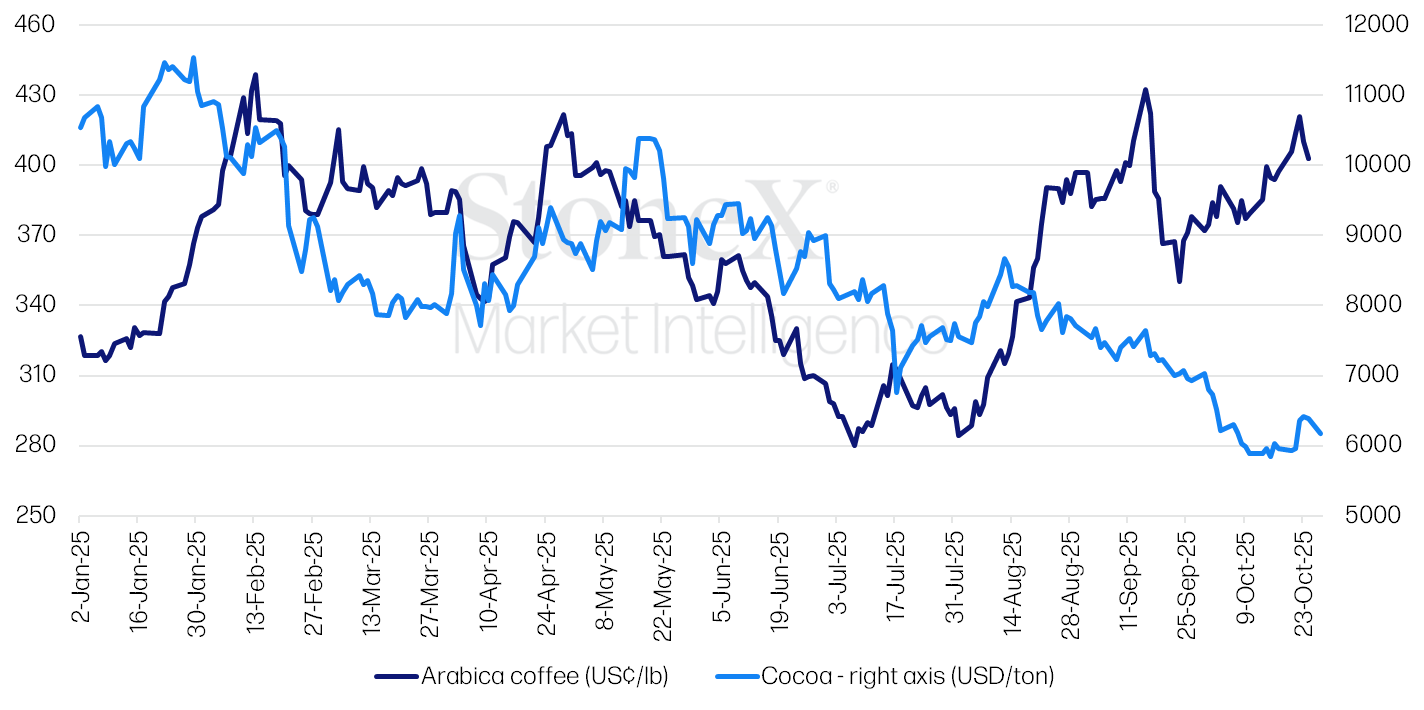
Both markets still face significant supply constraints. In the case of cocoa, however, signs of a partial recovery in production, together with a pullback in demand, were enough to trigger a significant repricing. Coffee, in turn, even amid indications of slower consumption, has yet to show a similar move. This raises the question of whether coffee could undergo a comparable move.
In the case of coffee, global production, especially in Brazil, was strongly affected by a sequence of weather phenomena between 2020 and 2024. Brazil, responsible for about 35 percent of global supply, faced almost three consecutive years of La Niña, marked by dry spells of varying intensity. In 2021, a severe frost hit the coffee belt and compromised a large part of the crop. Then El Niño brought a hotter and drier weather pattern, worsening losses.
StoneX estimates for Brazilian coffee production (million bags)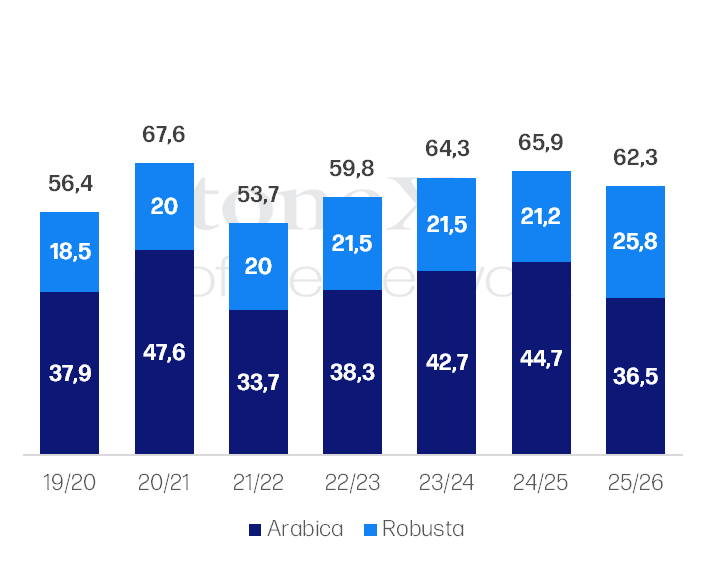
At the end of 2024, new adverse conditions during the flowering period and in the early stages of crop development resulted in a sharp drop in arabica coffee production in 2025. According to StoneX estimates, arabica production fell 18.4 percent compared to 2024, while robusta grew by about 22 percent.
Even so, the country’s total production fell 5.4 percent, totaling 62.3 million bags. Persistently unfavorable weather reduced global stocks and pushed prices, which reached the all-time high of US¢ 425.1 per pound in New York in early February 2025.
A similar phenomenon occurred with cocoa. The exceptional rise in international prices, which took beans to a record of USD 12.5 thousand per metric ton in December 2024, resulted from a combination of structural and cyclical supply-side factors. The appreciation began at the end of 2022, gained strength in 2023 and intensified in 2024 after successive crop failures in West Africa, a region responsible for around 70 percent of global production, with particular emphasis on Côte d’Ivoire, which accounts for approximately 40 percent.
Global cocoa balance (thousand tons)
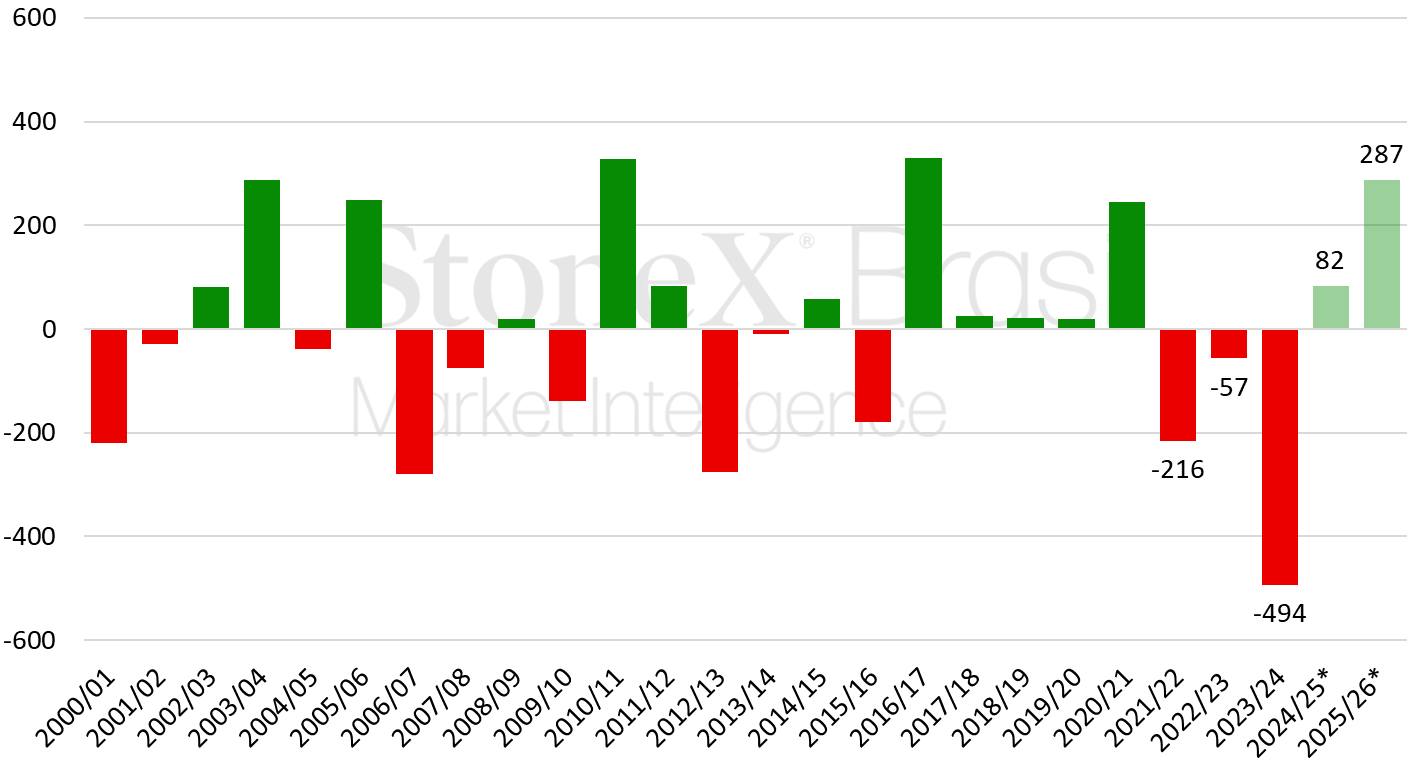
Adverse weather conditions in West Africa, characterized by excessive rainfall, high temperatures and extreme events, reduced productivity and broadened the spread of fungal diseases such as witches’ broom and cocoa swollen shoot virus disease. The presence of aging trees and low investment in farm renewal limited producers’ ability to respond, consolidating a structural downward trend in supply. The succession of global deficits reduced stocks to critical levels, which increased bullish pressure on contracts traded on the New York (ICE-US) and London (ICE-EU) exchanges and generated a scenario of strong backwardation in the futures curve, with premiums of up to 65 percent for the nearest maturities.
This move was amplified by the activity of funds and speculative investors who, perceiving the imbalance between supply and demand, increased their long positions and heightened volatility. Thus cocoa became one of the best-performing commodities of 2024, driven both by solid scarcity fundamentals and by a more intense financial dynamic. The parallel with coffee is evident. Both face an environment in which weather has become the main price determinant, with financial markets quickly reflecting changes in agents’ expectations.
The history of coffee and cocoa prices reveals another important parallel that occurred in the 1970s. Over the years, the two markets have followed distinct trajectories, with coffee notably more volatile. However, in that decade both faced a severe supply shock caused by weather factors. In Brazil, the black frost drastically affected coffee production, while in Africa dry conditions compromised cocoa output. The combination of these events resulted in supply shortages and drove the prices of both commodities to record levels for the time.
The recent path of cocoa inevitably recalls the last major surge recorded in the mid-1970s. In both periods the market was marked by severe crop failures in West Africa, successive deficits and a pronounced imbalance between supply and demand that drove prices to historically high levels. The 1976/77 crop year has a direct parallel with the 2023/24 crop year, when global production fell by more than 10 percent and the stock-to-use ratio reached 19.1 percent, the lowest in the series to that point. In 2023/24 this ratio reached 26.4 percent, confirming a tight scenario, though less severe than in the 1970s.
Both in the 1970s and in the recent period, the cocoa market showed two waves of gains followed by a correction process. In the episode of the 1970s, prices took about five years to return to levels closer to the historical average, reflecting the time needed for the recovery of production and demand, a pattern consistent with the stock cycle of roughly five years observed in the cocoa market. This cycle stems from the perennial nature of the crop, which imposes lags between the price stimulus and the effective supply response.
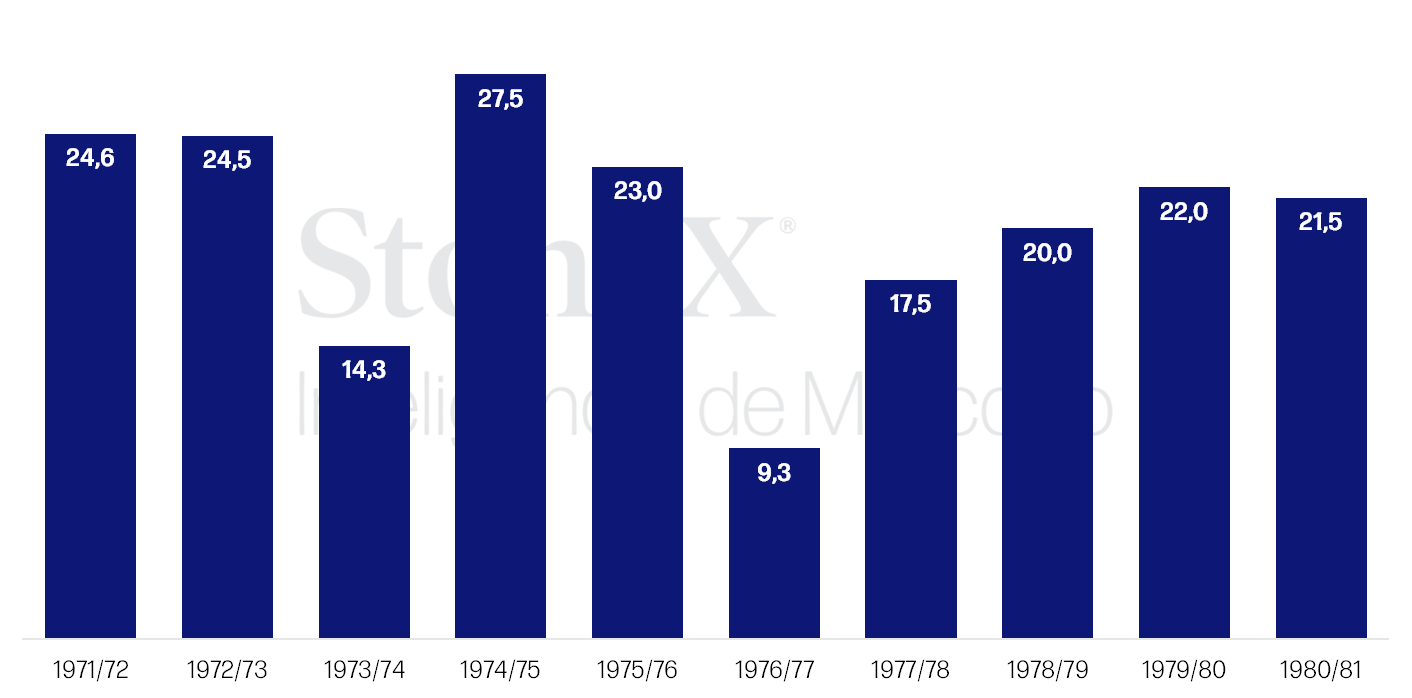
For coffee, the sharp price increase is directly linked to the frost that hit Brazilian production in the 1970s. The state of Paraná, which at the time was the country’s largest producer, was the most affected by the phenomenon. According to USDA data, Brazil accounted for just over 33 percent of global coffee production. In 1974 the country produced 27.5 million bags, while global production totaled around 82.6 million bags. The following year Brazilian production fell from 27.5 to 23 million bags, a reduction of 16 percent.
In 1976 the impact was even more drastic, with production plunging from 23 million to 9.3 million bags, a drop of almost 60 percent in just one year. In comparative terms, that would be equivalent today to a reduction from 65 million to 26 million bags. This historic drop in Brazilian production was far more severe than those seen in subsequent decades and explains the intensity of the price increase at the time. The concentration of production in Paraná contributed to exacerbate the losses, since practically all national supply originated from that state.
Brazilian coffee production in the 1970s (million bags)
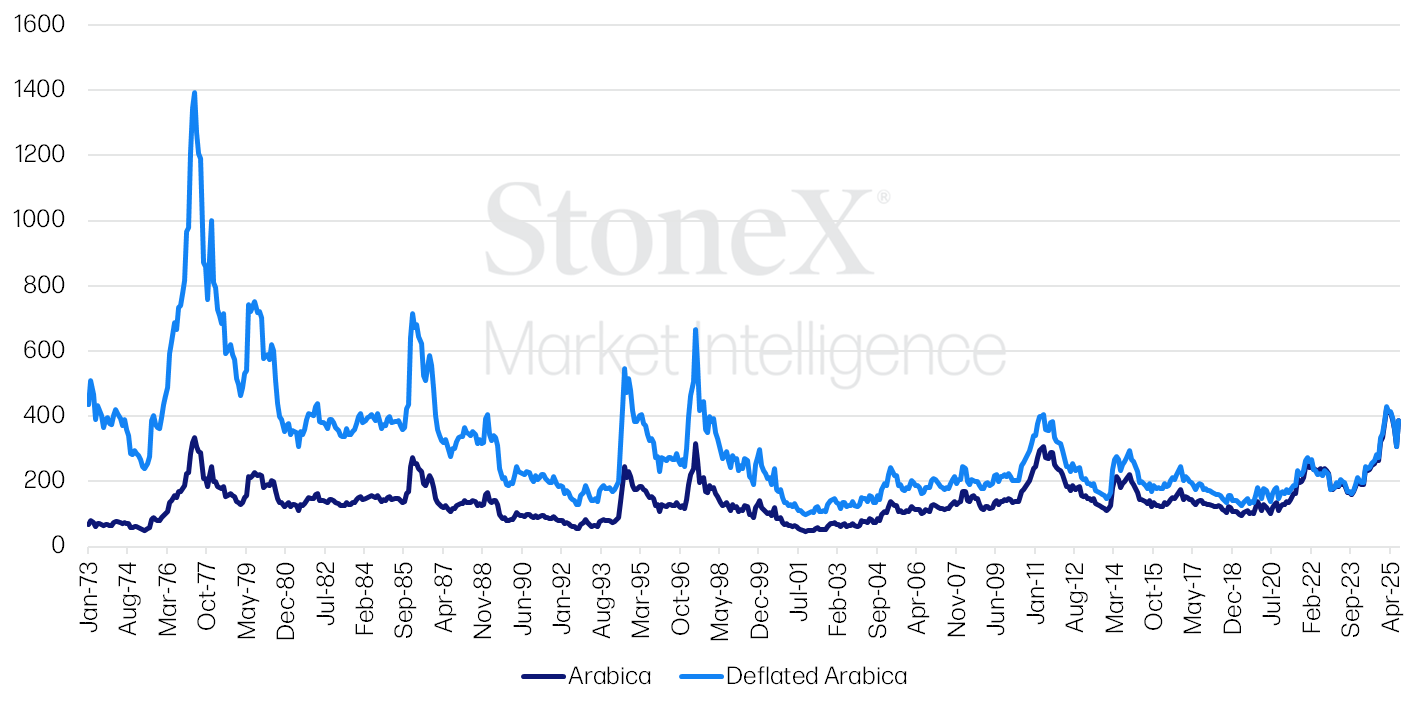
In nominal terms, the most recent historical highs were recorded between 2024 and 2025, with cocoa exceeding USD 12.5 thousand per ton and coffee surpassing US¢ 425.00 per pound. Despite these expressive values, they do not represent the real historical highs. When adjusted for inflation, the highest prices occurred in the 1970s.
To calculate the deflated prices of coffee and cocoa, data from the New York terminal and the United States Producer Price Index were used. Historical analysis shows that the deflated peaks for cocoa and coffee were recorded in 1977, with cocoa reaching a price above USD 20.7 thousand per ton and arabica coffee reaching almost US¢ 1,400 per pound. For reference, this would be equivalent to cocoa prices around BRL 6,700 per 60 kg bag and coffee prices around BRL 9,940 per 60 kg bag, considering the current dollar level.
Arabica coffee prices, nominal and deflated (US¢/lb)
Cocoa prices, nominal and deflated - ICE NY (USD/ton)
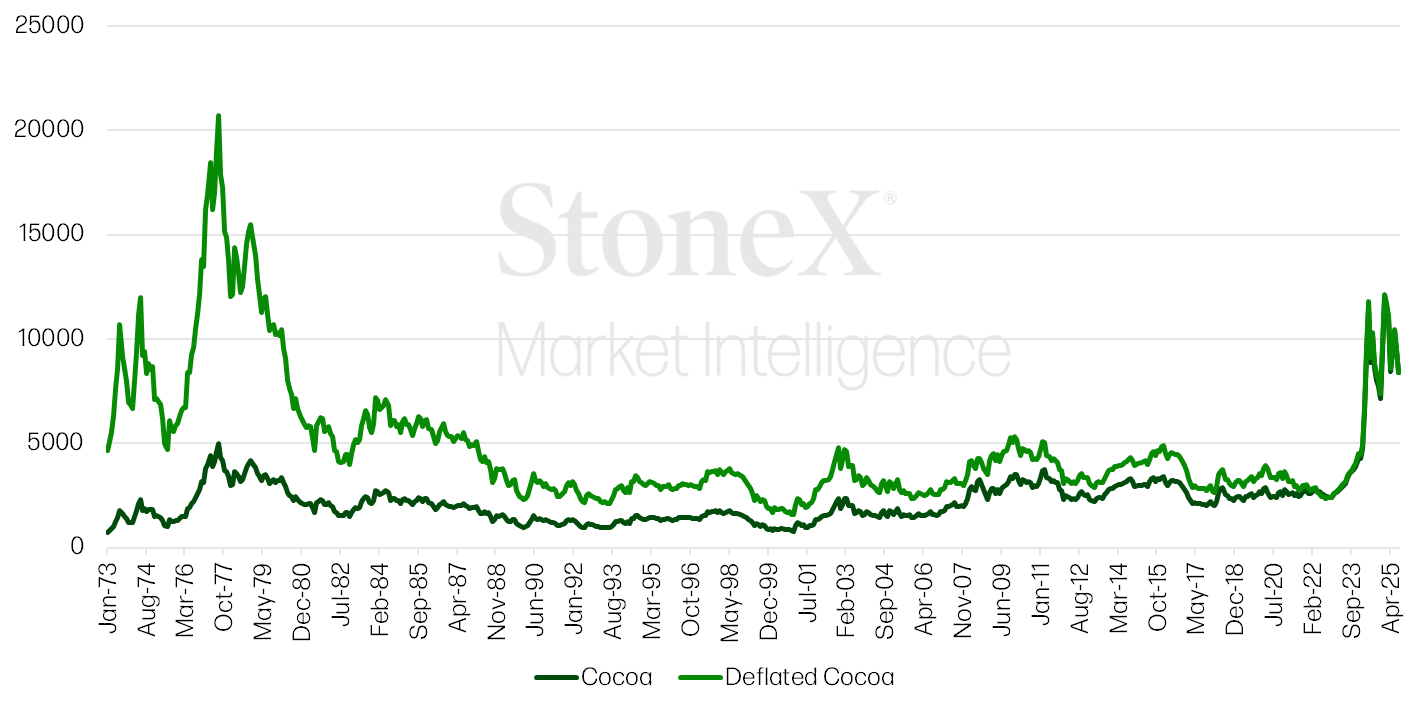
Thus, for current prices to reach those real historical highs again, cocoa would need to rise about 65 percent relative to its nominal record, while coffee would have to climb approximately 229 percent. These figures show how, despite recent records, the real appreciation power of commodities in the 1970s remains unmatched, reflecting a period of intense supply shocks and structural transformations in global agricultural markets.
After reaching the historical peak of USD 12.5 thousand per ton in December 2024, the international cocoa market began a gradual and uneven adjustment throughout 2025. Even with the correction, prices remain far above the historical average, at around USD 6 thousand per ton, reflecting both the low level of stocks and the uncertainties and structural fragilities of production in West Africa. Still, the expectation of two global surplus crops after three consecutive years of deficit opened room for a more moderate trajectory.
On the supply side, there has been a marginal recovery in production in Côte d’Ivoire and Ghana, favored by less adverse weather conditions, better farm management and investments in tree renewal. At the same time, there is an acceleration of production in emerging countries, especially in Ecuador, driven by high prices and the prospect of more attractive financial returns.
The main bearish pressure, however, comes from the demand side, which has shown signs of weakening since the second quarter of 2025. The exceptional price surge in 2024 prompted industrial adjustments and substitutions, with lower demand for cocoa derivatives and increased use of cocoa butter equivalents. In addition, manufacturers reformulated products to reduce the share of cocoa used, which has been decreasing total consumption and changing the valuation structure of byproducts.
Quarterly cocoa processing in the main regions (thousand tons)
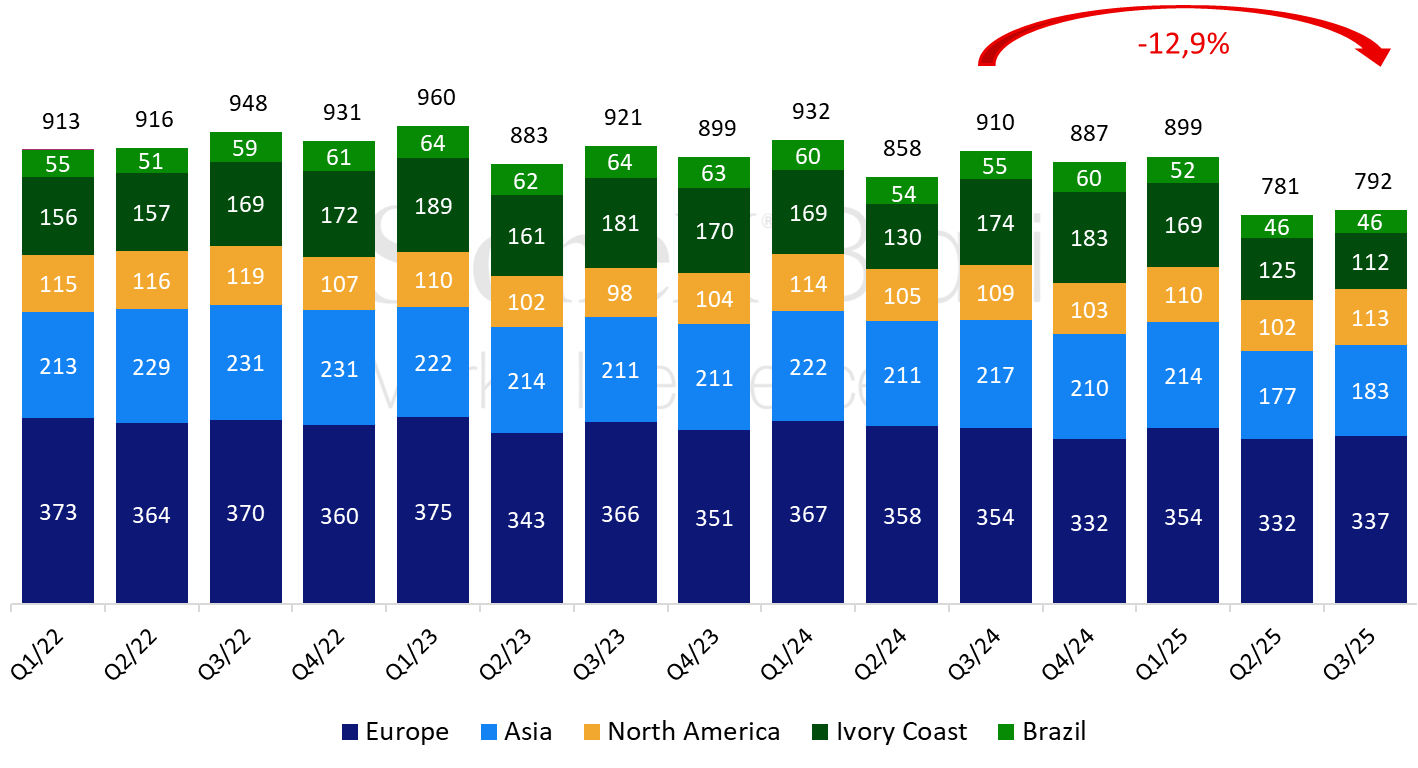
Butter ratios, for example, have been weakening since mid-2024, squeezing processor margins and discouraging grinding in some regions. This lower industrial attractiveness has limited demand for beans and led industries to adjust purchase volumes and optimize costs. In the current context, the partial destruction of demand triggered by the price surge in 2023 and 2024 tends to have persistent effects. Technological adjustments and substitutions in industrial formulations do not reverse quickly, which may keep demand subdued for longer.
On the other hand, structural barriers to expanding supply in West Africa, such as aging trees, disease spread and low investment, limit the possibility of prices returning to the USD 2 to USD 3 thousand per ton levels seen in previous decades.
In the main African producing countries, it is also worth highlighting the difficulty in transmitting high international exchange quotations to local farmers. This occurs due to the practice of fixed prices paid to producers and marketing monopolies, factors that have limited the pass-through of higher values and can generate additional inertia in farm recovery.
Farm-gate cocoa prices in Côte d’Ivoire (thousand CFA/ton)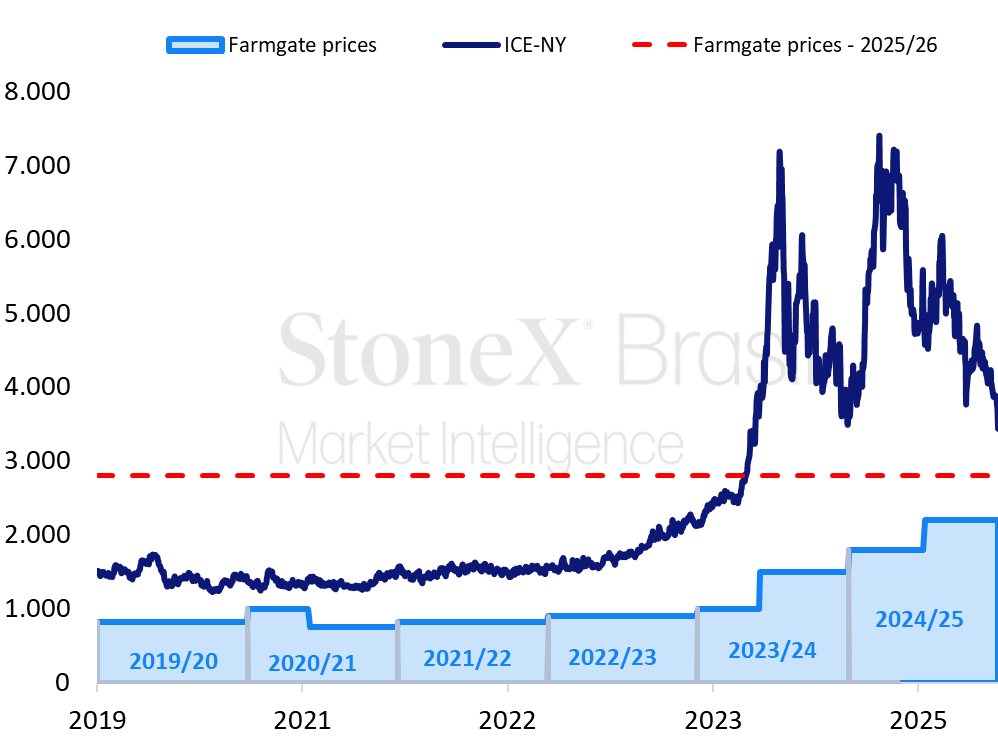

In this sense, emerging countries such as Ecuador, Brazil, Indonesia and Nigeria should lead the supply response in the coming years, benefiting from higher prices and more flexible regulatory frameworks. Even so, the rebuilding of global stocks should be slow and uneven, indicating that the current correction cycle could extend to the end of the decade. The lessons of the 1970s show that even after the peak, normalization tends to be gradual, and future balance will depend on the interaction between supply recovery and the return of global consumption.
For coffee, in 2025, the behavior was different. Prices rose in the first quarter and reached the nominal maximum. In the second quarter they retreated with the advance of the Brazilian harvest, but rose again in the third quarter. Over the year, arabica prices rose while robusta prices fell, reflecting the smaller supply of arabica worldwide and, at the same time, the expectation of greater robusta production, with a 22 percent increase in the Brazilian crop and a projected 7 percent recovery in Vietnam, whose harvest begins next month. This combination of factors defined price behavior throughout the year.
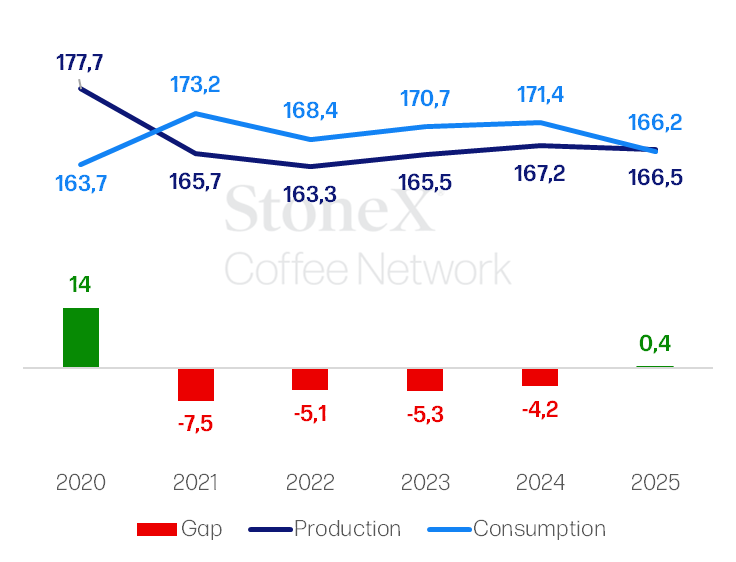
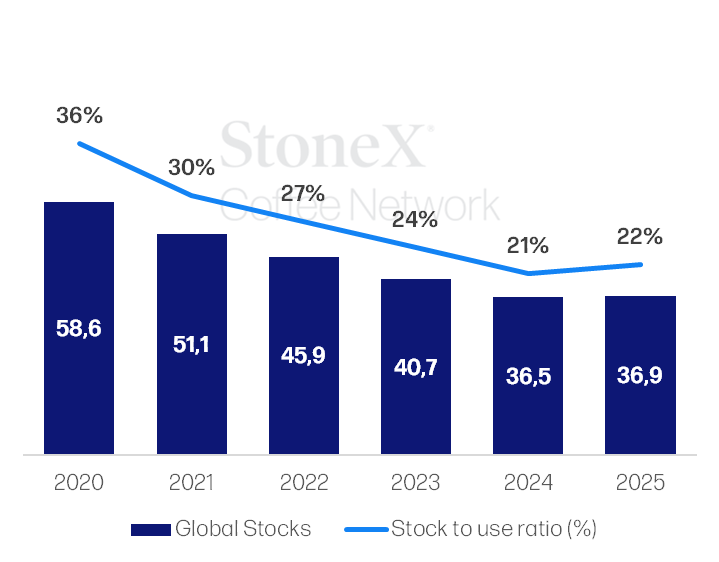
Since the historical peak, coffee prices fell and then returned to near record levels in October 2025, although without surpassing them. This recent move is related to short-term supply concerns, a reduction in certified stocks, uncertainties about production development in Brazil and trade tensions between the United States, Brazil and Colombia, which raise fears of new tariffs. Despite some pullback, prices remain elevated due to these factors and the low level of global stocks. Between 2021 and 2024 more than 22 million bags were consumed, and in 2025 production should still not be sufficient to rebuild stocks, which keeps support for prices at least until the next season.
Global coffee supply and demand (million bags), stocks and stock-to-use ratio
While cocoa faces a scenario of falling prices associated with input substitution and adjustments in the confectionery industry, coffee shows different behavior. Although there are signs of a slowdown in consumption, the impact is more limited. In Brazil, ABIC data indicate a 5.4 percent drop in retail coffee sales, and in Japan consumption fell by more than 3 percent between January and August 2025, with similar evidence in the United States and Europe. StoneX estimates point to a global reduction of around 3 percent in coffee consumption in 2025.
Even so, it is unlikely that coffee will replicate the price collapse for the same reasons as cocoa. The main difference lies in the structure of the markets. In the case of cocoa, it is possible to replace part of the butter with fats from other sources or to reformulate products, which reduces consumption. In coffee there is no direct substitute. At most there can be a shift from arabica to robusta consumption, but the end product must be coffee. In addition, the price elasticity of consumption is lower for coffee than for cocoa. Coffee is more embedded in consumption habits and responds less intensely to price changes.
The current coffee market scenario is characterized by a predominance of bullish factors, supported mainly by uncertainties surrounding the 2026 Brazilian crop, the tariffs imposed by the United States on imports from Brazil, the escalation of tensions between the United States and Colombia and the reduction in certified stocks. These elements combined indicate a tight global supply picture, which has helped keep prices elevated since August.
However, there are variables that could partially reverse this move. The main potential bearish factor would be a possible removal of trade tariffs by the United States, which would reduce costs and increase the flow of coffee in the international market. This measure alone would already have a significant impact on prices, since tariffs were one of the main catalysts of the recent rally.
Another point that could alter the upward bias is weather behavior in Brazil. If weather conditions remain favorable and good fruit set from the flowering is confirmed, expectations of a large 2026/27 crop tend to generate negative pressure on prices, since the market anticipates supply moves. This is highly relevant, as the size of the next Brazilian crop is one of the pillars of price formation in the global market. StoneX is conducting the post-flowering field survey and will release the first estimate for the 2026/27 crop in November, which may influence price behavior.
In addition, the progress of the harvest in Vietnam, expected over the coming months, tends to exert additional pressure, mainly on Robusta prices traded on the London terminal, considering the increased supply available. Thus the coffee market finds itself at a delicate balance point, with a predominance of bullish factors in the short term, but with potential corrective elements that may emerge as weather and trade conditions evolve.
The StoneX Group Inc. group of companies provides financial services worldwide through its subsidiaries, including physical commodities, securities, exchange-traded and over-the-counter derivatives, risk management, global payments and foreign exchange products in accordance with applicable law in the jurisdictions where services are provided. References to over-the-counter (“OTC”) products or swaps are made on behalf of StoneX Markets LLC (“SXM”), a member of the National Futures Association (“NFA”) and provisionally registered with the U.S. Commodity Futures Trading Commission (“CFTC”) as a swap dealer. SXM’s products are designed only for individuals or firms who qualify under CFTC rules as an ‘Eligible Contract Participant’ (“ECP”) and who have been accepted as customers of SXM. StoneX Financial Inc. (“SFI”) is a member of FINRA/NFA/SIPC and registered with the MSRB. SFI is registered with the U.S. Securities and Exchange Commission (“SEC”) as a Broker-Dealer and with the CFTC as a Futures Commission Merchant and Commodity Trading Adviser. References to securities trading are made on behalf of the BD Division of SFI and are intended only for an audience of institutional clients as defined by FINRA Rule 4512(c). References to exchange-traded futures and options are made on behalf of the FCM Division of SFI . StoneX is a trading name of StoneX Financial Ltd (“SFL”). SFL is registered in England and Wales, Company No. 5616586. SFL is authorized and regulated by the Financial Conduct Authority [FRN 446717] to provide to professional and eligible customers including: arrangement, execution and, where required, clearing derivative transactions in exchange traded futures and options. SFL is also authorised to engage in the arrangement and execution of transactions in certain OTC products, certain securities trading, precious metals trading and payment services to eligible customers. SFL is authorised & regulated by the Financial Conduct Authority under the Payment Services Regulations 2017 for the provision of payment services. SFL is a category 1 ring-dealing member of the London Metal Exchange. In addition SFL also engages in other physically delivered commodities business and other general business activities which are unregulated and not required to be authorised by the Financial Conduct Authority. StoneX Group Inc. acts as agent for SFL in New York with respect to its payments services business. StoneX APAC Pte. Ltd. acts as agent for SFL in Singapore with respect to its payments services business. ‘StoneX’ is the trade name used by StoneX Group Inc. and all its associated entities and subsidiaries.
Trading swaps and over-the-counter derivatives, exchange-traded derivatives and options and securities involves substantial risk and is not suitable for all investors. Past performance of any futures or option is not indicative of future success. Indicators are not a trading system and are not published as a specific trade recommendation. The information herein is not a recommendation to trade nor investment research or an offer to buy or sell any derivative or security. It does not take into account your particular investment objectives, financial situation or needs and does not create a binding obligation on any of the StoneX group of companies to enter into any transaction with you. You are advised to perform an independent investigation of any transaction to determine whether any transaction is suitable for you. No part of this material may be copied, photocopied or duplicated in any form by any means or redistributed without the prior written consent of StoneX Group Inc.
© 2026 StoneX Group Inc. All Rights Reserved.
Our subscribers have access to comprehensive market analysis from StoneX spanning commodities, equities, currencies and more.
Daily coffee report

August 12 – Today’s focus is on inflation, with the July consumer price index data out this morning. We have this, and one more month of data, ahead of the next Federal Reserve meeting. Of course, headlines from the Middle East and the Black Sea wars also have an ongoing influence on the markets. Stock futures posted gains this morning, while the VIX traded just below 15. The dollar index traded near 99.7. Yields on 10-year Treasuries are trading near 4.66%, while yields on 2-year Treasuries are trading near 4.18%. WTI crude oil is trading near $83, while Brent trades near $88 per barrel. The grain and oilseed markets rebounded from yesterday’s losses ahead of today’s highly anticipated WASDE crop report that is due out at Noon Eastern Time.

Daily coffee report
Our market expertise, advanced platforms, global reach, culture of full transparency and commitment to our clients’ success all set us apart in the financial marketplace.
Reach
With access to 40+ derivatives exchanges, 180+ foreign exchange markets, nearly every global securities marketplace and numerous bilateral liquidity venues, StoneX’s digital network and deep relationships can take clients anywhere they want to go.
Transparency
As a publicly traded company meeting the highest standards of regulatory compliance in the markets we serve, our financials and track record are matters of public record. StoneX’s commitment to “doing the right thing over the easy thing” sets us apart in the industry and helps us build respect, client trust and new partnerships.
Expertise
From our proprietary Market Intelligence platform to “boots-on-the-ground” expertise from award-winning traders and professionals, we connect our clients directly to actionable insights they can use to make more informed decisions and achieve their goals in the global markets.