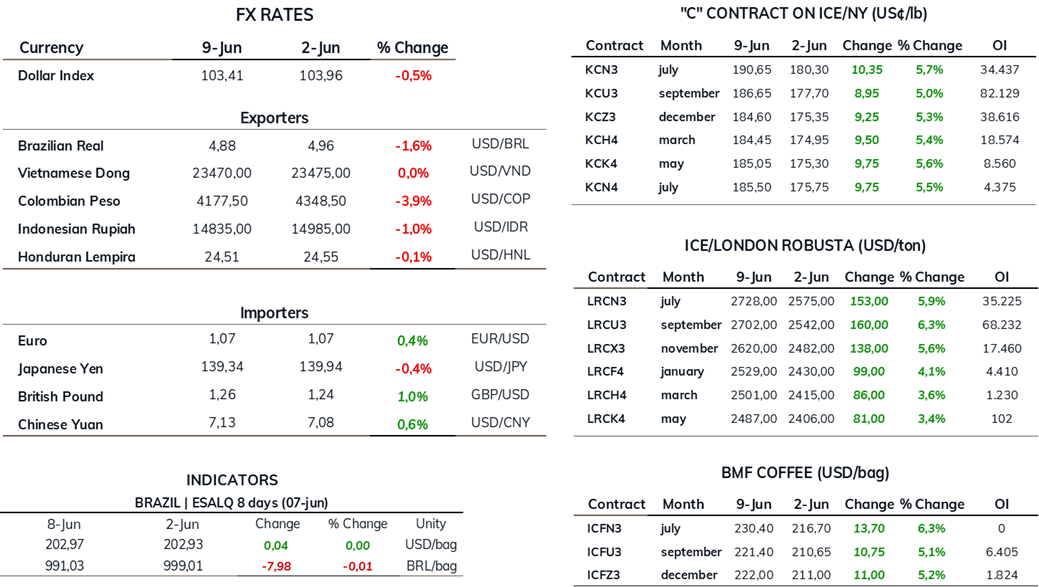
• Arabica futures increased by 895 points (5%) to US¢ 186.65/lb.
• Robusta coffee appreciated by USD 160/ton (6.3%) to USD 2702/t.
• Cepea indicator for Arabica ended the week high by 1.2% to BRL 1,005.37/bag.
• Cepea indicator for Robusta increased by 2.0%, ending Friday quoted at BRL 725.84/bag.
• Vietnamese coffee exports dropped by 8.5% in May to 2.49 million bags.
• USDBRL drops to BRL 4.87 and reaches one-year lows.
• Favorable results for GDP and IPCA in the country have favored the appreciation of the BRL.
• Fed decision and US inflation release in May should move global markets in the week.
• Coffee market is still reactive to possible drops in temperatures in Brazil.
• Certified Arabica coffee stocks fell by 23,129 bags in the week.
• US coffee imports dropped by 25% in April.
• USDA estimates Brazilian production at 66.4 million bags.
• In the Attaché report, USDA projects Brazilian consumption at 22.56 million bags and exports at 45.35 million.
Last week, coffee futures made strong advances in New York and London, reflecting the approach of a polar mass in Brazil, the fall in certified stocks, the USDBRL drop and the prospect of a limited supply of Robusta – data from Vietnam's customs agency show that the country's exports in May totaled 2.49 million bags, down 8.5% compared to the previous month, but 5.2% above that observed in May 2022. In addition, on Thursday (08), both showed the highest rise of the week amid the absence of players from Brazil due to the Corpus Christi holiday.
In New York, the most active Arabica contract ended the week 895 points (5%) higher, closing Friday's session at US₵ 186.65/lb. In London, the most active contract showed an increase of USD 160/t (6.3%), closing the week quoted at USD 2702/t.
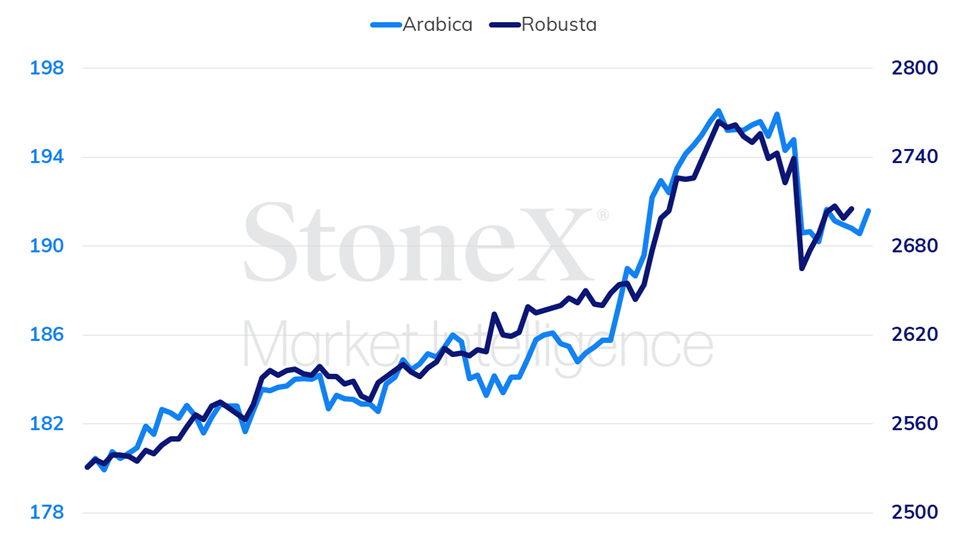
One of the factors behind the appreciation of coffee prices was the USDBRL drop, which, as discussed later, retreated amid lower-than-expected inflation results in Brazil and weaker-than-anticipated data in the US. In Brazil, the dollar fell 1.6%, closing at BRL 4.87.
In Brazil, prices in the domestic market followed the movements observed in New York and London, ending the week higher. The Cepea indicator for Arabica showed an increase of 1.2%, closing at BRL 1005.37/bag. For Robusta, the Cepea indicator ended the period at BRL 725.84/bag, representing an increase of 2%.
The biggest highlight in the macro environment is the Federal Reserve's monetary policy decision on Wednesday afternoon (14). After the lower-than-expected data for the US economy, most agents expect that the US central bank will keep the US interest rate unchanged, between 5.00% and 5.25% p.a., before making a last adjustment in the July decision.
In this sense, a factor that should influence expectations for the decision is the Consumer Price Index (CPI) for May in the United States, which will be released by the Bureau of Labor Statistics (BLS) on Tuesday (13). The indicator is expected to rise from an annual high of 4.9% in April to 4.1% in May, with the core CPI slightly dropping from 5.5% to 5.3% when excluding food and energy. Although the outcome of the CPI alone is unlikely to influence changes in Wednesday's decision, it may affect the statements and analysis of Fed members regarding the monetary authority's future steps.
Thus, a higher-than-expected result for the CPI, that is, that they demonstrate still resilient inflation, tends to influence the bets for a new adjustment of the basic rate in July, as well as its maintenance at a high level for longer, which tends to act as a bullish factor for the US currency. On the other hand, if the indicator identifies clearer signs of cooling in the acceleration of consumer prices, the quotes of emerging currencies, such as the real, and other riskier assets, such as commodities, tend to benefit.
As has been commented in other editions of this report, the approach of any cold wave in Brazil tends to support Coffee prices, given the agents' memory of the frost in 2021. Last week, the approach of a polar mass contributed to the appreciation. The latest models show a drop in temperatures in the producing regions, but the temperature should stay above the level capable of causing frost in the coffee areas. Although the models do not point to the risk of the phenomenon at the moment, any new wave could impact prices. Thus, it is necessary to monitor it.
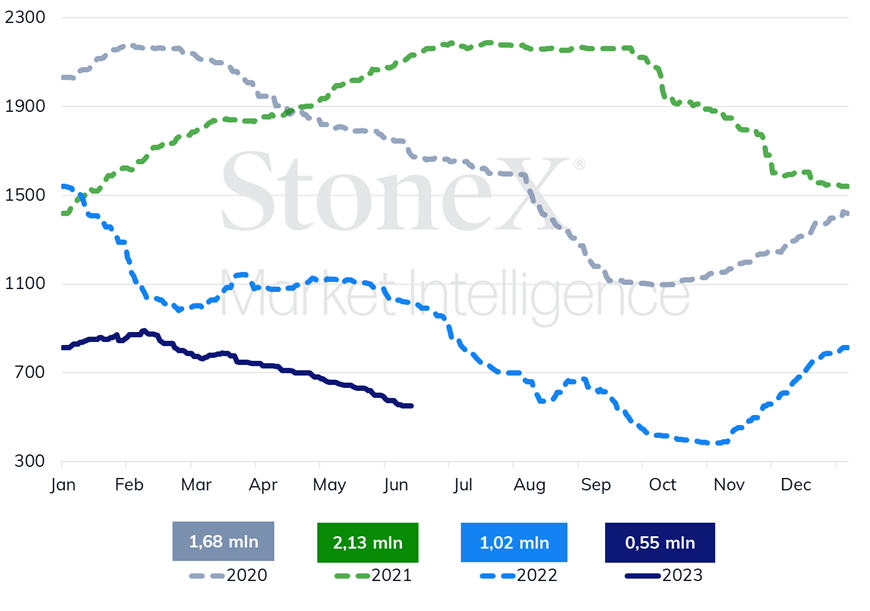
The latest report released by ICE showed that certified Arabica stocks fell by 23,129 bags in the week, totaling 550,379 bags last Friday (09). Certified stocks tend to follow this trend until the price differentials at the origins weaken to the parity level, contributing to new coffees being certified by the exchange. As shown in the last report, the parity for the certification of Brazilian coffees is around -14 to -15 cents/lb. As a survey by StoneX, coffee spreads have been losing strength in Brazil – at the end of April, the FOB spreads for semi-washed coffee 2/3 fine cup 14/16 was close to zero; at the end of May this differential retreated to -6 cents/lb and last week it was seen at -9 cents/lb.
Certified Arabica stocks (million bags)
Looking ahead, one of the critical points will be the export data in Brazil in May by the Council of Coffee Exporters of Brazil (Cecafé), whose release is scheduled for Tuesday afternoon (13). Since the beginning of the year, Brazilian exports have fallen in the annual comparison, which raises doubts about the availability of coffee in Brazil and foreign demand.
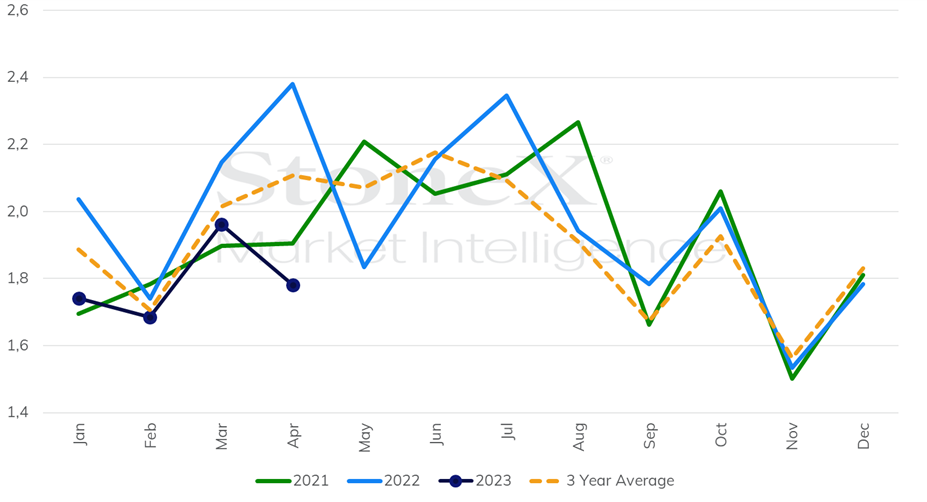
One of the points discussed in recent weeks is the concern of agents with coffee consumption. With the interruption of GCA's release of US stock data, the only indicator available is the volume imported into the country. Data released by the USDA last week for April showed that coffee imports in the country totaled 1.78 million bags, which represents a drop of 25% compared to April last year, and 9.2% compared to the volume imported in the previous month. In addition, the imported volume is still 15.5% below the import average over the past three years.
US monthly coffee imports (million bags)
Last week the USDA released its Attaché report for Brazil, with the expectations of the American agency for coffee production in the country and other important indicators. According to the report, production is expected to advance by 3.8 million bags (6%) compared to the previous season, totaling 66.4 million bags. Arabica coffee production is expected to total 44.7 million bags, an increase of 12%, and Robusta production is 21.7 million bags, representing a decrease of 5%.
Evolution of USDA projections for production in Brazil (million bags)
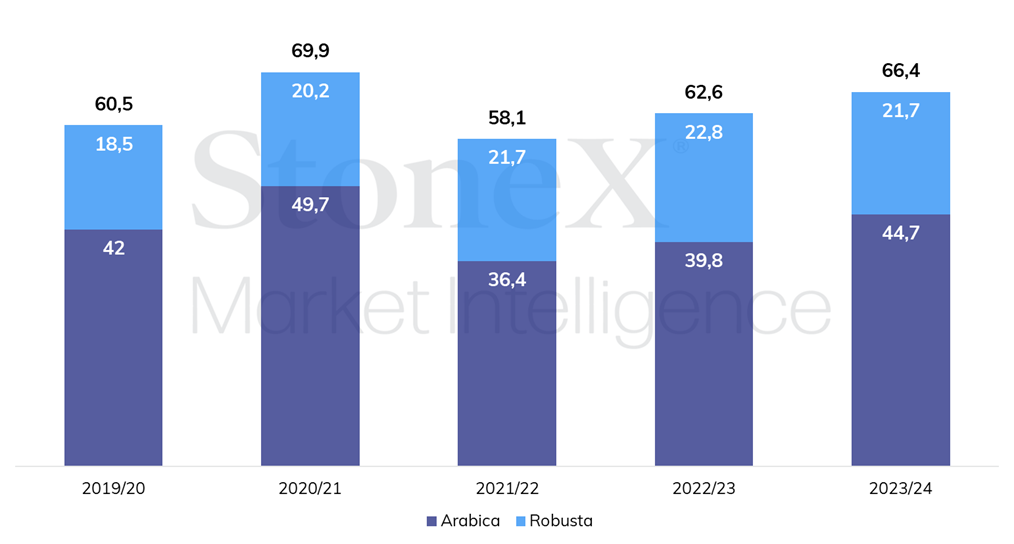
According to the USDA, Minas Gerais received above-average rainfall volumes in January, making pest and Disease Control difficult in some regions. However, the greater availability of water contributed to the development of the fruits, resulting in heavier grains and increasing the expectation for the production of Arabica coffee.
For Robusta, the USDA justified the reduction in estimates due to unsuitable weather during the development stages and the strong wind gusts observed in Espírito Santo. Despite the return of rainfall from October last year, some early stages of development were impacted by dry weather.
Regarding consumption, the agency estimated a total of 22.56 million bags in 2023/24, being 21.6 million roasted ground coffee and 960 thousand instant coffee, which represents an increase of 0.5% compared to the estimate for 2022/23, which was 22.45 million bags (21.5 million roasted&ground bags and 950 thousand instant). According to the report, some economic indicators, such as the expectation of modest economic growth, inflation and high retail coffee prices, have created difficulties for consumption growth in the country.
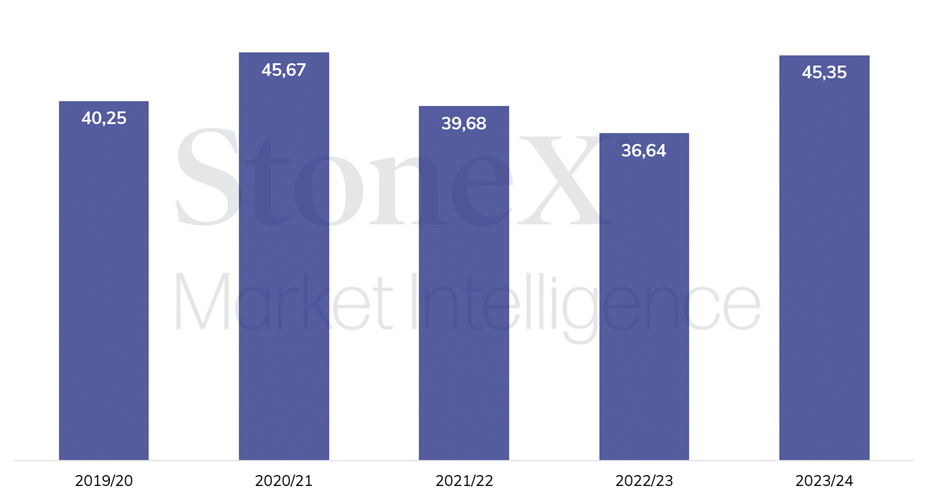
The USDA estimated that Brazilian coffee exports in 2023/24 are expected to total 45.35 million bags, a volume 26% higher than exports in 2022/23, estimated at 36.64 million bags. Instant coffee exports are estimated at 4.3 million bags, representing an increase of 20% compared to 2022/23, when 3.6 million bags were exported. Despite the progress, the report indicates that the Russia-Ukrainian war still impacts Brazilian instant coffee exports.
USDA projections for Brazilian coffee exports (million bags)
According to the data presented, coffee stocks in Brazil are expected to total 2.68 million bags in 2023/24, which indicates a drop of 35% compared to the final stocks of the 2022/23 cycle, estimated at 4.12 million bags.