Dollar to reflect the search for indications from the Federal Reserve, new US tariffs, and ECB's interest rate decision
- Bullish
- The prospect of new US tariffs on Brazilian products tends to reduce the inflow of dollars into the country and create uncertainty among investors, which is likely to hurt the Brazilian real's performance.
- Bearish
- Recent data indicating a decline in inflationary pressures in the US reduced expectations of immediate interest rate hikes, weakening the USD globally.
- The prospect of potential interest rate hikes by the European Central Bank (ECB) tends to strengthen the euro globally and may indirectly favor the real's performance against the USD.
The week in review
- Consumer Price Index (CPI) and Producer Price Index (PPI) in the US surprised with deflation of 0.4% and 0.2%, respectively. This benign reading reduced bets on short-term interest rate hikes.
- New US tariffs on Brazilian products were confirmed. With this measure, exports face an additional 25% tax starting Thursday (22), although there is a long list of exceptions.
- In the Middle East, the resumption of military operations between the US and Iran reduced expectations of resolution and increased geopolitical risk perception among investors.
USDBRL and Dollar Index (points)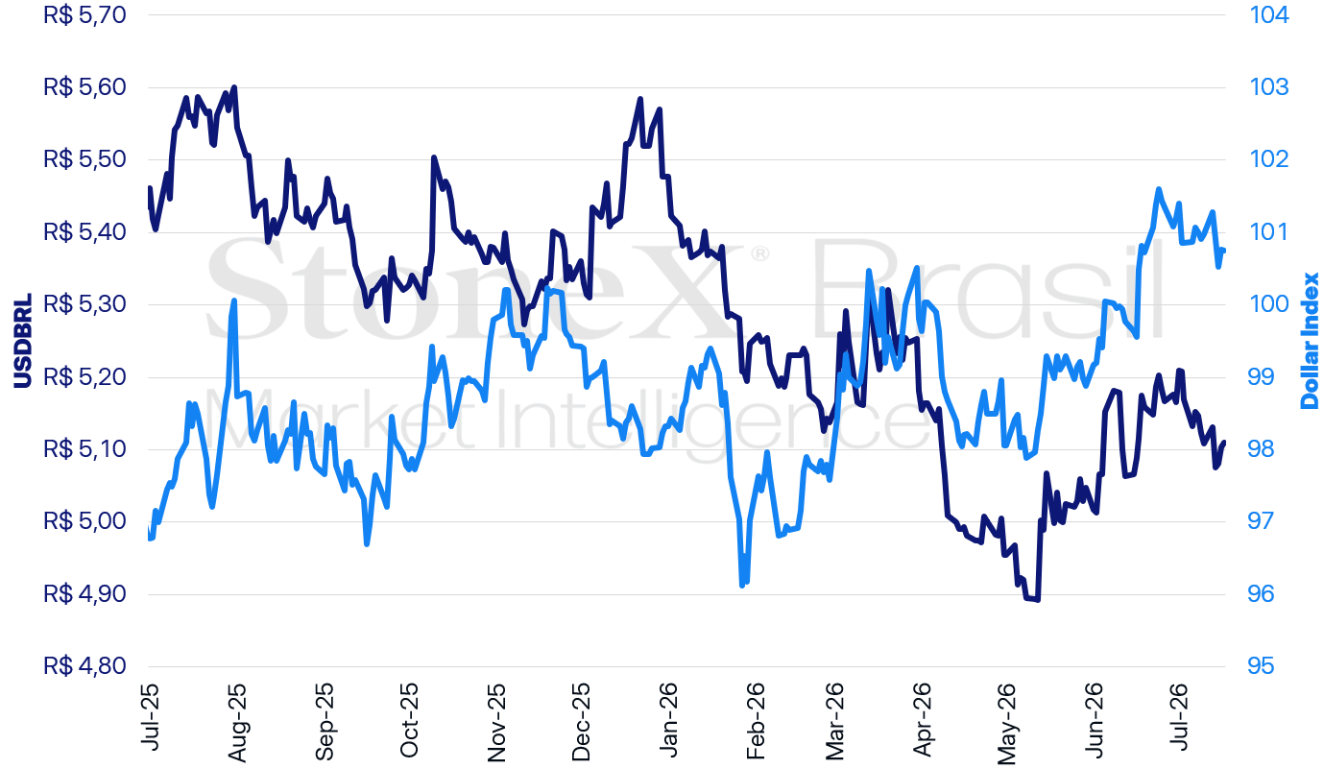
Source: StoneX cmdtyView. Design: StoneX.
USDBRL variations | Daily: +0.14% | Weekly: +0.02% | Monthly: -1.08% | Annual: -6.70% | In 12 months: -7.89%
Dollar index variations | Daily: -0.02% | Weekly: -0.22% | Monthly: -0.45% | Annual: +2.47% | In 12 months: +2.14%
KEY EVENT: Federal Reserve's next steps
Expected impact on the USDBRL: bearish
US: Historical and projected interest rates – updated July 17, 2026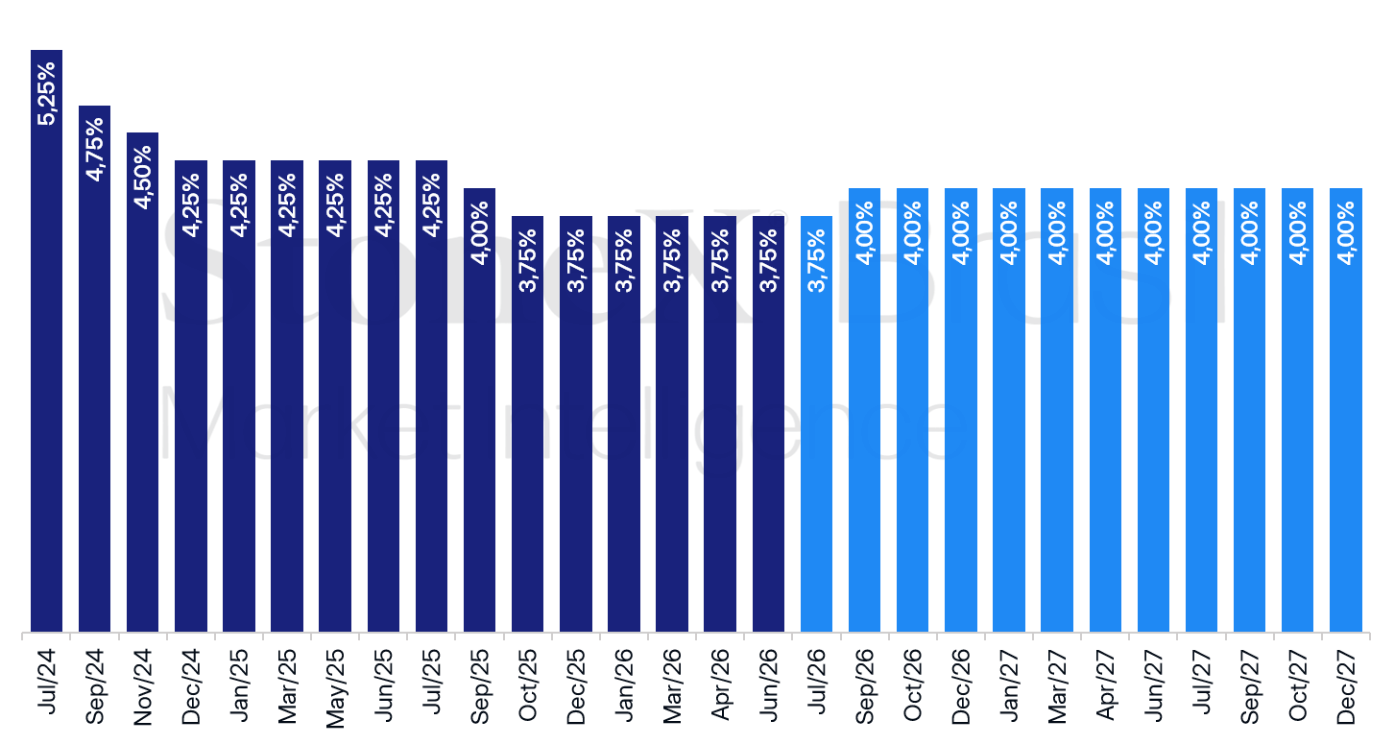
Source: CME FedWatch Tool. Design: StoneX. Refers to the most probable market futures bet on the indicated date.
With the release of the last major macroeconomic indicators before the Federal Open Market Committee (FOMC) interest rate decision, investors are recalibrating their expectations for the trajectory of US monetary policy.
Why this matters: Signs of slowing inflation reduce bets on short-term interest rate hikes, lowering yields on US Treasury securities and weakening the dollar globally.
Inflation data surprises: Last week's June readings of CPI and PPI surprised with lower-than-expected results, pointing to deflation of 0.4% and 0.2%, respectively.
- In the 12-month inflation of these indicators, there was a deceleration from 4.2% to 3.5% (CPI) and from 6.0% to 5.5% (PPI).
- With this benign reading, investors reduced their bets on short-term interest rate hikes. However, it is worth noting that June was marked by an easing of military tensions in the Middle East and a reduction in possible inflationary pressures from oil, which may have contributed to the result.
- For July, with the conflict's escalation and oil prices recovering to near USD 90/barrel, some inflationary pressures may return.
- After the June CPI reading, Chicago Federal Reserve President Austan Goolsbee noted that a single benign reading should not suffice to convince that inflation is returning to the target, reinforcing caution among monetary authorities.
Inflation measures for the United States (12-month accumulations)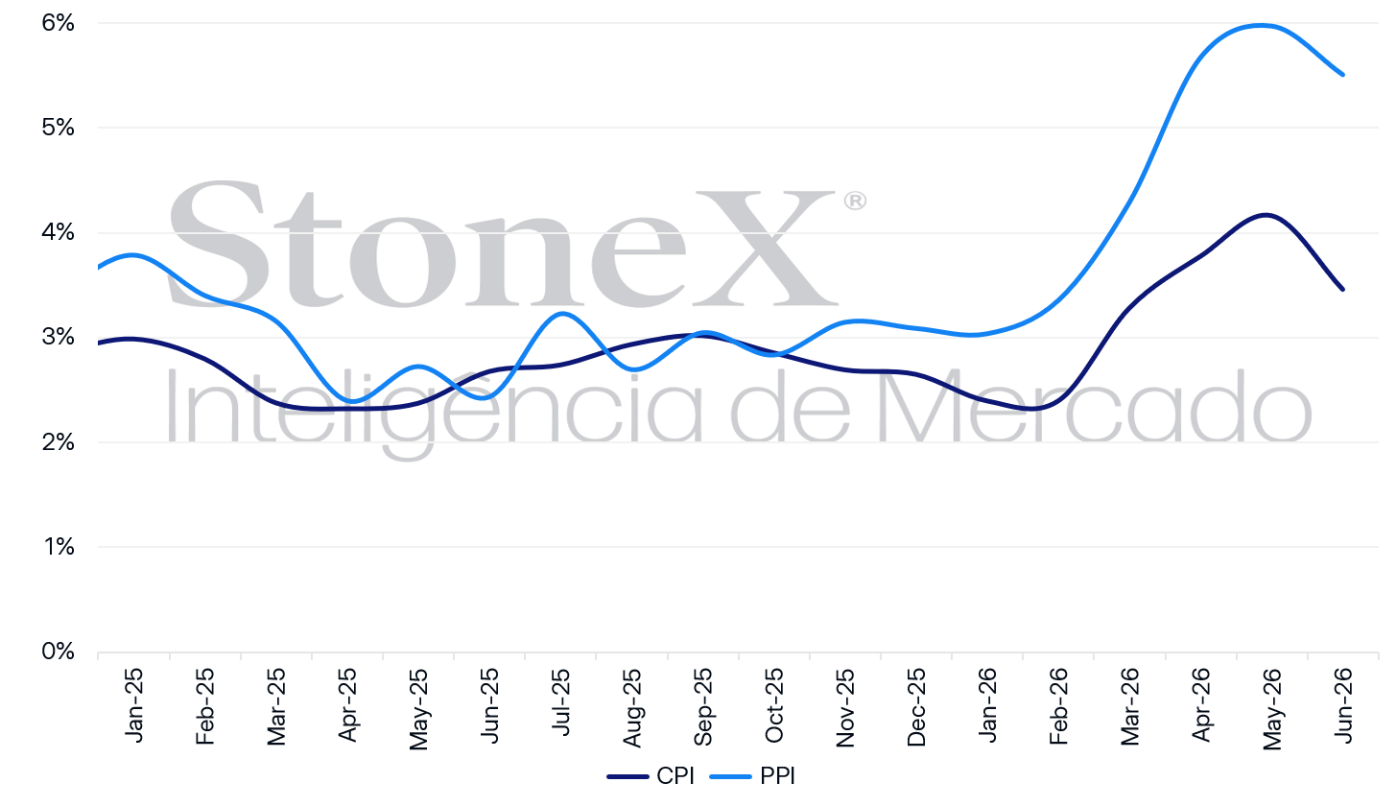
Source: U.S. Bureau of Economic Analysis (BEA), U.S. Bureau of Labor Statistics (BLS), Federal Reserve Bank of St. Louis. Design: StoneX.
Kevin Warsh in US Congress: During the week, Kevin Warsh participated in the semiannual testimony of the Federal Reserve Chairman to Congress.
- In line with his enigmatic style, Warsh offered no forward guidance or economic commentary, making it difficult for investors to calibrate expectations.
- During the testimony, Warsh only reiterated the Fed's commitment to controlling inflation and stated that the benign inflation data did not signify a "mission accomplished" for the Federal Reserve.
- However, to achieve its inflation target, the Fed Chairman did not provide hints about the implementation instrument.
- Previously, Warsh responded to critics of the lack of signals by advising them to watch the data, not the Federal Reserve.
Other Federal Reserve officials: Unlike Kevin Warsh, other Fed advisors were clearer and provided more signals throughout the week.
- Advisor Lisa Cook stated she prefers waiting for more disinflation evidence but signaled readiness to support another rate hike if inflation does not continue to ease in the coming months.
- Advisor Christopher Waller indicated he would need to observe several consecutive months of lower inflation before gaining confidence in the convergence process towards the 2% target.
- New York Federal Reserve President John Williams offered a more optimistic perspective, stating inflation remains high but expressing encouragement that it may have peaked and should gradually decline. Williams also described current monetary policy as "well-positioned."
- Despite tonal differences, the officials' statements suggest most FOMC members are adopting a "wait-and-see" approach, seeking more evidence before considering tightening or loosening monetary policy.
Tariff arrangement between the US and Brazil
Expected impact on the USDBRL: bullish
Among the factors influencing the real's behavior next week, the progress of US-imposed trade measures emerges as a significant risk vector.
- With the 25% surcharge effective on the 22nd, the average tariff on Brazilian products will rise from 11.7% to 18.22%, before falling to around 14.4% on the 26th when the additional 10% surcharge expires.
- Even so, the final rate represents a significant increase compared to last week, likely pressuring export performance in the coming months.
Why this matters: The increased cost of Brazilian products in the US market reduces export competitiveness and foreign currency inflow, while greater unpredictability in trade relations deters foreign investment in domestic assets.
- Domestically, the government signaled plans to strengthen the Sovereign Brazil Plan to support affected companies, maintaining fiscal targets. The potential application of the Reciprocity Law also remains on the radar as a countermeasure.
- The topic is expected to remain central to political debate, increasing asset sensitivity and maintaining depreciation pressure on the real until the final tariff arrangement is consolidated.
ECB interest rate decision
Expected impact on USDBRL: bearish
The European Central Bank (ECB) meeting on Thursday (23) is expected to maintain the benchmark interest rate at 2.25% annually.
- For upcoming meetings, investors anticipate two more hikes by mid-2027, one as early as September. However, developments in the Middle East conflict and potential inflationary pressures via oil will determine monetary policy's next steps.
Why this matters? The prospect of the ECB maintaining high interest rates, or even possible new hikes, tends to strengthen the euro globally.
- This scenario weakens the USD and may indirectly favor the BRL's performance.
In detail: Recent CPI data indicated a slowdown, with inflation over the last 12 months decreasing from 3.2% to 2.8% in June, though still above the ECB's 2% target.
- The core indicator, excluding volatile items like food and energy, also slowed from 2.6% to 2.4%.
- Amid uncertainties from the Middle East conflict escalation and inflationary pressure slowdown, the ECB is expected to adopt a "wait-and-see" stance before determining its direction.
- Recently, German Central Bank President Joachim Nagel stated, "It remains advisable to react cautiously but act decisively if necessary," highlighting monetary authorities' attentiveness.

INDICATORS
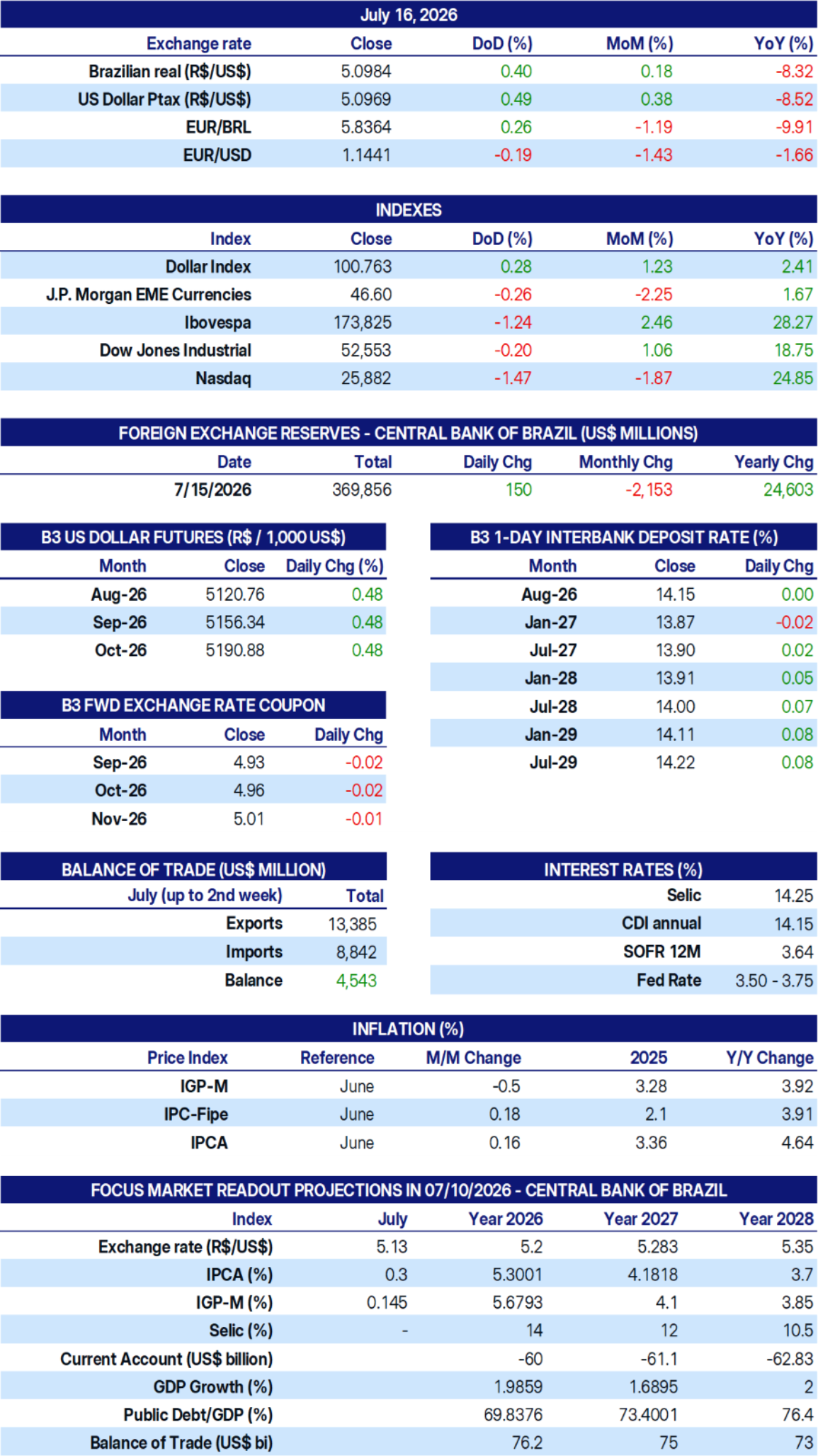
Sources: Central Bank of Brazil; B3; IBGE; Fipe; FGV; MDIC; IPEA and StoneX cmdtyView.