Dollar expected to be influenced by FOMC interest rate decision, US/Brazil economic data, Middle East developments, and end-of-month PTAX figures
- Bullish
- The expectation of a more cautious stance by the Federal Reserve is likely to reinforce bets on higher interest rates for a longer period in the country, favoring capital attraction and consequently strengthening the USD globally.
- The conflict in the Middle East and the lack of diplomatic progress between the US and Iran increase geopolitical uncertainty, leading investors to seek safe-haven assets such as the US dollar and US Treasury bonds.
- Bearish
- Signs of slowing inflation in the US are likely to reduce bets on interest rate hikes in the short term, which tends to reduce capital attraction and weaken the USD globally.
- Signs of reacceleration of domestic inflation tend to reduce bets on maintaining the cycle of interest rate cuts, which should increase yields on domestic government bonds and strengthen the Brazilian real globally.
The week in review
- With no relevant indicators during the week, geopolitical news was the main factor of volatility in the currency market.
- The escalation of the Middle East conflict and the closure of the Bab el-Mandeb Strait in the Red Sea pushed oil prices close to USD 100/barrel, reigniting global inflationary fears and increasing risk aversion.
- New US tariffs on Brazilian products came into effect throughout the week, raising the total rate to 37.5%, with the simultaneous expiration of the previous 10% tariff.
USD/BRL and Dollar Index (points)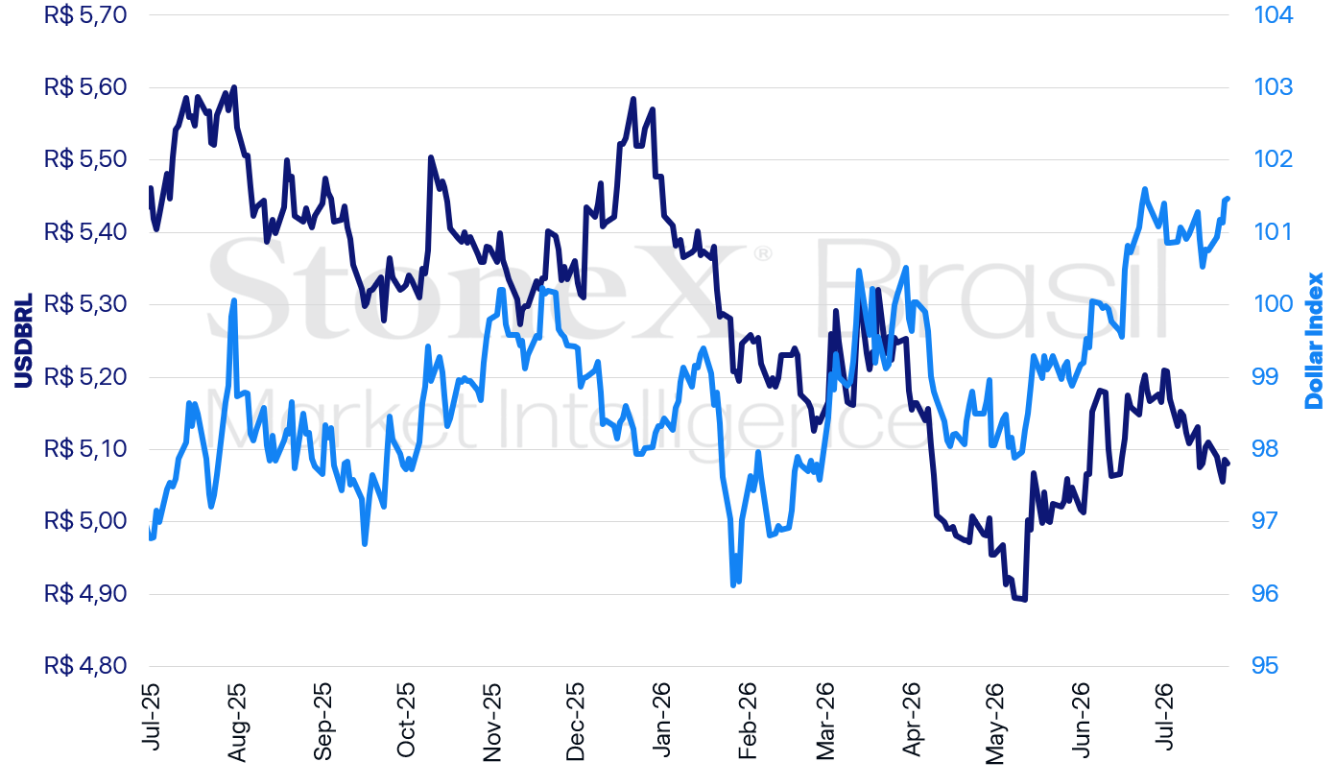
Source: StoneX cmdtyView. Design: StoneX.
USDBRL | Daily: -0.11% | Weekly: -0.57% | Monthly: -1.65% | Annual: -7.23% | In 12 months: -7.97%
Dollar index variations | Daily: +0.03% | Weekly: +0.72% | Monthly: +0.26% | Annual: +3.20% | In 12 months: +4.20%
KEY EVENT: FOMC interest rate decision
Expected impact on the USDBRL: bullish
US: Historical and expected interest rates – updated on July 24, 2026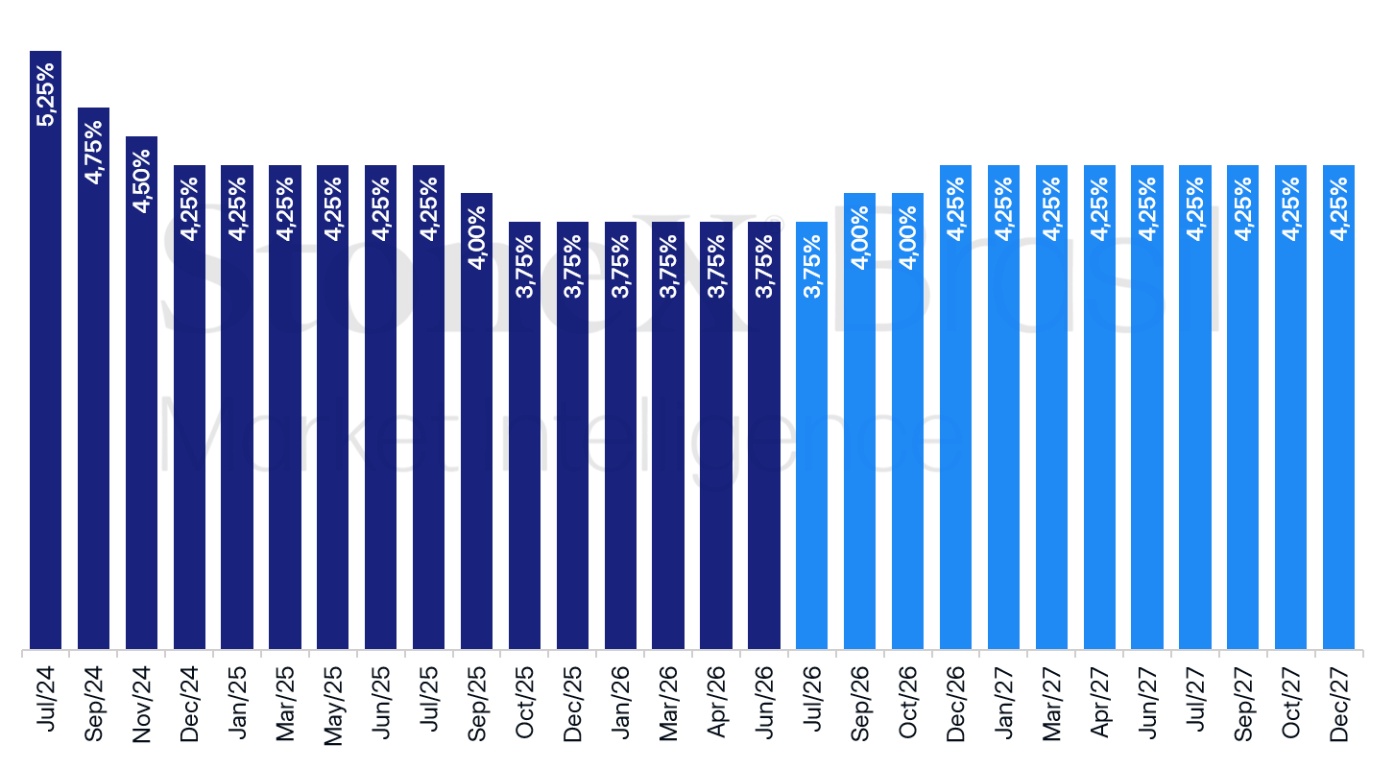
Source: CME FedWatch Tool. Design: StoneX. Refers to the most probable market future interest rate bet on the indicated date.
This week, the currency market will monitor the Federal Open Market Committee (FOMC) decision, which is expected to keep the US benchmark interest rate in the range of 3.50% to 3.75% per year.
- With most investors betting on steady rates, the focus will be on possible signals for the monetary authority's next steps, although the reading may be complicated by the enigmatic style of Federal Reserve (Fed) Chairman Kevin Warsh.
Why this matters: The expectation of a more cautious stance by the Federal Reserve should reinforce bets on higher interest rates for a longer period in the country.
- This, in turn, tends to increase yields on US Treasury bonds and favor the attraction of external capital, strengthening the dollar globally.
Inflation data surprises: June readings of the Consumer Price Index (CPI) and Producer Price Index (PPI) surprised with readings below expectations and pointed to a slowdown in accumulated inflation over the last 12 months from 4.2% to 3.5% and 6.0% to 5.5%, respectively.
- The benign reading contributed to investors reducing their bets on a short-term rate hike. However, it is worth noting that June was marked by the signing of a ceasefire and relief from military tensions in the Middle East.
- In July, however, the conflict's re-escalation and the closure of the Bab el-Mandeb Strait favored the recovery of oil prices to levels close to USD 100/barrel, which heightens investors' inflationary concerns.
US inflation measures (accumulated over 12 months)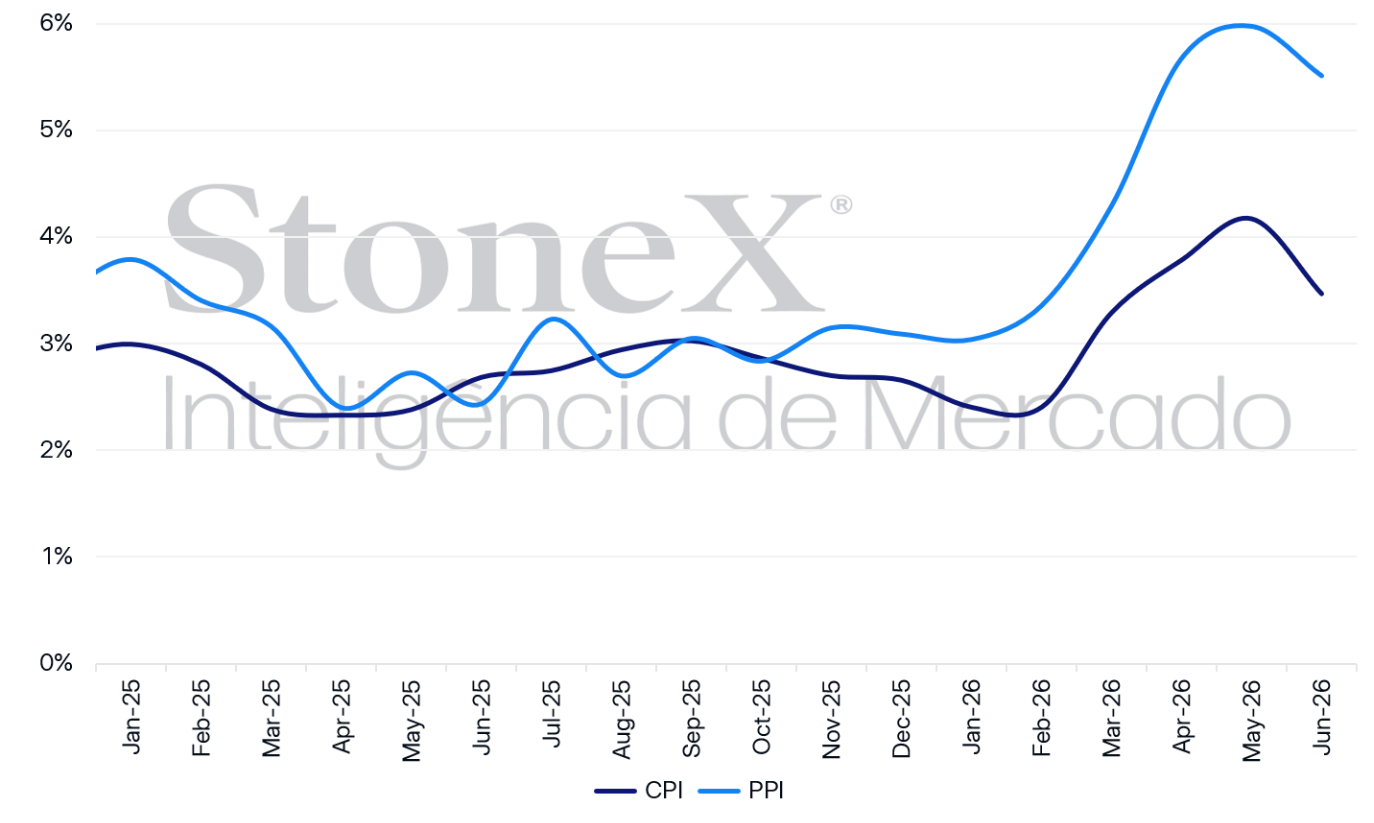
Source: US Bureau of Economic Analysis (BEA), US Bureau of Labor Statistics (BLS), Federal Reserve Bank of St. Louis. Design: StoneX.
Labor market slows: The June Employment Situation Report presented a reading far below expectations, with a net gain of 57,000 jobs compared to projections of 114,000.
- Additionally, the June reading was revised downward from a positive balance of 172,000 to 129,000 new jobs.
- On the other hand, the unemployment rate fell from 4.3% to 4.2% after 720,000 people exited the labor force. Consequently, the participation rate dropped to 61.5%, the lowest level since March 2021.
Variation in total non farm jobs (000 of people) and unemployment rate (%) in the United States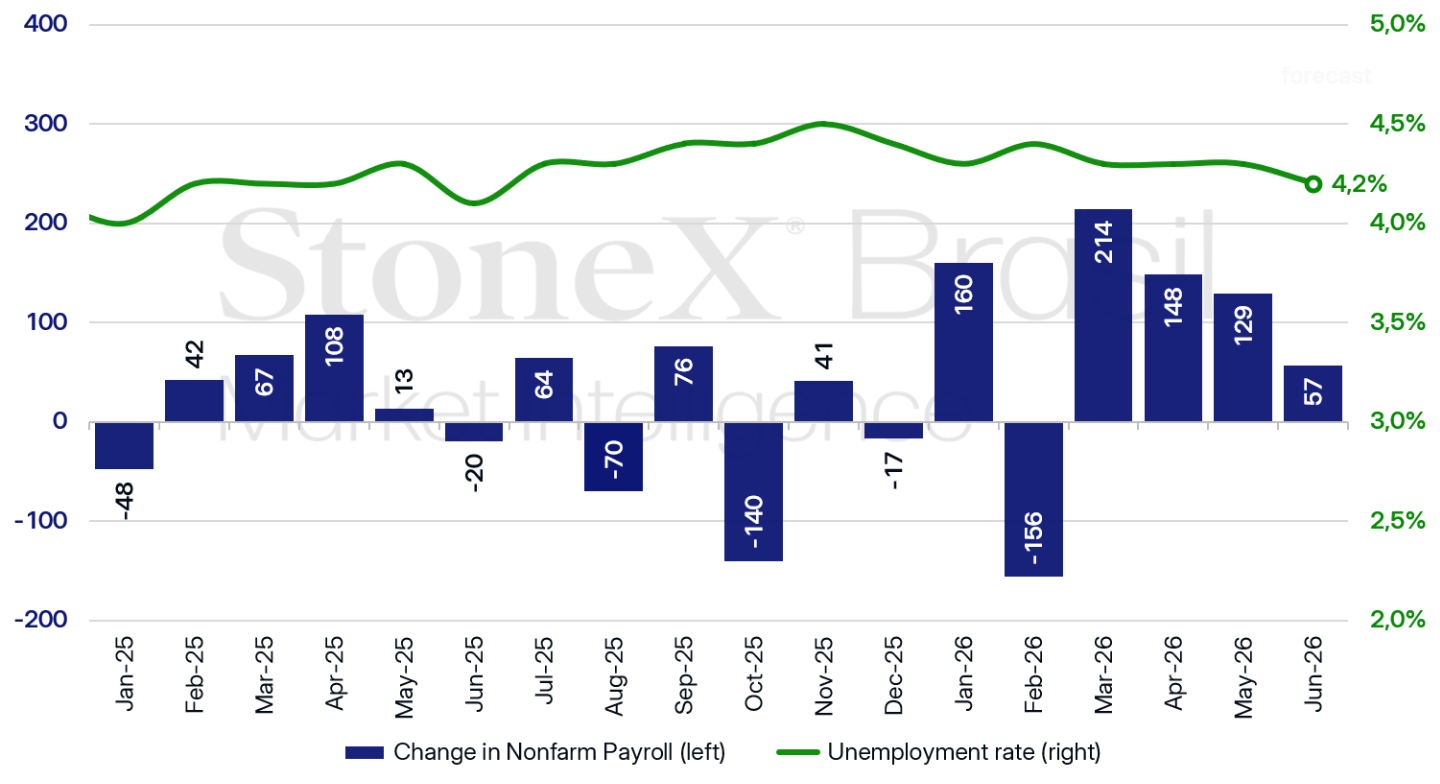
Source: US Bureau of Labor Statistics (BLS), Federal Reserve Bank of St. Louis. Design: StoneX.
Directors’ signals: Before the silence period preceding the meeting, some FOMC members publicly commented on the latest inflation data.
- Chicago Fed President Austan Goolsbee observed that one benign inflation reading is not enough to conclude inflation is returning to the target, reinforcing a tone of caution.
- Director Lisa Cook stated she prefers to wait for more evidence of disinflation but signaled she is prepared to support another rate hike if inflation does not continue decelerating in the coming months.
- In a more optimistic tone, New York Fed President John Williams acknowledged inflation remains high but highlighted encouraging signs that the inflation peak may be behind us, with potential gradual deceleration ahead. Williams also classified current monetary policy as "well-positioned."
- Finally, the Fed Chairman reiterated his commitment to controlling inflation and stated the benign inflation data does not mean "mission accomplished." To achieve his goal of returning inflation to the target, Warsh offered no forward guidance.
Wait and see: In this context, the expectation is for a “wait and see” stance from monetary authorities, reinforced by the recent conflict resumption in the Middle East.
- FOMC directors are likely to closely monitor upcoming economic indicators, especially inflation data, to assess potential impacts of oil price increases on the US economy.
- Signs of inflation reacceleration, combined with uncertainty over diplomatic negotiations between the US and Iran, are likely to reinforce the argument for maintaining interest rates at restrictive levels and may even strengthen discussions about rate hikes.
- Conversely, only a scenario of consistent benign readings is likely to strengthen discussions about room for rate cuts.
Inflation in the US
Expected impact on the USDBRL: bearish
US inflation measures (%)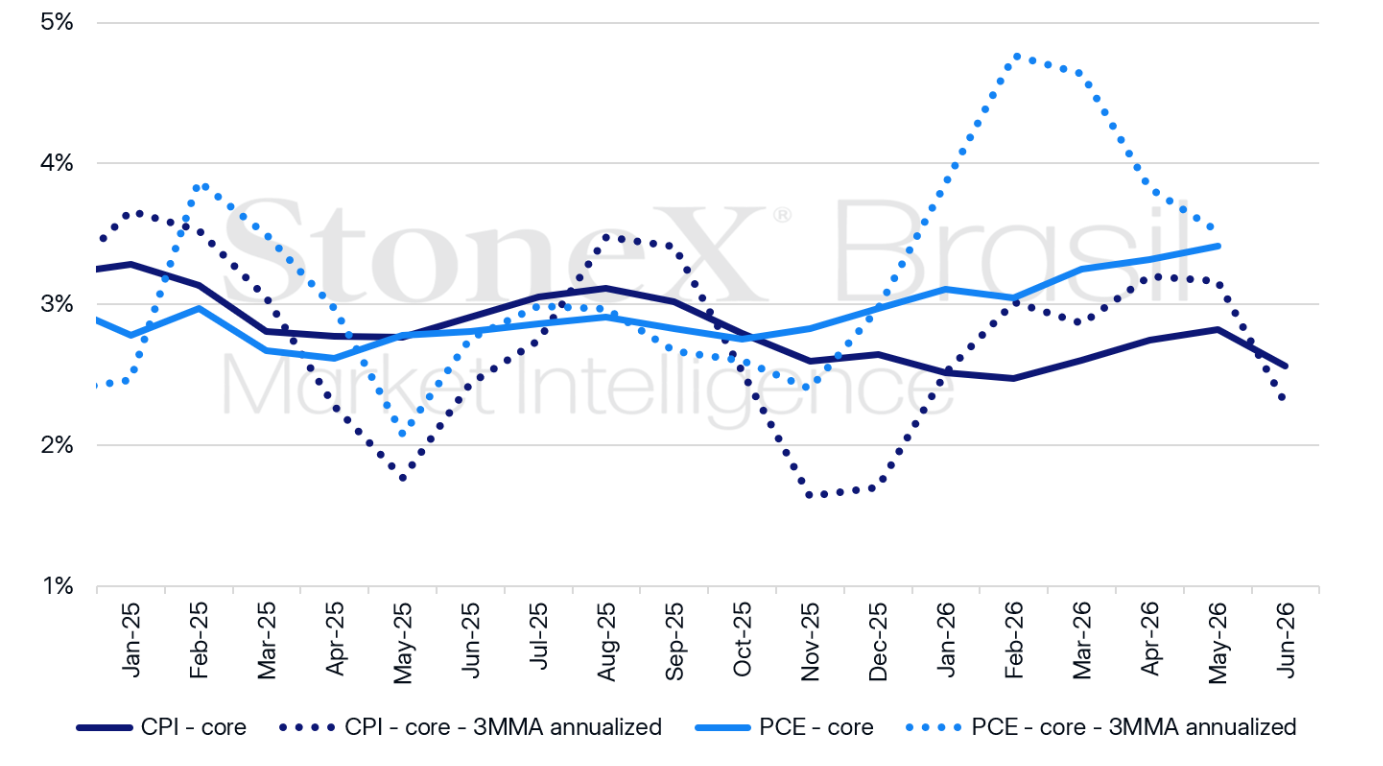
Source: US Bureau of Economic Analysis (BEA), US Bureau of Labor Statistics (BLS), Federal Reserve Bank of St. Louis. Design: StoneX.
After the FOMC interest rate decision, investors are expected to monitor the June reading of the Personal Consumption Expenditures Price Index (PCE), the Fed's favorite indicator for tracking inflation.
Why this matters: Signs of slowing inflation tend to reduce bets on interest rate hikes in the short term, which tends to decrease the attractiveness of US Treasury bonds and weaken the dollar globally.
Inflationary concerns: In light of benign readings of the Consumer Price Index (CPI) and Producer Price Index (PPI) in June, which surprised and pointed to deflation of 0.4% and 0.2%, respectively, the PCE for the same period is also expected to present a benign reading.
- However, it is worth noting that June corresponded to the signing of a provisional ceasefire agreement between the US and Iran, which lowered oil prices and eased potential global inflationary pressures transmitted via energy commodity.
- The June PCE reading is expected to be an important indicator for investors but does not reflect the current global geopolitical scenario, marked by the Middle East conflict resumption and oil price recovery.
- Investors are currently seeking to calibrate their expectations for the potential impacts of the conflict resumption.
Economic activity: In addition to the PCE, the first reading of the US Gross Domestic Product (GDP) for the second semester will be released, which should indicate possible impacts of the Middle East conflict on economic activity.
- Projections point to a growth rate of 2.3% (annualized rate) during the period, representing an acceleration compared to the 2.1% (annualized rate) growth recorded in the previous quarter.
Inflation in Brazil
Expected impact on the USDBRL: bearish
Domestically, the highlight indicator is expected to be the Broad National Consumer Price Index 15 (IPCA-15) for July, which should capture the possible initial inflationary impacts of the Middle East conflict resumption.
Why this matters: Signs of inflation reacceleration tend to reduce bets on maintaining the interest rate cut cycle by the Monetary Policy Committee (Copom), which should increase yields on domestic government bonds and strengthen the Brazilian real globally.
Recent data: The latest price indicator was the June reading of the Broad National Consumer Price Index (IPCA), which pointed to inflation of 0.16%, below investors' expectations of a 0.31% rise.
- With this result, the accumulated inflation over 12 months fell from 4.72% to 4.64%, still above the tolerance ranges of inflation targets.
- As in the US case, the June reading corresponded to the period of signing the provisional ceasefire agreement between the US and Iran, which reduced oil prices and potential inflationary pressures transmitted via energy commodity.
Expectations: In the last Focus bulletin, the median projection for accumulated inflation in 2026 pointed to a rise of 5.15%, indicating that financial institutions expect inflation to rise from current levels.
- For Monday (27), the new bulletin publication should provide updated projections from institutions, considering the strong oil price increase of over 9% recorded this week.
US and Iran enter third consecutive week of hostilities
Expected impact on the USDBRL: bullish
Tensions between the United States and Iran continue with no diplomatic solution in sight and, tomorrow, will enter their third consecutive week of hostilities.
- After the failure of peace negotiations and attempts to establish a memorandum of understanding between the two countries, clashes continue to intensify, while new ceasefire proposals are also facing resistance.
- The conflict's continuation has again pushed international energy prices upward, with Brent crude approaching the USD 100 per barrel mark.
Why this matters: In times of greater geopolitical uncertainty, investors tend to reduce exposure to assets considered riskier and allocate resources to safe-haven assets like the US dollar and US Treasury bonds.
- In this environment, currencies of emerging markets such as the Brazilian real tend to face additional pressure.
- As such, if the conflict remains without diplomatic progress or presents a new escalation during the week, increased global demand for safe-haven assets may contribute to a strengthening of the dollar against the real, keeping the foreign exchange market under pressure.
End-of-month Ptax rate
Expected impact on the USDBRL: undefined
End-of-month Ptax rate – selling (BRL/USD)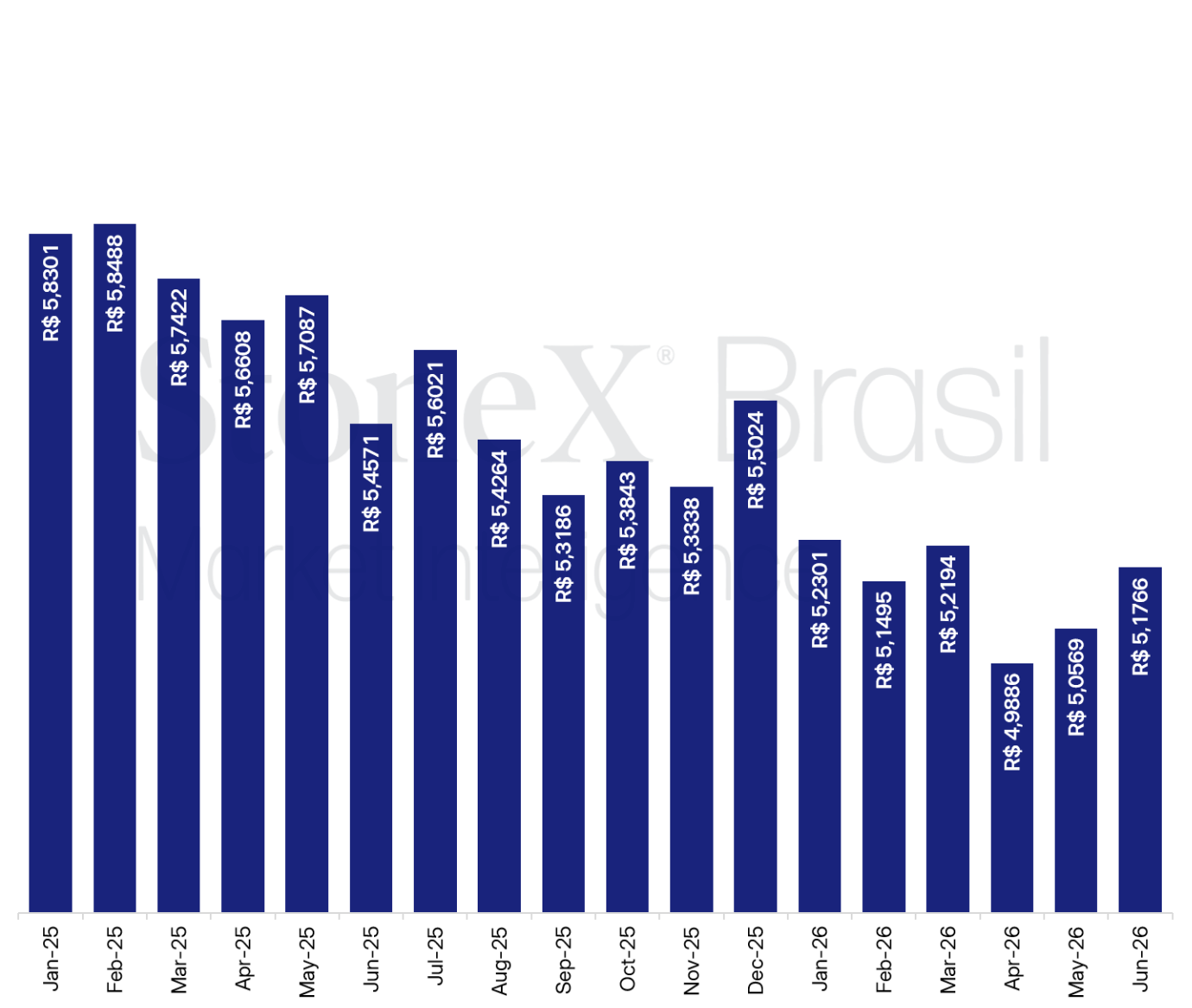
Source: Central Bank of Brazil. Design: StoneX.
The trading volume and volatility of the exchange rate are expected to increase on the last trading day of July due to the formation of the end-of-month Ptax rate.
- The Ptax rate is a reference published daily by the Central Bank, and its end-of-month value is widely used in foreign exchange and derivative contracts.
- The Central Bank calculates its value based on the average of quotes obtained during four time slots, between 10:00 AM and 1:10 PM.
Why this matters: Financial market operators intensify their operations during the intervals of forming the last Ptax rate of the month to try to influence its value in a more advantageous direction for their positions, making it difficult to interpret the real's movements on that day.

INDICATORS
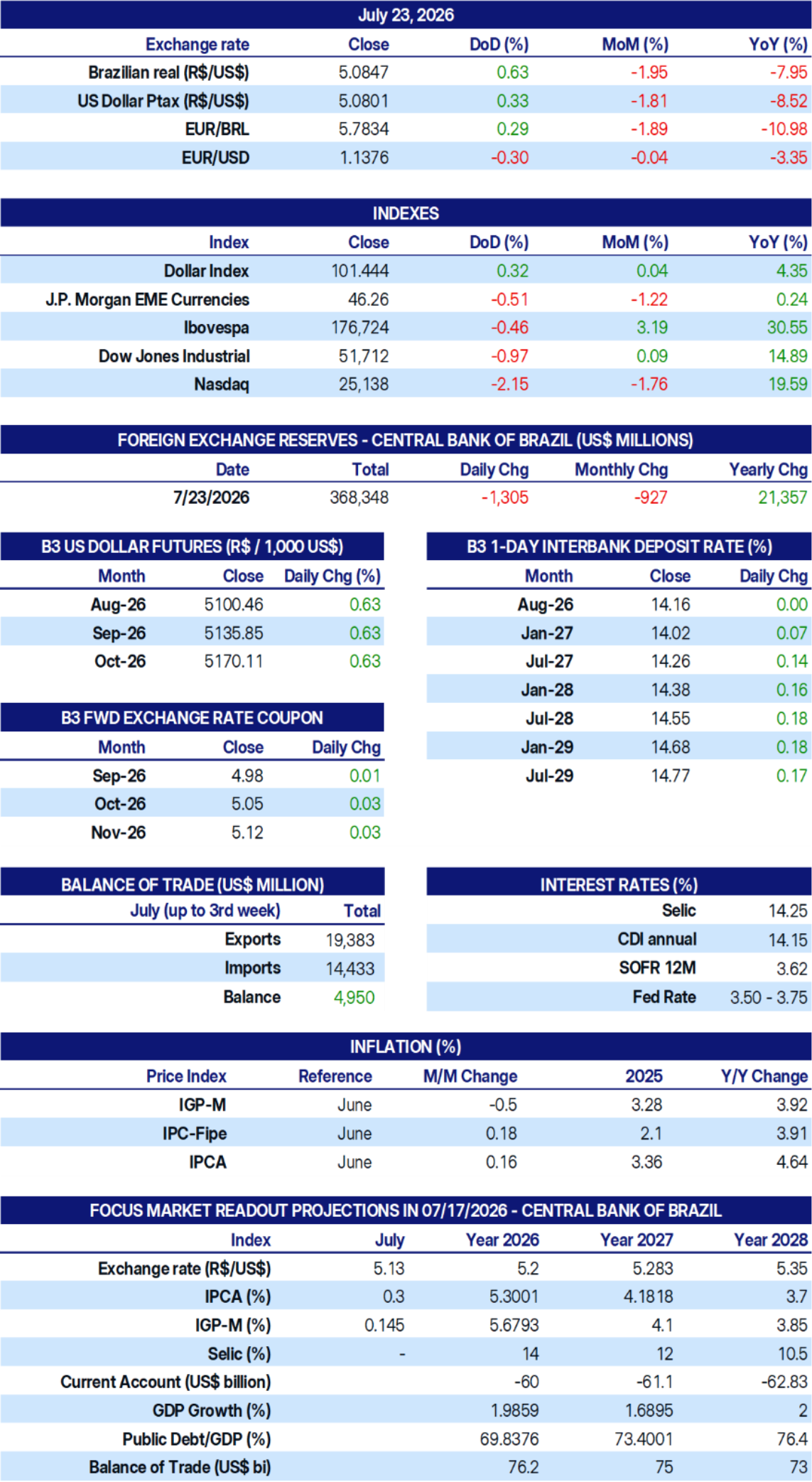
Sources: Central Bank of Brazil; B3; IBGE; Fipe; FGV; MDIC; IPEA and StoneX cmdtyView.