

FX Weekly Overview (Brazil Issue)
Dollar expected to reflect Copom minutes, US inflation data, and concerns about national economic policy

Leonel Mattos
- Currencies
Market Intelligence Analyst • BRAZIL PRS

USDBRL and Dollar Index (points)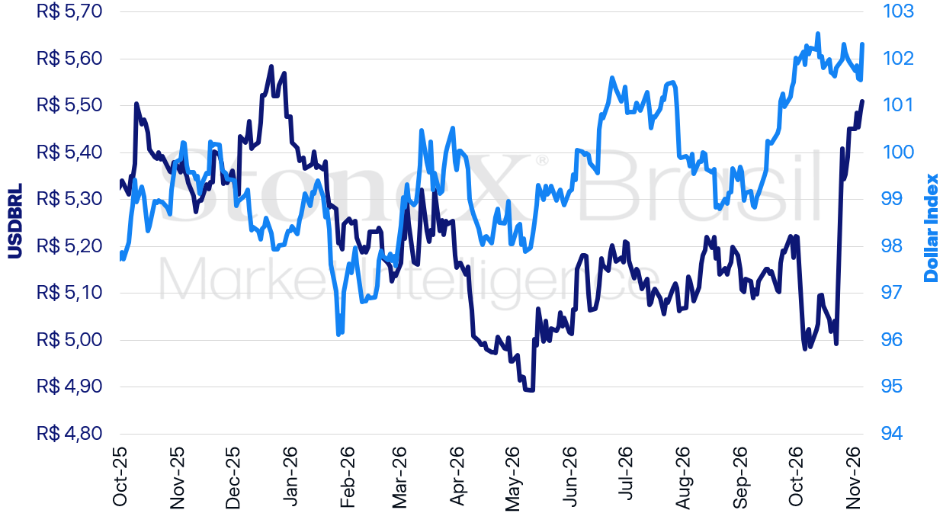
USDBRL variations | Daily: +0.35% | Weekly: +1.09% | Monthly: +1.09% | Annual: +0.60% | 12 months: +3.00%
Dollar Index variations | Daily: +0.76% | Weekly: +0.37% | Monthly: +0.37% | Annual: +4.06% | 12 months: +2.59%
Brazil: Historical and expected interest rate – Focus report from October 30, 2026 (% p.a.)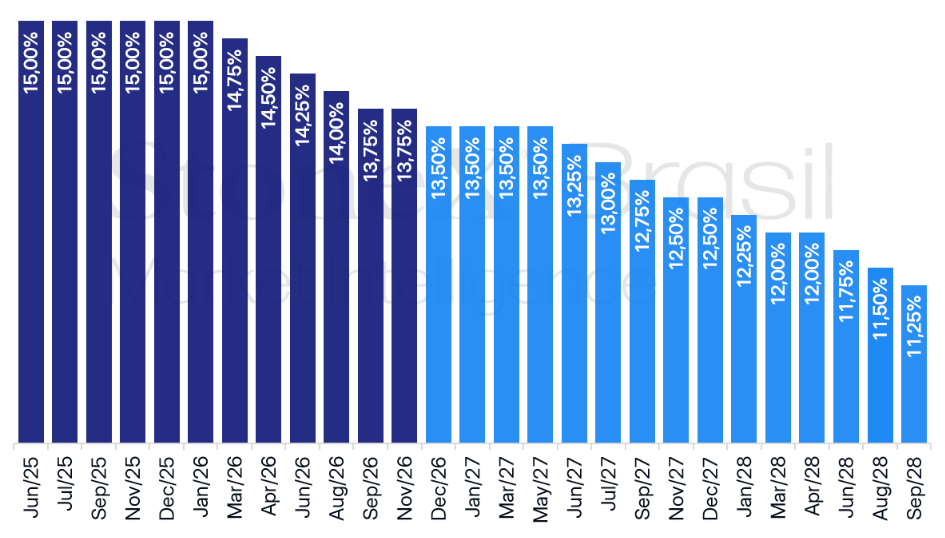
On Tuesday (10), the Monetary Policy Committee (Copom) will release the minutes from its last decision, which kept the basic interest rate (Selic) at 13.75%, interrupting a streak of five cuts.
Why this matters: If the document reinforces Copom’s neutral tone and cautious stance, investors are likely to increase bets on halting the interest rate cutting cycle, raising domestic bond yields and attracting foreign capital, which tends to support the real’s performance.
Challenging inflation scenario: In the statement issued post-decision, Copom raised its inflation projections for accumulated inflation in 2026 and 2027 to 5.6% and 4.7%, respectively, further deviating from the target’s midpoint.
Signs of economic slowdown: Alongside the challenging inflation scenario, recent indicators reinforce perceptions of economic cooling.
Stagflation risk? In this context, Copom faces opposing risks that cannot be mitigated simultaneously.
IPCA: In this regard, on Thursday (12), investors are expected to react to October’s Consumer Price Index (IPCA) reading, which should indicate a monthly inflation drop from 0.82% in September to 0.30% in October.
12-month accumulated IPCA and Focus projections (%)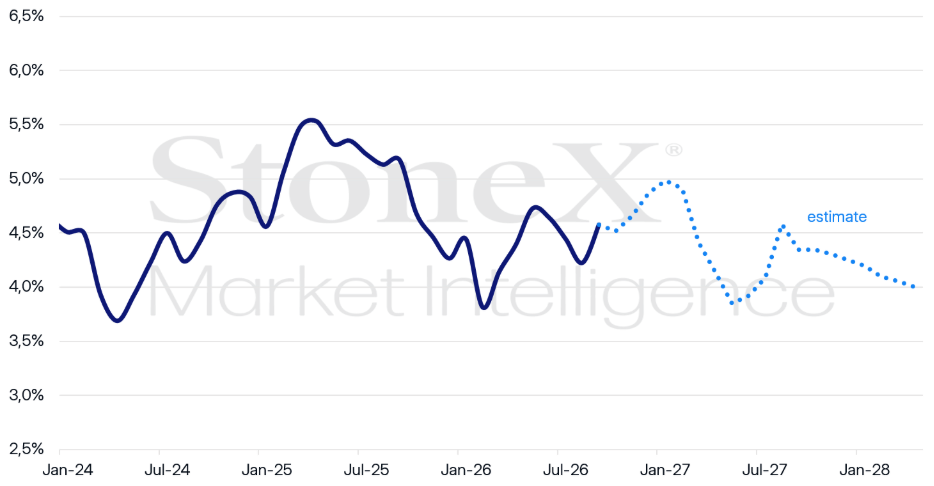
Investors are expected to continue reacting to the pessimistic and skeptical sentiment surrounding economic policies during President Luiz Inácio Lula da Silva’s fourth term, closely monitoring signs about fiscal policy management and the composition of his economic team.
Why this matters: Investors anticipate a more expansionary fiscal policy under Lula’s new government, leading to a faster acceleration of national debt levels.
Lula’s address: To alleviate financial market concerns, Lula recorded a national address to be aired on Sunday (08).
Rumored proposals: Media reports indicate the government is debating the possibility of adopting the fiscal target center for resource contingency, increasing the base of expenses subject to contingency by 20%, and reducing the maximum limit for the annual real growth of expenditures.
Federal Reserve interest rate decision bets for December 9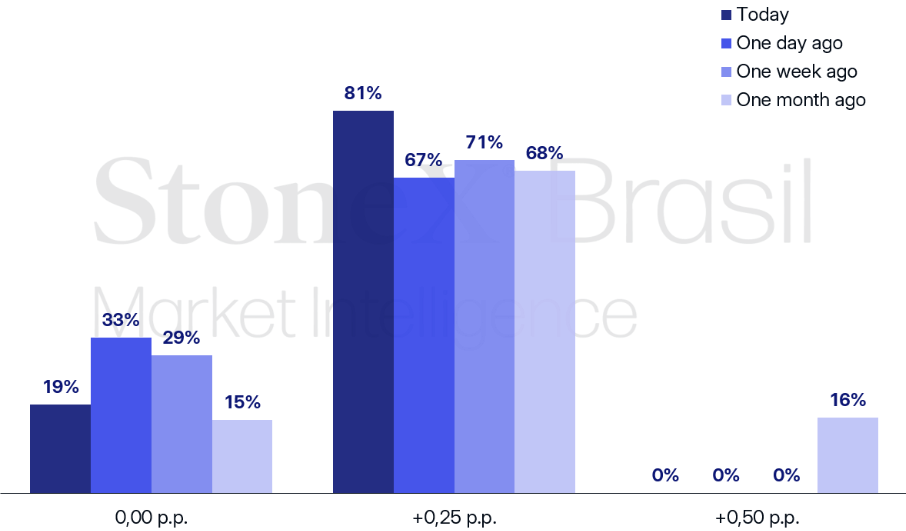
Abroad, the currency market is expected to react to the release of the US Consumer Price Index (CPI) and Producer Price Index (PPI) for October, the final readings before the Federal Reserve’s December 9 interest rate decision.
Why this matters: The readings for CPI and PPI are expected to reinforce the perception of a risk balance inclined toward inflation, increasing bets on interest rate hikes by the Federal Reserve in the coming months.
Estimates: The median estimates for CPI suggest the monthly variation should decrease from 0.6% in September to 0.3% in October, while the monthly variation of the core indicator, excluding volatile components like food and energy, should drop from 0.3% to 0.2% during the same period.
Inflation risks: While a slowdown in the monthly increases of both indices is anticipated, it is unlikely to change the perception of a risk balance inclined toward inflation.
Heated economy: The perception of a risk balance inclined toward inflation in the United States is further reinforced by the strong performance of productive activity and labor market indicators.
Stronger-than-expected payroll: The Employment Situation Report indicated a net creation of 165,000 jobs in the US in October, well above the median estimate of 62,000.
Variation in total non-farm jobs in the United States – 3-month average (000 of people)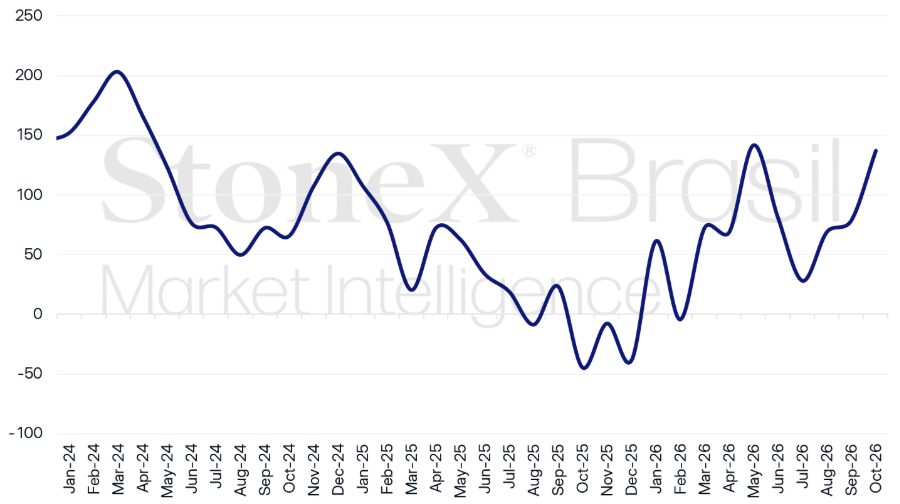

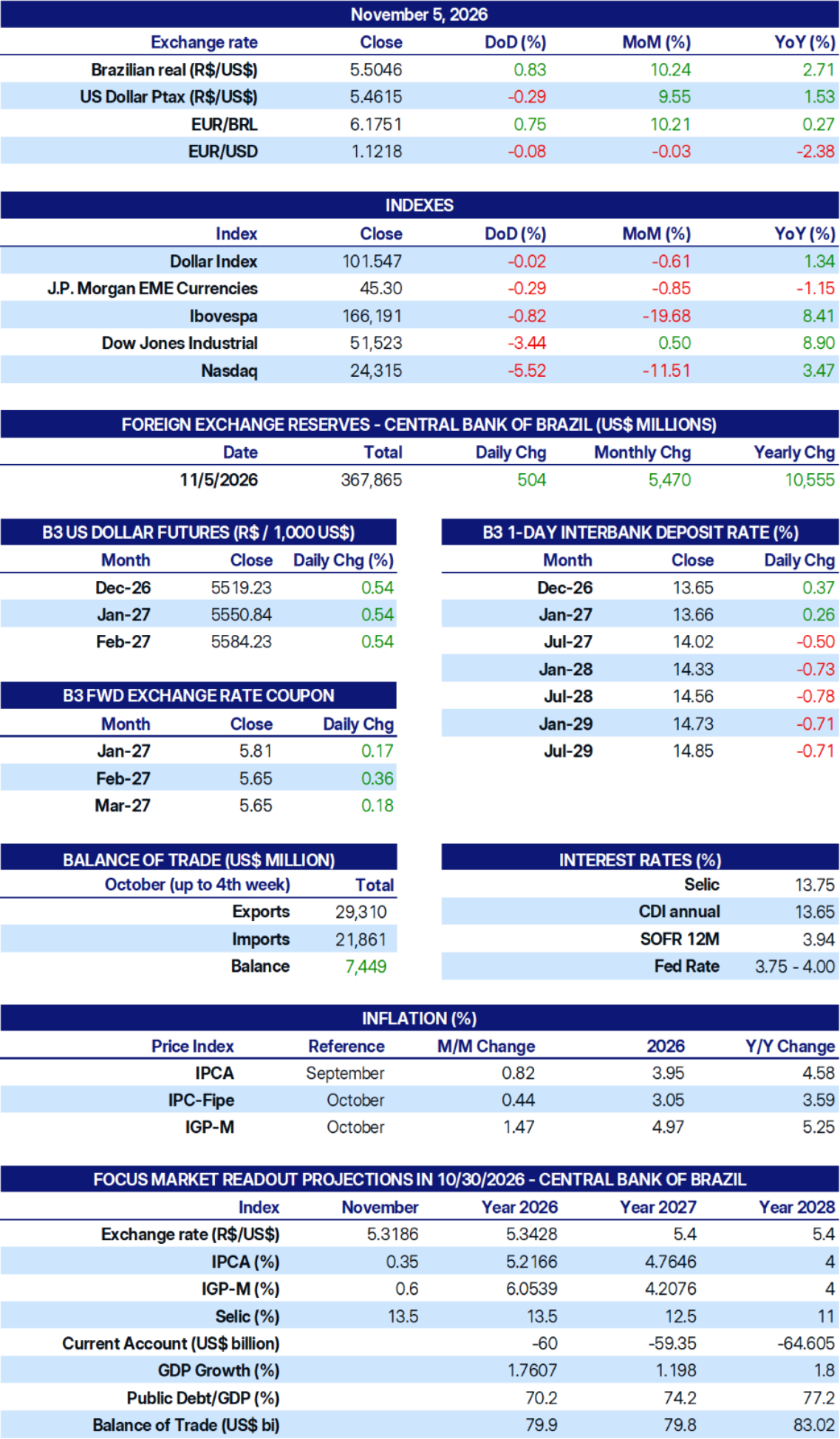
INDICATORS
The StoneX Group Inc. group of companies provides financial services worldwide through its subsidiaries, including physical commodities, securities, exchange-traded and over-the-counter derivatives, risk management, global payments and foreign exchange products in accordance with applicable law in the jurisdictions where services are provided. References to over-the-counter (“OTC”) products or swaps are made on behalf of StoneX Markets LLC (“SXM”), a member of the National Futures Association (“NFA”) and provisionally registered with the U.S. Commodity Futures Trading Commission (“CFTC”) as a swap dealer. SXM’s products are designed only for individuals or firms who qualify under CFTC rules as an ‘Eligible Contract Participant’ (“ECP”) and who have been accepted as customers of SXM. StoneX Financial Inc. (“SFI”) is a member of FINRA/NFA/SIPC and registered with the MSRB. SFI is registered with the U.S. Securities and Exchange Commission (“SEC”) as a Broker-Dealer and with the CFTC as a Futures Commission Merchant and Commodity Trading Adviser. References to securities trading are made on behalf of the BD Division of SFI and are intended only for an audience of institutional clients as defined by FINRA Rule 4512(c). References to exchange-traded futures and options are made on behalf of the FCM Division of SFI . StoneX is a trading name of StoneX Financial Ltd (“SFL”). SFL is registered in England and Wales, Company No. 5616586. SFL is authorized and regulated by the Financial Conduct Authority [FRN 446717] to provide to professional and eligible customers including: arrangement, execution and, where required, clearing derivative transactions in exchange traded futures and options. SFL is also authorised to engage in the arrangement and execution of transactions in certain OTC products, certain securities trading, precious metals trading and payment services to eligible customers. SFL is authorised & regulated by the Financial Conduct Authority under the Payment Services Regulations 2017 for the provision of payment services. SFL is a category 1 ring-dealing member of the London Metal Exchange. In addition SFL also engages in other physically delivered commodities business and other general business activities which are unregulated and not required to be authorised by the Financial Conduct Authority. StoneX Group Inc. acts as agent for SFL in New York with respect to its payments services business. StoneX APAC Pte. Ltd. acts as agent for SFL in Singapore with respect to its payments services business. ‘StoneX’ is the trade name used by StoneX Group Inc. and all its associated entities and subsidiaries.
Trading swaps and over-the-counter derivatives, exchange-traded derivatives and options and securities involves substantial risk and is not suitable for all investors. Past performance of any futures or option is not indicative of future success. Indicators are not a trading system and are not published as a specific trade recommendation. The information herein is not a recommendation to trade nor investment research or an offer to buy or sell any derivative or security. It does not take into account your particular investment objectives, financial situation or needs and does not create a binding obligation on any of the StoneX group of companies to enter into any transaction with you. You are advised to perform an independent investigation of any transaction to determine whether any transaction is suitable for you. No part of this material may be copied, photocopied or duplicated in any form by any means or redistributed without the prior written consent of StoneX Group Inc.
© 2026 StoneX Group Inc. All Rights Reserved.
Our subscribers have access to comprehensive market analysis from StoneX spanning commodities, equities, currencies and more.
Dollar expected to reflect Copom minutes, US inflation data, and concerns about national economic policy

Payrolls and CPI arrive back to back, giving the U.S. dollar index a two-step test of Federal Reserve rate hike expectations. Labor data sets the first read, and the inflation update tests how well that read holds.


Eurozone headline inflation is climbing while core inflation holds steady, keeping concern about rising prices alive. Yet the euro is recovering against the dollar mainly because the U.S. dollar is weakening, not because of the inflation data.
Our market expertise, advanced platforms, global reach, culture of full transparency and commitment to our clients’ success all set us apart in the financial marketplace.
Reach
With access to 40+ derivatives exchanges, 180+ foreign exchange markets, nearly every global securities marketplace and numerous bilateral liquidity venues, StoneX’s digital network and deep relationships can take clients anywhere they want to go.
Transparency
As a publicly traded company meeting the highest standards of regulatory compliance in the markets we serve, our financials and track record are matters of public record. StoneX’s commitment to “doing the right thing over the easy thing” sets us apart in the industry and helps us build respect, client trust and new partnerships.
Expertise
From our proprietary Market Intelligence platform to “boots-on-the-ground” expertise from award-winning traders and professionals, we connect our clients directly to actionable insights they can use to make more informed decisions and achieve their goals in the global markets.