Dollar to reflect pessimism over Brazil's fiscal outlook, PCE, and IPCA-15
- Bullish
- Deep investor pessimism and skepticism regarding the fiscal scenario in Lula's new government is likely to increase the perception of fiscal risks for Brazilian assets, weakening the BRL.
- October's PCE reading is expected to reinforce the perception of a risk balance tilted towards inflation in the United States, increasing bets on Federal Reserve rate hikes in the coming months and strengthening the USD globally.
- The November IPCA-15 slowdown could reduce bets on a resumption of hikes to the basic interest rate (Selic), lowering the yield of domestic securities and weakening the BRL.
- Bearish
- No predominantly bearish factors have been identified for the exchange rate this week. However, it is important to consider that the exchange rate is historically volatile, and a drop remains possible, either due to frustration over bullish assumptions or unexpected events.
The week in review
- The deep investor pessimism and skepticism regarding the economic policies of Lula's new government resulted in a strong depreciation of the BRL for the fourth consecutive week.
- The Senate approved the government's fiscal package aimed at adjusting public accounts. However, investors considered the measures timid and insufficient for a sustained improvement in the fiscal outlook.
- The Federal Reserve's interest rate decision minutes indicated concern over the inflationary scenario in the US, consolidating bets on additional rate hikes in the coming months, strengthening the USD globally.
USDBRL and Dollar Index (points)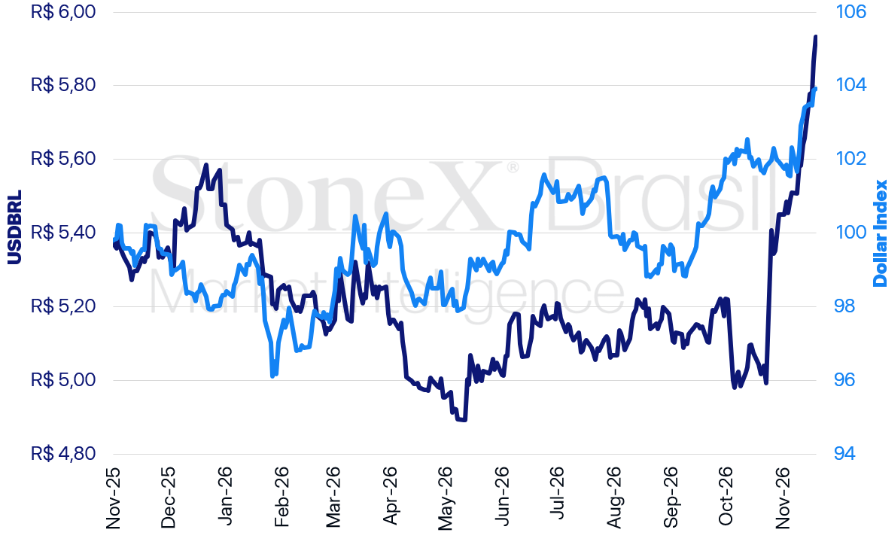
Source: StoneX cmdtyView. Design: StoneX.
USDBRL variations | Daily: +1.15% | Weekly: +4.90% | Monthly: +8.86% | Annual: +8.33% | Over 12 months: +11.18%
Dollar Index variations | Daily: +0.03% | Weekly: +0.49% | Monthly: +1.94% | Annual: +5.69% | Over 12 months: +3.68%
KEY EVENT: Confidence crisis regarding Brazilian economic policies
Expected impact on the USDBRL: bullish
The foreign exchange market is expected to reflect deep investor pessimism and skepticism over the management of economic policies in Luiz Inácio Lula da Silva's upcoming government, anticipating a worsening of Brazil's macroeconomic scenario.
- As a result, the BRL has accumulated an 18.8% depreciation since the last trading session before the second round of elections.
Why this matters: Pessimism and skepticism regarding the fiscal outlook of the next government are likely to increase the perception of fiscal risks for national assets and raise the demand for risk premiums from investors, making it harder to attract foreign resources to Brazil and weakening the Brazilian real.
Government gestures: In recent weeks, Planalto Palace has sought to allay investor concerns about Brazil's fiscal trajectory through a national address by Lula reaffirming his commitment to fiscal responsibility and presenting fiscal adjustment proposals to Congress.
- Last week, the Federal Senate approved Complementary Bill (PLP) 299/26, which outlines measures to achieve savings between BRL 45 billion and BRL 56 billion in the 2027 budget.
- Measures in the bill include creating a mechanism to curb expenses, managing the budget through the fiscal framework's center of the target, a linear reduction of 20% in tax benefits granted by the government, instruments to reduce expenses in areas without constitutional ties, and limiting transfers to states and municipalities.
- The House of Representatives has scheduled an extraordinary session for this Monday (23) to consider the proposal.
- Finance Minister Dario Durigan stated that the PLP represents “the first step” of broader fiscal adjustments by the government.
- In addition, media reports suggest the government is preparing new legislative measures to further expand fiscal adjustments, such as a Constitutional Amendment Proposal (PEC) to reduce expenses currently excluded from the fiscal target and expand the curbing of some mandatory expenditures.
Investor indifference: However, the government's gestures have been ignored by financial market operators, who display deep distrust regarding the fiscal and monetary policy management of the next government.
- Investors interpreted the measures presented to Congress as timid and insufficient for a sustained improvement in Brazil's fiscal trajectory.
- Therefore, they concluded there is little willingness from the government to present more profound proposals to adjust public expenditures, exacerbating pessimism about the country's macroeconomic evolution.
Period of uncertainties: Although there is significant pressure on national asset prices, Lula still needs to define the composition of his next economic team before advancing new proposals for fiscal policy.
- Therefore, it is likely that uncertainty over the government composition or fiscal priorities will maintain investor pessimism and prolong the BRL's depreciation.
Central Bank interventions: Last week's sharp deterioration in Brazilian assets led the Central Bank to conduct two interventions in the foreign exchange market of USD 1 billion each—a swap auction on Thursday and a spot dollar sale on Friday.
- However, these interventions were insufficient to contain the Brazilian currency's depreciation.
- If the adverse scenario persists next week, additional interventions by the monetary authority are possible.
US economic data
Expected impact on the USDBRL: bullish
Bets for the Federal Reserve’s rate decision on December 9
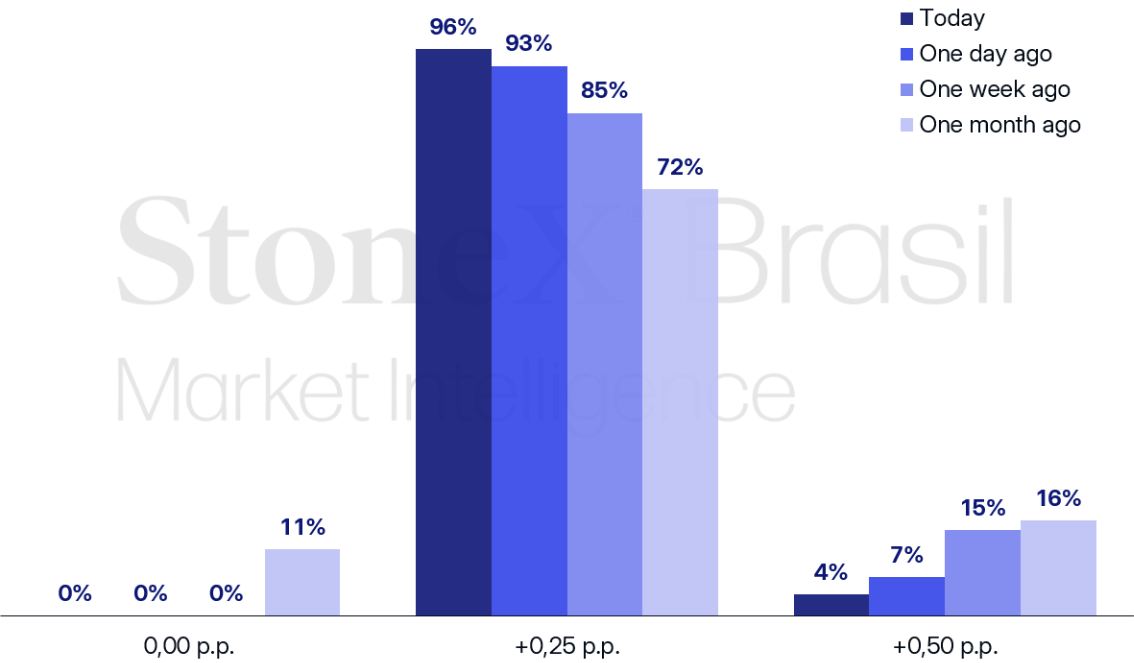
Source: CME FedWatch Tool. Design: StoneX. Futures market probabilities as of November 19, 2026.
Abroad, investors are likely to react to the release of the Personal Consumption Expenditures (PCE) Price Index for October and the second estimate for third-quarter Gross Domestic Product (GDP) in the United States, aiming to calibrate expectations for the trajectory of US interest rates.
- The PCE is the official metric used by the Federal Reserve (Fed) to monitor consumer inflation.
- However, the index is often anticipated by analysts who already have access to Consumer Price Index (CPI) and Producer Price Index (PPI) data for the month.
Why this matters: Economic data should reinforce the perception of a risk balance skewed towards inflation in the US, increasing bets on Federal Reserve rate hikes in the coming months.
- This, in turn, tends to raise the yield on US Treasury securities and attract foreign capital to the country, strengthening the USD globally.
Estimates: Median estimates for the PCE point to a slowdown from 0.5% in September to 0.3% in October, while the core indicator, which excludes volatile components like food and energy, would repeat a 0.3% increase during the period.
- If confirmed, this reading would increase the 12-month cumulative rise from 3.6% in September to 3.8% in October, and from 3.1% to 3.2% for its core during the same period.
- The result would reinforce the perception of more persistent and widespread inflationary pressure, as observed in October's Consumer Price Index (CPI), which indicated price acceleration in categories like food, housing, fuel, and electronics.
- The second reading of third-quarter GDP is expected to remain at an annualized 3.4% growth rate, driven by personal consumption and business investment expansion.
More rate hikes ahead: Last week, minutes from the Federal Reserve’s latest rate decision revealed that “almost all” Fed members anticipated that US inflation would remain elevated and that further rate hikes would be necessary to restore price stability.
- Additionally, “some” members stated that a double rate hike (i.e., 0.50 p.a.) could be required if inflation continued to evolve unfavorably.
- The minutes reinforced the Federal Reserve's concern over the inflationary scenario, consolidating bets on additional rate hikes in the coming months.
November IPCA-15
Expected impact on the USDBRL: bullish
Lastly, investors may react to the release of November’s Broad Consumer Price Index 15 (IPCA-15), which is expected to show a slight deceleration compared to October.
Why this matters: The slowdown in IPCA-15 could alleviate investor concerns about Brazil’s inflationary scenario, which would reduce bets on a resumption of hikes to the basic interest rate (Selic).
- This, in turn, tends to lower the yield on domestic securities and hinder the attraction of foreign capital, weakening the BRL.
Relief in IPCA: In October, the IPCA fell more than anticipated, showing a 0.14% increase after a reading of 0.82% in September.
- The core inflation, which excludes volatile items like food and energy, rose only 0.08%, while service prices increased by just 0.15%, suggesting weaker inflationary pressures.
Challenging inflationary scenario: On the other hand, minutes from the latest interest rate decision by the Monetary Policy Committee (Copom) indicated a worsening of Brazil’s inflationary scenario, with acceleration in core inflation measures, divergence in inflation expectations, and simultaneous supply shocks elevating inflationary risks.

INDICATORS
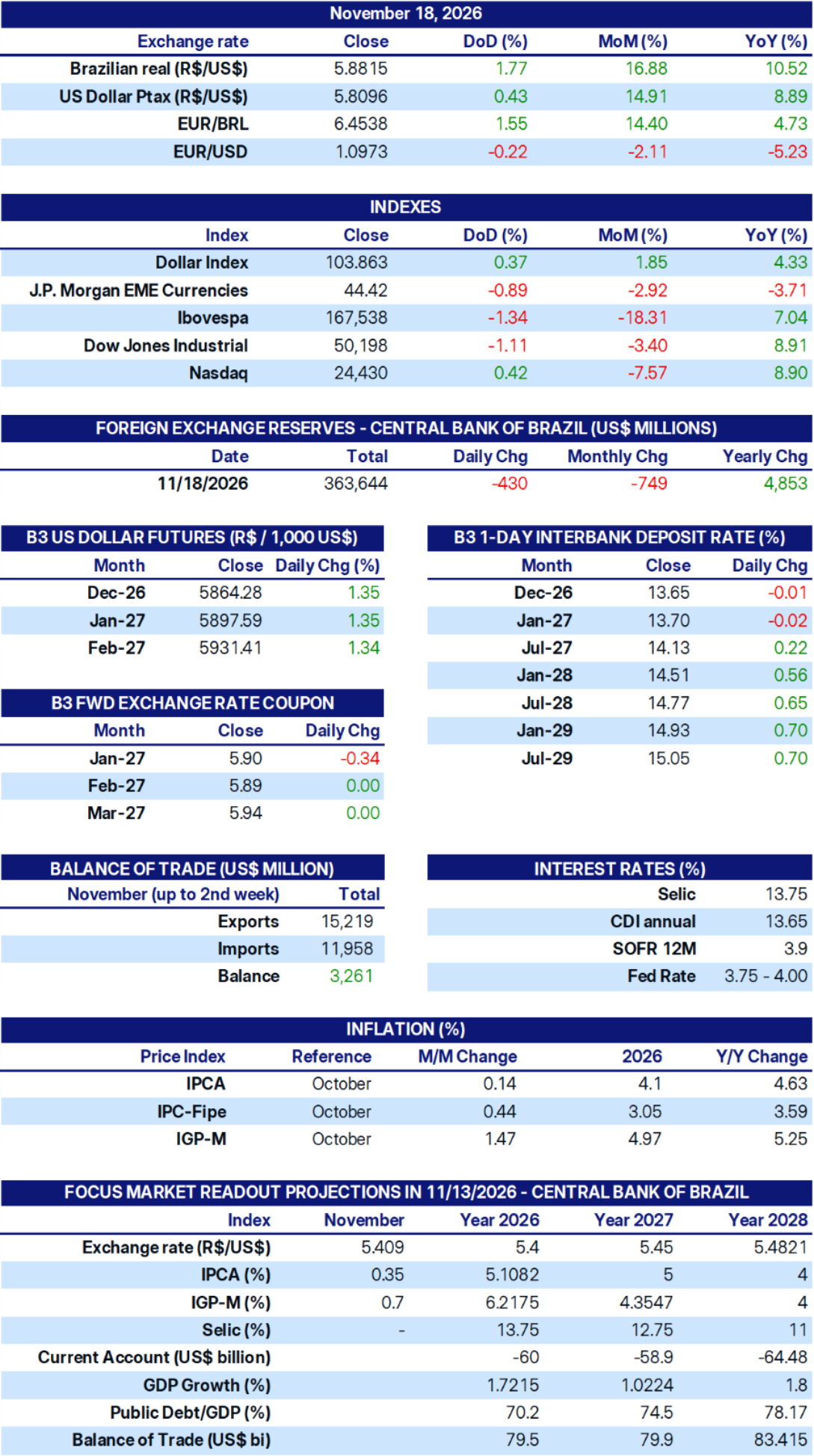
Sources: Central Bank of Brazil; B3; IBGE; Fipe; FGV; MDIC; IPEA and StoneX cmdtyView.