With the 2022/23 crop almost finished, attention is turning to the 2023 crop development, which, under adequate weather conditions, should reflect the recovery of the crops that suffered from frost and adverse weather in 2021. Considering that part of the crops impacted by the weather phenomena was pruned or renewed, there is an expectation that the production in 2023 could be large or even exceed the volume harvested in 2020. Of course, it is still too early to estimate the 2023/24 crop, and making it clear that this is NOT a StoneX estimate, there have been rumors of participants projecting a crop of 70 million bags or higher.
But before these expectations become a reality, Brazilian coffee crops still need to go through flowering, a crucial stage that could define the potential for 2023. Whatever the problem is at this stage, Brazilian production would be compromised, as was seen in the previous two years.
The success of coffee flowering depends on the uniformity of rainfall
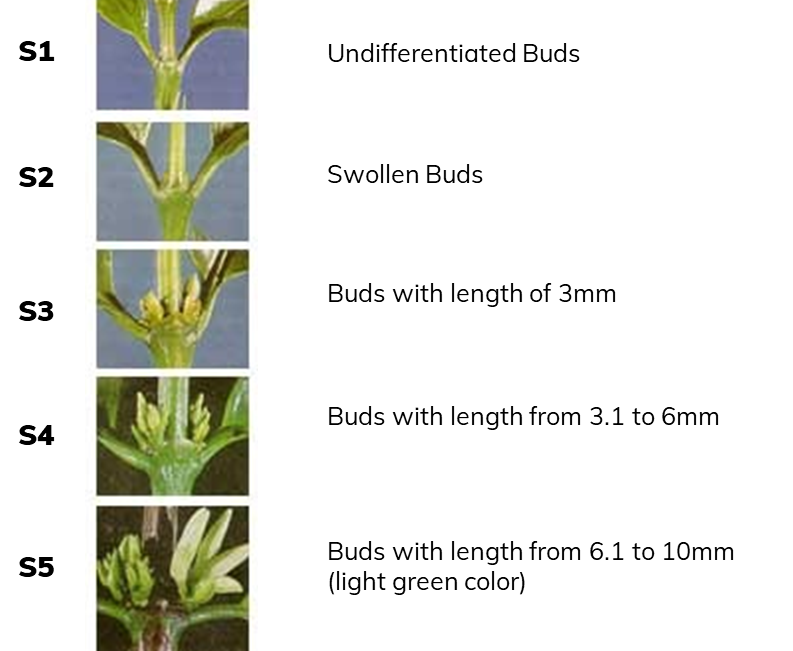
Before analyzing the flowering scenario in Brazil, it is important to remember the process stages. For this report, we will focus only on the development and opening of flowers from the biennial cycle of the coffee plant. The growth of the floral bud intensifies from February to August, when the day length begins to decrease, reaching less than 13 hours of adequate sunlight. The flowering process can be separated into four distinct stages, with a certain degree of overlap between them: (stage 1) flower bud initiation; (stage 2) flower bud differentiation and development; (stage 3) flower bud dormancy; and (stage 4 and 5) flower opening.
Coffee floral bud development stages
Source: Camayo&Arcila, 1996. Design: StoneX
Coffee floral buds go from stage 1 to stage 3 between February and August when dormancy begins. While in dormancy, floral buds are less susceptible to damage from drought and high temperatures. The flower-opening stage begins when the plant faces an increase in soil water potential, which is basically the availability of water in the soil (it will occur after rainfall or irrigation). Still, the buds will remain dormant if the weather is dry. Once the flower buds begin their opening process, after an initial increase in soil moisture potential, it cannot be stopped, and the flower will open. Once open, coffee flowers become very susceptible to damage from drought and high temperatures.
La Niña maintenance may replicate the flowering scenario of the last two years
First of all, we need to understand that we are dealing with the weather, one of the most unpredictable factors that can affect coffee. Even the weather forecast models have a high level of uncertainty. Weather forecasts that are longer than 48 hours are considered long-term forecasts and have a high degree of uncertainty.
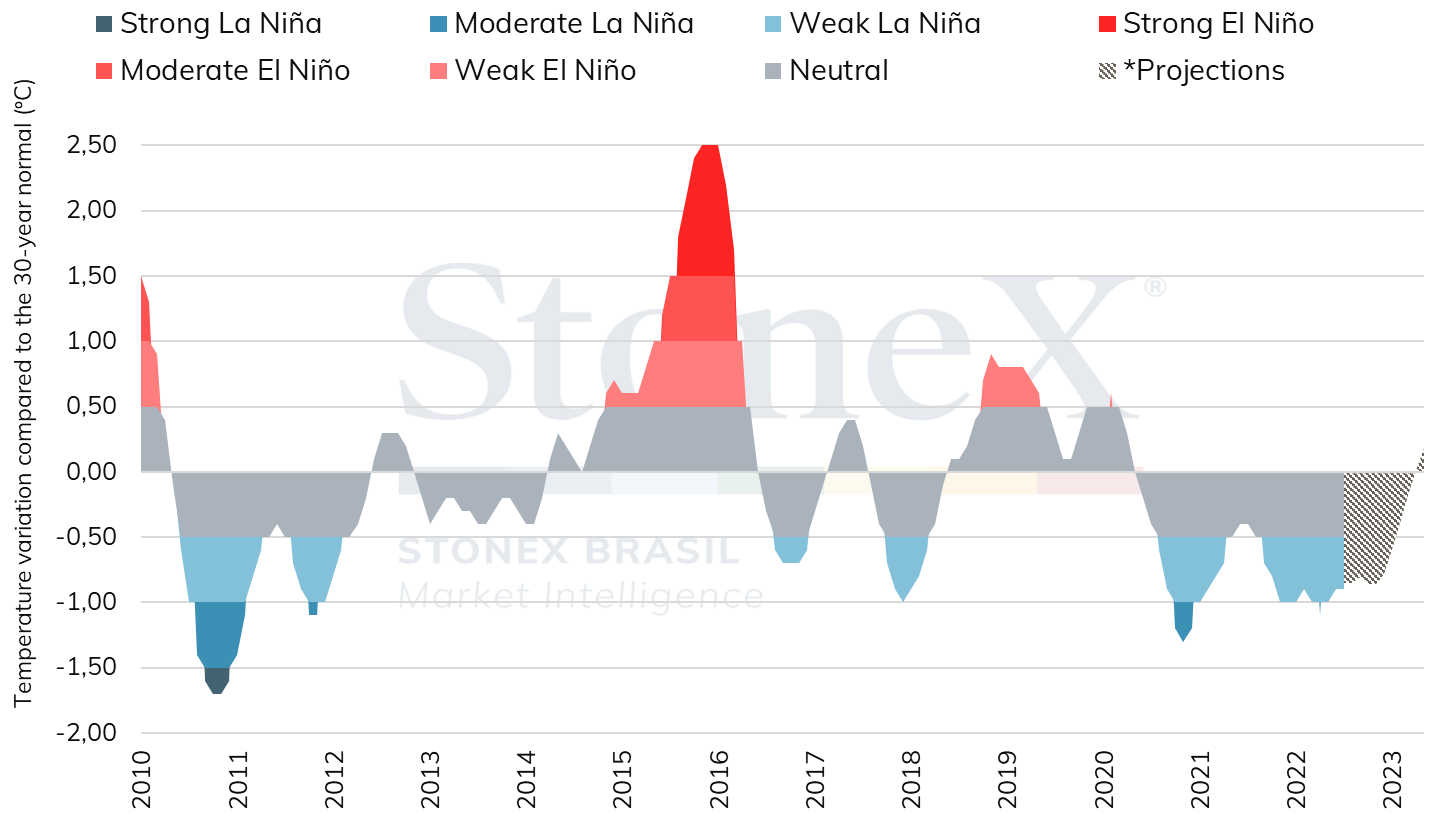
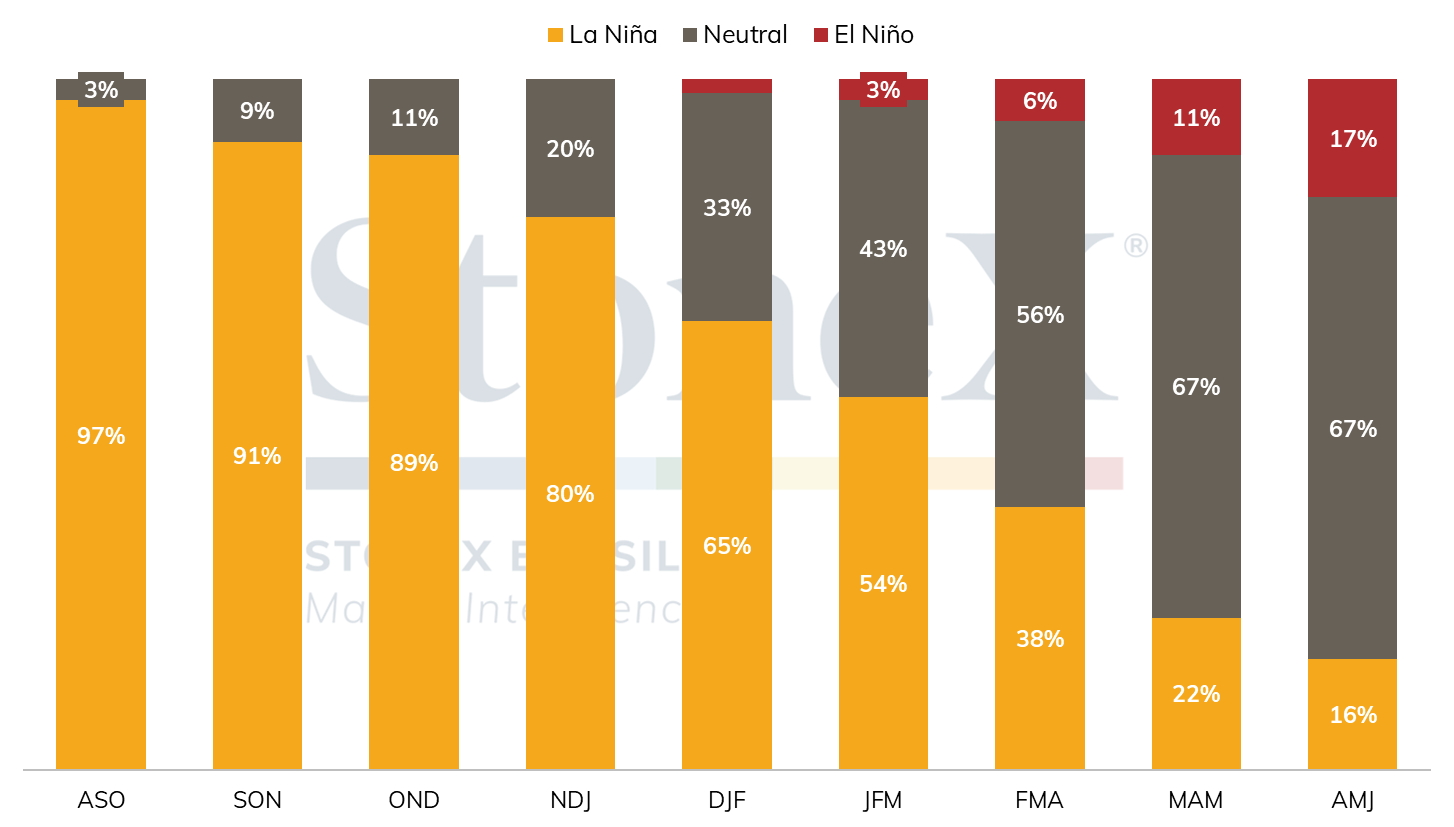
In 2022, similarly to the last two years, the Pacific conditions favor the La Niña phenomenon and the probability forecasts projections of NOAA (US National Oceanic and Atmospheric Administration), the US weather agency, indicate that the phenomenon should persist throughout the second half of the year, with a probability above 90% for the SON quarter (September, October and November) and probability above 80% until the NDJ quarter (November, December and January).
El Niño/La Niña Probability Forecast
Source: IRI/CPC/NOAA. Design: StoneX.
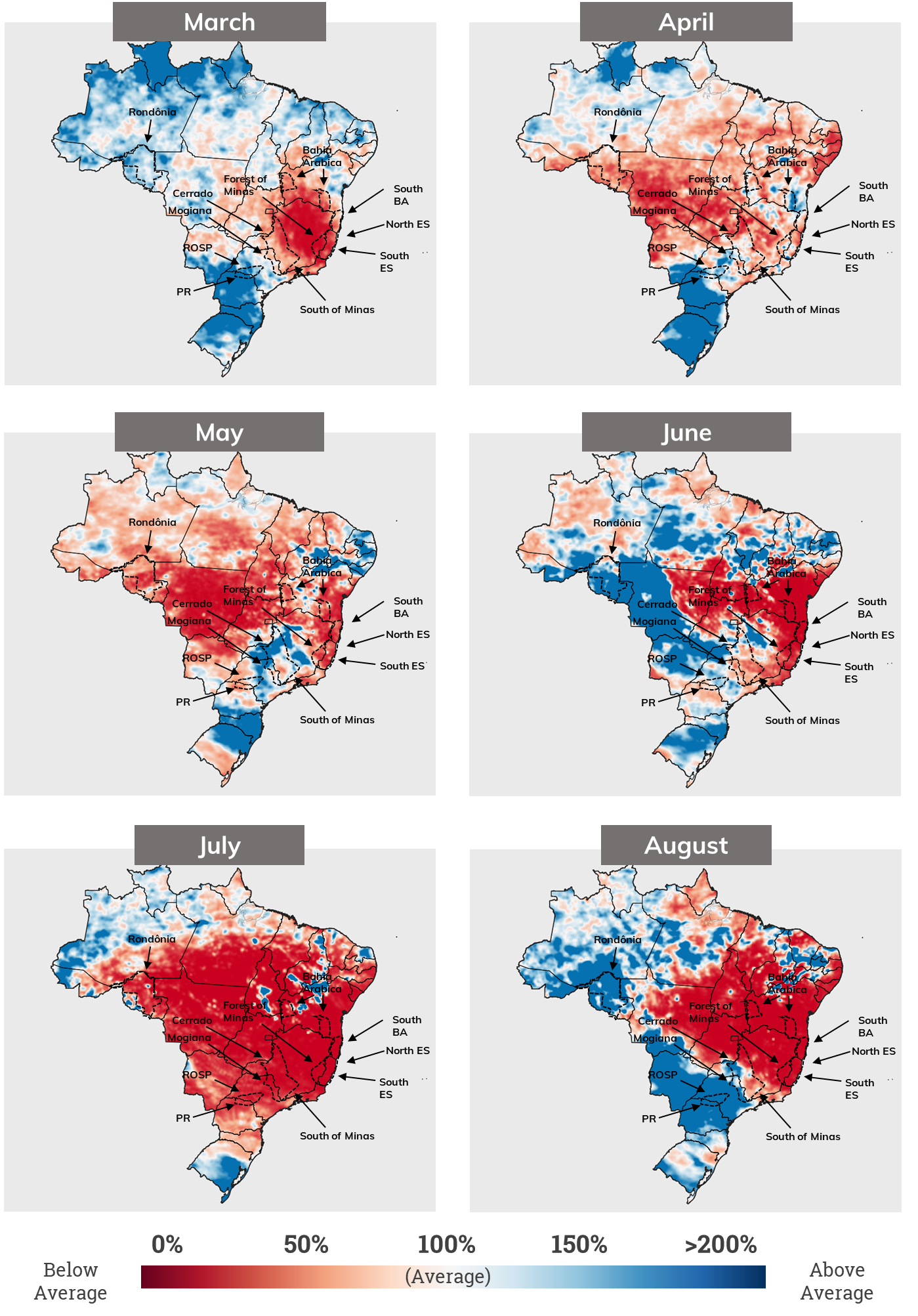
Although some coffee crops in 2022 are recovering from the 2021 weather, they faced some months of unfavorable weather in 2022. According to the rainfall anomaly maps, which compare the observed volume with the historical average for the region, February and May had above-average rainfall volumes in much of the belt. However, in the remaining months - March, April, June, July, and August - most of the coffee belt saw volumes well below the historical average. In mid-August, some municipalities in the southern region of Minas received up to 36 mm, which resulted in the start of a small flowering, but the main flowering is still to come.
Precipitation in 2022 compared to the average of the last 20 years in Brazil