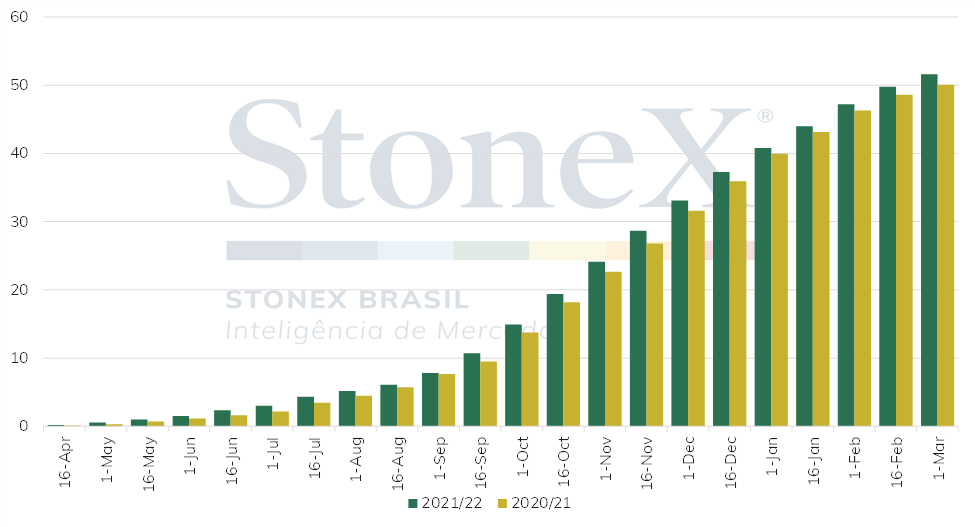
Source: MAPA Design: StoneX.
This result follows the occurrence of regular rainfall during the vegetative development period of sugarcane fields. Between January and September 2021, for example, sugarcane areas in NNE Brazil received 829.7 mm, in line with normal climatological conditions.
However, higher moisture has also pressured the crops’ average TRS, which is 124.8 kg/t, representing a 4.6% decrease in the crop-over-crop comparison. With lower sugar concentration in the cane and a sugar-directed mix of 45.3%, sugar production amounts to just under 2.8 million tonnes (-3.6%). In parallel, ethanol distillation stands at 2.1 million m³, with anhydrous supply taking a leading role and rising 7.4% YoY.
Specifically, this performance is due to the good pace of field work in Alagoas, with accumulated crushing of about 17.0 million tonnes so far (+8.9% in the annual comparison). A similar result is observed in Pernambuco, a state where sugarcane processing is at a 4.3% higher rate than in 2020/21.
However, the productive potential of the sugarcane fields in Paraíba remains a point of attention, since this region was impacted by the lack of rainfall in recent months. In the first two months of 2022, for example, the main sugarcane areas of the state received 229.7 mm, a volume that represents a 47% decrease in relation to normal. In light of this, soil moisture is at critical levels, according to USDA reports, which may also harm the average yield of the next cycle.
Based on this, weather forecasts for the coming months will be key to draw perspectives for the 2022/23 season in the NNE. According to data from the National Meteorological Institute (INMET), moisture on the main producing states of the region should be about 10 to 100 mm above normal between April and June 2022. If this happens, the situation may benefit development of the sugarcane fields that will be processed from September of this year.