Grain Markets: Tight Supplies, Trade Tensions & Weather Risks Are Raising the Stakes
Key Takeaways
- Tight Global Supplies: Major corn and wheat exporters outside the U.S. are running lean, leaving less room for supply shocks
- Brazil’s Soybean Advantage: A strong Brazilian harvest and currency advantage continue to shift Chinese demand away from U.S. soybeans, reinforcing a longer-term trend
- Market Risks Are Stacking Up: Inflation-driven speculation, weather uncertainties, and shifting trade policies under the Trump administration all add to market volatility
Stay in the loop. Get on the list for Arlan Suderman’s monthly Global Commodities Market Outlook and receive advance notification for every webinar. Register here.
The global grain market may not be in crisis yet, but the cracks are showing. Corn and wheat exporters outside the U.S. are running tight on supplies, leaving less room for error.
During his February Market Outlook, StoneX Chief Commodities Economist Arlan Suderman told listeners the market is stable, at least for now. Suderman sees no need to ration demand with higher prices currently, but he cautions that could change in the weeks or months ahead. Weather, politics, and demand shifts could all throw the grain markets a curveball, and if that happens, the delicate balance may not hold for long. The real question: Is the market ready for what comes next?
Brazil’s Soybean Surge is Weighing on U.S. Exports
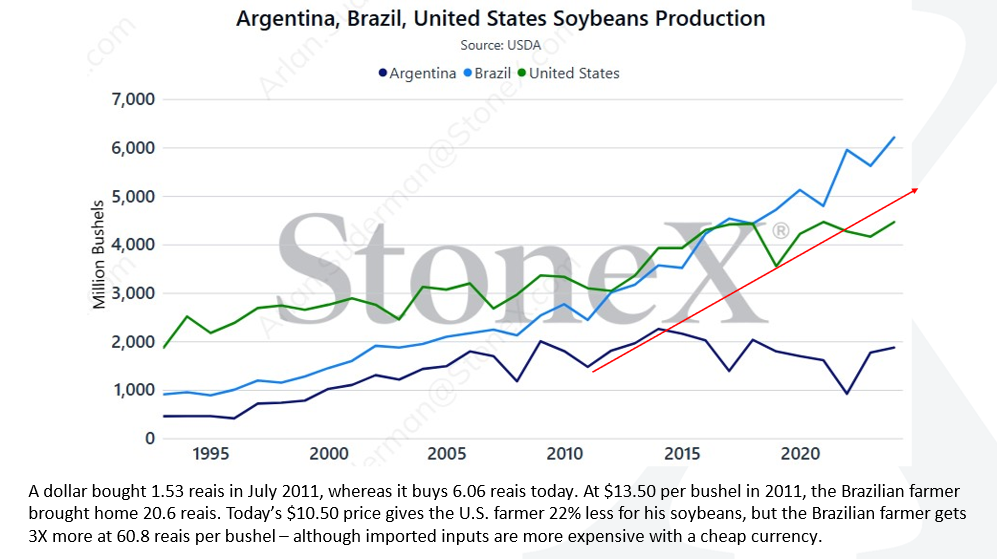
While Brazil churns out a massive soybean crop, China is scooping up supply at a discount. That currency advantage makes Brazilian beans cheaper, and makes life harder for U.S. exporters.
U.S. soybean exports tell the story, having started strong this marketing year, but momentum has slowed. Suderman doesn’t think that is a short-term blip, but rather part of a longer trend.
“The U.S. is losing ground. China’s shifting more of its buying to Brazil, and unless something changes, that’s going to be the story for a while according to Suderman.”
Currency shifts don’t just impact exchange rates, they reshape global trade flows, as this comparison makes clear.
Source: StoneX.com, USDA
Re-Inflation and the Speculative Money Machine
And while inflation has been a tailwind for commodities, the trade has become more crowded of late. Managed money has stacked up long positions in a clear bet on rising prices. But if macro conditions shift – if the Fed signals more rate hikes or if economic data softens – those bets could unwind fast.
“We’ve seen this before,” Suderman says. “Funds pile in, and when sentiment shifts, the exits get crowded.”
With grain markets already showing signs of strain under non-commercial selling, if inflation expectations start cooling off, he believes we shouldn’t be surprised to see some fast moves lower.
2025 Growing Season: A Weather Market in the Making?
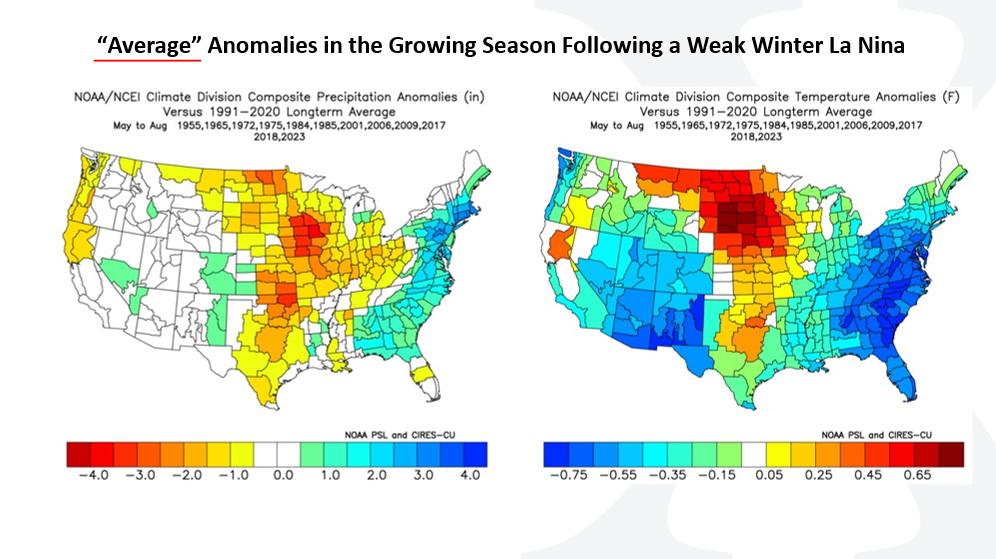
Weather models are hinting at a tricky growing season ahead, telegraphing that La Niña is still in play. That’s a real concern for farmers west of the Mississippi as historically, weak La Niña years bring heat and dryness.
“Six out of ten years with this setup have led to some level of production stress,” Suderman points out. “That’s not a guarantee, but it’s a risk the market can’t ignore.” Subsoil moisture levels are already low, and planting windows could be narrow. If the season gets off to a rough start, watch for supply risks to get priced in fast.
The historical trends are clear: weak La Niña years often bring challenges for farmers, and current models suggest 2025 could be no exception.
Source: StoneX.com, NOAA, NCEI
Trade, Tariffs, and Political Wild Cards
And it’s not just fundamentals moving the market. Headline risk is here to stay. The Trump administration is back, and trade policy uncertainty is climbing. Recent tariff moves on Mexico and Canada were put on hold, but that doesn’t mean they’re off the table. “Trump likes using tariffs as leverage,” Suderman says. “If trade negotiations stall, those 25% tariffs could come back fast.”
China is another question mark. Relations have cooled, and while a trade agreement is possible, it’s not a given. “Xi Jinping is playing the long game,” says Suderman. “He’s willing to make short-term compromises, but the bigger strategy hasn’t changed.”
The Bottom Line
Grain markets aren’t on fire, but the risks are stacking up.
- Supplies are getting tighter
- Speculative money is deep in the trade
- Weather could be a problem
- Political volatility is high
This isn’t a market for passive positioning. Traders and producers need to stay flexible, because the next shift could come fast. This article is based on insights shared during Arlan Suderman’s February 2025 Commodity and Economic Outlook webinar. Watch the full episode here .
Dive Deeper
Don’t miss Arlan’s monthly analysis and insights. Register today and receive advance notification before the next Commodity and Economic Outlook webinar.
Register Here
---Written by: Andrew Catsimanes
---Expert: Arlan Suderman, StoneX Chief Commodities Economist