StoneX logo

Featured | Indonesia bans palm oil exports, further supporting prices

By: StoneX Intelligence Brazil, StoneX Intelligence Brazil

Indonesia bans palm oil exports, further supporting prices
 
Luigi Bezzon
 
Ana Luiza Lodi
analuiza.lodi@stonex.com
  
THE COUNTRY MAY NOT BE ABLE TO MAINTAIN THE MEASURE FOR LONG, AMID THE IMPORTANCE OF THE SECTOR TO THE ECONOMY

In an already delicate market context, after the disruption caused by the war in Ukraine and prices exploring historical highs, the global vegetable oil market was caught by surprise when Indonesia announced it would ban palm oil exports "until domestic prices ease." On Monday, April 25, however, Indonesian government officials brought some relief to the news by stating that the ban on shipments would fall only on refined palm oil, which even brought down prices on Bursa at the time, in light of the breach in expectations. Over last week, however, rumors pointed to all varieties of palm oil, including crude, also being included in the list of retained products - which was finally confirmed on Wednesday afternoon, April 27, leading oil futures prices on Bursa to jump 10% on the day, touching the up limit. 

Indonesia is a protagonist in the global vegetable oil market and by far the largest exporter of palm oil, the most consumed oil globally. The USDA estimates that the country's palm oil exports will reach 28 million tonnes in the 2021/22 cycle. This volume represents more than half of the domestic production and 56% of global palm oil exports. By way of comparison, the estimated export of Malaysia, the second-largest producer and exporter, stands at 16.2 million tonnes. In contrast, Argentina, the largest exporter of soybean oil, would export 5.9 million tonnes.

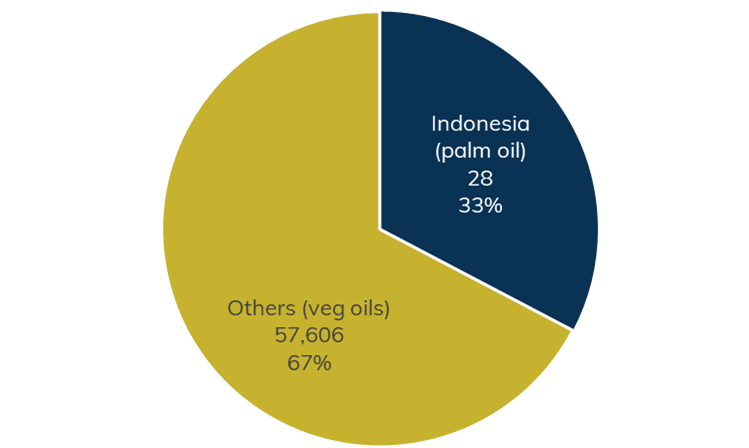
Considering the export of all vegetable oils, according to the USDA, the estimated 28 million tonnes of palm oil from Indonesia would represent 33% of the total.

World exports of vegetable oils and share of Indonesian palm oil - 2021/22 (MMT and share)
image 36194
Source: USDA. Design: StoneX. 
 

The disruption of palm oil supplies from Indonesia comes on top of a shortage of sunflower oil stemming from reduced Ukrainian and Russian exports following the outbreak of war in late February. Sunflower oil is the 4th most consumed oil globally, behind palm, soybean, and canola, and Russia and Ukraine account for about 60% of its global supply. In this sense, the oil complex, which was already going through a moment of tight availability driving prices up, surpassed the historical highs again in the last few days in the main negotiation centers. 

Given its greatness in the market, there is no possible substitute for Indonesia's palm exports in the short term. Malaysia, which already has historically low stocks, will not be able to suddenly increase its production and exports and fill the vacuum left by its neighbor. However, even if there is no official date for exports to resume in Indonesia, the ban is unlikely to last for many days. The sector's absence of foreign revenue will be quickly felt, which should pressure the government to resume shipping to the foreign market.

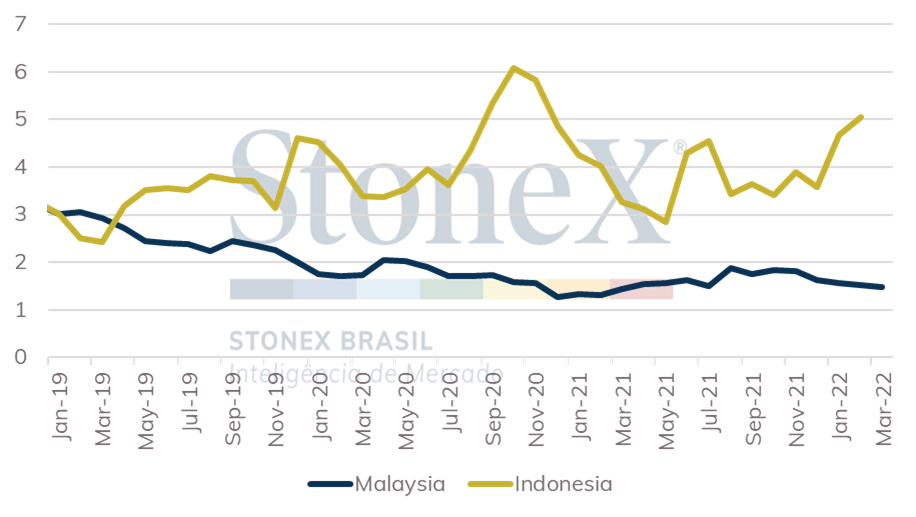
In addition, the monthly export volume of palm oil in Indonesia is twice as high as the domestic consumption, and the retention of this volume should generate overcrowding of stocks in a few days. 

Indonesia's processing industry is not prepared to store all the volume produced domestically. Currently, there are around 5 million tonnes of oil in stock, and the storage capacity of the country's industries is between 6 and 7 million tonnes, according to local sources.

Palm oil stocks at the end of the month in Indonesia and Malaysia (MMT)

image 36195
Sources: MPOB and GAPKI. Design: StoneX.

As a result of this probable pressure on stocks, two probable outcomes emerge: either export will resume in the coming days; or the domestic production will have to be significantly reduced, impacting producers, who will see their products deteriorating inside the gate - besides generating financial problems among small and medium producers, mainly. According to the country's President, the policy will be reviewed monthly, but analysts already expect that there will be a relaxation of shipments in about three weeks.

Also, next week, the Eid al-Fitr festival in Indonesia and Malaysia will occur, which usually increases the consumption of vegetable oils in the region. Therefore, it is believed that part of the political motivation to cease shipments was to maintain sufficient supply in Indonesia during peak consumption and replenish stocks. 

  • Grains & Oilseeds

The StoneX Group Inc. group of companies provides financial services worldwide through its subsidiaries, including physical commodities, securities, exchange-traded and over-the-counter derivatives, risk management, global payments and foreign exchange products in accordance with applicable law in the jurisdictions where services are provided. References to over-the-counter (“OTC”) products or swaps are made on behalf of StoneX Markets LLC (“SXM”), a member of the National Futures Association (“NFA”) and provisionally registered with the U.S. Commodity Futures Trading Commission (“CFTC”) as a swap dealer. SXM’s products are designed only for individuals or firms who qualify under CFTC rules as an ‘Eligible Contract Participant’ (“ECP”) and who have been accepted as customers of SXM. StoneX Financial Inc. (“SFI”) is a member of FINRA/NFA/SIPC and registered with the MSRB. SFI is registered with the U.S. Securities and Exchange Commission (“SEC”) as a Broker-Dealer and with the CFTC as a Futures Commission Merchant and Commodity Trading Adviser. References to securities trading are made on behalf of the BD Division of SFI and are intended only for an audience of institutional clients as defined by FINRA Rule 4512(c). References to exchange-traded futures and options are made on behalf of the FCM Division of SFI . StoneX is a trading name of StoneX Financial Ltd (“SFL”). SFL is registered in England and Wales, Company No. 5616586. SFL is authorized and regulated by the Financial Conduct Authority [FRN 446717] to provide to professional and eligible customers including: arrangement, execution and, where required, clearing derivative transactions in exchange traded futures and options. SFL is also authorised to engage in the arrangement and execution of transactions in certain OTC products, certain securities trading, precious metals trading and payment services to eligible customers. SFL is authorised & regulated by the Financial Conduct Authority under the Payment Services Regulations 2017 for the provision of payment services. SFL is a category 1 ring-dealing member of the London Metal Exchange. In addition SFL also engages in other physically delivered commodities business and other general business activities which are unregulated and not required to be authorised by the Financial Conduct Authority. StoneX Group Inc. acts as agent for SFL in New York with respect to its payments services business. StoneX APAC Pte. Ltd. acts as agent for SFL in Singapore with respect to its payments services business. ‘StoneX’ is the trade name used by StoneX Group Inc. and all its associated entities and subsidiaries.
 
Trading swaps and over-the-counter derivatives, exchange-traded derivatives and options and securities involves substantial risk and is not suitable for all investors. Past performance of any futures or option is not indicative of future success. Indicators are not a trading system and are not published as a specific trade recommendation. The information herein is not a recommendation to trade nor investment research or an offer to buy or sell any derivative or security. It does not take into account your particular investment objectives, financial situation or needs and does not create a binding obligation on any of the StoneX group of companies to enter into any transaction with you. You are advised to perform an independent investigation of any transaction to determine whether any transaction is suitable for you. No part of this material may be copied, photocopied or duplicated in any form by any means or redistributed without the prior written consent of StoneX Group Inc.
 
© 2026 StoneX Group Inc. All Rights Reserved.

Satellite view of Earth at night showing illuminated cities across Asia and the Middle East

Discover more insights

Our subscribers have access to comprehensive market analysis from StoneX spanning commodities, equities, currencies and more.

Related articles for Grains & Oilseeds

Perspective: Morning Commentary for August 14

August 14 – The S&P is on the cusp of new highs again this morning following another relatively quiet night in stock futures. This week’s inflation data was a non-event for the markets, as it came in at to modestly below expectations, leaving this morning’s retail sales numbers to finish out the week. Those numbers came in softer than expected, leading to lower Treasury yields and increased hopes that the Federal Reserve will back off its rate hike ideas, which supported stock futures. The VIX continues to trade near 14, which is near 2026 lows. The dollar index is trading near 99.6. Yields on 10-year Treasuries are trading near 4.65%, while yields on 2-year Treasuries are trading near 4.13% as the yield curve continues to steepen. WTI crude oil is trading near $81 this morning, while Brent trades near $87 per barrel. The roller coaster continues in the grain and oilseed markets, with prices higher this morning on escalating tensions in the Russia – Ukraine war.

Arlan Suderman
Arlan Suderman
  • Grains & Oilseeds
  • Energy
  • Dairy
  • Renewable Fuels
  • Cocoa
  • Coffee
  • Cotton
  • Sugar
  • Meats & Livestock
  • Forest Products

What a Super El Niño Means for Food Inflation Over the Next Six Months

A strong super El Niño has started, but the crop damage that would lift food prices is still expected to land between September and December. Indian wheat area and Southeast Asian palm oil production sit at the front of the transmission chain, with Brazil the larger unresolved question.

Editorial Team
Editorial Team
  • Grains & Oilseeds

Russian Wheat's Logistics Crisis Is Turning into a Production Problem

Damage to Black Sea ports has stalled grain exports, but the more serious risk is now forming on the farm. Collapsed farmgate prices and a Russian fuel crisis have put part of the wheat harvest in question.

Editorial Team
Editorial Team
  • Grains & Oilseeds
StoneX: We open markets

Our market expertise, advanced platforms, global reach, culture of full transparency and commitment to our clients’ success all set us apart in the financial marketplace.

Reach

With access to 40+ derivatives exchanges, 180+ foreign exchange markets, nearly every global securities marketplace and numerous bi-lateral liquidity venues, StoneX’s digital network and deep relationships can take clients anywhere they want to go.

Transparency

As a publicly traded company meeting the highest standards of regulatory compliance in the markets we serve, our financials and record of accomplishment are matters of public record. StoneX’s commitment to “doing the right thing over the easy thing” sets us apart in the industry and helps us build respect, client trust and new partnerships.

Expertise

From our proprietary Market Intelligence platform, to “boots on the ground” expertise from award-winning traders and professionals, we connect our clients directly to actionable insights they can use to make more informed decisions and achieve their goals in the global markets.