
FX Weekly Overview (Brazil Issue)
Dollar to reflect US economic data, Central Bank minutes, inflation in Brazil, and the Middle East

Leonel Mattos
- Currencies
By: StoneX Intelligence Brazil, StoneX Intelligence Brazil


The monetary policy decision of the Federal Reserve may bring a more aggressive tone in the search for price stabilization in the United States and favor a strengthening of the USDBRL.
The risk of an unprecedented default on US sovereign debt increases risk aversion and decreases the appetite for risky assets, weakening the BRL.
The European Central Bank's monetary policy decision is expected to spell out that further interest rate readjustments will be needed in upcoming decisions to fight inflation in the eurozone despite signs of an economic slowdown, contributing to strengthening the euro.
Positive economic data for the United States may suggest a more intense economic slowdown and the possibility of an economic recession in the short term, favoring the end of the Fed's interest rate hike cycle and weakening the dollar.
Copom's monetary policy decision should maintain Brazil's wide interest rate differential compared to emerging and major economies, favoring the entry of financial investments and strengthening the BRL.
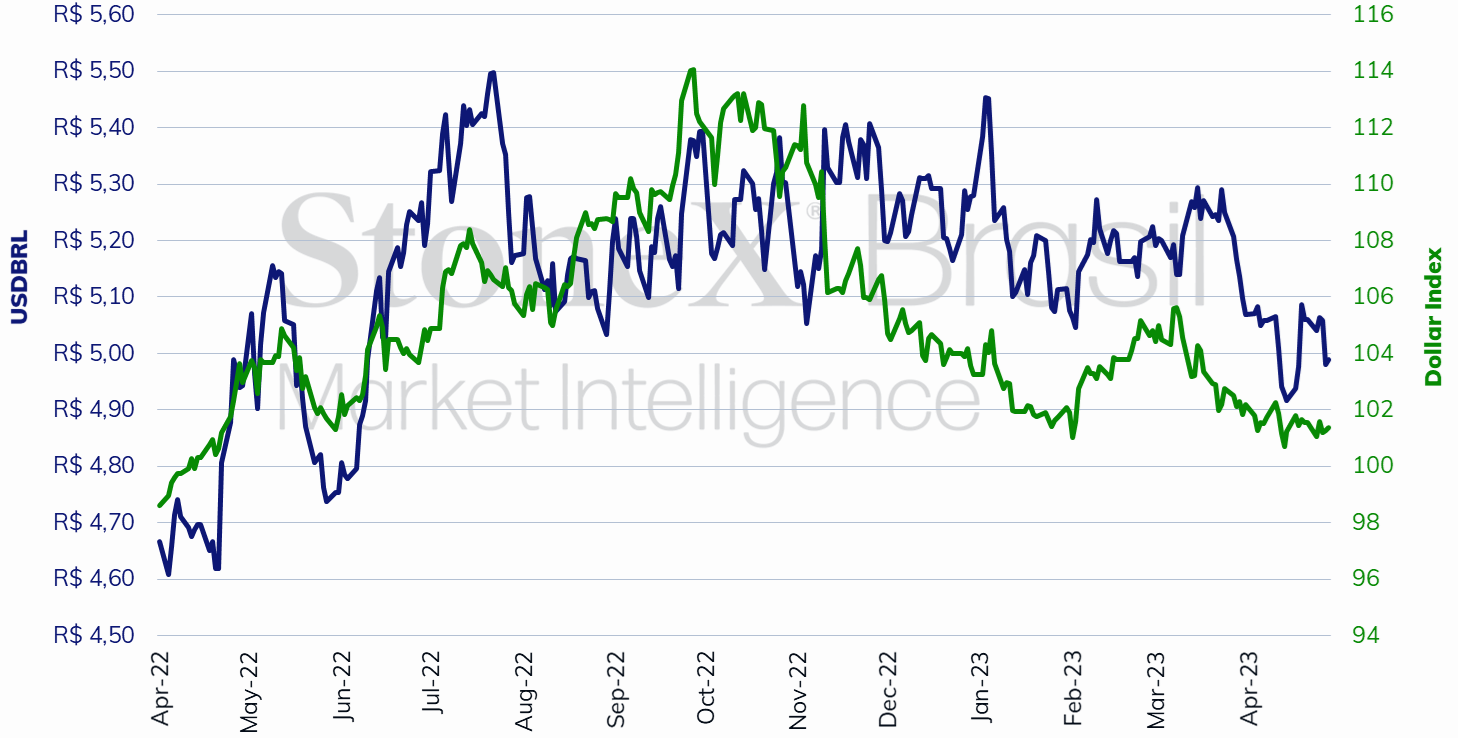
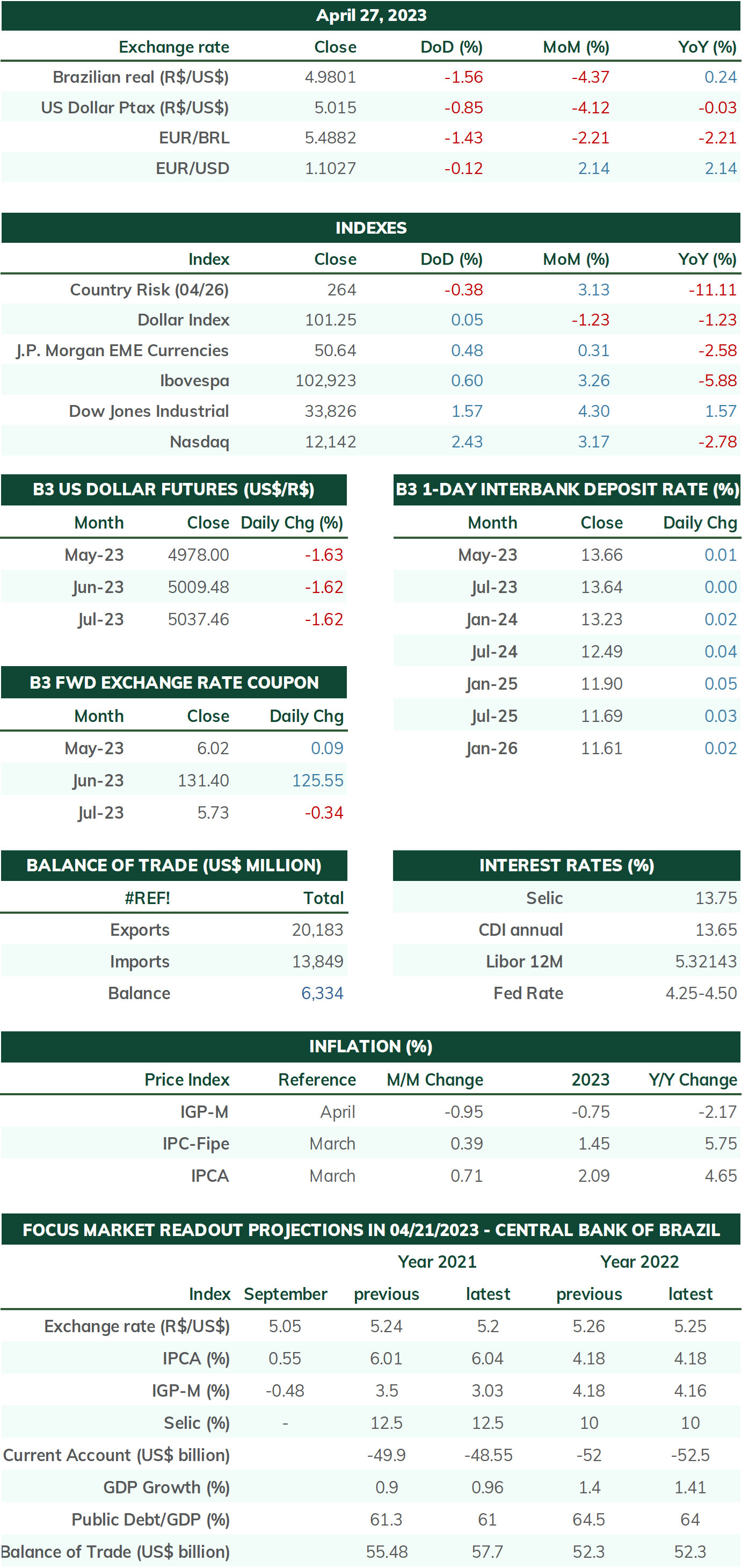
The USDBRL ended Friday's session (28) at BRL 4.989, a weekly decline of 1.4%, monthly of 1.6% and annual of 5.5%. The dollar index closed the session at 101.4 points, a change of -0.2% in the week, -0.8% in the month and 1.8% in the year. The week was marked by the broad weakening of the dollar amid the release of weaker-than-expected economic activity data for the United States. At the same time, investors in Brazil were optimistic with data suggestive of an inflationary moderation in the country and a unanimous decision of the Supreme Court that authorized the collection of federal taxes on tax incentives and may collaborate in the fiscal adjustment sought by the economic team of the Administration.
Expected impact on USDBRL: bullish
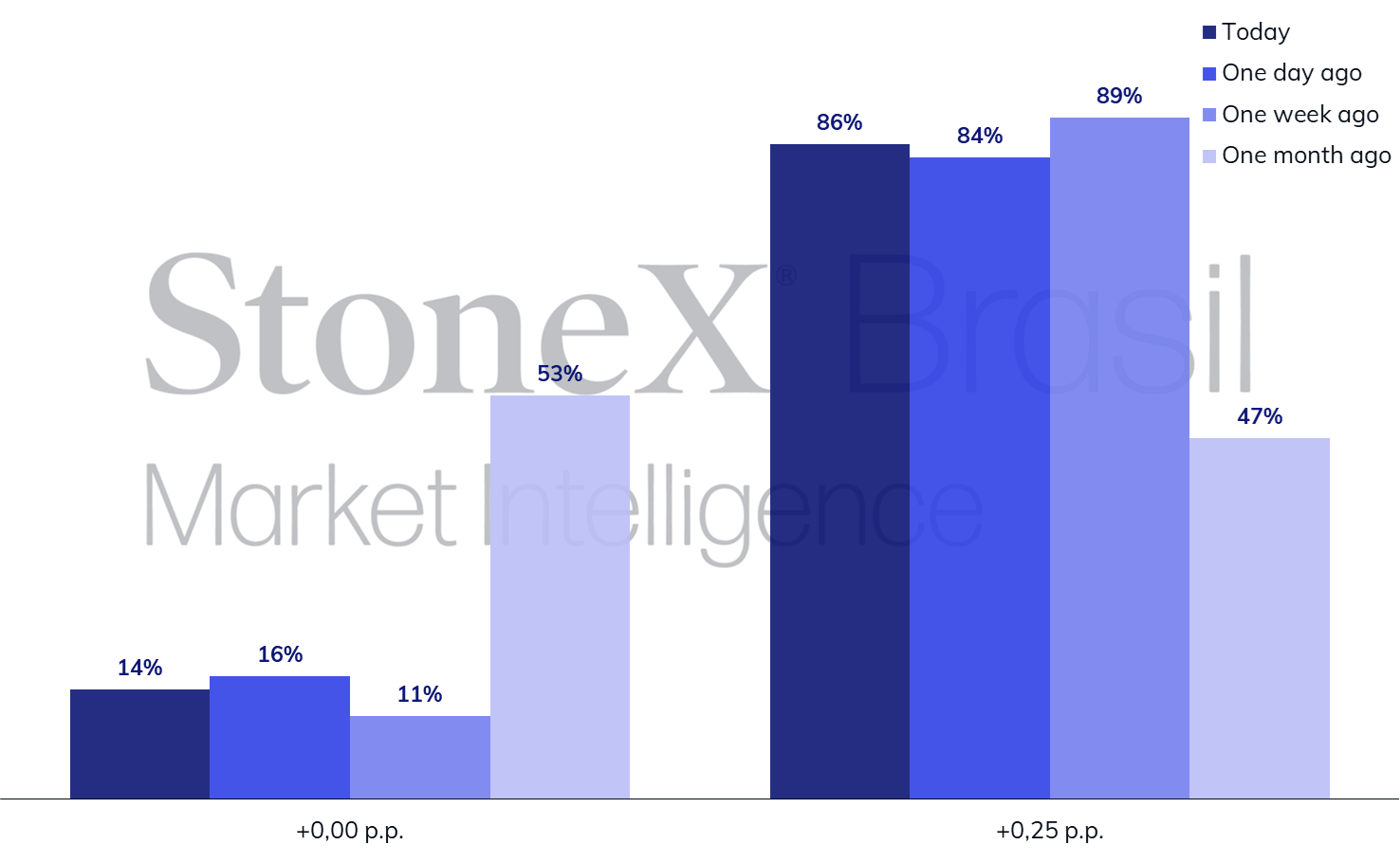
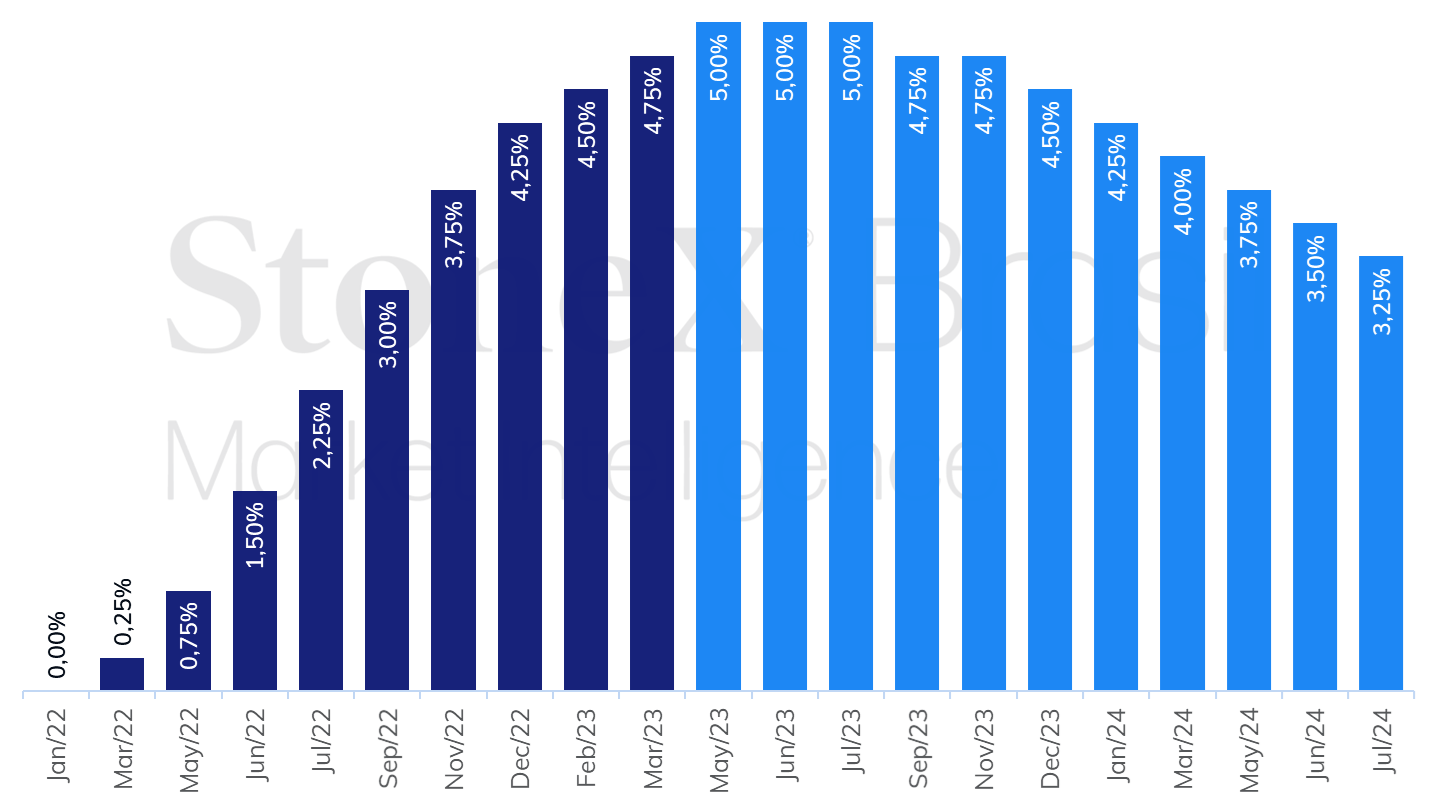
The investors' attention should be on the monetary policy decision of the Federal Open Market Committee (FOMC) on Wednesday (03), whose bets on the interest futures market point to a high probability of a 0.25 p.p. readjustment to the US key interest rate, raising it to the range between 5.25% and 5.50% p.a. There is greater doubt, however, about what the committee's stance will be in its decision, that is, whether the FOMC will adopt a more aggressive stance and indicate the need to persist in further interest rate increases to fight the acceleration of prices in the US or whether it will adopt a softer stance and open the possibility of interruption in interest rate readjustments from June. Nevertheless, most analysts believe the Fed will hold its last rate hike this week and will decide to end the cycle of hikes in the June 14 decision.
Expected impact on USDBRL: bearish
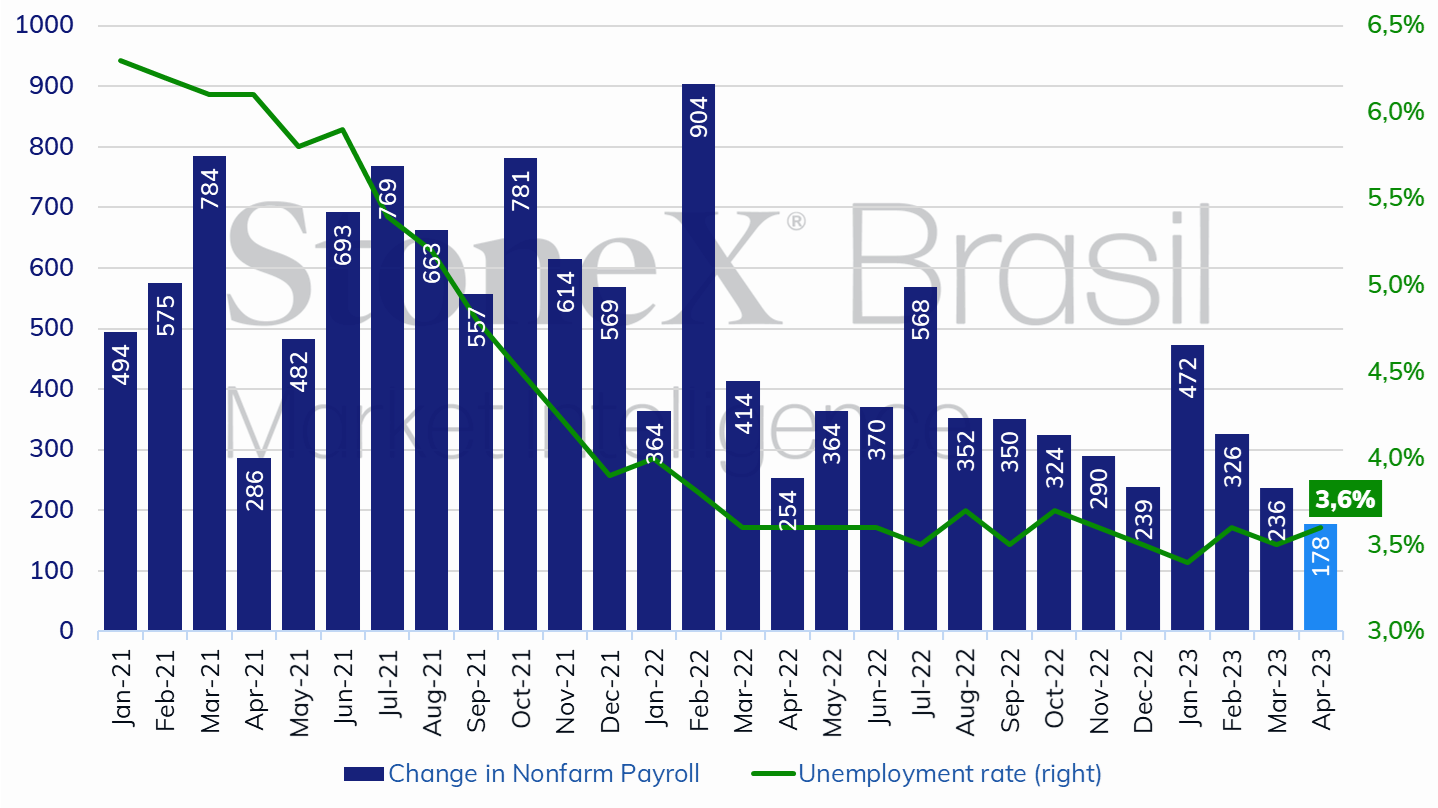
In addition to the FOMC decision, the week brings important indicators on economic activity and the labor market in the United States. The ISM Institute releases the April Purchasing Managers' Indices (PMI) for manufacturing on Monday (01) and for services on Wednesday (03), with a negative bias after regional indicators of economic activity during April suggested mostly a weakness in the productive sector. The median of expectations points to a reading of 46.8 points for the industrial PMI, indicating a contraction (below 50 points), and 51.7 points for the services PMI, consistent with the interpretation that services activity can sustain its level of activity and, probably, should maintain pressure on the price level of the segment. In addition, the Employment Situation Report for April is expected to moderate the creation of new jobs throughout the month, with a balance of 178 thousand new vacancies. Still, it would be the 28th consecutive month of net job expansion in the United States, suggesting that the labor market remains firm and that wage gains, too, should keep pressure on accelerating prices in the country, particularly on service segments highly correlated with personal consumption expenditures.
Expected impact on USDBRL: bullish
Another point of attention that has provoked caution and risk aversion in global asset markets is the need to extend the public debt limit in the United States and the possibility of an unprecedented default on US Treasury bonds. The debt limit law established in 1917 establishes the maximum debit the US Treasury Department can issue to pay its expenses. Since 1960, Congress has authorized raising or temporarily suspending the debt limit on 80 occasions. The last debt limit increase came in December 2021, extending the US borrowing limit until January 2023. In testimony to the country's parliament, Treasury Secretary Janet Yellen warned US members of Congress that the US risks defaulting for the first time unless the debt limit is raised or suspended by mid-June.
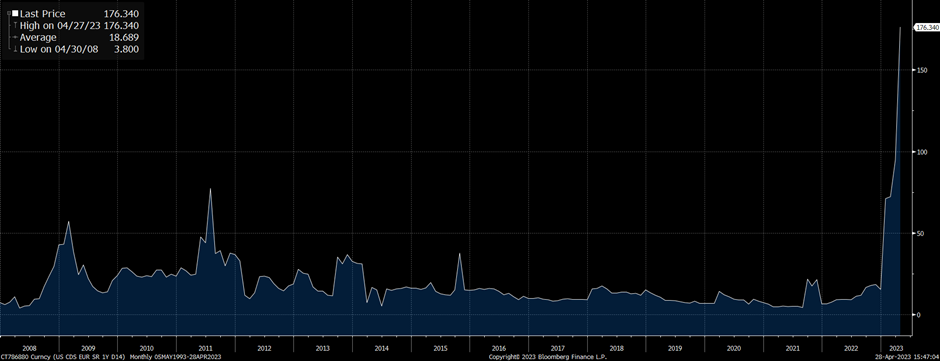
After the November legislative elections, the Democrats, the party of President Joe Biden, managed to maintain their majority in the Senate but lost control of the House to the Republicans. In a context of deepening political polarization in the country, both parties are in an impasse, as Republicans are seeking to extract political concessions from Democrats by conditioning strategic programs on the president's agenda to be abandoned for the House to approve the new public debt limit – something that Democrats consider unacceptable. Accordingly, the spread of Credit Default Swap (CDS) contracts for US Treasury bonds – in theory, among the safest in the world – are at their highest historical value; that is, they reveal that those who agree to insure such securities are demanding high premiums due to the increasing probability of a non-receipt. Last Friday (28), a payment of 1.76% of the value of the security was required each year as a premium for the CDS.
Economists on all theoretical fronts agree that a default on the country's sovereign debt would produce severe financial turmoil in virtually all global asset markets. However, neither side seems willing to resolve the impasse. And, as Fitch noted well in a warning to investors, small short-term extensions will only reproduce new impasses soon. This limitation is unique to the American reality, which needs a new fiscal and financial regime to avoid these sources of tension for financial markets.
Expected impact on USDBRL: bearish
Despite the high volume of criticism by the executive and parliamentarians of the government base, it is practically a consensus among analysts that the Central Bank of Brazil's Monetary Policy Committee (Copom) will keep the basic interest rate (Selic) unchanged on Wednesday (03), at 13.75% a. a. Participating in two sessions to discuss monetary policy in the Federal Senate last week, the Central Bank of Brazil's president Roberto Campos Neto practically justified the need to sustain monetary tightening for a longer period by outlining for congressmen an analysis of inflation projections (especially of inflationary cores, which exclude the volatile components of food and energy), a perspective of the degree of idleness of the economy ("output gap") of inflation expectations of financial institutions, the financial market and the Central Bank itself and carried out a balance of risks between inflation, economic activity and inflation, labor market and financial stability. Therefore, investors will focus on signals of when a possible interest rate cut cycle could begin or what conditions need to be met for the start of interest rate reduction in the country.
Expected impact on USDBRL: bullish
In the eurozone, on Thursday (04), there will be a great debate on whether the European Central Bank (ECB) will readjust its key interest rate by 0.25 p.p. or by 0.50 p.p., with an explicit division among its members depending on inflationary resilience and clearer signs of weakening productive activity. However, although there are doubts about the pace of readjustments, there is still a consensus that the ECB needs to extend its interest rate hike cycle for another period as it started its monetary tightening late compared to its peers, which should favor the strengthening of the euro against the dollar in the coming months.

The StoneX Group Inc. group of companies provides financial services worldwide through its subsidiaries, including physical commodities, securities, exchange-traded and over-the-counter derivatives, risk management, global payments and foreign exchange products in accordance with applicable law in the jurisdictions where services are provided. References to over-the-counter (“OTC”) products or swaps are made on behalf of StoneX Markets LLC (“SXM”), a member of the National Futures Association (“NFA”) and provisionally registered with the U.S. Commodity Futures Trading Commission (“CFTC”) as a swap dealer. SXM’s products are designed only for individuals or firms who qualify under CFTC rules as an ‘Eligible Contract Participant’ (“ECP”) and who have been accepted as customers of SXM. StoneX Financial Inc. (“SFI”) is a member of FINRA/NFA/SIPC and registered with the MSRB. SFI is registered with the U.S. Securities and Exchange Commission (“SEC”) as a Broker-Dealer and with the CFTC as a Futures Commission Merchant and Commodity Trading Adviser. References to securities trading are made on behalf of the BD Division of SFI and are intended only for an audience of institutional clients as defined by FINRA Rule 4512(c). References to exchange-traded futures and options are made on behalf of the FCM Division of SFI . StoneX is a trading name of StoneX Financial Ltd (“SFL”). SFL is registered in England and Wales, Company No. 5616586. SFL is authorized and regulated by the Financial Conduct Authority [FRN 446717] to provide to professional and eligible customers including: arrangement, execution and, where required, clearing derivative transactions in exchange traded futures and options. SFL is also authorised to engage in the arrangement and execution of transactions in certain OTC products, certain securities trading, precious metals trading and payment services to eligible customers. SFL is authorised & regulated by the Financial Conduct Authority under the Payment Services Regulations 2017 for the provision of payment services. SFL is a category 1 ring-dealing member of the London Metal Exchange. In addition SFL also engages in other physically delivered commodities business and other general business activities which are unregulated and not required to be authorised by the Financial Conduct Authority. StoneX Group Inc. acts as agent for SFL in New York with respect to its payments services business. StoneX APAC Pte. Ltd. acts as agent for SFL in Singapore with respect to its payments services business. ‘StoneX’ is the trade name used by StoneX Group Inc. and all its associated entities and subsidiaries.
Trading swaps and over-the-counter derivatives, exchange-traded derivatives and options and securities involves substantial risk and is not suitable for all investors. Past performance of any futures or option is not indicative of future success. Indicators are not a trading system and are not published as a specific trade recommendation. The information herein is not a recommendation to trade nor investment research or an offer to buy or sell any derivative or security. It does not take into account your particular investment objectives, financial situation or needs and does not create a binding obligation on any of the StoneX group of companies to enter into any transaction with you. You are advised to perform an independent investigation of any transaction to determine whether any transaction is suitable for you. No part of this material may be copied, photocopied or duplicated in any form by any means or redistributed without the prior written consent of StoneX Group Inc.
© 2026 StoneX Group Inc. All Rights Reserved.
Our subscribers have access to comprehensive market analysis from StoneX spanning commodities, equities, currencies and more.
Dollar to reflect US economic data, Central Bank minutes, inflation in Brazil, and the Middle East

US indices have led sentiment to fresh highs this past week even as the fundamental backdrop struggles to present a solid foothold. Will thin liquidity aid or hamper the swell and what does the event risk ahead propose?


A softer run of U.S. data is doing more to move the U.S. dollar than any chart, with a jobs report and an inflation print set to land back to back. A cooler U.S. CPI report would hand the Federal Reserve room to ease, and that prospect is already loosening the dollar's grip.

Our market expertise, advanced platforms, global reach, culture of full transparency and commitment to our clients’ success all set us apart in the financial marketplace.
Reach
With access to 40+ derivatives exchanges, 180+ foreign exchange markets, nearly every global securities marketplace and numerous bi-lateral liquidity venues, StoneX’s digital network and deep relationships can take clients anywhere they want to go.
Transparency
As a publicly traded company meeting the highest standards of regulatory compliance in the markets we serve, our financials and record of accomplishment are matters of public record. StoneX’s commitment to “doing the right thing over the easy thing” sets us apart in the industry and helps us build respect, client trust and new partnerships.
Expertise
From our proprietary Market Intelligence platform, to “boots on the ground” expertise from award-winning traders and professionals, we connect our clients directly to actionable insights they can use to make more informed decisions and achieve their goals in the global markets.