USDBRL should reflect trade tensions between Beijing and Washington, inflation in Brazil and the United States, concerns about American private credit, and the U.S. government shutdown
- Bullish
- The escalation of trade tensions between the United States and China raises fears of a global economic slowdown, which may stimulate demand for “safe-haven” assets and hurt the performance of the real.
- American consumer inflation is expected to show another moderate increase, which tends to reduce expectations of interest rate cuts by the Federal Reserve in the coming months and, thus, strengthen the dollar globally.
- A moderate reading of October’s IPCA-15 may increase bets on cuts to Brazil’s Selic interest rate in 2025, which would harm the yield on Brazilian bonds and weaken the real.
- Concerns about a U.S. credit crisis may result in higher global risk aversion and stimulate demand for “safe-haven” assets, hurting the performance of the real.
- Bearish
- The U.S. government shutdown suspends the release of economic indicators for the country, making it difficult to understand the nation’s situation and potentially harming the attraction of foreign investments.
The week in review
- Intensified trade tensions between the United States and China and issues in the U.S. private credit market led to increased global risk aversion among investors.
- Statements from Federal Reserve officials increased bets on interest rate cuts by the Fed in October.
- The U.S. government shutdown persisted, with no signs of an imminent resolution.
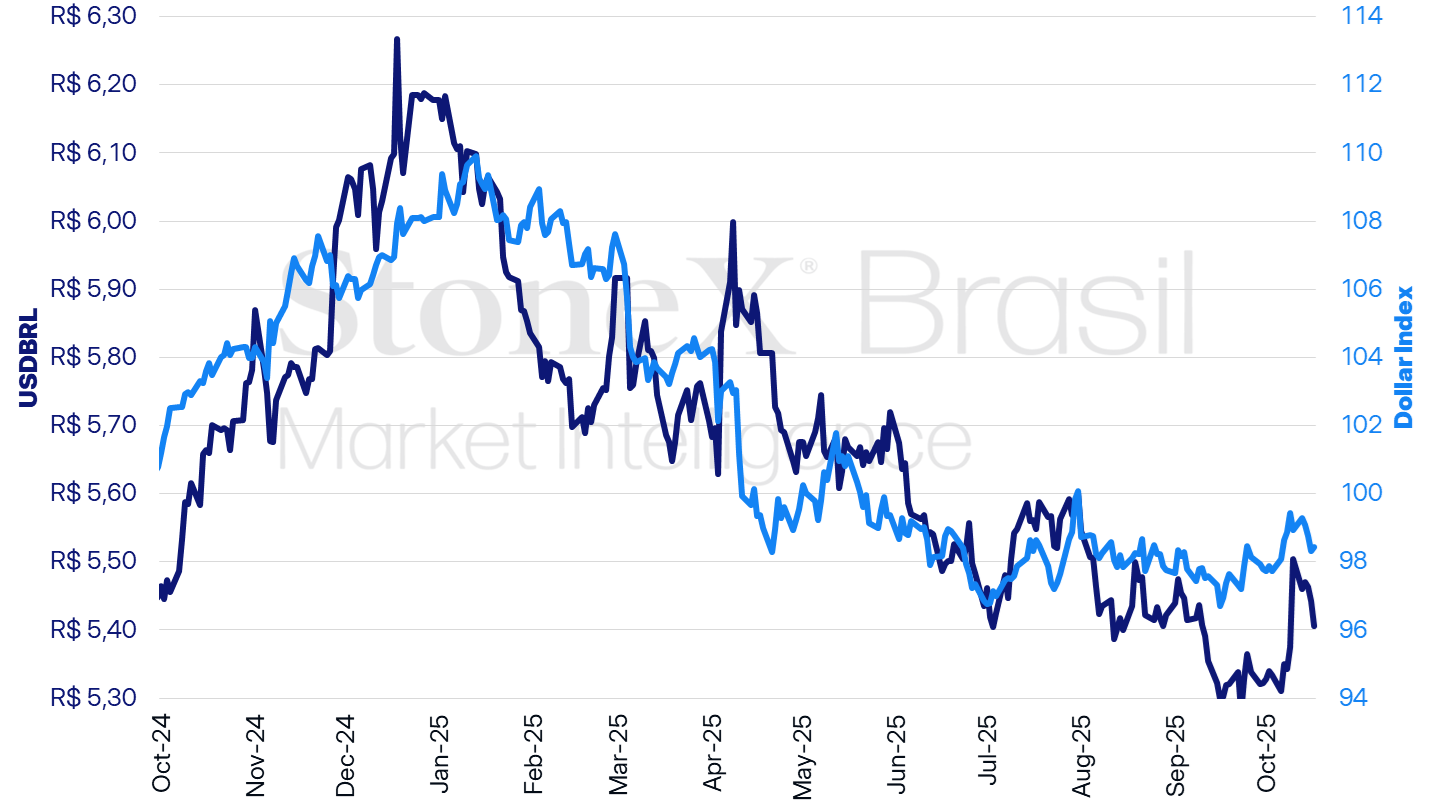
USDBRL and Dollar Index (points)
Source: StoneX cmdtyView. Design: StoneX.
Commercial Dollar Variations | Daily: -0.68% | Weekly: -1.78% | Monthly: +1.57% | Year-to-date: -12.49% | Last 12 months: -4.49% |
Dollar Index Variations | Daily: +0.10% | Weekly: -0.52% | Monthly: +0.65% | Year-to-date: -8.98% | Last 12 months: -5.20% |
MOST IMPORTANT: U.S.-China Trade Tensions
Expected Impact on USDBRL: Bullish
In recent weeks, Washington and Beijing have intensified trade tensions between the two nations, raising concerns about the resurgence of a trade war between the world’s two largest economies.
Why this matters: Increased tensions between the two countries generate fears of a return to significant trade barriers between the two largest global economies, potentially causing a more pronounced slowdown in the growth of both.
- The prospect of slowing demand in both China and the U.S. may increase global risk aversion among investors, which would harm the performance of riskier assets such as the Brazilian real.
Ups and downs: In recent weeks, Chinese and American officials have alternated statements and actions that have either worsened or alleviated trade tensions between the two countries.
- For example, last week, Chinese authorities announced a plan to restrict exports of critical rare earth minerals, essential for many industrial applications.
- These restrictions were China’s response to U.S. export restrictions to China, particularly in the advanced chip technology sector.
- Additionally, Chinese authorities imposed surcharges last Tuesday (14) on ships owned, operated, constructed, or flagged by Americans in response to identical surcharges imposed by the U.S. on Chinese ships.
- In response, U.S. President Donald Trump threatened to impose 100% tariffs on Chinese imports and cancel a meeting with Chinese President Xi Jinping scheduled for October 29.
- U.S. Treasury Secretary Scott Bessent stated that Chinese authorities “cannot be trusted” and called a prominent Chinese trade negotiator, Li Chenggang, “disrespectful” and “unbalanced.”
- Chinese Commerce Minister Wang Wentao declared that the United States is to blame for escalating trade tensions between the two countries due to introducing new restrictions and trade barriers after the agreement negotiated in September.
- Meanwhile, Bessent stated that the current "truce" on import tariffs against China could be extended long-term if China ends restrictions on rare earth mineral exports.
- Trump also stated that 100% tariffs are “not sustainable” and that “everything will be fine” in negotiations with China.
- Conversely, Chinese Foreign Minister Wang Yi said that a “decoupling” between the two countries is not a realistic or rational option and that they should resolve disagreements peacefully and respectfully.
Inflation in the United States
Expected Impact on USDBRL: Bullish
U.S.: Historical and forecasted interest rate trends – updated on October 17, 2025
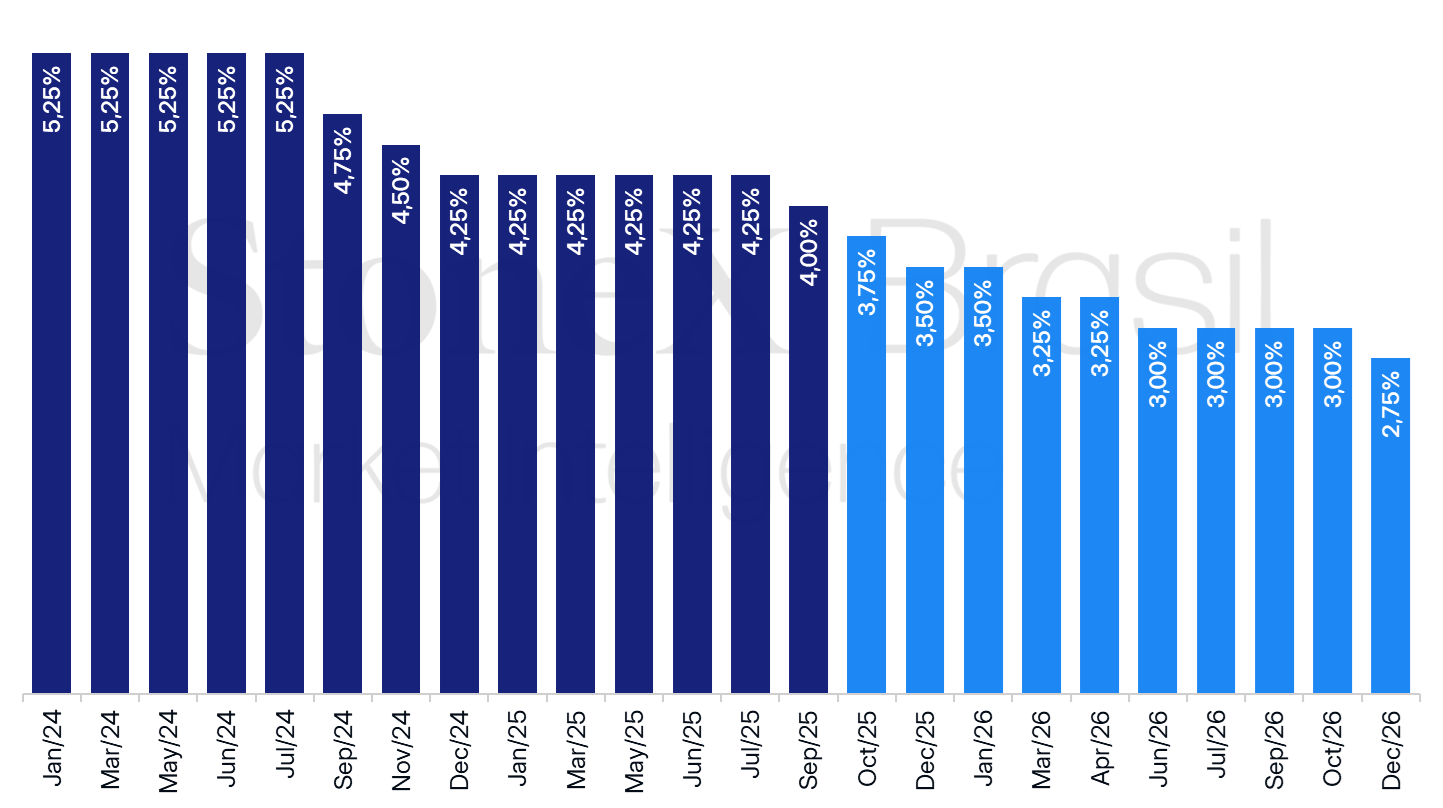
Source: CME FedWatch Tool. Design: StoneX. Refers to the most probable market futures interest rate bet on the indicated date.
The Consumer Price Index (CPI) for September will be released, with delay, next Friday (24th) and is expected to show another moderate increase for the month, potentially indicating higher inflationary pressures.
Why this matters: A hotter CPI reading could reduce expectations for interest rate cuts by the Federal Reserve and bolster the outlook for American bond yields, which tends to strengthen the dollar globally.
What to expect: Median projections point to identical acceleration seen in August for September, with a 0.4% increase in the headline index and 0.3% in its core measure, which excludes the volatile food and energy components.
- Prices for industrial goods should continue to accelerate, offsetting a milder increase in service prices.
- If this projection is confirmed, the annual CPI increase would rise from 2.9% in August to 3.1% in September, while the annual increase in its core would remain at 3.1% over the same period.
Outlook: The Federal Reserve pursues two main goals, price stability and maintaining full employment.
- In theory, stabilizing U.S. inflation at a level far from the Federal Reserve’s 2% annual target and risks of inflationary pressures caused by import tariffs reduce the institution’s ability to cut interest rates.
- However, recent statements from Federal Reserve officials generally indicated that they believe the economic outlook and risk balance remain similar to what was observed during the September 17 decision, suggesting that risks to labor market slowdown are higher and risks of inflationary resurgence are lower.
- Therefore, only a surprisingly hot or widespread reading for U.S. inflation in September would be enough for the Fed to keep its rates unchanged in its October 29 decision.
- Nonetheless, even a moderately hot CPI reading should slightly reduce investors’ expectations for a rapid rate-cutting cycle in the U.S.
U.S. Government Shutdown
Expected Impact on USDBRL: Bearish
Duration of U.S. government shutdowns since 1980 (days)
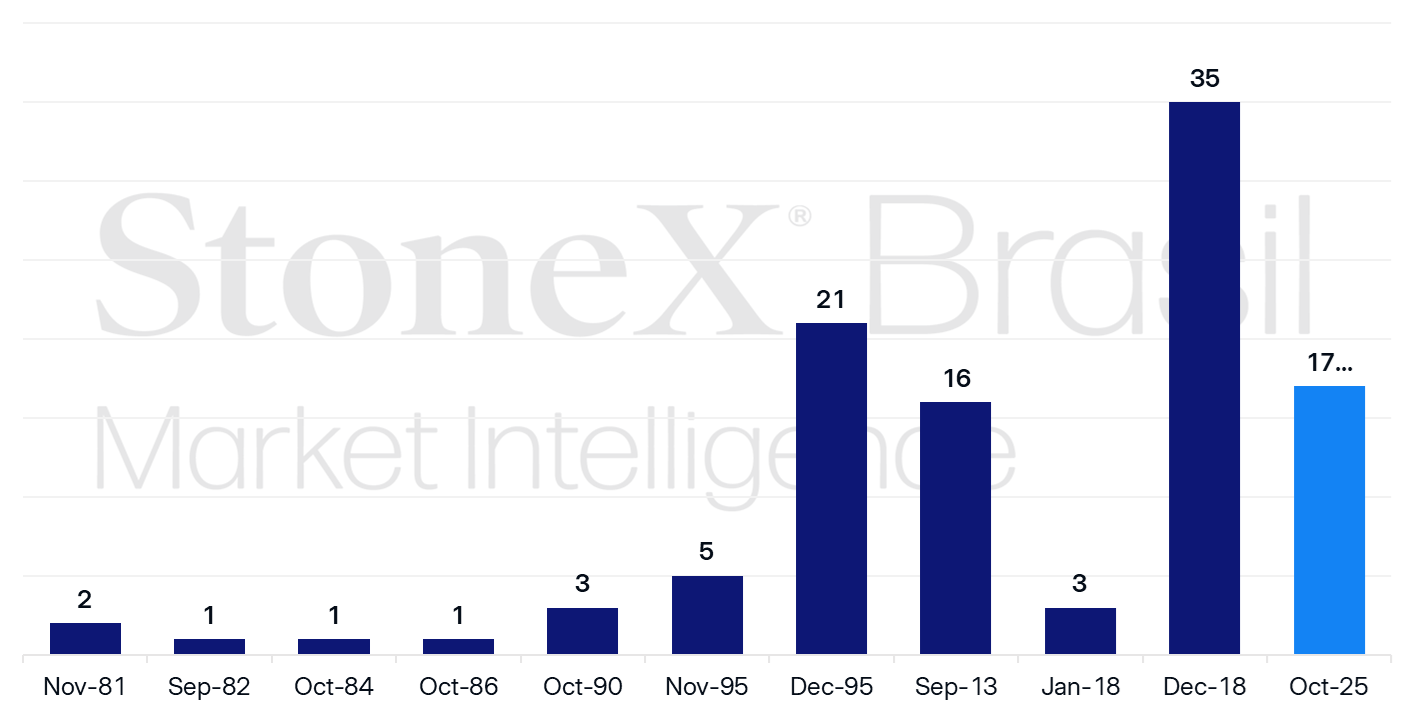
Source: U.S. House of Representatives Office of Art and Archives. Note: Includes only shutdowns lasting more than 24 hours.
The U.S. government shutdown continues with no immediate resolution in sight, amid a stalemate between Republicans and Democrats over reaching an agreement to approve a new budget in Congress or extend the previous one.
- As of now, the outlook is for a prolonged shutdown, lasting at least another week.
Why this matters: The shutdown affects most of the U.S. public sector, including departments responsible for collecting and publishing economic statistics, which have suspended all indicator releases since last Wednesday.
- This could result in a greater perception of risks for U.S. assets as it complicates investors’ understanding of the country’s economic situation, potentially weakening the dollar globally.
Outlook: Sixty Senate votes are required to approve a new budget or extend the previous one, but the Senate is divided between 53 Republicans and 47 Democrats.
- However, according to press reports, the Republican Senate leader (John Thune) and Democratic Senate leader (Chuck Schumer) did not even speak to each other last week.
- Democrats demand guarantees that funds for U.S. public health programs will not be reduced and will be effectively spent.
- This year, the White House “rescinded” several expenses approved by the U.S. Congress with the consent of Republican lawmakers, who have a majority in both the House and Senate and voted against congressional objections to these rescissions.
- The two parties seem to bet that the prolonged impasse will favor their electoral performance in November’s legislative elections next year.
- Until greater political pressure arises – for example, polls indicating that most voters blame one party more for the shutdown – it seems unlikely that a consensus will be reached.
- Some analysts suggest that this pressure may increase on November 1, when costs for public health program usage would rise substantially.
- Additionally, the White House continues to threaten mass layoffs and not paying public servants retroactively for the shutdown period, despite such payment being legally mandated by a 2018 law.
Data delays: The shutdown threatens the release of market data on employment, economic activity, and inflation ahead of the Federal Reserve’s next interest rate decision on October 29.
- For example, the Employment Situation Report, the Producer Price Index, Retail Sales, and Industrial Production data for September have not yet been released.
- The Consumer Price Index is expected to be released, with delay, on October 24, as this data is required for adjusting pensions, which by law must be reported by November 1.
- The absence of official indicator releases increases the importance of regional and private data on financial market movements.
Stress in the U.S. Private Credit Market
Expected Impact on USDBRL: Bullish
Investors should monitor news related to difficulties faced by American companies in meeting their financial obligations.
Why this matters: Concerns about the health of the U.S. credit system may increase global risk aversion among investors, harming the performance of riskier assets such as emerging market currencies, including the Brazilian real.
Details: Concerns about the U.S. credit market began after the collapse of vehicle financier Tricolor Holdings and auto parts supplier First Brands Group, which were highly leveraged and recently filed for bankruptcy protection in the U.S.
- These concerns intensified last week after two American regional banks, Zions Bancorp and Western Alliance, reported millions in losses from two investment funds that allegedly defrauded loan guarantees, preventing the recovery of financed amounts.
- These events reignited fears of a possible credit crisis in the U.S. and resulted in increased demand for “safe-haven” assets in times of stress and uncertainty.
- Last Tuesday (14), J.P. Morgan CEO Jamie Dimon expressed concern about potential credit problems in the U.S. during the company’s earnings release, stating, “I probably shouldn’t say this, but when you see a cockroach, there’s probably more. Everyone should be warned about this.”
Stress in the Brazilian Inflation Outlook
Expected Impact on USDBRL: Bearish
The National Consumer Price Index 15 (IPCA-15) is expected to show moderate growth in September.
Why this matters: Moderation in inflation in Brazil may reinforce the perception of price stabilization in the country and slightly increase bets on cuts to the basic interest rate (Selic) in 2025, which may harm the yield on Brazilian bonds and contribute to a weakening of the real.
What to expect: The monthly variation of the IPCA-15 is expected to slow from 0.48% in September to around 0.20% in October.
- If this projection is confirmed, the annual increase in the IPCA-15 would remain at 5.3% from September to October.
- September’s rise was influenced by a strong increase in electricity prices, but the rise in service prices and the indicator’s core, excluding volatile food and energy components, was relatively mild.
Unchanged expectations: Although the moderate rise in IPCA-15 may help to ease inflationary fears, the data alone is unlikely to significantly change investors’ expectations for Brazilian interest rates.
- Central Bank officials have consistently communicated that confirmation of a trend in price stabilization over several consecutive months will be required before considering cuts to the Selic rate.

INDICATORS
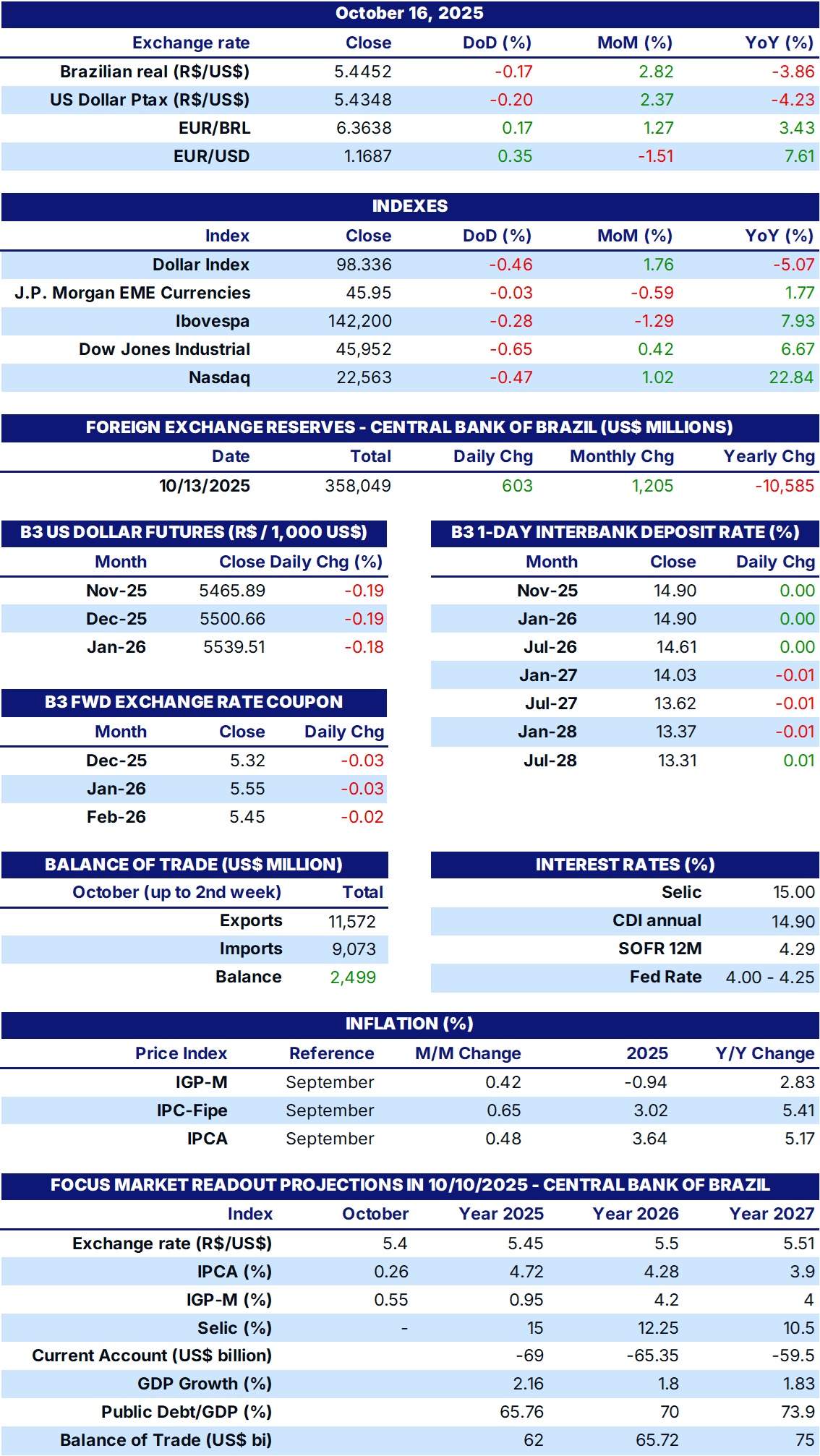
Sources: Central Bank of Brazil; B3; IBGE; Fipe; FGV; MDIC; IPEA and StoneX cmdtyView.