Dollar to reflect US labor market data, Brazilian election scenario, and end-of-month Ptax
- Bullish
- The expectation of strong data for the US labor market should reinforce bets on interest rate hikes by the Federal Reserve later this year, increasing the yield on US Treasuries and strengthening the USD globally.
- The release of voting intention polls in Brazil should reinforce the scenario of re-election for President Luiz Inácio Lula da Silva, increasing political risk perception of national assets by investors and weakening the BRL.
Last week’s summary
- The United States and Iran held their first round of direct negotiations to advance a lasting peace agreement for the Middle East.
- Minutes from Copom’s decision and the Monetary Policy Report clarified that the Central Bank does not intend to extend the relevant horizon for monetary policy, but that the authority anticipated a significant drop in inflation by 2028.
- The IPCA-15 rose less than expected in June, suggesting there is still room for the Central Bank to cut the benchmark interest rate (Selic).
- The PCE Index for May rose slightly less than anticipated in the US, reducing bets on interest rate hikes in the country in the short term.
- Concerns about excessive investments in AI-related infrastructure dragged down technology stocks worldwide and increased risk aversion.
USD/BRL and Dollar Index (points)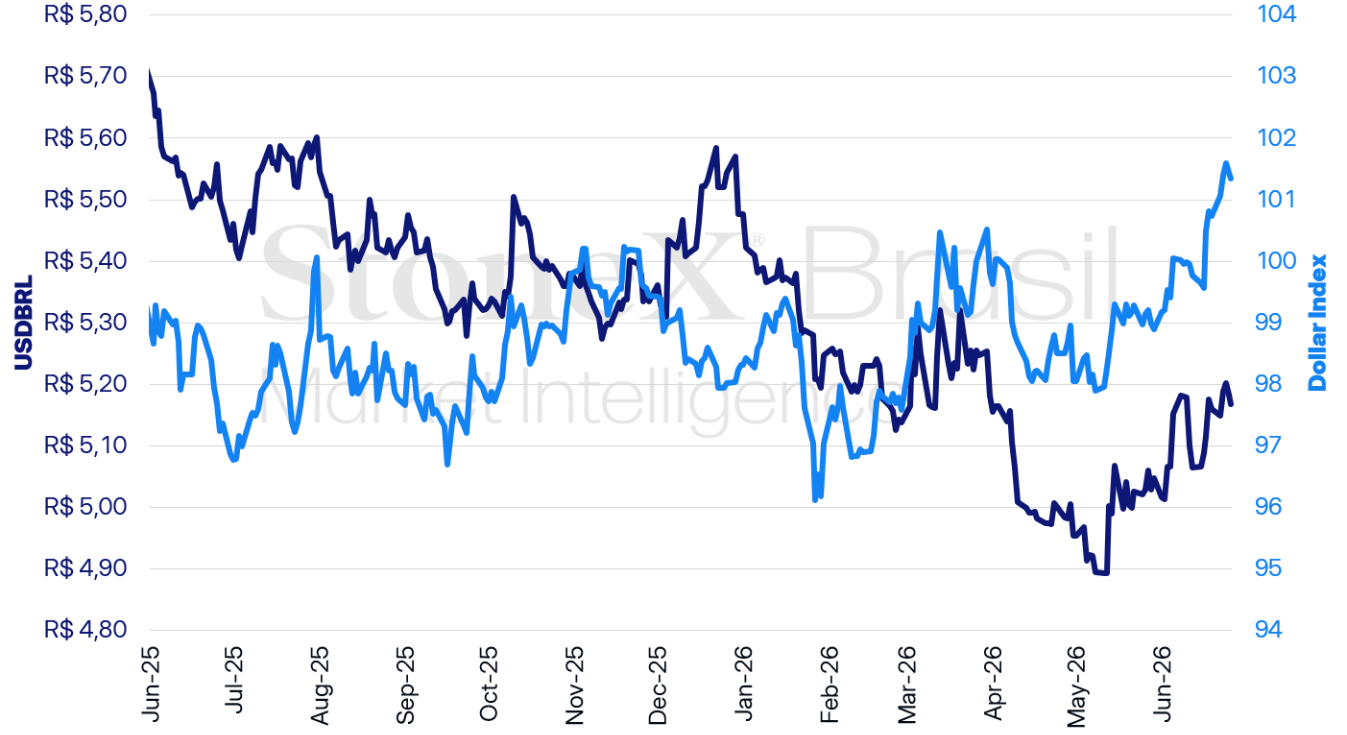
Source: StoneX cmdtyView. Design: StoneX.
USDBRL Variations | Daily: -0.30% | Weekly: +0.16% | Monthly: +2.36% | Yearly: -5.65% | 12 months: -6.02%
Dollar Index Variations | Daily: -0.09% | Weekly: +0.62% | Monthly: +2.49% | Yearly: +3.08% | 12 months: +4.22%
KEY EVENT: US economic data
Expected Impact on the BRL Rate: Bullish
USA: Historical and forecast interest rates – updated June 26, 2026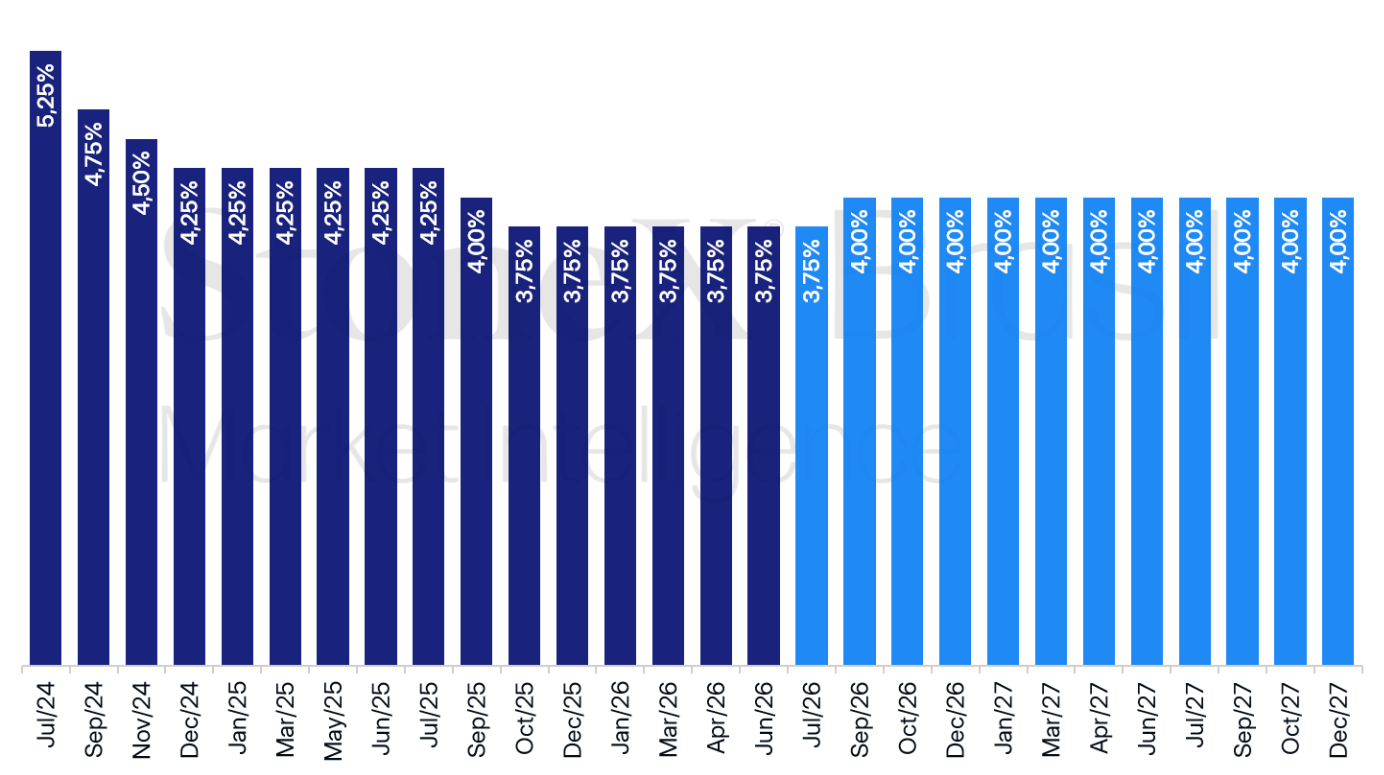
Source: CME FedWatch Tool. Design: StoneX. Refers to the highest probability bet in the futures market for interest rates on the indicated date.
Investors are expected to react to the release of US labor market data, seeking to calibrate expectations for the country's interest rate trajectory.
Why this matters: The expectation of strong labor market data is likely to reinforce bets on interest rate hikes by the Federal Reserve later this year, increasing the yield on US Treasury bonds (Treasuries) and strengthening the dollar globally.
Estimates: The median estimate points to the net creation of 110,000 jobs in the US in June.
- Although this reading reinforces the perception of a stronger labor market, it represents a slowdown compared to the average of 188,000 over the last three months.
- The unemployment rate is estimated to remain at 4.3%.
US Nonfarm Payrolls (000 Jobs) and Unemployment Rate (%)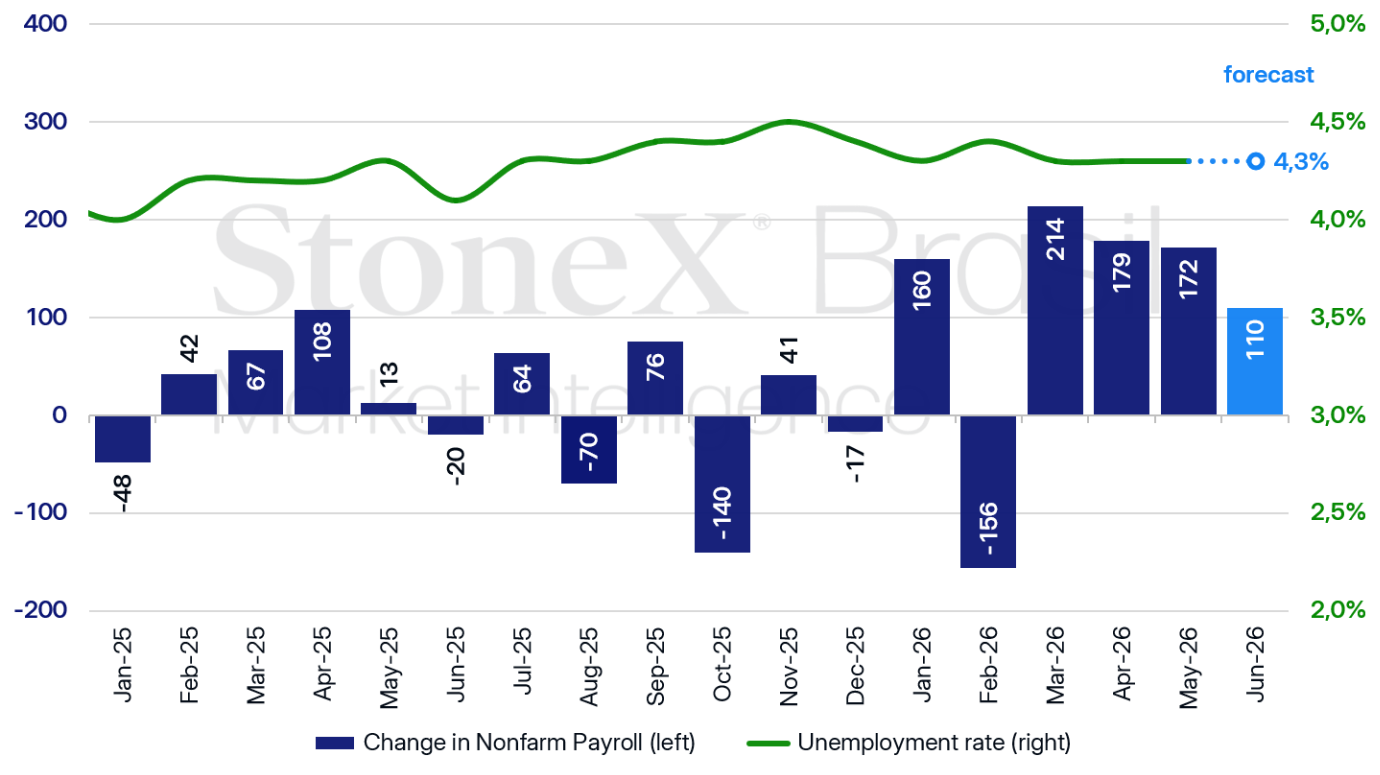
Source: US Bureau of Labor Statistics (BLS), Federal Reserve Bank of St. Louis. Design: StoneX.
Expectation of higher interest rates: Overall, indicators point to a stronger and more resilient US economy, suggesting the capacity to absorb higher interest rates.
- For example, consumer income and personal consumption expenditures grew above expectations in May, both expanding by 0.7%, while the annualized GDP growth for Q1 was revised upward from 1.6% to 2.1%.
- Meanwhile, inflation in May moderated slightly compared to April's figures but remains at a level far from the 2% annual target, reinforcing investor bets on interest rate hikes by the Federal Reserve in 2026.
Inflation measures for the United States (%)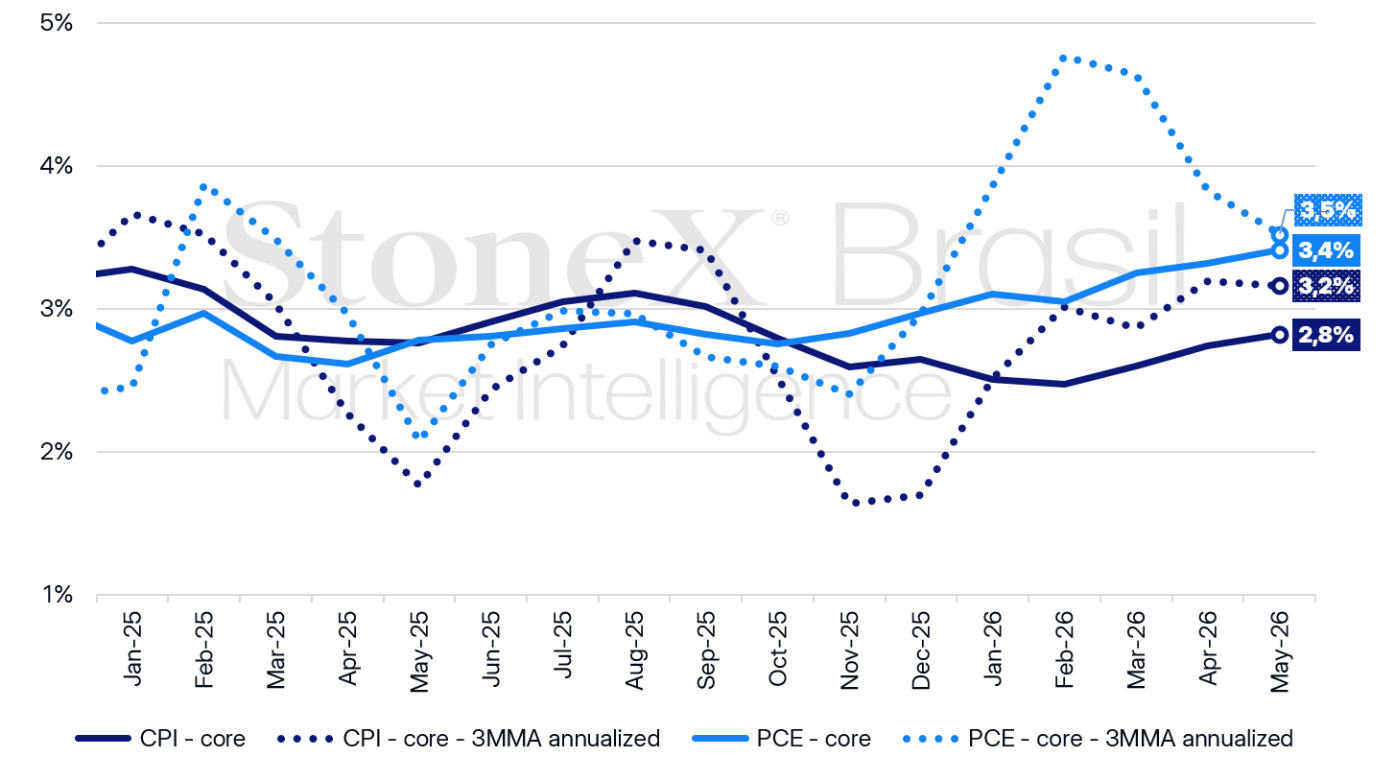
Source: US Bureau of Economic Analysis (BEA), U.S. Bureau of Labor Statistics (BLS), Federal Reserve Bank of St. Louis. Design: StoneX.
Firm Fed tone: The latest Federal Reserve interest rate decision surprised financial market agents both by the high number of Fed members anticipating further rate hikes in 2026 and by the firm stance of the institution's new president, Kevin Warsh, in defending price stability.
- However, Warsh was quite succinct in his statements, refusing to comment on the economic situation or provide any evaluation of future monetary policy.
- Thus, investors are awaiting Warsh's remarks this Wednesday (01) at an important European Central Bank (ECB) event to better understand the Fed's next steps.
- Warsh will participate in a monetary policy debate with ECB President Christine Lagarde and Bank of England Governor Andrew Bailey
Brazilian political and electoral scenario
Expected Impact on the BRL Rate: Bullish
As the national elections approach, domestic financial markets tend to become more sensitive to updates about the electoral race.
- In this context, two electoral polls will be released next week, which should help investors adjust their expectations for the election.
Why this matters: If the polls reinforce the scenario of President Luiz Inácio Lula da Silva's re-election, they are likely to increase political risk perception of national assets by investors, weakening the BRL.
Fiscal concerns: In recent months, investors have already reacted negatively to election-related news, such as after the announcement of pre-candidacies for Luiz Inácio Lula da Silva and Flávio Bolsonaro for the presidency.
- In practice, recent reactions from financial market agents reveal a preference for the election of a new president, who might be more fiscally conservative.
Lula in the lead? In the most recent polls, President Lula garnered 46% of voting intentions, compared to 43% for pre-candidate Flávio Bolsonaro.
- For next week's polls, investors aim to capture potential impacts from news involving former Senate government leader Jaques Wagner and recent statements by former first lady Michelle Bolsonaro.
In detail: Jaques Wagner was targeted by Federal Police operations in the new phase of Operation Compliance Zero, investigating an alleged illicit scheme involving Banco Master.
- Meanwhile, Michelle Bolsonaro posted a statement on social media claiming to have been humiliated by Flávio Bolsonaro, exposing a conflict between family members.
- According to Michelle, the conflict began late last year after the former first lady criticized the Liberal Party's (PL) negotiations seeking support from Ceará gubernatorial candidate Ciro Gomes to build a political platform in the state.
End-of-month Ptax rate
Expected impact on USDBRL: undefined
End-of-month Ptax rate – sale (BRL/USD)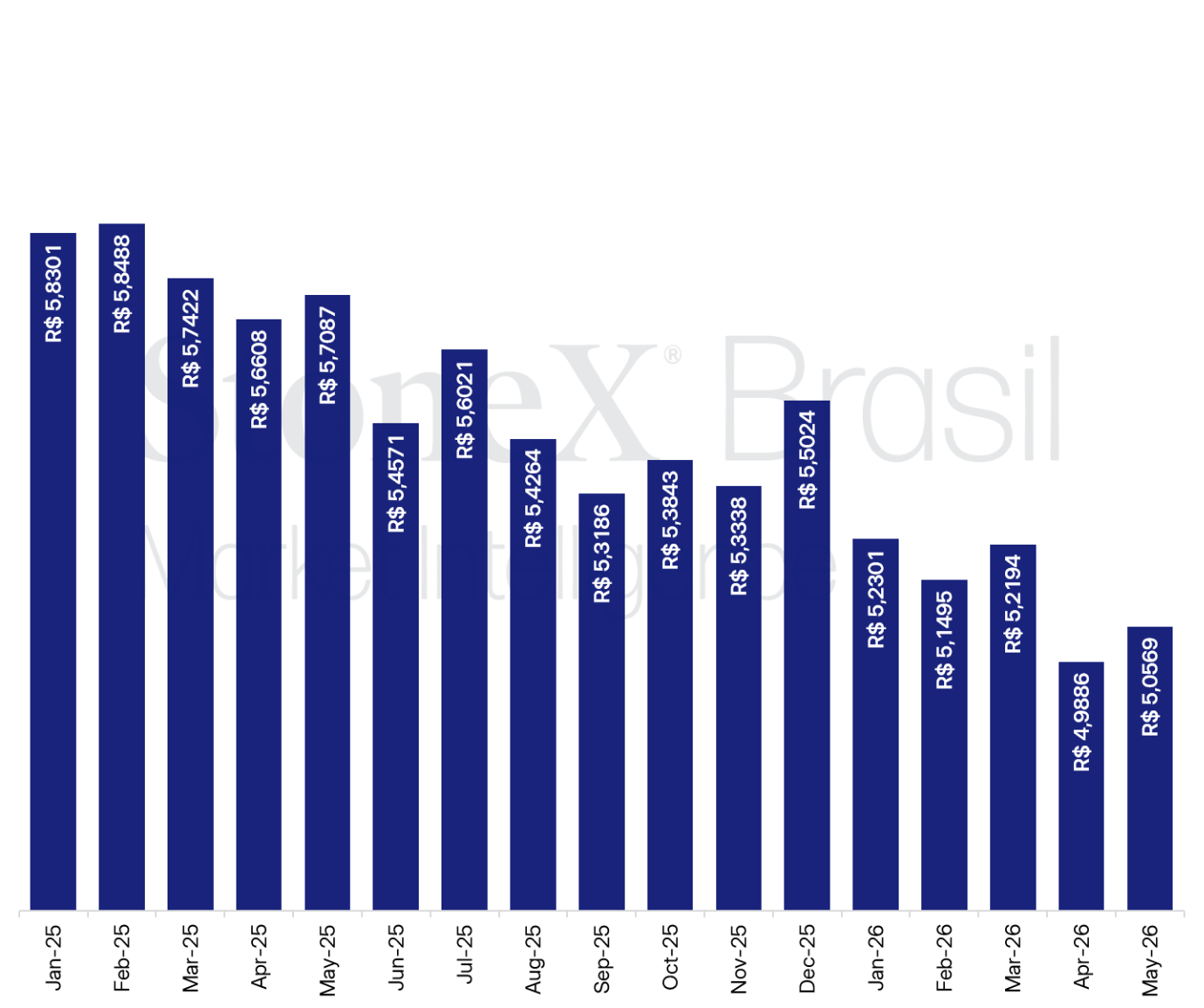
Source: Central Bank of Brazil. Prepared by: StoneX.
Trading volume and exchange rate volatility are expected to increase on the last trading day of June due to the formation of the end-of-month Ptax rate.
- The Ptax rate is a daily reference published by the Central Bank, and its end-of-month value is widely used in exchange contracts and derivatives.
- The Central Bank calculates its value based on the average of quotes obtained during four consultation windows, between 10:00 AM and 1:10 PM.
Why this matters: Financial market operators intensify their operations during the intervals of the last Ptax rate formation of the month to try to influence its value in a direction that benefits their positions, making it harder to interpret real movements on the day.

INDICATOR
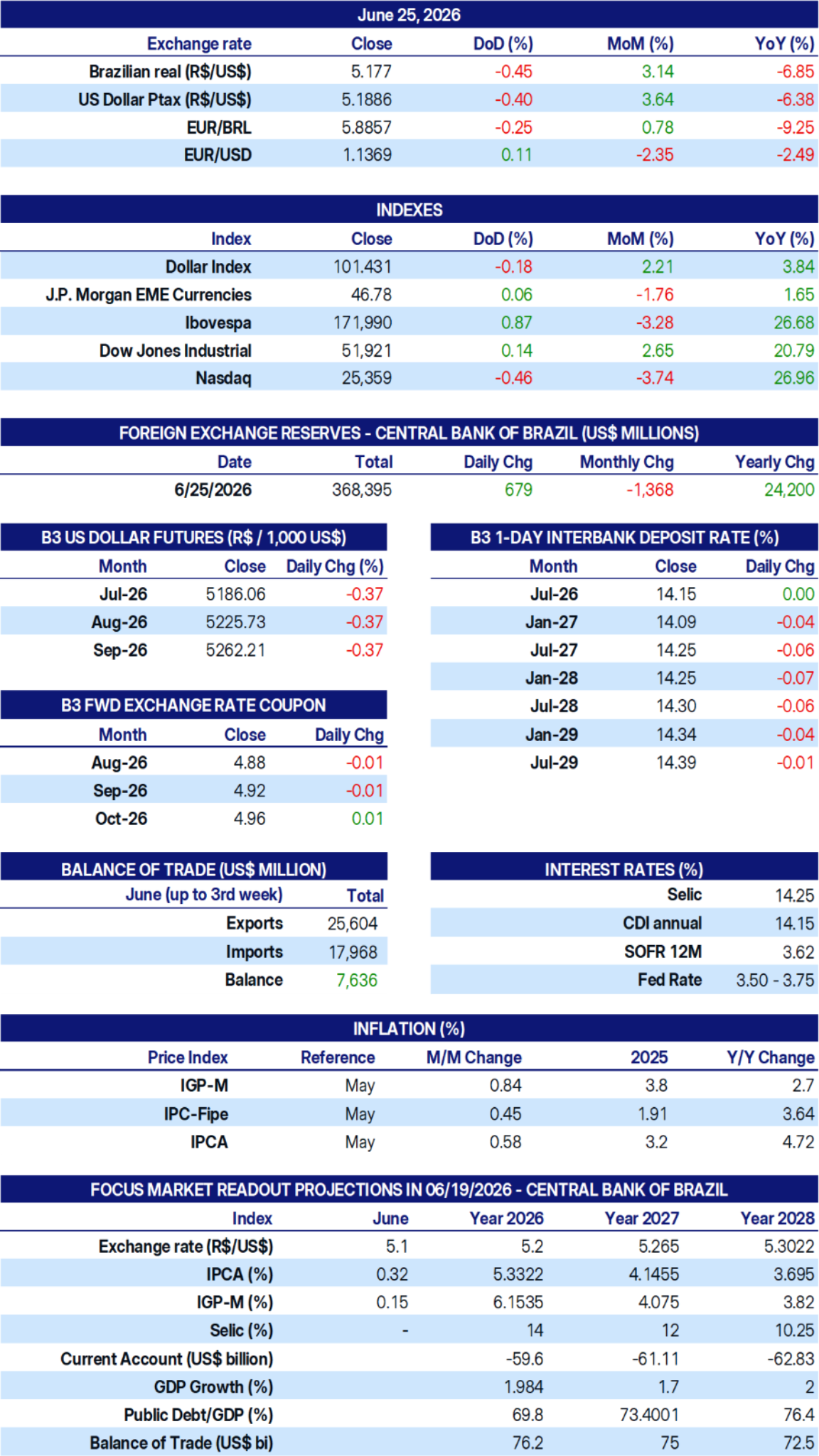
Sources: Central Bank of Brazil; B3; IBGE; Fipe; FGV; MDIC; IPEA and StoneX cmdtyView.